

TL;DR:
- Focusing on premium clients increases profitability and long-term referral growth.
- Positioning, targeted messaging, and operational quality attract high-value prospects effectively.
- Use specific direct response strategies and proper qualification filters to acquire and nurture premium clients.
Chasing low-value leads is exhausting. You spend money on ads, write proposals nobody reads, and still end up with clients who nickel-and-dime every invoice. Meanwhile, there are businesses out there attracting clients who happily pay premium rates, stay loyal for years, and refer their high-spending friends without being asked. The difference is not luck. It is strategy. One B2B development firm achieved a $9 cost per lead for projects valued at $5,000 and above using targeted Google Ads. That kind of result is repeatable. This guide breaks down exactly how to do it.
Table of Contents
- Define what makes a premium client
- Prepare your business for premium client attraction
- Strategies and channels to target premium clients
- Verify, optimize, and scale your premium client acquisition
- Why most small businesses struggle and how direct response fixes it
- Unlock premium client acquisition with expert support
- Frequently asked questions
Key Takeaways
| Point | Details |
|---|---|
| Premium clients amplify growth | Focusing on high-value clients drives increased revenue and longer-lasting relationships. |
| Specific targeting works | Direct response marketing with clear qualification filters attracts the right clients efficiently. |
| Optimize and scale results | Regularly measure and refine your approach to continually improve premium client acquisition. |
| Quality beats quantity | A few well-qualified premium clients are far more valuable than numerous low-value leads. |
Define what makes a premium client
Before you can attract premium clients, you need to know exactly what you are hunting. A premium client is not just someone with money. They are a specific type of buyer who makes your business more profitable, less stressful, and far more sustainable in the long run.
Here is what separates a premium client from a regular one:
- High revenue potential. They are willing to invest in solutions that solve real problems, which means larger project values, longer contracts, and bigger lifetime value to your business.
- Repeat business. They do not bounce after one transaction. Premium clients come back, upgrade, and deepen their relationship with you over time.
- Low price sensitivity. They are not shopping for the cheapest option. They want results, reliability, and quality. Price is secondary to the outcome you deliver.
- Referral quality. They move in high-value circles and tend to refer other premium clients. One premium referral can be worth ten low-tier leads.
- Decision-making authority. They can say yes without running it through seventeen layers of approval. You close faster and waste less time on proposals that die in committee.
The financial impact of focusing on this segment is staggering. Research shows that advisors who outsource investment management add $14.5 million in assets under management per year compared to peers who do not. That is not a small gap. That is a business-changing difference driven entirely by the quality of clients they serve, not the quantity.
Screening for premium clients is a skill, and it starts with qualifying leads before you invest time in them. Build your screening criteria around budget authority, project size, timeline, and long-term need. If a prospect cannot pass those filters, they are not your client.
"The goal is not to get more clients. The goal is to get the right clients. One premium client who pays on time, refers others, and renews contracts is worth ten headaches who drain your energy and dispute every invoice."
Now that the value of premium clients is clear, let us lay the groundwork for your marketing strategy.
Prepare your business for premium client attraction
Premium clients are not going to show up because you lowered your prices or ran a flash sale. They show up because your business looks, sounds, and operates like something worth paying for. Getting that right requires work on three fronts: positioning, messaging, and operational quality.
Positioning is how you occupy a specific place in the market. Instead of being "a marketing agency," you become "the agency that generates premium leads for B2B tech companies." The more specific you are, the more attractive you become to the exact client you want. Generic positioning attracts generic clients. Sharp, specialized positioning acts like a magnet for high-value buyers who recognize expertise when they see it.
Messaging is where most small businesses leak money. Your website copy, your ads, and your proposals should all send one clear signal: "We work with serious clients who are ready to invest in results." Direct response marketing prioritizes measurable responses, like bookings and inquiries, over vague awareness. Every piece of your messaging should push the reader toward a specific, trackable action. No fluff. No "learn more." Give them a reason to raise their hand right now.
Here is a quick comparison of what weak versus strong messaging looks like for premium client attraction:
| Element | Weak messaging | Strong messaging |
|---|---|---|
| Headline | "We help businesses grow" | "We generate $5K+ leads for B2B dev firms" |
| Call to action | "Learn more" | "Book a 20-minute strategy call" |
| Proof | "We have great reviews" | "$14.5M AUM added per client annually" |
| Target audience | "Small businesses" | "Tech startups with $500K+ revenue" |
| Offer specificity | "Marketing services" | "Done-for-you lead generation system" |
Operational quality is the part people overlook. Premium clients expect fast responses, polished proposals, clear contracts, and a smooth onboarding experience. If your back-end operations are a mess, no amount of clever marketing will keep a premium client around after the honeymoon phase. Audit your client experience from first contact to final delivery and ask yourself honestly: does this feel like a premium operation?

Pro Tip: Before running any ads, do a quick "premium audit" of your website. If a high-value prospect landed on your homepage today, would they immediately understand who you serve, what result you deliver, and why you are the obvious choice? If not, fix the positioning before spending a dollar on traffic.
Investing in boosting business revenue starts with making sure the foundation is solid. Sending premium traffic to a mediocre-looking offer is like putting race fuel in a car with four flat tires.
Strategies and channels to target premium clients
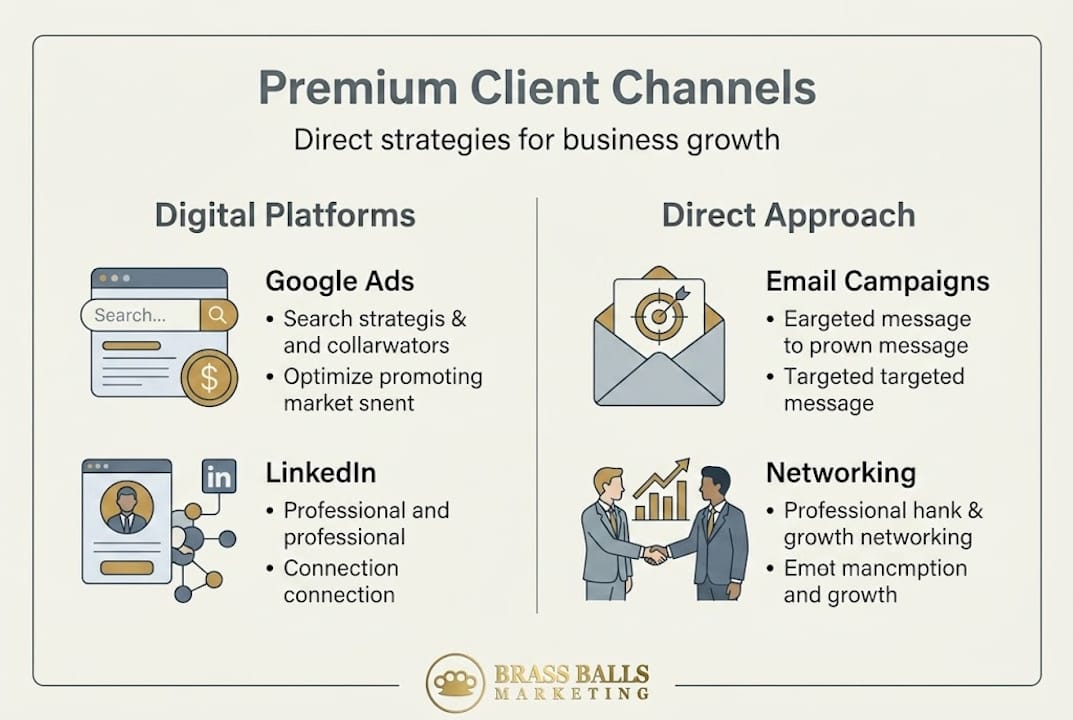
Once your business is ready to receive premium clients, it is time to go get them. This is where direct response marketing earns its reputation as the most powerful tool in a small business owner's arsenal. You are not hoping someone stumbles onto your brand. You are engineering a system that filters, attracts, and converts exactly the right prospects.
Here is a step-by-step approach to deploying direct response tactics across the channels that matter most:
- Build a qualification filter into your ad copy. One B2B firm achieved a $9 cost per lead for projects valued at $5,000-plus by including a minimum project size directly in their Google Ads copy. That one move scared away every tire-kicker and pre-qualified every click. Use language like "for businesses investing $5K+" or "minimum engagement $10K" right in the headline.
- Use LinkedIn for B2B premium targeting. LinkedIn's targeting lets you filter by job title, company size, industry, and seniority level. If you want to talk to the CFO of a 200-person manufacturing company, you can do exactly that. Pair that targeting with a direct response offer (a free audit, a strategy call, a specific guide) and you have a premium lead machine.
- Segment your audience ruthlessly. Not every lead deserves the same treatment. Use segmentation optimization to split your audience by behavior, engagement level, and revenue potential. Warm leads who have visited your pricing page three times deserve a different message than someone who clicked a cold ad once.
- Deploy a conversion funnel designed for premium clients. A basic funnel will not cut it. Sales funnels for client acquisition need to be engineered for high-value prospects, including multi-step qualification, social proof from recognizable clients, and a discovery call as the conversion goal rather than a direct purchase.
- Study proven funnel structures. Learning from funnel examples that work in your market gives you a shortcut to results instead of reinventing the wheel.
Here is a quick comparison of ad platforms for attracting premium clients:
| Platform | Best for | Cost efficiency | Premium targeting |
|---|---|---|---|
| Google Ads | B2B, service businesses | High when filtered | Keyword intent signals |
| LinkedIn Ads | B2B, high-ticket services | Moderate | Job title, seniority, company size |
| Facebook/Instagram | B2C, niche consumer premium | Variable | Interest and behavior layering |
| YouTube | Brand trust building | Lower CPM | Interest and demographic stacking |
The common thread across all of these channels is specificity. You are not broadcasting to everyone. You are narrowing your message to speak directly to people who have the budget, the authority, and the urgency to become premium clients.
Verify, optimize, and scale your premium client acquisition
Finally, to maximize results and maintain growth, you must always measure and adjust. This is where a lot of small business owners drop the ball. They run a campaign, get some leads, and declare victory or defeat without actually analyzing what happened.
Here is what you need to track at every stage:
- Cost per qualified lead. Not just cost per lead. Anyone can get cheap leads. You want to know how much you are paying for a lead that actually meets your premium criteria.
- Conversion rate from lead to discovery call. If 100 people request your free audit and only two book a call, your follow-up sequence is broken.
- Conversion rate from call to client. If you are closing below 20%, your proposal or pricing positioning needs work.
- Client lifetime value. Premium clients should generate significantly more revenue over 12 to 24 months than a standard client. Track this obsessively.
- Referral rate. A healthy premium client base generates referrals. If yours is not, you need to ask why.
The numbers back up how transformative a focus on premium clients can be. Research shows that advisors who outsource investment management add 14 new premium clients per year on average, compared to just 4 for their peers. That is a 250% difference in acquisition results, achieved through better systems and focus, not harder hustle.
Common mistakes that kill premium client acquisition results include:
- Failing to qualify before the call. If you are jumping on discovery calls with anyone who books, you are wasting time. Use an application form or questionnaire to filter first.
- Ignoring the nurture phase. Most premium clients do not buy on first contact. Lead nurturing sequences that deliver value over weeks or months keep you top of mind when the prospect is ready to move.
- Skipping email as a nurture channel. Email marketing for funnels remains one of the highest ROI activities in premium client acquisition. Automated email sequences that educate, build trust, and offer specific next steps convert warm leads into paying clients without you lifting a finger on each send.
Pro Tip: Once you have a campaign that is generating qualified premium leads at a profitable cost, do not tinker with it. Scale the budget first, then optimize. Most people optimize prematurely and kill momentum before they ever see what the system can really do.
Why most small businesses struggle and how direct response fixes it
Here is the uncomfortable truth most marketing gurus will never tell you: most small businesses fail at client acquisition not because they lack talent, but because they are addicted to hope-based marketing. They post on social media hoping someone notices. They run vague brand awareness ads hoping to build recognition. They attend networking events hoping the right person is in the room.
Hope is not a strategy. It is a slot machine with worse odds.
Direct response marketing is the antidote. It forces you to engineer measurable outcomes instead of praying for them. When you embed a price qualifier in your ad copy, add a booking form that filters prospects, and build reliable funnel marketing around specific client types, you stop playing the lottery and start running a system. The shift in mindset is from "let us get our name out there" to "let us engineer a pipeline of high-value prospects who have already self-selected." That single mental shift is worth more than any specific tactic in this article.
Unlock premium client acquisition with expert support
You have got the strategy. Now it is time to put it to work without the trial-and-error tax most business owners pay on the way to their first premium client.
At Brass Balls, we have built our entire operation around helping small business owners and entrepreneurs skip the guesswork and move straight to results. Whether you need a done-for-you funnel, a step-by-step course, or expert guidance on premium client marketing solutions, we have the frameworks, the tools, and the track record to back it up. Stop leaving premium clients on the table for your competitors to grab. Your next move is one conversation away.
Frequently asked questions
What qualifies as a premium client?
A premium client is someone with high revenue potential, repeat business, and low price sensitivity, typically seeking long-term value. Research shows businesses focused on premium clients can add $14.5M AUM annually compared to peers.
Which marketing channel works best for attracting premium clients?
Direct response methods like targeted Google Ads with minimum project filters deliver measurable results, achieving as low as a $9 cost per lead for $5K-plus projects when copy includes a clear budget qualifier.
How do I ensure leads are truly premium?
Use qualification criteria and segmented funnels that filter applicants by revenue potential and industry fit, since direct response marketing prioritizes measurable responses like bookings over general awareness.
What's the first step to attract premium clients?
Define exactly who your ideal premium client is, then align your messaging and offers specifically to their needs, budget range, and desired outcomes before spending any money on ads or outreach.