

TL;DR:
- Automated funnels save time, boost conversions, and shorten sales cycles effectively.
- They enable small businesses to scale revenue without increasing staff.
- Simplicity and targeted messaging are crucial for successful automation implementation.
If you're still manually following up with leads, copying data between spreadsheets, and sending individual emails one by one, you're not running a business. You're running a very exhausting hobby. Automated funnels save time by handling follow-ups and repetitive tasks, freeing you to focus on the work that actually moves the needle. In this guide, we'll break down exactly how automated sales funnels save time, scale revenue, and deliver measurable ROI for small business owners who are tired of working harder instead of smarter. No fluff. No hype train. Just the real stuff.
Table of Contents
- The time and efficiency gains of automated funnels
- Scaling your business: How automation boosts acquisition and revenue
- Unlocking ROI: Data insights and proven results from automation
- Automation mechanics and common pitfalls: What every entrepreneur should know
- What most funnel guides get wrong (and how to do it right)
- Ready to streamline your growth with automated funnels?
- Frequently asked questions
Key Takeaways
| Point | Details |
|---|---|
| Save time and stress | Automating routine marketing tasks frees up hours every week for entrepreneurs to focus on bigger goals. |
| Scale without new hires | Automated funnels allow small businesses to nurture more leads and increase revenue without growing their team. |
| Proven high ROI | Marketing automation delivers outstanding returns and more qualified leads when set up and optimized correctly. |
| Avoid over-complication | Simple, human-centric automation works best—overly complex systems can backfire and reduce customer satisfaction. |
The time and efficiency gains of automated funnels
Let's get one thing straight: an automated funnel is not some magic black box. It's a system, plain and simple. It captures leads, qualifies them, nurtures them with relevant messages, and moves them toward a buying decision, all without you sitting at your laptop at midnight typing the same email for the 47th time.
The tasks it handles include things like sending follow-up emails after someone opts in, logging contact details into your CRM, scheduling reminder messages, and segmenting leads based on behavior. These are the kinds of jobs that feel small individually but quietly devour your week in chunks.
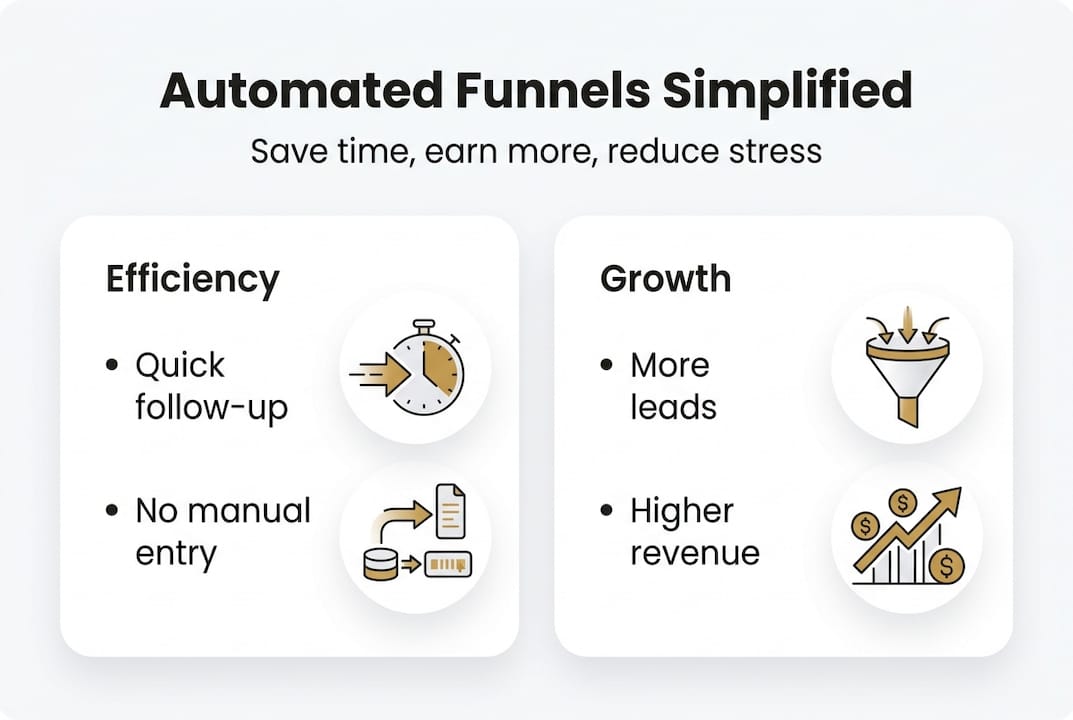
Here's a number worth writing on a sticky note: sales reps save 5 to 7 hours per week on data entry alone when they use automation. And automating your lead funnel reduces administrative time by 40%. That is not a rounding error. That's basically a full workday handed back to you every week.
Here are the top processes you can automate right now with the right marketing automation solutions:
- Lead capture forms connected to your CRM
- Welcome email sequences triggered by opt-ins
- Follow-up reminders when a prospect goes quiet
- Appointment booking confirmations and reminders
- Post-purchase thank-you and upsell sequences
- Lead scoring based on email opens, clicks, and page visits
The benefits of automated funnels go well beyond just saving time, but time is where you feel it first. When you stop doing administrative busywork, you suddenly have mental bandwidth for strategy, client conversations, and the creative work that actually builds your brand.
Pro Tip: Start by automating the task you hate most. Hate sending follow-up emails? Automate those first. You'll get an immediate win and build momentum for the rest of your setup.
Scaling your business: How automation boosts acquisition and revenue
With administrative tasks streamlined, let's see what this means for scaling your client base effectively.
Here's the brutal truth about growing a small business without automation: you can only talk to so many people. There are only so many hours in a day, and if every lead requires manual nurturing, your growth hits a ceiling fast. Automation smashes that ceiling.
When you set up the right system, you can be driving client acquisition for hundreds of prospects simultaneously, each getting timely, relevant touchpoints, without you lifting a finger. And the numbers back this up. Businesses using automated funnels report 10 to 15% higher conversions and up to 50% shorter sales cycles. That means leads close faster and more of them say yes.
"Automation enables businesses to scale revenue without increasing headcount." This is the scalability play that lets you grow revenue without hiring three more sales staff.
Let's make this concrete. Imagine you run a consulting business. Traditionally, you send proposals manually, follow up by hand, and juggle five prospects at a time before things fall through the cracks. With automation, you can nurture 200 prospects simultaneously, each receiving personalized sequences based on where they are in the decision process. The email automation impact on revenue becomes very real, very fast.

| Factor | Traditional workflow | Automated funnel |
|---|---|---|
| Lead capacity | 5 to 10 at a time | 200+ simultaneously |
| Follow-up consistency | Hit or miss | 100% consistent |
| Sales cycle length | Long, unpredictable | Up to 50% shorter |
| Revenue scalability | Limited by team size | Scales without hiring |
| ROI potential | Modest | Significantly higher |
For the biggest revenue impact, prioritize automating your first follow-up sequence, your lead qualification process, and your appointment booking flow. These three alone can transform how many deals you close each month.
Unlocking ROI: Data insights and proven results from automation
Beyond scaling up, let's see just how big an impact automation can make on your bottom line.
If you're still on the fence about whether automation is worth the investment, consider this: marketing automation provides 451% more qualified leads and delivers up to 544% ROI. Read that again. Five hundred and forty-four percent return on investment. That's not a typo.
And here's where it gets even more interesting. It's not just about volume. It's about quality. Lead scoring, which is the practice of assigning point values to leads based on their actions (opening emails, visiting pricing pages, clicking CTAs), helps you identify who is ready to buy and who still needs nurturing. Lead scoring reduces the sales cycle by 23% and boosts close rates by 17%. You stop chasing cold leads and start spending time where it counts.
| Automation metric | Benchmark result |
|---|---|
| ROI on marketing automation | Up to 544% |
| Increase in qualified leads | 451% |
| Sales cycle reduction | Up to 50% |
| First-year ROI improvement | 25% |
| Close rate increase (lead scoring) | 17% |
Here are 3 steps to start leveraging data insights in your funnel right now:
- Set up lead scoring. Assign values to actions like email opens, page visits, and form fills. Anyone over a threshold score gets a personal outreach from you.
- Segment your list. Use behavior-based tags to separate cold leads from warm ones and tailor your messaging for each. Segmenting client journeys can dramatically lift conversion rates.
- Review funnel analytics monthly. Look at open rates, click-throughs, and drop-off points. Small tweaks based on real data will compound over time. Check out real funnel examples to see what optimized systems actually look like in practice.
Businesses that optimize their funnels report a 25% increase in ROI within the first year. That kind of result doesn't happen by accident. It happens because you're making informed decisions, not guessing.
Automation is not a set-it-and-forget-it tool. Think of it more like a high-performance engine: it runs great, but it still needs oil changes. Monitor, tweak, and improve regularly.
Automation mechanics and common pitfalls: What every entrepreneur should know
Now let's peek under the hood and dodge common mistakes, so your automation actually works for you.
The typical automated funnel is powered by a combination of tools: email marketing platforms, CRM software, chatbots for website engagement, and increasingly, AI personalization engines that tailor messaging based on user behavior. Together, these create a system that feels personal even when it's running on autopilot.
The tactics that consistently deliver results include email segmentation (sending the right message to the right person), triggered sequences (automated emails that fire based on specific actions), and lead scoring (as covered above). Email segmentation alone shows 847% ROI, and triggered campaigns deliver 534% ROI. These aren't vanity metrics. They're proof that the right message at the right moment is a revenue machine.
But here's where most entrepreneurs shoot themselves in the foot. They overcomplicate things. They build 47-step sequences, add 12 conditional branches, and then wonder why their automation feels like a Rube Goldberg machine that confuses prospects and drains resources. Here's the uncomfortable truth: 61% of overly complex automated journeys deliver negative ROI. Complexity kills conversions.
The most common pitfalls to avoid when building your funnel:
- Building too many steps before testing a single one
- Over-automating to the point where leads feel like numbers, not people
- Ignoring mobile optimization for emails and landing pages
- Forgetting to add human touchpoints for high-value prospects
- Never reviewing analytics to see what's actually working
Pro Tip: Start with a three-email welcome sequence and one follow-up. That's it. Get it working, measure results, then layer in complexity only where the data tells you to. You can learn more about avoiding funnel over-optimization before it costs you clients.
The goal is always balance. Automation should speed things up and keep things consistent, but never at the expense of feeling like a real business that actually cares about its clients.
What most funnel guides get wrong (and how to do it right)
Here's the thing nobody in the funnel space wants to admit: most guides are selling you a dream, not a strategy. They show you screenshots of six-figure months and 47-step automation sequences, then conveniently skip the part where half those systems annoy customers into unsubscribing.
As some experts point out, sales funnels are overhyped, and beginners should focus on genuine value over rigid structures. We're not saying funnels don't work. They absolutely do. But the magic is not in the complexity of the system. It's in the quality of the communication inside it.
What years of trial and error have taught us: the entrepreneurs who win with automation are the ones who start with clear, helpful client communication and then automate it. Not the ones who automate first and figure out the messaging later. A mediocre message in a perfect funnel is still a mediocre message.
Pro Tip: Focus on outcomes, not automation for automation's sake. Ask yourself, "What do I want my prospect to feel after this email?" Then build the automation around that answer. Mastering automation workflows starts with clarity, not complexity.
Stay connected with your clients. Check in. Respond to replies. Automation handles the volume. You handle the relationship.
Ready to streamline your growth with automated funnels?
If smarter, simpler automation sounds like the upgrade your business needs, the good news is you don't have to figure it all out alone.
At BrassBalls, we specialize in done-for-you marketing systems built specifically for small business owners who want results without the overwhelm. No bloated tech stacks. No complicated setups that gather digital dust. Just clean, high-converting funnels designed around your business and your clients. Want to see what this looks like in practice? Browse our automation case studies and discover what a properly built funnel can do for your revenue. When you're ready to take the next step, our team is here to help you build it right from day one.
Frequently asked questions
What tasks can I automate with sales funnels?
You can automate follow-ups, lead scoring, contact nurturing, and data entry, letting you focus on business priorities instead of repetitive admin work.
Will automation hurt my client relationships?
Not if used wisely. Automation enhances outreach speed and personalization, but preserving human touchpoints for high-value prospects keeps relationships genuine and strong.
How soon can I see ROI from automated funnels?
Many businesses see significant results within 3 to 12 months, with marketing automation averaging 544% ROI and a 25% increase in first-year returns when funnels are properly optimized.
Are automated funnels too complex for small businesses?
Not at all, as long as you keep it simple. 61% of complex journeys produced negative ROI, which is exactly why starting with a basic sequence and scaling gradually is the smarter play.
Recommended
- Marketing funnel examples to boost business growth
- Email marketing drives funnel success: small business 2026
- Why choose funnel marketing: grow your revenue reliably
- Scalable sales funnels: the key to consistent SMB growth
- 📊 Automatisering met Google Sheets & Google Forms – slimmer werken zonder programmeerkennis - AlexandervanDijl.nl - Bel 020 262 1789