

TL;DR:
- Automating your marketing system allows your business to generate leads, nurture prospects, and close sales automatically, saving time and increasing revenue.
- Before implementing automation, assess your marketing needs, ensure your tech stack is ready, and start with simple workflows tailored to clear customer journey triggers.
You're spending three hours a day on marketing tasks that produce the same lukewarm results every single week. Sound familiar? Manual follow-ups, one-off email blasts, social posts that disappear into the void, and a lead pipeline that looks more like a trickle than a flood. Here's the thing: it's not that you're bad at marketing. It's that you're doing it manually when you could be running an automated system that works while you sleep, sells while you're on a call, and nurtures leads while you're dealing with actual business. This guide gives you the no-fluff, step-by-step playbook to make that happen.
Table of Contents
- Assessing your marketing needs and automation prerequisites
- Choosing the right automation tools and workflow platforms
- Designing and building effective marketing automation workflows
- Common mistakes, troubleshooting, and optimizing for ROI
- What most guides miss about automated marketing system success
- Next steps: Unlock your business's automation potential
- Frequently asked questions
Key Takeaways
| Point | Details |
|---|---|
| Start with key triggers | Begin automation with high-intent triggers for immediate impact and simplicity. |
| Choose scalable tools | Pick platforms that fit your business and allow easy workflow expansion as you grow. |
| Design workflows carefully | Plan triggers and outcomes before building to prevent data lock-in and wasted effort. |
| Optimize for down-funnel results | Track clicks and purchases, not just opens, to measure true automation ROI. |
| Treat automation as ongoing | Continuously revise workflows based on behavioral feedback for sustainable growth. |
Assessing your marketing needs and automation prerequisites
Before you go buying tools and building workflows like a kid with a new Lego set, stop. The biggest mistake small business owners make is jumping straight to automation without knowing what they actually need to automate. Automation without clarity is just organized chaos with a monthly subscription fee.
Start by asking yourself three things. What does your customer journey actually look like right now? Where are leads falling through the cracks? And which of those gaps happen over and over again? Those repeating gaps are your automation goldmines.
Here's a quick checklist to figure out your readiness:
- Business goals are defined (lead gen, nurture, conversion, retention)
- Customer journey is mapped from first touch to paying client
- You have basic content (at least one lead magnet or welcome email)
- You have some traffic or list to feed into your automation
- Someone on your team can manage the tech or you're willing to learn
According to the customer journey trigger framework, the most effective approach is to first define the concrete moments that should trigger automation, such as form submissions, pricing page visits, or webinar attendance, and then connect those triggers to downstream actions like tagging, follow-up content, and sales notifications. That's not just smart. That's the difference between automation that prints money and automation that just sends emails nobody reads.
You also want to check your tech stack before adding more tools. The small business automation steps that actually work are the ones built on a solid foundation, not stacked on top of a pile of disconnected apps.
Pro Tip: Start with minimum viable automation. One trigger, one outcome. A lead fills out your contact form and gets a welcome sequence. That's it. Build from there once you see it working.
| Automation readiness factor | Ready | Needs work |
|---|---|---|
| Clear customer journey map | Journey is documented | Journey is vague or undocumented |
| Content availability | Lead magnets and emails exist | Content needs to be created first |
| Tech setup | CRM or email platform active | Still using spreadsheets |
| Traffic or list size | 200+ contacts or monthly leads | Starting from zero |
| Time for setup and maintenance | 3+ hours/week available | Totally maxed out right now |
If you're checking more boxes in the "needs work" column, don't panic. Just know that automation is a multiplier, not a miracle worker. Fix the foundation first, and your effective small business strategies will get dramatically easier to build on.
Choosing the right automation tools and workflow platforms
Once you know your prerequisites, selecting the right automation platform is critical. And yes, there are a lot of options. Picking the wrong one is like buying a sports car to deliver pizza. It might technically work, but it's going to cost you more than it should.
Here's a breakdown of two of the most commonly used platforms for small business marketing automation:
| Platform | Best for | Key strength | Watch out for |
|---|---|---|---|
| HubSpot | B2B, service businesses | Deep CRM integration and workflow logic | Can get expensive fast as you scale |
| Klaviyo | E-commerce, product-based | Revenue-focused flows and benchmarks | Less suited for complex B2B sequences |
| Active Campaign | Mixed business types | Affordable with solid automation depth | Interface can feel clunky at first |
| Mailchimp | Beginners and simple flows | Easy to use and widely known | Limited advanced workflow logic |
According to the HubSpot workflow setup documentation, marketing automation in HubSpot is implemented via Workflows with enrollment triggers, re-enrollment and unenrollment settings, and workflow actions. You can build from templates, from AI suggestions, or completely from scratch. That flexibility is gold if you know what you're building. If you don't, it can turn into a three-hour rabbit hole faster than you'd expect.
For e-commerce businesses, Klaviyo is the weapon of choice for a reason. Their 2026 email benchmarks, based on analysis of over 183,000 brands, show specific average performance ranges for automated flows including click rates and placed order rates that consistently outperform manual campaigns. Those aren't small differences either. We're talking meaningful revenue gaps.

If you want to stay lean on budget but still get serious about automation, tools like AI email management platforms can help you manage and optimize your email workflows without the enterprise price tag. Always match the tool to your actual business size and stage.
A solid workflow automation masterclass will usually help you compare platforms against your specific use case, which beats reading fourteen "top 10 tools" blog posts that all say the same thing. For a broader view of what tools actually move the needle, check out the roundup of must-have marketing tools for small business growth.
Pro Tip: Don't choose a platform because it's popular. Choose it because it integrates with your existing CRM and supports the specific trigger types your business needs. A mismatch here costs you weeks of rebuilding later.
Designing and building effective marketing automation workflows
With your automation tools selected, you're ready to build workflows that drive results. This is where most guides go full PowerPoint mode and show you pretty diagrams without telling you what actually matters. Let's not do that.
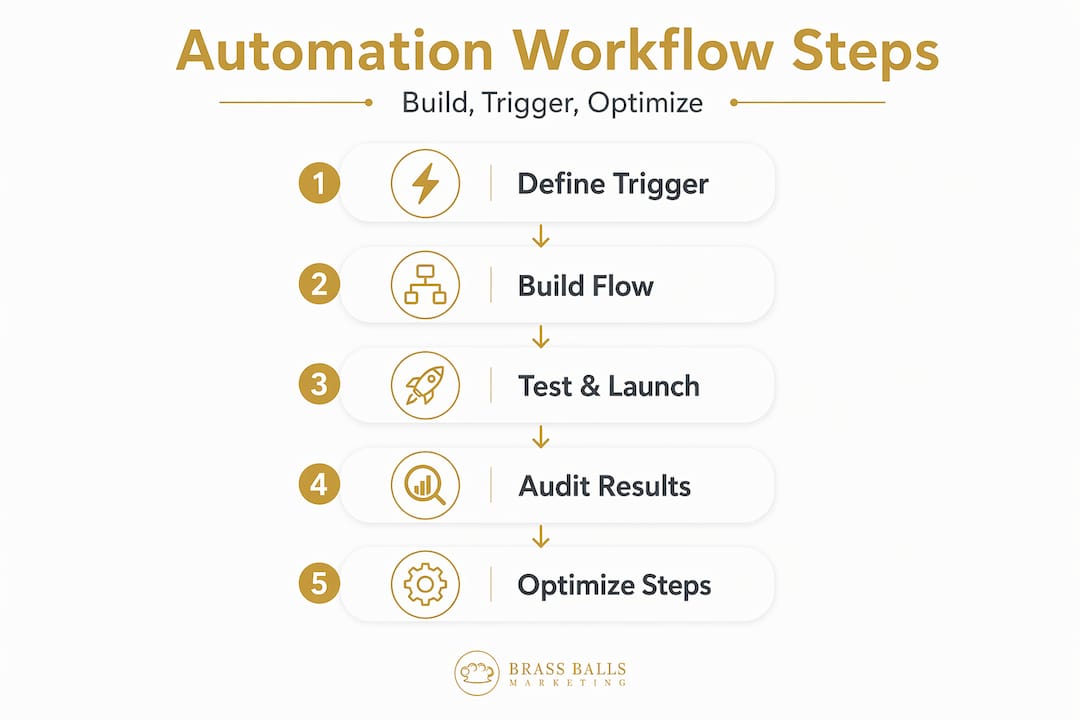
Here's a step-by-step process for building a workflow that converts:
- Choose your entry trigger. What action by the lead kicks off the workflow? Form submission, page visit, content download, or a specific tag added to their contact record are all solid starting points.
- Define your goal. What does success look like for this workflow? A booked call, a purchase, a replied email? Your goal shapes every action that follows.
- Map your email or action sequence. Decide how many touchpoints, what content, and what time delays between steps. Don't just blast five emails in two days. Give it breathing room.
- Add conditional logic. If someone clicks the pricing link, route them differently than someone who hasn't opened a single email. This is where automation gets genuinely powerful.
- Set exit or unenrollment conditions. When should someone leave the workflow? Once they book a call? Once they buy? Define this clearly or you'll have contacts stuck in a zombie sequence forever.
- Test before you publish. Enroll a test contact. Check every email, every delay, every conditional branch. Fix what's broken. Then go live.
"Advanced automation isn't about sending more messages. It's about smarter filtering and decision-making. Use behavioral triggers, multi-path logic, and route qualified, high-intent contacts directly to sales." This insight from the HubSpot advanced workflows guide is basically the cheat code for small business automation done right.
One nuance worth knowing from the HubSpot from-scratch workflow setup is that different enrollment trigger types, like schedule-based or filter-criteria-based, fix the object type once set. That means you need to plan your data model before you start clicking around. Otherwise, you'll build twenty steps and then realize you have to scrap the whole thing because the trigger was wrong from the start.
| Workflow type | Trigger | Primary goal | Typical length |
|---|---|---|---|
| Welcome series | Form submission or opt-in | Build trust and introduce offer | 3 to 5 emails over 7 to 10 days |
| Lead nurture | Content download | Educate and qualify | 5 to 8 emails over 2 to 3 weeks |
| Abandoned cart | Cart add without purchase | Recover lost revenue | 2 to 3 emails over 48 hours |
| Re-engagement | No opens in 60 to 90 days | Win back or clean list | 2 emails then remove |
Pro Tip: High-intent triggers give you the biggest bang for your buck early on. Someone who visits your pricing page three times in a week is not a casual browser. They're a buyer sitting on the fence. Build a workflow specifically for that behavior and watch your conversion rate jump. Pair this with solid email marketing strategies and you'll start seeing steps for better ROI play out in real time.
Common mistakes, troubleshooting, and optimizing for ROI
After building your workflows, it's crucial to monitor results and sidestep common mistakes. Because here's the uncomfortable truth: most small business owners set up their automation, feel great about it for two weeks, and then never touch it again. That's not a strategy. That's a slow leak in your marketing engine.
Here are the most common mistakes and how to fix them:
- Set-and-forget mentality. Automation is not a fire-and-done system. It needs regular review. Check performance monthly and update messaging when conversion rates drop.
- Optimizing for open rates only. Open rates are a vanity metric if purchases don't follow. Automated email flows deliver about 3x higher click rates (5.58% vs 1.69%) and about 13x higher placed order rates than one-off campaigns. That's the metric worth chasing.
- Trigger lock-in. As mentioned earlier, enrollment settings can lock the object type in your workflow builder after trigger selection. Plan your data model and triggers before you build out long downstream branches, or you'll waste hours rebuilding from scratch.
- No segmentation. Sending every contact the same sequence is like handing the same prescription to every patient in a waiting room. Segment by behavior, intent level, and where they came from.
- Ignoring email deliverability. A beautifully crafted automation sequence that lands in the spam folder is worth exactly nothing. Warm your domain, clean your list regularly, and monitor sender reputation.
According to 2026 email benchmarks, overall flow open rates sit in the high 30% range, with welcome flows and abandoned cart flows performing differently from each other. These benchmarks give you a realistic target. If your flows are pulling significantly below these numbers, something in your setup, your audience, or your offer needs work.
Optimization isn't a one-time thing. Think of it like tuning a car engine. You tweak, test, measure, and tweak again. Track your email funnel success metrics over time, not just in the first week after launch. Combine that with understanding the email advantages for growth and apply the marketing tips for 2026 that are actually relevant to your niche.
Pro Tip: Build a simple optimization calendar. Audit one workflow every month. Check the click-to-open rate, the goal completion rate, and the exit points. Fix the single biggest drop-off point. Repeat. Small consistent improvements compound into serious revenue over time.
What most guides miss about automated marketing system success
Here's where we get real. Most guides on marketing automation stop at "build your workflows and watch the money roll in." That's the marketing equivalent of telling someone to "just eat less and exercise more." Technically correct. Practically useless.
The real ROI from automation comes not from the initial setup, but from how quickly you adapt the system as your business evolves. Your audience changes. Your offer changes. The way people discover you changes. A workflow you built eighteen months ago might be fighting your current messaging like a cramp in the middle of a sprint.
The businesses that win with automation treat it as a living system. They measure signal accuracy, which means they ask whether the triggers they're using actually predict high-intent behavior or just activity. A lead who downloads a free PDF might be curious. A lead who visits your pricing page twice and then downloads that PDF? That's someone ready to buy.
Micro-journey feedback is another thing most guides completely ignore. Look at the specific steps where contacts disengage in your workflows. Not just the overall drop-off rate, but which email, which link, which offer causes them to check out. That feedback is telling you something specific about your messaging, your timing, or your audience fit. It's like having a customer constantly giving you notes on your pitch. Listen to it.
Understanding why targeting small businesses requires a different approach also matters here. Small business owners are skeptical, time-poor, and see straight through generic sequences. Your automation has to feel personal, relevant, and valuable at every step. Otherwise they unsubscribe and forget you ever existed.
The real competitive edge is speed of decision-making inside your automation. How fast does a high-intent signal get routed to a sales action? How quickly does a cold contact get sent something genuinely useful? The businesses crushing it with automation are the ones shortening the gap between signal and response.
Next steps: Unlock your business's automation potential
With actionable guidance in hand, here's how you can accelerate marketing automation for your business. Building a system like this from scratch takes time, strategy, and more than a few trial runs. But you don't have to figure it all out alone.
At Brass Balls, we specialize in done-for-you marketing systems and direct response strategies built specifically for small business owners who are tired of spinning their wheels. Whether you want a fully built automation funnel, a proven framework you can implement yourself, or hands-on training to sharpen your skills, we have the tools and resources to get you moving fast. Stop patching together marketing tactics that don't connect. Get a system that works together, converts consistently, and scales without burning you out. Visit us at Brass Balls and let's build something that actually works.
Frequently asked questions
What's the minimum setup a small business needs for marketing automation?
Start with one or two high-intent triggers like lead capture and a welcome flow, then add qualification logic as you gather behavioral data to avoid wasting sales time on low-intent leads.
How do automated email flows compare to regular campaigns in performance?
Automated flows outperform one-off campaigns significantly, delivering about 3x higher click rates and about 13x higher placed order rates, making them the clear choice for revenue-focused marketing.
What's a common mistake when building marketing automation workflows?
Trigger enrollment settings can lock your object type in HubSpot after trigger selection, so always design your data model and triggers before building out extensive downstream branches.
How should small businesses track automation success?
Focus on down-funnel metrics like clicks and purchase rates rather than open rates, since automated flows consistently outperform campaigns on revenue-driving KPIs where it actually counts.
Are there benchmarks for automated email flows in 2026?
Yes, overall flow open rates sit in the high 30% range, with performance varying by flow type including welcome series, abandoned cart, and browse abandonment sequences.