

Small business owners often assume paid ads are the only path to growth. Yet community-driven businesses achieve 46% higher customer lifetime value compared to traditional marketing approaches. This guide reveals why building a marketing community can transform your client acquisition strategy, reduce costs, and create sustainable revenue streams. You'll discover practical steps to launch and scale a community that supports your business goals without draining your budget or requiring complex technical skills.
Table of Contents
- Key Takeaways
- How marketing communities drive growth and reduce costs
- Core mechanics and best practices for building your community
- Expert nuances, challenges, and measuring success
- Applying community building to your small business strategy
- Why start building your marketing community now
- FAQ
Key Takeaways
| Point | Details |
|---|---|
| Increased lifetime value | Communities deliver 46 percent higher customer lifetime value and greater average spend than traditional advertising. |
| Lower acquisition costs | Community led growth reduces customer acquisition costs by 32 to 62 percent versus product led approaches. |
| Strong ROI potential | ROI can exceed 296 to 328 percent for small and medium businesses building communities. |
| Start with core group | Begin with 10 to 100 engaged users to test content, refine onboarding, and shape community culture before scaling. |
How marketing communities drive growth and reduce costs
Marketing communities create measurable financial advantages for small businesses. When customers connect around shared interests related to your brand, they spend more and stay longer. Communities drive 46% higher customer lifetime value and 2.5x customer spend compared to businesses relying solely on traditional advertising.
Wonderbly, a personalized children's book company, built a community that generated over 21,000 social posts and increased revenue through authentic customer engagement. Members shared creative ideas, celebrated purchases, and recommended products to friends without prompting. This organic advocacy replaced expensive ad campaigns and created a self-sustaining growth engine.
The cost benefits extend beyond increased spending. Community-led growth reduces customer acquisition costs by 32-62% compared to product-led or sales-led approaches. For small businesses operating on tight budgets, this difference can mean the gap between profitability and struggle. You're not paying for every new customer through ads. Instead, existing members bring in new ones through genuine recommendations.
"Community-led growth reduces customer acquisition costs by 32-62% and delivers ROI up to 328% for small and medium businesses."
Return on investment from community building can exceed 296-328% according to recent industry analysis. This performance surpasses many traditional marketing channels while requiring less capital upfront. Small businesses and entrepreneurs can stretch limited budgets by investing in community infrastructure rather than constant ad spending.
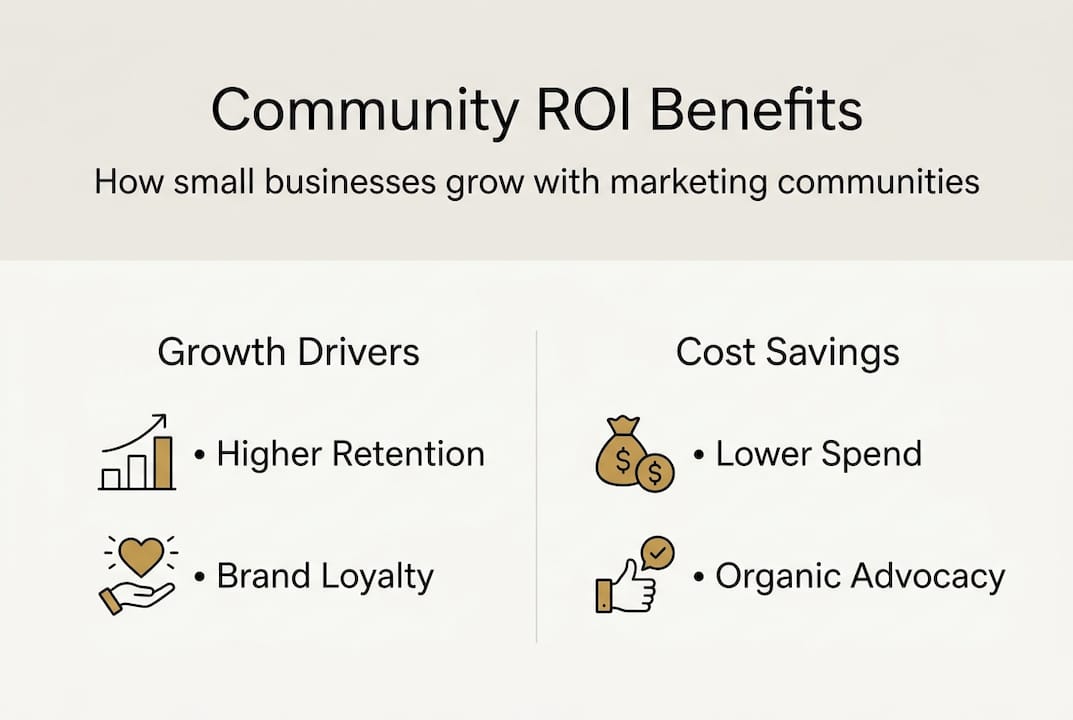
The marketing system small business guide approach emphasizes building assets that compound over time. Communities function as such assets. Each new member adds value for existing members, creating network effects that accelerate growth without proportional cost increases. Your first 100 members might cost significant time and effort to acquire, but members 101-200 often join through referrals and organic discovery.
This dynamic shifts the marketing equation from constant spending to strategic investment. You build once and benefit repeatedly. Traditional advertising stops working the moment you stop paying. Communities continue generating value as long as you maintain engagement and deliver consistent value to members.
Core mechanics and best practices for building your community
Building an effective marketing community starts with defining a clear purpose that aligns with both business goals and member needs. Your community should solve specific problems or fulfill desires your target audience experiences. Vague purposes like "connect with our brand" fail to motivate participation. Specific purposes like "share proven client acquisition tactics for service businesses" create immediate value propositions.

Start with 10-100 engaged users rather than trying to launch with thousands. This kernel group allows you to test content, refine onboarding, and establish culture before scaling. Large communities launched too quickly often suffer from low engagement and unclear identity. Small groups foster deeper connections and make moderation manageable for resource-constrained teams.
Platform selection matters significantly for accessibility and engagement. Use platforms like Slack or Discord depending on your target audience's preferences and technical comfort. B2B audiences often prefer Slack's professional interface, while creative communities thrive on Discord's flexible channels. Facebook Groups work well for audiences already active on that platform, though you sacrifice some control and face algorithm changes.
Deliver value-first content and structured onboarding to establish trust and engagement patterns. Members join communities seeking knowledge, connections, or entertainment, not sales pitches. Share actionable frameworks, industry insights, and peer experiences before promoting products or services. This approach mirrors no-BS marketing strategies boost client acquisition principles by prioritizing genuine value over hype.
Implement these essential practices to build momentum:
- Create member introduction threads where new joiners share their business challenges and goals
- Host monthly expert sessions featuring industry practitioners who share tactical insights
- Establish content themes for different days (case study Mondays, tactical Thursdays)
- Develop onboarding sequences that guide new members through community resources and norms
- Recognize active contributors publicly to reinforce desired behaviors and build social proof
- Set clear community guidelines that prevent spam while encouraging authentic discussion
Consistent onboarding prevents the common problem of members joining but never participating. Send welcome messages explaining how to get value immediately. Tag new members in relevant discussions. Prompt introductions that spark conversations rather than generic hellos. The first 48 hours after joining determine whether members become active participants or silent observers.
Pro Tip: Avoid overpromoting your products or services in community spaces. Focus 90% of content on peer-to-peer value like member questions, shared experiences, and collaborative problem solving. Reserve 10% for relevant offers that genuinely help members achieve stated goals. This ratio maintains trust while still connecting community engagement to business outcomes.
Expert nuances, challenges, and measuring success
Even well-intentioned community efforts fail when founders make critical mistakes. 78% of members disengage if community feels overly promotional, treating the space as a sales funnel rather than a value exchange. This mistake destroys trust faster than any other misstep. Members join seeking peer connections and knowledge, not constant product pitches disguised as helpful content.
Under-resourcing community management leads to disengagement and eventual failure. Communities require consistent moderation, content creation, and member engagement to thrive. Assigning community building as a side task to already busy team members guarantees mediocre results. Allocate dedicated time or hire community managers who can nurture relationships and maintain activity levels.
Some niches require micro-communities or strategic partnerships instead of broad community approaches. Highly specialized B2B services with tiny addressable markets might benefit more from intimate mastermind groups than open communities. Evaluate whether your market size and customer interaction patterns support community dynamics before investing significant resources.
Navigate these five common challenges with proven solutions:
- Low initial engagement: Seed discussions with team members and kernel group participants until organic activity builds momentum naturally
- Content fatigue: Rotate content formats between text discussions, video sessions, resource libraries, and member-generated contributions to maintain freshness
- Scaling moderation: Train power users as volunteer moderators who embody community values and can handle routine questions and conflicts
- Measuring ROI: Track attribution from community to sales through member surveys, referral codes, and CRM tagging to quantify financial impact
- Preventing cliques: Actively introduce new members to existing participants and create sub-groups around specific interests to maintain inclusivity
| Failed Communities | Successful Communities |
|---|---|
| Focus on promotion over peer value | Prioritize member-to-member connections |
| Inconsistent moderation and activity | Daily engagement and clear guidelines |
| Vague purpose and mixed audiences | Specific purpose with defined target member |
| No onboarding or welcome process | Structured introduction and resource guides |
| Ignore member feedback and requests | Actively incorporate suggestions and iterate |
Ideal health score is above 15% and advocacy rate above 25% for active communities. Health score measures the percentage of members who engage weekly through posts, comments, or reactions. Below 15% indicates most members are passive observers rather than active participants. This metric reveals whether your content and culture resonate with the audience.
Advocacy rate tracks how many members actively recommend your community or business to others. Above 25% advocacy rate signals strong member loyalty and satisfaction. These advocates become your most effective marketing channel, bringing in qualified prospects who trust peer recommendations over advertising claims. Monitor both metrics monthly to identify trends and adjust strategy accordingly.
Pro Tip: Start with 10-20 highly engaged members who genuinely care about your community's purpose rather than rushing to 100+ lukewarm participants. These founding members establish culture, create initial content, and become your biggest advocates. Quality of early members matters far more than quantity for long-term success. You can always scale once foundations are solid.
Integrate email marketing best practices 2026 to keep community members engaged outside the primary platform. Weekly digests highlighting top discussions, upcoming events, and member wins maintain visibility and prompt return visits. Email serves as a bridge for members who don't check community platforms daily but still want to stay connected.
Applying community building to your small business strategy
Community building directly supports client acquisition, retention, and referral objectives that drive revenue growth for small businesses. The strategies and data discussed translate into practical implementation steps you can start today. Begin by identifying where your target customers already gather online and what problems they discuss most frequently. This research informs your community purpose and initial content strategy.
Integrate community building into your marketing strategy through these concrete steps:
- Define a specific problem your community will help members solve related to your business expertise
- Choose a platform where your target audience already spends time or feels comfortable adopting
- Recruit 10-15 passionate customers or prospects to form your kernel group before public launch
- Create a content calendar with weekly themes that deliver tactical value without requiring sales pitches
- Set up simple onboarding automation that welcomes new members and guides them to high-value discussions
- Schedule 30 minutes daily for community engagement, responding to questions and sparking new conversations
Balance community-driven growth with product-led growth depending on your product maturity and market niche. Early-stage products benefit from community feedback that shapes development and creates launch advocates. Community is not always required pre-launch but beneficial long-term and for retention once you achieve product-market fit. Mature products use communities to reduce churn and increase expansion revenue through deeper customer relationships.
| Timing | Advantages | Disadvantages |
|---|---|---|
| Pre-launch community | Validates demand, shapes product, creates launch advocates | Requires significant time before revenue, risks building wrong audience |
| Post product-market fit | Leverages existing customers, clearer value proposition, faster growth | Misses early feedback opportunity, harder to shift established perceptions |
Small teams must scale sustainably to avoid burnout while maintaining community quality. Automate repetitive tasks like welcome messages, resource sharing, and event reminders through platform integrations or simple tools. Empower active members to answer common questions and welcome newcomers, distributing workload across passionate volunteers. Set realistic activity goals that match your available time rather than trying to match large competitors with dedicated community teams.
Entrepreneurs with limited advertising budgets gain disproportionate advantages from community building. While competitors spend thousands monthly on ads that stop working when budgets run out, your community continues generating referrals and repeat business. This dynamic mirrors principles in digital lead generation guide 2026, where owned assets outperform rented attention over time.
Community building requires patience and consistent effort but delivers compounding returns. Your first month might feel slow with limited engagement. Month three shows momentum as early members invite others and discussions become self-sustaining. By month six, the community often generates more qualified leads than paid channels while strengthening relationships with existing customers. This timeline demands commitment but rewards persistence with sustainable growth infrastructure.
Why start building your marketing community now
Small business owners who delay community building miss compounding advantages that accelerate over time. Every month without a community means lost opportunities for customer connections, referrals, and organic growth. The businesses winning in 2026 started building communities years ago, creating network effects that new competitors struggle to replicate quickly.
Brassballs provides proven frameworks and support for entrepreneurs serious about building marketing systems that drive consistent client acquisition and revenue growth. Our approach combines direct response marketing tactics with community building strategies that work for resource-constrained small businesses. You get practical tools and training designed to attract premium clients without complex technical requirements or massive ad budgets.
Pro Tip: Integrate community building into your existing marketing systems early rather than treating it as a separate initiative. Communities amplify email marketing, content marketing, and referral programs by giving customers a place to engage between purchases. This integration creates synergies that multiply results across all channels.
Contact our team for personalized guidance on building a marketing community aligned with your specific business goals and target audience. We help you avoid common pitfalls and accelerate the path from launch to engaged, revenue-generating community.
FAQ
What is a marketing community?
A marketing community is a group of customers and prospects connected by shared interests related to your brand or business. It fosters engagement through peer-to-peer value rather than one-way promotional messages. Members help each other solve problems, share experiences, and build relationships that strengthen loyalty to your business.
How can a small business start building a marketing community effectively?
Begin with a small core group of 10-100 passionate users who genuinely care about your community's purpose. Choose accessible platforms like Slack or Discord that match your audience's preferences. Focus on delivering value-first content through tactical insights, member discussions, and expert sessions rather than constant product promotion. Implement consistent onboarding that guides new members to high-value resources and conversations immediately.
What metrics indicate a healthy marketing community?
Community health score above 15% signals good engagement, measuring the percentage of members who participate weekly through posts, comments, or reactions. Advocacy rate above 25% shows strong member loyalty and willingness to recommend your community or business to others. Track both metrics monthly alongside referral conversions and customer lifetime value increases to evaluate overall community impact on business growth.
What are common mistakes to avoid when building a marketing community?
Overpromoting products instead of prioritizing peer value destroys trust and causes 78% of members to disengage quickly. Under-resourcing community management leads to inconsistent activity and eventual failure as members lose interest. Lacking a clear, specific purpose creates confusion about what value the community provides, resulting in low participation and high churn rates among new members.
Is building a community essential before launching a product?
Not always required pre-launch but beneficial for long-term retention and growth once you achieve product-market fit. Pre-launch communities validate demand and create launch advocates but require significant time investment before generating revenue. Small businesses can choose timing based on available resources, product maturity, and whether early feedback would significantly improve the offering. Post-launch communities leverage existing customers and clearer value propositions for faster growth.