

TL;DR:
- Trust is measurable through signals like reviews, referrals, and customer loyalty.
- Building trust involves transparency, consistency, personalization, and reducing self-orientation.
- Prioritizing trust over tactics creates a reinforcing cycle that drives sustainable growth.
You've probably heard someone say "buyers buy from people they trust" so many times that it sounds like a fortune cookie. But here's the thing—trust is measurable through observable signals tied directly to retention, referrals, and revenue. Trust isn't some warm, fuzzy feeling you hope your prospects stumble into. It's a system. And when you engineer it deliberately into your sales funnel, it becomes the most powerful conversion lever you have. This article breaks down exactly what trust means in funnel terms, how to measure it, and how to use it to turn skeptical leads into loyal customers who send you more business.
Table of Contents
- Why trust matters in modern sales funnels
- Defining trust: The trusted advisor framework
- Measuring trust within your sales funnel
- Navigating trust in the age of AI-powered funnels
- Building trust at every funnel stage: Practical checklist
- Why trust, not tactics, sets winning funnels apart
- Take your sales funnel to the next level
- Frequently asked questions
Key Takeaways
| Point | Details |
|---|---|
| Trust drives funnel success | Building trust is the most reliable way to boost conversions and customer loyalty in your sales funnel. |
| Measurable trust metrics | Track reviews, repeat purchases, and referrals to quantify how trust impacts business growth. |
| Balance automation and human touch | AI can improve funnels, but transparent, empathetic engagement preserves trust where it matters most. |
| Apply trust at every stage | Implement clear messaging, social proof, and consistent follow-up to build trust from top to bottom. |
Why trust matters in modern sales funnels
Let's be blunt: most prospects arrive at your funnel already suspicious. They've been burned by shady offers, aggressive sales reps, and websites that promised the moon and delivered a parking ticket. Your funnel has to overcome that baggage before it can even think about converting anyone.
Trust is not just the cherry on top of a well-designed funnel. It's the cake. Without it, your beautiful opt-in pages, clever email sequences, and perfectly timed follow-ups are basically a very expensive ghost town. Prospects bounce. They ghost you. They go find someone else who feels safer.
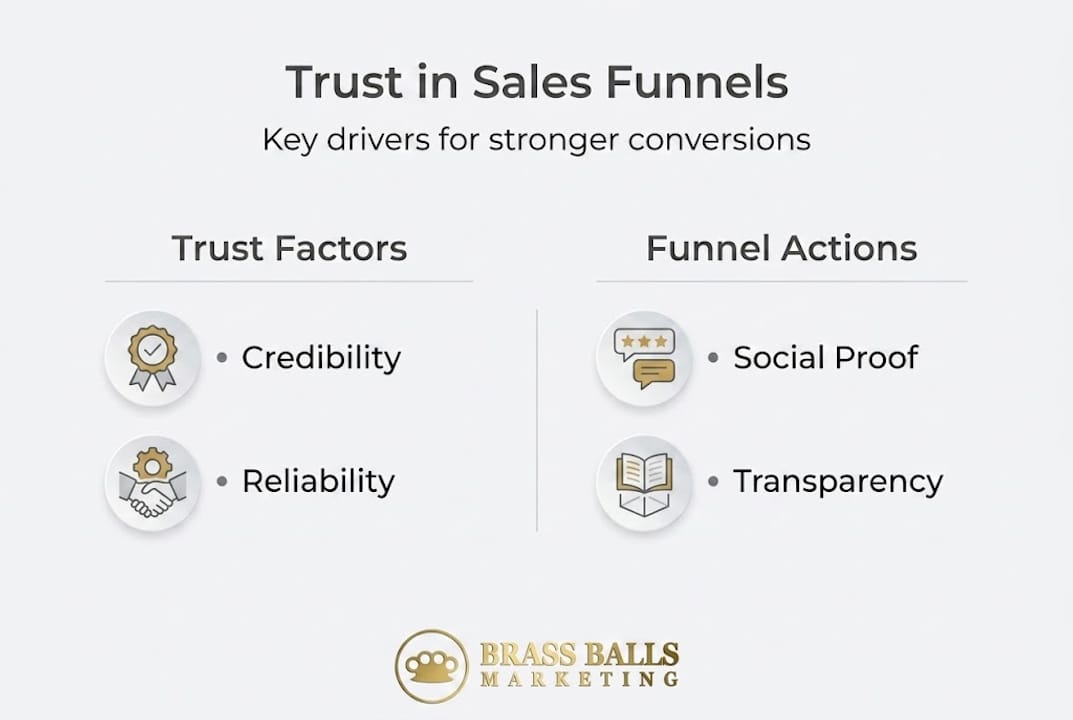
The buying landscape has shifted dramatically. Over 67% of B2B buyers prefer a "rep-free" experience, meaning they want to navigate the buying journey entirely through digital touchpoints before talking to anyone. That puts an enormous amount of pressure on your content, your messaging, and your funnel structure to carry the trust-building load that a skilled sales rep would traditionally handle.
So what does trust actually look like in a digital-first funnel? Here's how it gets formed at each touchpoint:
- Clear, specific information that answers the prospect's real questions without burying the lead in corporate fluff
- Transparent pricing and process so prospects aren't mentally bracing for a bait-and-switch
- Consistent branding and messaging across every touchpoint, from the ad to the landing page to the confirmation email
- Prompt follow-up that signals you actually show up when you say you will
- Social proof placed strategically where doubt is highest, not just scattered randomly
"Trust and decision confidence matter even more as buyers increasingly go 'rep-free' earlier in the journey." This means your funnel has to become the trusted rep, not just the delivery mechanism.
Using marketing automation for small businesses thoughtfully is one way to maintain that consistency at scale without losing the human quality that builds genuine rapport.
With the value of trust established, we next need to define exactly what trust means in a sales funnel and how to build it practically.
Defining trust: The trusted advisor framework
Trust sounds abstract until you put a formula around it. Enter the Trusted Advisor framework, which breaks trust down into four concrete, workable components. According to trusted advisor research, the formula looks like this:
Trust = (Credibility + Reliability + Intimacy) / Self-Orientation
Each variable has a direct funnel application. Let's map them out.
| Trust component | What it means | Funnel action |
|---|---|---|
| Credibility | Do you know your stuff? | Show credentials, certifications, media features, expert content |
| Reliability | Do you do what you say? | Consistent email cadence, on-time deliveries, clear expectations |
| Intimacy | Do you understand me? | Personalized messaging, segmented content, direct-response copy |
| Self-Orientation | Are you in it for you or me? | Lead with buyer benefit, not your features |
That denominator, self-orientation, is the killer. The moment your funnel starts sounding like it's all about you, your product, your awards, and your story, trust evaporates. Buyers can smell self-orientation from a mile away, and it repels them like bad cologne.
Here's how to actively build each component in your funnel:
- Build credibility by leading with specific results and verifiable claims, not vague promises like "we help businesses grow." Show the actual numbers. Feature client logos. Link to press mentions.
- Demonstrate reliability by sending follow-up emails exactly when you said you would. Use automation workflows for trust to make sure nothing slips through the cracks, even when your team is stretched thin.
- Create intimacy through segmented messaging that speaks directly to the buyer's specific pain point, not a generic everyman persona.
- Lower self-orientation by auditing your copy for the ratio of "we/our" versus "you/your." If your homepage talks about you more than the buyer, fix it today.
Pro Tip: Do a five-minute "self-orientation audit" of your funnel's top three pages. If you count more sentences about your business than about your prospect's problems, flip the ratio. You'll see engagement numbers climb almost immediately.
Knowing the dimensions of trust is crucial, but how do you leverage them for measurable business growth?
Measuring trust within your sales funnel
Here's where most small business owners check out, because they think trust is unmeasurable. Wrong. Dead wrong. Trust leaves footprints all over your analytics, and you just have to know where to look.
These are the trust signals worth tracking right now:
- Net Promoter Score (NPS): Would your customers recommend you? Low NPS means trust is leaking somewhere.
- Review quality and volume: Not just star ratings, but the specificity of praise. Detailed reviews signal deep trust.
- Repeat purchase rate: Returning customers are the clearest vote of trust you can get.
- Referral rate: When people send their friends to you, that's trust transferred at zero cost to you.
- Churn reduction: If subscription or retention numbers improve after trust-building changes, you've found your lever.
Now compare those to the traditional metrics most funnels obsess over:
| Traditional funnel metrics | Trust-based funnel metrics |
|---|---|
| Click-through rate | Review specificity and sentiment |
| Cost per lead | Referral rate and word-of-mouth volume |
| Conversion rate | Repeat purchase rate |
| Bounce rate | NPS and customer satisfaction score |
| Email open rate | Churn rate and retention curves |
Neither column is wrong. But funnel examples for growth consistently show that businesses chasing only the left column miss the compounding value hiding in the right one. When you improve trust metrics, the traditional metrics follow. Not always the other way around.
One of the most overlooked late-funnel trust tools is the case study. Strategic use of testimonials and case studies helps prospects move from "I'm interested" to "I'm ready to buy" faster than almost any other piece of content. A well-crafted case study answers the exact objections a prospect has at the bottom of your funnel, using another real human's voice instead of yours.

If you're still fuzzy on what a marketing funnel actually is and how it connects to these trust layers, that's a good place to get grounded before you start making changes.
Beyond measurement, the way you deploy trust during automation and digital engagement is changing, especially with AI becoming part of funnel execution.
Navigating trust in the age of AI-powered funnels
AI in sales funnels is a bit like a very enthusiastic intern. Given the right instructions, it can save you hours and create a slicker, faster experience. Given the wrong instructions, it can make your prospects feel like they're talking to a toaster.
Here's where AI genuinely helps trust:
- Speed: Instant follow-ups and responses signal that you're attentive, not scrambling.
- Consistency: AI doesn't forget to send the Day 3 email or drop the ball on a nurture sequence.
- Personalization at scale: Segmenting by behavior and serving tailored content would take a human team weeks; AI does it in real time.
But here's the trust risk that most people ignore. AI in sales funnels can either build or erode trust depending on whether it improves engagement or makes interactions feel cold and robotic. When prospects sense they're just a data point in a machine, they bounce. The impersonal experience is a trust killer, full stop.
The specific risks you need to manage:
- Impersonal scripting: AI-generated copy that sounds canned or generic strips intimacy from your funnel.
- Data misuse: If your personalization feels like surveillance, it crosses from "helpful" to "borderline creepy." Prospects notice.
- Loss of emotional context: AI doesn't yet read grief, excitement, or frustration the way a human does. Emotional moments in the buyer journey need a human touch.
Pro Tip: Map your funnel touchpoints and label each one as "logic" or "emotion." Logic touchpoints (order confirmations, FAQ responses, routine follow-ups) are perfect for AI automation. Emotion touchpoints (complaints, high-stakes decisions, onboarding calls) need a real human in the loop. Keeping AI and segmentation in funnels calibrated to this distinction is what separates funnels that convert from funnels that frustrate.
With trust strategies and risks mapped out, let's bring it all together with steps to put trust-building into action in your own funnel.
Building trust at every funnel stage: Practical checklist
You don't need a six-figure tech stack to build trust into your funnel. You need clarity, consistency, and a few well-placed proof points. Here's a stage-by-stage checklist you can actually use this week.
Top of funnel (TOFU): First impressions matter most
- Homepage clarity check: Can a stranger understand what you do and who you help within five seconds? If not, your credibility takes a hit before the prospect even reads a word.
- Transparent positioning: Be specific about who you serve and who you don't. Trying to appeal to everyone signals that you specialize in nothing.
- Immediate social proof: A strong headline testimonial or recognizable media logo near the top of your page anchors trust from the first scroll.
Middle of funnel (MOFU): Keep the momentum going
- Consistent email follow-up: Send what you promised, when you promised it. Use direct response automation to make sure every lead gets the right sequence without you babysitting it manually.
- Educational content that solves real problems: Not promotional fluff disguised as value. Real answers. Real solutions. This builds intimacy and credibility simultaneously.
- Transparent objection handling: Address the obvious hesitations before the prospect even has to ask. This tells them you understand their situation.
Bottom of funnel (BOFU): Close the gap between interest and action
- Case studies and specific testimonials: Late-stage enablement content is proven to move undecided buyers across the line. One detailed success story beats ten vague five-star reviews.
- Clear, upfront pricing or process outline: Removing price mystery removes a massive trust barrier.
- Low-risk entry points: A free trial, a discovery call, or a money-back guarantee signals confidence in your offer and lowers the buyer's perceived risk.
Pro Tip: Walk through your own funnel as if you're a suspicious, skeptical prospect with no prior knowledge of your business. Note every moment you feel confused, pressured, or uncertain. Those are your trust leaks. Plug them one by one, starting with the stage where the most prospects currently drop off.
These steps form the foundation. But what do most small businesses miss when it comes to trust?
Why trust, not tactics, sets winning funnels apart
Here's the uncomfortable truth that most funnel gurus won't say out loud: the checklist is necessary but not sufficient. You can implement every item on that list and still have a funnel that underperforms, because you've treated trust like a checklist item instead of a flywheel.
The real insight is that the traditional funnel is shrinking, and trust combined with loyalty and community has become the more durable competitive advantage. Instead of a linear path from stranger to buyer, trust operates as a reinforcing loop. A credible reputation attracts better leads. Better leads convert more easily. Happy customers refer others. Referrals arrive with pre-built trust. The loop compounds.
What conventional wisdom misses is that most buyers aren't comparing your features to your competitor's features. They're managing their own anxiety about making the wrong decision. Your funnel's job is not to persuade. It's to reduce that anxiety until the decision feels safe. In crowded, noisy markets, the business that feels safest wins. Not always the best product. Not always the cheapest. The safest. That's a consistent funnel growth mindset that compounds over time and becomes genuinely hard to copy.
Take your sales funnel to the next level
Building trust into your funnel isn't a one-time project. It's an ongoing system that rewards you with better leads, higher conversion rates, and customers who actually stick around and refer their friends. That's the kind of growth that doesn't rely on constantly buying more traffic or running more ads.
If you're ready to stop guessing and start building funnels that actually work, Brassballs offers no-BS strategies, done-for-you systems, and practical frameworks designed for small business owners who want real results fast. From proven marketing automation strategies to full funnel builds, the tools and expertise are ready when you are. Stop leaving trust to chance and start engineering it into every touchpoint of your business.
Frequently asked questions
What is the most important trust signal in a sales funnel?
Customer testimonials and transparent communication are among the strongest trust signals, especially at the bottom of the funnel where buying decisions are made. Specific, detailed proof beats generic praise every time.
How can small businesses measure trust in their funnels?
Track repeat purchases, referral rates, and review quality as your primary indicators, since these observable trust signals connect directly to retention and revenue outcomes. Churn reduction is another underrated metric that reveals trust health.
How does AI affect trust in digital sales funnels?
AI can build or erode trust depending on how it handles engagement. Consistent and fast responses help, but impersonal or robotic interactions drive prospects away. Governance and human oversight at emotional touchpoints are essential.
What is self-orientation and why does it decrease trust?
Self-orientation means prioritizing your goals and messaging over the buyer's actual needs, which signals to prospects that the seller cares more about closing than helping. When buyers sense this, trust drops and so does your conversion rate.