

TL;DR:
- Trust significantly boosts business growth, customer retention, referrals, and willingness to pay premium prices.
- Building trust involves transparency, ethical marketing, reputation, and consistent experience.
- Internal trust in marketing data is crucial for making confident, effective decisions and sustainable growth.
Why building trust in marketing fuels lasting business growth
Trust is not a soft, feel-good concept you hang on the wall next to your mission statement. It's a commercial lever, and when you pull it correctly, real money moves. Trust affects commercial outcomes like retention, referrals, and revenue in ways that are observable, measurable, and actionable. Most small business owners are out here chasing the next shiny tactic, running Facebook ads into the void, or praying their latest email blast converts, when the actual growth accelerator has been sitting right under their noses the whole time. Trust. Let's fix that.
Table of Contents
- Why trust matters: The business impact
- How trust works: Components, measurement, and nuance
- Proven trust-building tactics for small businesses
- Internal trust: Why your team's confidence matters too
- A new lens on trust: What most guides miss
- Take your next step in building trust
- Frequently asked questions
Key Takeaways
| Point | Details |
|---|---|
| Trust drives business growth | Earning trust leads to more loyal customers, higher referrals, and greater revenue potential. |
| Trust is multi-dimensional | Building trust involves ability, reputation, ethical conduct, and authentic communication. |
| Transparency and ethics matter | Being transparent and ethical directly increases how much customers trust your brand. |
| Measure internal and external trust | Track trust through customer behaviors and ensure your team trusts your own marketing data. |
| Focus on credibility, not perfection | Authenticity in messaging and social proof builds deeper, lasting trust than trying to appear perfect. |
Why trust matters: The business impact
Let's start with a number that should stop you mid-scroll. Campaigns that significantly increase brand trust are associated with a 27 percentage point higher likelihood of delivering large business growth effects, hitting 93% versus just 66% for average campaigns. That's not a rounding error. That's the difference between a business that scales and one that flatlines.
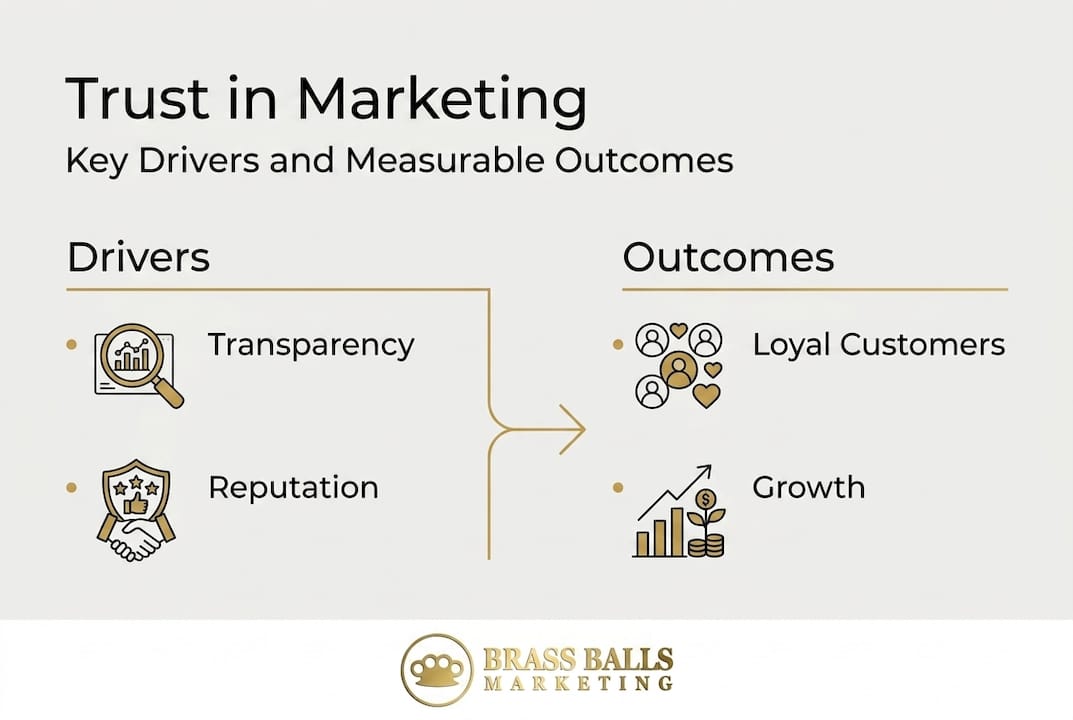
So why does trust have such an outsized effect? Think of trust as the invisible lubricant in every customer interaction. When someone trusts your business, the mental friction of buying from you drops to almost nothing. They don't need three follow-up emails, a discount code, or a glowing review from a stranger. They already believe you'll deliver, so they pull out their wallet faster and come back sooner.
Here's what trust actually does for your bottom line:
- Retention: Customers who trust you stick around longer and buy more over time, increasing their total lifetime value.
- Referrals: Trusted businesses get talked about. Word-of-mouth referrals from genuinely loyal customers convert at a higher rate than almost any paid channel.
- Premium pricing: When people trust you deeply, price sensitivity drops. They pay more because the perceived risk is lower.
- Marketing efficiency: You spend less to re-acquire loyal customers, which cuts your cost per acquisition and improves overall margins.
Implementing proven marketing strategies on top of a trust foundation multiplies results instead of just adding to them.
| Metric | Low trust baseline | High trust scenario |
|---|---|---|
| Business growth effect probability | 66% | 93% |
| Customer retention rate | Lower | Significantly higher |
| Referral rate | Minimal | Strong and consistent |
| Price sensitivity | High | Low |
| Cost per acquisition | High | Reduced over time |
"Trust is not a soft asset. It's a commercial mechanism with measurable outputs. Businesses that operationalize it outperform those that treat it as a branding afterthought."
This is why small business marketing success almost always correlates with how effectively an owner builds and maintains trust at scale.
Pro Tip: Stop treating trust as abstract. Define it in behavioral terms. Track repeat purchase rates, NPS (Net Promoter Score, which measures how likely customers are to recommend you), and referral volume. If those numbers move, trust is moving with them.
With trust's role established, let's examine the components and nuances that make it work.
How trust works: Components, measurement, and nuance
Here's where most business owners get it wrong. They think trust is one thing, like a single dial you turn up or down. In reality, trust is not one-dimensional, and which components matter most can vary dramatically depending on where your customer sits in their advocacy journey.
Let's break trust down into its working parts:
- Ability: Can you actually deliver what you promise? Skills, expertise, and reliability all fall here.
- Experience: What does it feel like to work with you? The quality of each touchpoint shapes perception.
- Reputation: What do others say about you when you're not in the room? Social proof, reviews, and word-of-mouth live here.
- Reciprocity: Do you give value before you ask for something in return? Generosity builds goodwill fast.
- Joint interests: Do customers believe you genuinely care about their outcomes, not just your commission?
- Continuity: Are you consistently showing up, communicating, and delivering over time?
Each of these elements plays a different role depending on who you're talking to. Research measuring NPS impact paints a stark picture: customers with high trust report an NPS of +36.5, while those with low trust report a deeply negative NPS of negative 68.6. That's a swing of over 100 points. Think about what that means for referrals and word-of-mouth at each end of that scale.
| Trust component | Primary business effect | NPS impact |
|---|---|---|
| Ability | Repeat purchases, retention | High positive |
| Experience | Loyalty, reduced churn | Moderate to high |
| Reputation | Referrals, new client acquisition | High positive |
| Reciprocity | Goodwill, engagement | Moderate |
| Joint interests | Advocacy, long-term loyalty | Very high |
| Continuity | Predictable revenue, reduced friction | High positive |
Here's how to build and measure trust systematically in your small business:
- Audit your current touchpoints. List every interaction a customer has with you, from first ad click to post-purchase follow-up. Identify where trust is built or broken.
- Survey your best customers. Ask them why they chose you and why they stay. Their words will reveal which trust components matter most in your market.
- Implement NPS tracking. Send a simple one-question survey after each purchase or project. Track trends over time, not just one-off scores.
- Segment your trust data. Look at trust signals differently for new customers versus long-term ones. What converts a prospect is often different from what retains a loyalist.
- Iterate based on feedback. Treat trust-building like a product. Test changes, measure impact, and double down on what works.
Strong client acquisition strategies always have a trust architecture built into them, not bolted on as an afterthought.

Pro Tip: Don't chase a perfect five-star rating. Authenticity outranks perfection every single time. A business with 4.3 stars and genuine, detailed reviews will often outperform one with 5.0 stars that looks suspiciously polished. Customers smell fake from a mile away.
You can also use trust as the framework to grow your small business by building communities around shared values, not just shared products.
Knowing what trust is and isn't, it's time to get practical. How do you actually build it effectively?
Proven trust-building tactics for small businesses
Alright, no more theory. Here's what actually moves the needle when you're running a small business and you need trust to do real work for you.
Be radically transparent. Show your customers how your business operates. Share your process, your pricing logic, even your mistakes. People don't expect perfection. They expect honesty. When you pull back the curtain, you signal confidence in your product and respect for your customer's intelligence. That combination is almost irresistible.
Commit to ethical marketing. This one sounds obvious until you look at how many businesses still use bait-and-switch tactics, misleading headlines, or manufactured urgency. Transparency combined with ethical marketing is empirically linked to higher consumer trust in digital brands. It's not just morally right, it's commercially smart.
Respect privacy like it's your own. Data privacy isn't just a legal checkbox. It's a trust signal. When you make consent clear, explain how you use customer data, and give people control, you're telling them you see them as people, not just leads in a funnel. In a world where data breaches make news weekly, this differentiates you fast.
Here's a practical trust-building checklist you can start using this week:
- Rewrite your privacy policy in plain English so actual humans can understand it.
- Add a "how we use your data" explainer to your email opt-in page.
- Respond to every review, positive or negative, within 48 hours.
- Feature real customer stories with photos, not stock images, on your website.
- Share behind-the-scenes content that shows your team, process, or values in action.
- Remove any marketing copy that uses fake scarcity or manipulative pressure tactics.
Statistic callout: Transparent and ethical marketing practices are among the strongest predictors of consumer trust for digital brands, making them non-negotiable for businesses competing on value rather than just price.
Leaning into marketing tips for 2026 means embedding trust-first principles into your content strategy, your ad copy, and your sales process simultaneously. And if you want to go further, look at top growth strategies that treat customer relationships as the primary asset, not an afterthought.
Pro Tip: Every single customer touchpoint is a micro trust-building moment. Your email subject line, your invoice design, the hold music when someone calls you. None of them are neutral. They're all either building or eroding trust, so treat each one with the same intention you'd give your best sales pitch.
Trust also impacts your internal marketing successes. Here's why measurement confidence matters too.
Internal trust: Why your team's confidence matters too
Here's a truth bomb that most marketing guides won't tell you: the biggest trust problem in many small businesses isn't with customers. It's internal. And it's quietly strangling growth.
Over 60% of B2B marketers don't fully trust their own data, according to Forrester research from 2024. Sixty percent. That means the majority of marketing teams are making decisions based on numbers they're not even confident in. That's like navigating a highway with a foggy windshield and hoping for the best.
When your team doesn't trust the metrics, something insidious happens. Marketing performance starts to feel random. One campaign works, the next one doesn't, and nobody really knows why. So decision-making becomes gut-driven rather than data-driven. Budgets get cut in the wrong places. Winning strategies get abandoned too early. Losing ones get kept too long.
"Operational trust in your marketing data is just as critical as customer-facing trust in your brand. Without it, even your best campaigns can't scale consistently because the team loses confidence in the signals."
Here's how to close the internal trust gap in your business:
- Audit your data sources. Find out where your numbers come from, how they're collected, and where the gaps or inconsistencies are hiding.
- Standardize your key metrics. Everyone on your team should use the same definitions for terms like "conversion," "lead," and "revenue attributed." Sounds basic, but it's shockingly rare.
- Create a simple marketing dashboard. One place, key numbers, updated regularly. Visibility kills distrust faster than any policy document.
- Celebrate transparency around results. Share both wins and losses openly. When your team sees that bad data leads to honest conversations rather than blame, they'll start trusting the process.
- Invest in marketing automation for small businesses that reduces manual data entry errors and gives you cleaner reporting from the start.
Building internal trust also links directly to your ability to improve marketing ROI over time, because consistent, confident decision-making compounds into better results quarter after quarter.
Pro Tip: Hold a monthly "what did we learn" session with your team. Share what worked, what failed, and what the data is telling you. When failure becomes a learning ritual rather than a blame fest, your team's confidence in using data grows fast.
Having seen both the external and internal sides of trust, let's offer a fresh, experience-driven perspective on what actually works and what most guides miss.
A new lens on trust: What most guides miss
Here's our honest take after watching dozens of small businesses try to "build trust" and stall out. Most of the advice out there is too focused on the customer-facing layer, your star ratings, your testimonials, your brand aesthetics. That stuff matters, but it's the surface layer. The real accelerant sits underneath it.
When your customers trust you AND your team trusts your marketing data, growth becomes consistent rather than accidental. The measurable growth outcomes that every business owner wants, like reliable revenue, repeatable referrals, and scalable campaigns, only happen when both layers of trust are working together.
Conventional advice tells you to polish your brand, collect more reviews, and show up consistently on social media. That's not wrong, but it's incomplete. We've seen businesses with near-perfect online reputations struggle to scale because internally, their marketing team was flying blind. And we've seen scrappy businesses with average reviews grow fast because their team trusted the data and made sharp, consistent decisions.
Looking at effective small business strategies through this dual lens changes everything. Stop asking only "do our customers trust us?" and start also asking "does our team trust what our marketing is telling us?" Answer both, and you've got something genuinely scalable.
Take your next step in building trust
If this article has made one thing clear, trust is not a passive byproduct of good service. It's an active strategy you build, measure, and scale intentionally.
At Brass Balls, we help small business owners and entrepreneurs build the kind of marketing systems that generate trust at every level, from the first ad impression to the long-term client relationship. Whether you need a done-for-you funnel, a client acquisition framework, or just a no-BS blueprint to stop guessing and start growing, we've got you covered. Explore Brass Balls marketing solutions and find out what a trust-first, results-driven marketing strategy actually looks like in practice. Your customers are ready to trust you. Let's make sure your marketing is ready to earn it.
Frequently asked questions
How does building trust impact customer lifetime value?
When you invest in building trust, customers are more likely to return, refer others, and pay premium prices, all of which raise lifetime value significantly over time.
What are the most important trust factors in marketing?
Key trust factors include transparency, reputation, ethical practices, customer experience, and genuine alignment of your interests with the client's, and different factors carry more weight depending on where your customer sits in their relationship with you.
Can you measure trust in marketing?
Yes. Track repeat purchase behavior, referral rates, and use NPS surveys to quantify trust levels, because trust is observable through customer actions, not just feelings.
Why is team trust in marketing data important?
If your team doesn't trust its own metrics, decisions become inconsistent and gut-driven, and distrust in measurement makes your marketing performance feel random rather than controllable.
Does perfect social proof always build trust?
No. Overly polished or obviously curated social proof can actually reduce trust because customers detect inauthenticity quickly, so credibility beats polish every time.