

TL;DR:
- Client acquisition involves the complete process of turning strangers into paying clients, not just generating leads. It requires a repeatable system that includes nurturing prospects, tracking conversion rates, and optimizing channels for sustainable growth. Effective strategies depend on understanding your CAC, choosing suitable channels, and building reliable processes for long-term success.
Most business owners think filling the top of the funnel is the whole game. Pump in leads, watch the money roll in. But here's the uncomfortable truth: a bucket full of leads and zero conversions is just expensive confetti. Client acquisition is the full journey from "who are you?" to "take my money," and it's where sustainable growth actually lives. This guide cuts through the noise to define exactly what client acquisition is, compare every major channel with brutal honesty, give you a framework to pick the right one for your business, and hand you actionable tactics you can implement this week.
Table of Contents
- What is client acquisition?
- Core client acquisition channels explained
- How to choose the right acquisition channel for your business
- Beyond basics: Advanced insights and trends in client acquisition
- What most guides miss about client acquisition
- Ready to accelerate your client acquisition?
- Frequently asked questions
Key Takeaways
| Point | Details |
|---|---|
| Client acquisition defined | Client acquisition means converting ideal prospects into paying clients using structured strategies and systems. |
| Channel selection matters | Not all acquisition channels suit every business—balance speed, cost, and fit for optimal results. |
| Data beats guesswork | Track your Client Acquisition Cost for each channel to make smarter marketing decisions. |
| Advanced trends evolve quickly | Keep an eye on new tactics like AI and product-led growth for emerging client acquisition opportunities. |
| Sustained growth is strategic | Building layered, repeatable acquisition systems drives reliable long-term revenue, not just quick wins. |
What is client acquisition?
Now that we've set the stage for why client acquisition matters, let's define exactly what it means and why it's so important.
Client acquisition is the end-to-end process of attracting a stranger, earning their interest, and converting them into a paying client. Simple enough, right? But a lot of people confuse it with lead generation, and that confusion costs real money. Lead generation is one piece of the puzzle. It's about collecting contact information and building a list of prospects. Client acquisition picks up where lead generation stops and carries the relationship all the way to a signed contract, a paid invoice, or a completed purchase.
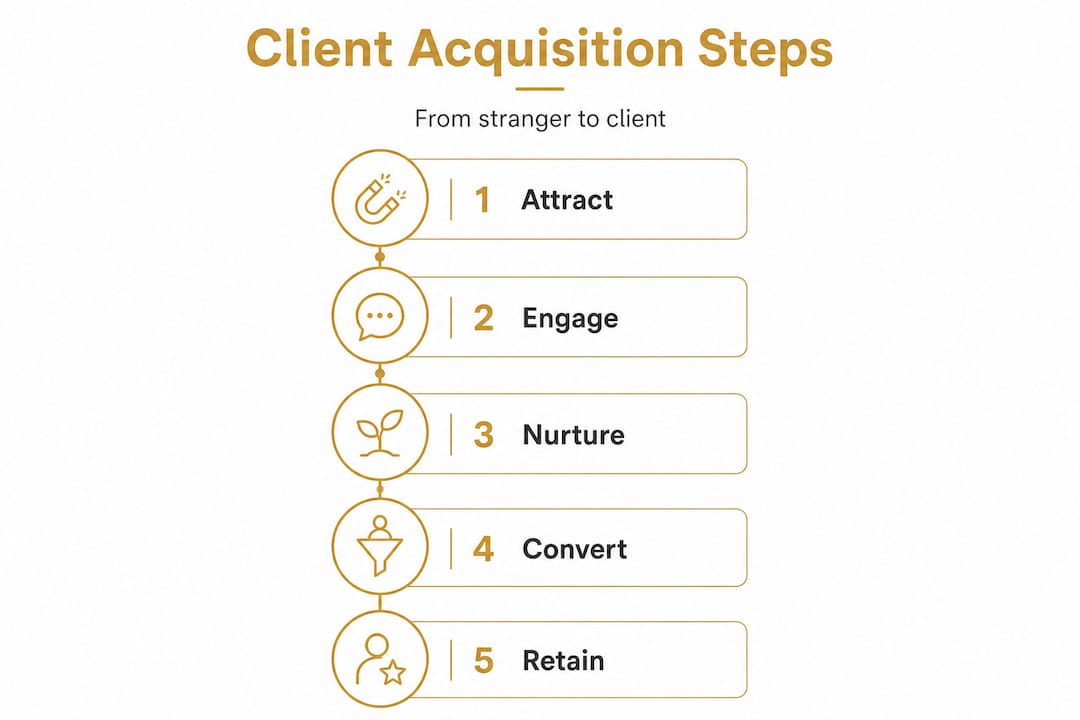
Lead nurturing sits in the middle of those two. Think of it as warming up a cold prospect until they're ready to buy. You might email them helpful content for six weeks, invite them to a webinar, or send a case study at just the right moment. All of that is nurturing. But the acquisition only counts when money changes hands.
Why does this distinction matter so much? Because if you optimize only for leads, you'll celebrate a list of 5,000 people who never buy anything. You need a process that moves people through every stage, not just the first one.
A strong client acquisition process gives you:
- Predictable revenue because you know roughly how many leads convert
- Scalability since you can dial up whichever channels produce the best return
- Lower dependence on luck, replacing hope with a repeatable system
- Better client quality when you target and qualify properly from day one
- Clearer data to know what's working and what's draining your budget
Pro Tip: Track your lead-to-client conversion rate, not just your lead volume. A 200-person list with a 20% conversion rate beats a 2,000-person list with a 1% rate every single time.
According to complete acquisition research, key methodologies include organic channels (SEO, content marketing), paid channels (Google Ads, social ads), outbound (cold email, LinkedIn DMs), inbound (lead magnets, nurturing), referrals, partnerships, and authority building through books and speaking engagements.
If you want a deeper look at what separates struggling businesses from those that grow consistently, the proven client acquisition strategies framework lays it out in plain language.
Core client acquisition channels explained
With a solid definition in place, let's dive into the primary ways businesses actually acquire clients and compare their pros and cons.
There's no one-size-fits-all channel. Every business is different, every market behaves differently, and what worked for the agency down the street might completely flop for you. The major acquisition methodologies break down into several distinct categories, each with its own rhythm, cost structure, and risk profile.
Here's a clear comparison to give you a bird's-eye view:
| Channel | Cost | Speed | Lead quality | Examples |
|---|---|---|---|---|
| Organic (SEO, content) | Low long-term | Slow (3-12 months) | High | Blog posts, YouTube, podcast |
| Paid advertising | High | Fast (days) | Medium | Google Ads, Facebook/Meta Ads |
| Outbound | Medium | Medium (weeks) | Variable | Cold email, LinkedIn DMs |
| Inbound | Low-medium | Medium | High | Lead magnets, email nurturing |
| Referrals | Very low | Unpredictable | Very high | Client referrals, word-of-mouth |
| Partnerships | Low-medium | Medium | High | Co-marketing, agency referrals |
| Authority building | Low | Very slow | Very high | Book, speaking, podcast guesting |
Let's unpack the ones that matter most for small business owners:
Organic channels are the slow-burn investment that pays dividends for years. A well-written blog post can attract clients in month 18 that you haven't even imagined yet. The catch? You need patience and consistency. Most business owners quit right before the compounding effect kicks in.
Paid advertising is the fast lane, but it's a paid toll road. You stop paying, the traffic stops. It's fantastic for testing offers quickly and for filling gaps in your pipeline. The challenge is that costs rise as more competitors pile in, and the targeting game gets more sophisticated every year.

Outbound methods like cold email and LinkedIn DMs have a bad reputation, mostly because people do them wrong. Spammy, generic messages deserve the delete button. But personalized, research-backed outreach to the right prospects can still deliver surprisingly good results, especially for B2B service businesses.
Referrals are the golden ticket. The conversion rates are higher, the clients are better, and the cost is almost zero. The frustrating part is that you can't just flip a switch and manufacture them. They're a byproduct of doing excellent work and systematically asking happy clients to spread the word.
Key strengths and risks to keep in mind:
- Organic: Compounds over time but requires consistent effort and technical know-how
- Paid: Predictable and fast but can burn budget quickly without proper optimization
- Outbound: Scalable when systemized but risks damaging your brand if done poorly
- Referrals: Cheapest and highest quality but difficult to control or predict
- Authority building: Builds credibility at scale but takes serious long-term commitment
For no-nonsense marketing strategies that don't overcomplicate things, you want to match your channel mix to your actual resources and sales cycle. And if you're not yet nurturing prospects through a deliberate process, these lead nurturing strategies are worth exploring before you pump more money into acquisition.
How to choose the right acquisition channel for your business
Now that we've detailed the options, choosing the best channel can seem daunting. Here's a framework to make that decision with confidence.
Let's start with the most important metric most small business owners ignore: Customer Acquisition Cost, or CAC. This is simply how much money you spend to acquire one paying client. If you spend $1,000 on ads and get five clients, your CAC is $200. Sounds straightforward, but the math gets tricky when you're running multiple channels at once and lumping all costs together.
The payback period is equally critical. This tells you how long it takes to recoup what you spent to acquire the client. A CAC payback under 12 months is generally considered healthy. If you're waiting two years to break even on every client, even great businesses can run into cash flow problems.
Here's a step-by-step framework to pick your channel:
- Define your primary goal. Are you trying to build a pipeline fast or build a brand that attracts clients for the next five years? Quick revenue needs paid or outbound. Long-term brand authority needs organic and content.
- Be honest about your budget. If you have $500 a month to spend, running Google Ads is a recipe for heartburn. Start with outbound or organic where your time is the main investment.
- Know where your ideal clients actually hang out. If you serve local restaurants, cold outreach and local SEO make sense. If you're chasing enterprise software companies, LinkedIn and content marketing are your arena.
- Audit your existing skills. You'll succeed faster on channels where you have genuine competence or can quickly build it. Don't hire a copywriter for cold email if you can write. Do hire an SEO specialist if you've never touched a meta description in your life.
- Test one primary channel for at least 90 days. Most people dabble in five channels poorly instead of mastering one. Commit. Measure. Iterate.
- Evaluate results with hard numbers. Look at conversion rate, CAC, and lifetime client value before declaring something a win or failure.
Pro Tip: Never track only your blended CAC (total marketing spend divided by total new clients). Break it down per channel. You might discover that referrals cost you $40 per client while paid ads cost $400. That insight alone can transform your strategy.
If you want to make this process easier, having the essential marketing tools in place to track these numbers is non-negotiable. Gut feelings are not a substitute for data.
Beyond basics: Advanced insights and trends in client acquisition
Having decided on a channel, it's crucial to understand new industry trends and advanced tactics that can help you stay ahead.
The blended CAC trap is real and it catches even experienced marketers. When you average your acquisition costs across all channels, the efficient ones subsidize the terrible ones and you never figure out which is which. Referrals deliver the highest quality clients at the lowest cost, but they're inherently unpredictable. You can't base a growth plan entirely on referrals unless you have a deliberate system to generate them consistently.
"Blended CAC masks channel variance; referrals are the highest quality but unpredictable; AI and product-led growth are emerging as critical mechanisms for scale in 2026." CAC Benchmarks for Startups in 2026
Common misconceptions and traps to avoid:
- Believing more leads automatically means more revenue (conversion matters more than volume)
- Treating all channels equally without testing their individual ROI
- Assuming what worked for a competitor will work for your business and audience
- Neglecting follow-up sequences after initial contact (most deals close after the fifth to twelfth touchpoint)
- Ignoring client lifetime value when calculating how much you can afford to spend on acquisition
Now for the exciting stuff. AI-powered targeting is no longer just for big brands. Tools like predictive lead scoring use machine learning to identify which prospects in your pipeline are most likely to convert, letting you focus human energy where it counts most. This isn't magic. It's pattern recognition at scale. Think of it as a very enthusiastic, very fast assistant who never sleeps.
Product-led growth (PLG) is a model where the product itself does the selling. Think free trials, freemium models, or demo tools that showcase value before any sales conversation happens. For SaaS businesses and digital service providers, PLG can dramatically reduce CAC because the product acts as a self-serving acquisition machine.
Here's a quick data framework to help you benchmark your approach:
| Strategy | Typical CAC range | Conversion rate | Time to results |
|---|---|---|---|
| Organic/SEO | Low ($10-$100) | 2-5% | 3-12 months |
| Paid advertising | Medium-High ($50-$500+) | 1-3% | Days to weeks |
| Outbound email | Low-Medium ($20-$200) | 1-5% | 2-8 weeks |
| Referrals | Very Low ($0-$50) | 20-40% | Unpredictable |
| Authority (speaking/book) | Very Low long-term | 10-30% | 6-24 months |
The pattern here is clear: the best quality and lowest cost almost always comes from trust-based channels. But they take time to build. Using sales funnels for acquisition is what turns organic and authority-based interest into actual conversions without you having to manually chase every single prospect.
What most guides miss about client acquisition
With the tactical and advanced landscape covered, let's zoom out to see what most advice overlooks and how that can completely reframe your approach.
Here's the uncomfortable truth most acquisition articles won't tell you: the tactics don't matter nearly as much as the system behind them. You can have the world's best cold email sequence and still fail if you don't have a follow-up process, a clear offer, or a way to measure what's working. The businesses that win at client acquisition aren't always using the newest tools or the flashiest strategies. They're the ones who've built boring, reliable, repeatable systems and then improved them consistently over time.
Most advice chases the shiny object. New platform? Jump on it. New ad format? Test it immediately. That kind of reactive behavior burns budget and morale simultaneously. The real edge comes from picking two or three channels that fit your business model, your strengths, and your market. Then doubling down relentlessly on what the data tells you is working.
The single biggest overlooked shift is this: track CAC and return on investment per channel, reinvest into what's compounding, and cut what's bleeding you dry. Sounds obvious. Almost nobody actually does it. They get emotionally attached to a channel ("but we've always done Facebook Ads!") long after the numbers stopped making sense.
Saying no to mismatched channels is a growth strategy, not a cop-out. A local consulting firm probably doesn't need a TikTok presence. A B2B software company probably doesn't need a print newsletter. Know what you're not going to do. That clarity frees up resources for what actually moves the needle.
If you want a strategic north star for this whole conversation, the entrepreneur acquisition blueprint ties these principles together in a way that's practical for real businesses, not theoretical MBA case studies.
Pro Tip: Systemize your client experience and follow-up process with the same rigor you apply to your lead generation. Happy clients who feel cared for become referral machines. That's a compounding asset that no ad budget can replicate.
Ready to accelerate your client acquisition?
If this article has sparked ideas you want to turn into real revenue, you don't have to figure it out alone.
At Brass Balls, we specialize in no-BS direct response marketing and proven acquisition systems built specifically for small business owners and entrepreneurs who are tired of wasting money on tactics that look good on paper but don't deliver in the real world. Whether you want a done-for-you marketing system, a self-serve course to build your own acquisition engine, or a framework tailored to your specific industry, we've got the tools and the track record to back it up. Stop guessing and start growing. Your next paying client is closer than you think.
Frequently asked questions
What is the difference between client acquisition and lead generation?
Client acquisition converts leads into paying clients through a full sales and nurturing process, while lead generation only collects prospect contact information. Lead generation is just the first step in a much longer journey.
Which client acquisition channel is best for a new small business?
Organic and referral channels are the most cost-effective starting points, but the right choice balances speed, budget, and your market. If you need clients quickly, a targeted outbound campaign can bridge the gap while organic builds momentum.
How can I lower my client acquisition cost (CAC)?
Improve your lead-to-client conversion rate, lean into referral programs, and eliminate channels that aren't delivering measurable ROI. Referrals generate the lowest CAC with the highest client quality, so building a systematic referral process is one of the highest-leverage moves you can make.
How long does it take to see results from a client acquisition strategy?
Paid and outbound channels can deliver clients within days to a few weeks, while organic and referral channels typically take three to twelve months to gain meaningful traction. A balanced strategy uses fast channels for short-term revenue while building slow channels for long-term compounding growth.
Recommended
- Proven client acquisition strategies for sustainable growth
- How sales funnels drive client acquisition: 2026 guide
- No-BS marketing strategies to boost client acquisition
- Entrepreneur marketing blueprint: proven steps for client acquisition
- AI-Driven Ad Strategy Guide for High-Impact Results - Palmador Blog