

TL;DR:
- A sales funnel systematically converts strangers into paying clients through deliberate steps.
- Start with basic, affordable tools and focus on one offer, one audience, and one funnel.
- Continuous measurement and iteration are key to optimizing funnel performance and growth.
You've got a website. Maybe some social media pages. You're running ads or posting content, and people are showing up. But somehow, the sales just aren't following. Sound familiar? You're not alone. Most small business owners hit this exact wall because a website is not a sales system. It's a brochure. A sales funnel, on the other hand, is a machine that takes strangers and turns them into paying clients, step by deliberate step. This guide walks you through exactly what you need, how to map the journey, how to build it, and how to fix it when something breaks.
Table of Contents
- What you need to build an online sales funnel
- Map your customer's journey for funnel success
- Step-by-step: Build and test your first online funnel
- Optimize, measure, and fix your funnel for growth
- The truth about online funnels: What most guides miss
- Get expert help with your sales funnel
- Frequently asked questions
Key Takeaways
| Point | Details |
|---|---|
| One funnel at a time | Start with a single mapped funnel to reduce risk and maximize learning before you scale. |
| Essential tools only | Choose simple, integrated software to save time and money when building funnels. |
| Customer journey mapping | Mapping your client's path ensures your funnel fits real buying decisions, not just theory. |
| Optimize to grow | Regularly check funnel metrics and improve weak spots to consistently increase sales. |
| Align sales and marketing | Keep both teams in sync to prevent leaks where prospects are lost between handoffs. |
What you need to build an online sales funnel
Now that you know what a sales funnel can do, it's time to make sure you have the right tools and preparation before you build. Think of this as your pre-flight checklist. You wouldn't fly a plane without checking the instruments, and you shouldn't launch a funnel without knowing what's in your toolkit.
The good news? You don't need to spend a fortune. A minimal viable funnel can be built with free or low-cost tools that do the heavy lifting without draining your budget. Here's a quick breakdown of what you actually need versus what's nice to have later.
| Funnel stage | What you need | Budget-friendly option | Premium option |
|---|---|---|---|
| Landing page | Page builder | WordPress (free) | ClickFunnels / Leadpages |
| Lead capture | Email platform | Mailchimp (free tier) | ActiveCampaign |
| Nurture sequence | Email automation | Mailchimp | HubSpot |
| CRM / tracking | Contact management | HubSpot free CRM | Salesforce |
| Analytics | Traffic tracking | Google Analytics (free) | Hotjar |
| Graphics | Visual assets | Canva (free) | Adobe Express |
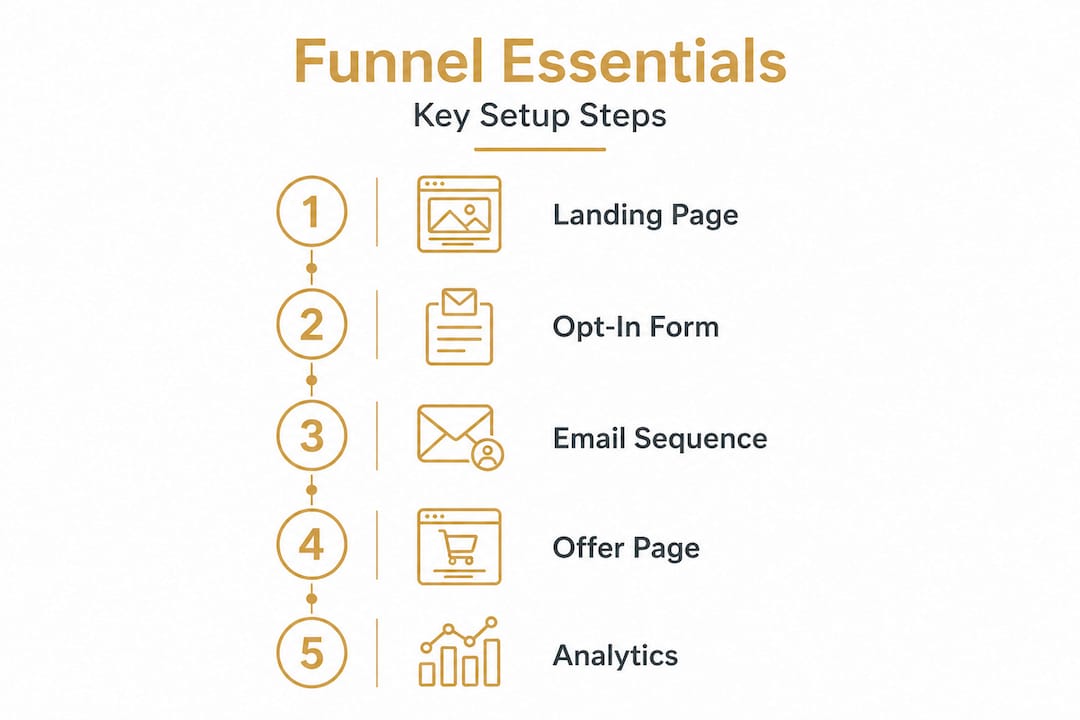
Notice what's not on that list? A $10,000 custom website. A team of developers. A complicated tech stack that takes six months to set up. You need a landing page, a way to capture emails, a sequence to follow up, and a way to track what's happening. That's it to start.
Here's what your essential checklist looks like before you build:
- A clear single offer (one product, one service, one outcome)
- A landing page builder account (WordPress works fine for beginners)
- An email marketing platform with basic automation (check out email marketing tools to compare options)
- A free Google Analytics account connected to your pages
- Basic brand assets: logo, colors, one or two images (Canva handles this in an afternoon)
- A thank-you page or confirmation step after opt-in
Pro Tip: Resist the urge to buy every shiny tool before you've validated your funnel. Start with free tools, get your first ten leads through the system, then upgrade what's actually slowing you down. Spending money before you have proof is how people end up with a $300/month tech stack and zero clients.
The biggest mistake beginners make is trying to build a Ferrari before they've learned to drive. One landing page, one email sequence, one offer. That's your starting point, full stop.

Map your customer's journey for funnel success
With your tools ready, the next step is to map out the path your customers will take so your funnel matches real decision-making behaviors. This is where most guides skip ahead too fast, and it costs you. If you build a funnel without mapping the journey first, you're basically guessing at what your customer needs at each stage. Guessing is expensive.
The marketing funnel stages follow a predictable pattern: awareness, interest, decision, and action. Your job is to match each stage with the right message and the right offer. Here's how to map it out in five steps:
- Define your ideal customer. Who are they, what problem keeps them up at night, and what outcome are they chasing? Be specific. "Small business owners" is not specific. "Plumbers in the Midwest who want more residential service calls without paying for a marketing agency" is specific.
- List every touchpoint. Where do they first hear about you? Social media, Google search, referral, paid ad? Write them all down. These are your awareness entry points.
- Identify the friction points. Where do people drop off or go quiet? This is usually between interest and decision. Something stops them from moving forward, and your job is to figure out what.
- Define the conversion moment. What exact action counts as a win? A booked call, a completed purchase, a signed contract? Be precise. Vague goals produce vague results.
- Test one path before building more. As funnel segmentation tips confirm, the smartest move is to map the journey first, test one funnel with real traffic, then scale what works.
Here's a simple comparison to show you what this looks like in practice:
| Stage | Blank template | Filled example (home services) |
|---|---|---|
| Awareness | Traffic source | Google ad targeting "emergency plumber near me" |
| Interest | Lead magnet | Free checklist: "5 signs your pipes need attention" |
| Decision | Nurture email | Case study email showing a $200 fix that saved $4,000 |
| Action | Conversion offer | Book a free 15-minute inspection call |
See how the filled example is completely specific? That specificity is what makes funnels convert. Generic funnels produce generic results.
Pro Tip: Align your sales and marketing definitions before you build. If marketing calls something a "lead" but sales won't touch it until it's "qualified," you've got a handoff leak that will bleed revenue quietly for months. Get everyone on the same page about what each stage means before a single page goes live.
Step-by-step: Build and test your first online funnel
Once you've mapped your customer journey, you're ready to bring your funnel to life with these practical steps. This is where the rubber meets the road. No more planning, no more prep. Let's build.
- Design your lead magnet. This is the free thing you offer in exchange for an email address. It should solve one specific problem fast. A PDF checklist, a short video, a free calculator, a mini-course. Keep it simple and immediately useful.
- Build your landing page. One headline, one subheadline, three to five bullet points on what they'll get, and one opt-in form. That's it. No navigation menu. No links to your blog. One page, one purpose. Check out real funnel examples to see what high-converting pages actually look like.
- Set up your email welcome sequence. Write three to five emails that deliver value, build trust, and move the reader toward your paid offer. Email one delivers the lead magnet. Email two tells a relevant story. Email three makes a soft offer. Emails four and five handle objections and close.
- Connect your systems. Link your landing page to your email platform. Make sure new subscribers trigger the welcome sequence automatically. Test it yourself by opting in with a personal email address.
- Add tracking. Install Google Analytics on your landing page and thank-you page. Set up a goal so you can see your opt-in conversion rate. This number is your north star.
- Drive traffic. Send your existing audience to the landing page first. Post it to your social channels, email your current list, or run a small paid ad test with $5 to $10 per day. You need real data before you can improve anything.
- Review and iterate. After your first 100 visitors, look at your conversion rate. Industry benchmarks suggest landing page conversions typically range from 10% to 25% for lead generation pages. If you're below 10%, something needs fixing, usually the headline or the offer.
Here are the fast-launch best practices that separate the businesses that get results from those that spin their wheels:
- Keep your first funnel to one offer and one audience segment
- Write your email subject lines before you write the email body (the subject line is the whole game)
- Use a real person's name in your from address, not a company name
- Send your first traffic from warm sources before spending on cold ads
- Review funnel optimization basics before you start tweaking variables
Pro Tip: The biggest funnel killer isn't bad design or weak copy. It's misalignment between what your ad promises and what your landing page delivers. If your ad says "free checklist for plumbers" and your landing page talks about general home services, people bounce instantly. Match the message at every stage, word for word if you have to.
Optimize, measure, and fix your funnel for growth
After your funnel is live, continual measurement and improvement are essential to maximize results and avoid wasted efforts. A funnel that you launch and ignore is just an expensive brochure with extra steps. The real money is in the iteration.
Here are the key metrics every small business owner should track:
- Landing page conversion rate: Visitors who opt in divided by total visitors. Aim for 15% or higher on a warm audience.
- Email open rate: Industry average hovers around 20% to 30% depending on your niche. Below 15% means your subject lines need work.
- Email click rate: How many people click the links inside your emails. Below 2% usually signals weak calls to action or irrelevant content.
- Sales page conversion rate: Of everyone who sees your offer, how many buy? Even 1% to 3% is solid for cold traffic.
- Drop-off points: Where do people leave your funnel without taking action? This is your biggest opportunity.
Tools like HubSpot and Google Analytics make it straightforward to see exactly where people exit your funnel. No guessing required.
Critical advice: Always align your team's definition of a lead and a sale before you analyze your numbers. If marketing counts an email opt-in as a lead but sales only counts a booked call, your conversion data will look wildly different depending on who you ask. Agree on definitions first. Then measure.
Here's your monthly funnel optimization checklist:
- Review landing page conversion rate and compare to previous month
- Check email open and click rates for every active sequence
- Identify the single biggest drop-off point in the funnel
- Run one A/B test on a headline, subject line, or call-to-action button
- Review your ad spend against the number of leads generated
- Read at least one resource on scaling your funnel to stay ahead
For deeper reading on how funnels directly impact new business, the guide on driving client acquisition is worth bookmarking. The businesses that grow consistently are the ones that treat optimization as a habit, not a one-time event.
The truth about online funnels: What most guides miss
Having explored the core steps, let's look at why most guides lead small businesses astray, and what really works in practice.
Here's the uncomfortable truth: most funnel guides are written by people who either sell funnel software or have never run a funnel on a shoestring budget with real stakes. They show you the 17-step, 9-page, 4-upsell monster funnel that a Fortune 500 brand uses and tell you to copy it. That's like handing a new driver a Formula 1 car and saying "good luck."
The businesses we see win with funnels are the ones that commit to one thing first. One audience. One offer. One funnel. They get it converting at a decent rate, then they scale it, then they add complexity. Not the other way around.
Overengineering is the silent killer of small business marketing. We've seen entrepreneurs spend three months building elaborate automation sequences before a single real human has opted in. That's not strategy. That's procrastination dressed up in tech.
The other thing most guides gloss over is the feedback loop. Fast feedback beats funnel perfection every single time. A simple funnel that you launch this week and learn from will outperform a "perfect" funnel you launch in three months. The market will tell you what works. But only if you're actually in the market.
Seasoned marketers know that choosing funnel marketing over spray-and-pray tactics isn't just about tools. It's about building a system that teaches you something every single week. Each data point is a lesson. Each failed email subject line is information. Each drop-off point is a clue.
The businesses that struggle are the ones waiting for perfect. The ones that win are the ones who ship something real, watch what happens, and improve relentlessly. That's the actual secret. Not a fancier tool. Not a bigger ad budget. Just faster learning cycles and the guts to act on what the data tells you.
Get expert help with your sales funnel
If you're ready to get hands-on help or want to skip common pitfalls, the right guidance can transform your results quickly. Building a funnel from scratch is absolutely doable, but having an expert in your corner can cut months off your learning curve and help you avoid the expensive mistakes that slow most businesses down.
At Brassballs Consulting, we specialize in direct response marketing and done-for-you funnel systems built specifically for small business owners and entrepreneurs. Whether you need a complete funnel built for you, a framework to follow yourself, or expert eyes on a funnel that isn't converting, we've got the tools, the track record, and the no-BS approach to get you moving. Stop guessing and start growing with a system that's been proven across real businesses in real industries.
Frequently asked questions
Which free tools are best for building a basic online sales funnel?
WordPress, Canva, and Mailchimp cover the essentials: site pages, graphics, and email automation, all without upfront cost. These three alone are enough to launch your first working funnel.
How long does it take to launch a simple online funnel?
Most small businesses can launch a basic funnel in a week if they focus on a single offer and keep the steps streamlined. The key is resisting the urge to add complexity before you have data.
What is the most common reason an online funnel fails?
A misaligned sales and marketing process causes leaks where leads get lost, usually at transitions between stages. Aligning your definitions of a lead and a sale before you build prevents most of these leaks.
How can I tell which part of my funnel needs improvement?
Track each step's conversion rate and look for the steepest drop-off point. That's where you focus your next test or fix, not where it feels broken, where the numbers actually show the problem.
Should I pay for a funnel builder or use free tools?
Start with free or low-cost tools and upgrade only after validating one working funnel. HubSpot, ClickFunnels, and Leadpages are worth the investment once you know your funnel converts, not before.