

TL;DR:
- Direct response marketing delivers immediate, measurable actions like clicks or purchases, unlike long-term brand building.
- Effective strategies include clear CTAs, targeted messaging, personalization, urgency, testing, multi-channel efforts, and metric tracking.
- Starting with direct response marketing helps small businesses generate cash flow before investing in brand development.
Most small business owners believe marketing is about getting your name out there, building brand awareness, and waiting for the magic to happen. Spoiler alert: that strategy is about as effective as shouting into a hurricane. The fastest path to new clients and real revenue is direct response marketing, a method built on action, not awareness. It demands a response, tracks every dollar, and tells you exactly what is working. This guide breaks down what direct response marketing really is, why it is the secret weapon most small businesses are sleeping on, and how you can use it to fill your pipeline starting now.
Table of Contents
- What is direct response marketing?
- Core strategies for effective direct response marketing
- Direct response marketing in action: real-world examples and frameworks
- Measuring success: metrics that matter in direct response marketing
- The uncomfortable truth most marketers won't tell you about direct response marketing
- Power up your business with expert direct response solutions
- Frequently asked questions
Key Takeaways
| Point | Details |
|---|---|
| Immediate action focus | Direct response marketing drives clients to act right away, boosting your revenue fast. |
| Measurable & scalable | You can track results, test strategies, and scale what works, minimizing risk and maximizing growth. |
| Personalization pays | Tailored campaigns can deliver nearly double the response rates, leading to higher client acquisition. |
| Mix channels for impact | Combining email, SMS, social ads, and direct mail creates the strongest campaigns. |
What is direct response marketing?
Direct response marketing (DR marketing) is exactly what it sounds like: marketing designed to get an immediate, measurable response from your audience. Not a vague feeling of brand warmth. Not a logo impression. A click, a call, a sign-up, a purchase. Something you can count.
Think of it as the gladiator of marketing strategies. It steps into the arena, fights for attention, and demands a result. Every piece of DR marketing has three non-negotiable elements: a clear offer, a specific call to action (CTA), and a way to track the response.
Here is what DR marketing looks like in the real world:
- Email campaigns with a single, focused CTA like "Book your free call today"
- SMS messages offering a limited-time discount with a reply-to-claim mechanic
- Social media ads that send people directly to a landing page built to convert
- Direct mail with a personalized offer and a trackable phone number or URL
- Webinars that pitch a product or service at the end with a clear buy-now button
Now contrast that with brand marketing. Brand marketing is the long game. It builds recognition, trust, and reputation over months or years. Think Nike's "Just Do It" or Apple's minimalist aesthetic. Powerful? Yes. But if you are a small business trying to pay the bills next month, you do not have the budget or the runway for that.
| Feature | Direct response marketing | Brand marketing |
|---|---|---|
| Goal | Immediate action and ROI | Long-term awareness |
| Measurability | Highly trackable | Difficult to measure |
| Timeline | Short-term results | Long-term payoff |
| Budget fit | Ideal for SMBs | Better for large brands |
| Risk level | Low (test and optimize) | High (slow feedback loop) |
As one sharp analysis puts it, DR focuses on immediate action and ROI rather than the slow burn of brand building, making it the smarter starting point for SMBs that need quick revenue wins. You can explore more marketing strategies for small businesses and see how DR fits into a broader growth plan, or check out these business growth marketing strategies to stack the odds in your favor.
The bottom line? Direct response marketing success is not about being the loudest voice in the room. It is about being the most relevant voice at exactly the right moment.
"The goal of direct response marketing is not to impress people. It is to move them to act."
Now that you have seen the big difference in marketing approaches, let us break down what direct response actually looks like in practice.
Core strategies for effective direct response marketing
With foundational concepts in place, it is time to focus on the strategies that drive measurable results. These are not fluffy marketing theories. These are battle-tested tactics that get people to raise their hand and say, "Yes, I want that."
Here are seven core strategies every small business should be using:
- Crystal-clear CTA: Every campaign needs one action for the reader to take. One. Not three. Not a menu of options. One clear next step.
- Targeted messaging: Speak directly to a specific person with a specific problem. Generic messaging is deader than disco.
- Personalization: Use the reader's name, location, behavior, or past purchases to make your message feel like it was written just for them.
- Urgency and scarcity: "Only 5 spots left" or "Offer ends Friday" creates the psychological nudge people need to act now instead of later.
- A/B testing: Run two versions of your ad, email, or landing page and let the data pick the winner. No guessing.
- Multi-channel approach: Hit your audience on email, SMS, social ads, and direct mail. Repetition across channels builds response without being annoying.
- Metric tracking: If you cannot measure it, you cannot improve it. Track everything.
Personalization deserves a special mention here. Personalization can increase response rates by up to 97%. That is not a typo. Nearly double the response just by making your message feel personal. That is the kind of ROI that makes accountants do a little happy dance.

Urgency works because of a very human truth: we procrastinate. A deadline forces a decision. Pair that with a genuinely compelling offer and you have a campaign that converts.
Pro Tip: Do not fake scarcity. If you say "only 3 spots left" every single week, your audience will catch on fast and your credibility will tank. Real urgency, real scarcity, real results.
For practical help building campaigns that actually convert, check out this guide on direct response ad creation and pair it with solid client acquisition marketing strategies. And if email is your primary channel, these email marketing best practices will sharpen your approach considerably.
The direct response strategies that work in 2026 are the same ones that worked decades ago, just turbocharged by better data, smarter targeting, and AI-powered personalization tools.
Direct response marketing in action: real-world examples and frameworks
Next, see how direct response strategies come alive with proven frameworks and creative tactics. Theory is great. Watching it work in the real world is better.
Two legends of direct response marketing, Gary Halbert and Dan Kennedy, gave us frameworks that still hold up today.
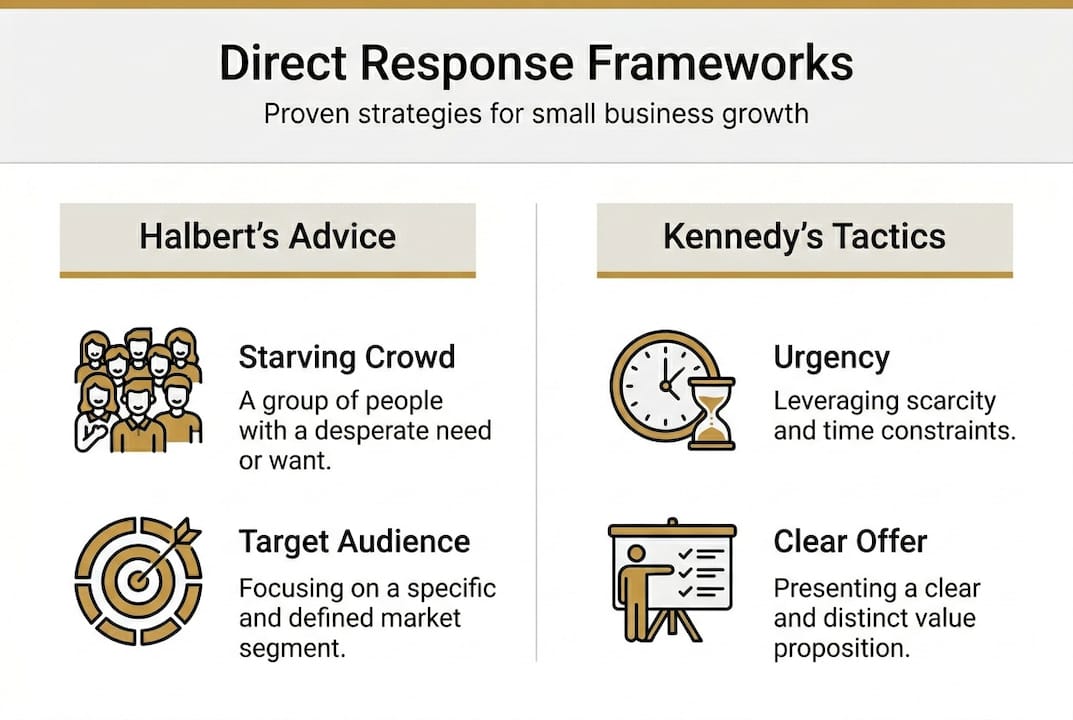
Halbert's starving crowd: Gary Halbert famously said that if he could have one advantage in business, he would want a starving crowd. Not the best product. Not the flashiest ad. Just a crowd of people desperately hungry for what he was selling. The lesson? Targeting beats everything. Find the people who already want what you offer, then make it ridiculously easy for them to get it.
Kennedy's A-pile principle: Dan Kennedy taught that your mail (or email) either lands in the A-pile (stuff people actually read) or the B-pile (trash). The secret to the A-pile? Write like a human being to one specific person. Not a corporate blast to "Dear Valued Customer." One person. One conversation. The Kennedy direct response tips that moved physical mail to digital inboxes are a masterclass in relevance and relationship.
Here is how these frameworks play out in real SMB campaigns:
- Email sequence for a fitness coach: Target people who downloaded a free workout guide (starving crowd). Send a three-email sequence: value, social proof, offer. CTA: book a free strategy call. Track open rates, click rates, and bookings.
- SMS campaign for a local restaurant: Send a personalized birthday offer to loyalty members. "Hey [Name], your birthday treat is waiting. Show this message for a free dessert this week." Track redemptions.
- Direct mail for a home services company: Send a postcard to homeowners in a specific zip code with a seasonal offer and a unique phone number to track calls.
| Campaign type | Channel | Key metric | Framework used |
|---|---|---|---|
| Lead generation | Click-to-open rate | Write to one person | |
| Loyalty offer | SMS | Redemption rate | Starving crowd |
| Local acquisition | Direct mail | Call tracking | A-pile principle |
Pro Tip: Start with one channel, nail the direct response workflow, and then expand. Trying to do everything at once is a recipe for mediocre results everywhere. Master one, then scale.
The expert nuances of targeting, copywriting, and relentless testing are what separate campaigns that break even from campaigns that 10x your investment. For a deeper look at improving marketing ROI, the data will always show you the way forward.
Measuring success: metrics that matter in direct response marketing
Understanding the core tactics is only half the battle. Knowing how to measure and optimize them is where SMBs win big. You can run the most creative campaign in history, but if you are not tracking results, you are flying blind.
Here are the metrics that actually matter:
- Response rate: The percentage of people who took your desired action (clicked, called, replied). Industry benchmarks vary by channel, but any improvement here directly impacts revenue.
- Conversion rate: Of the people who responded, how many became paying clients? This tells you whether your offer and follow-up process are doing their job.
- Return on ad spend (ROAS): For every dollar you put into a campaign, how many dollars come back? A ROAS of 3:1 means you are making three dollars for every one spent. Anything below 1:1 and you are losing money.
- Cost per acquisition (CPA): How much does it cost to acquire one new client? Lower is better, but only if the quality of the client is maintained.
- Lifetime value (LTV): The total revenue a client generates over their relationship with your business. A high LTV justifies a higher CPA.
| Metric | What it measures | Why it matters |
|---|---|---|
| Response rate | Initial engagement | Shows message relevance |
| Conversion rate | Offer effectiveness | Reveals funnel strength |
| ROAS | Revenue per dollar spent | Core profitability signal |
| CPA | Cost to acquire a client | Budget efficiency |
| LTV | Long-term client value | Justifies acquisition spend |
Tracking metrics like response rates, conversions, and ROAS is what makes DR marketing a low-risk, scalable growth engine. You test small, find what works, and pour fuel on the winner. That is how smart businesses grow without gambling their entire budget on a hunch.
Pro Tip: Set a benchmark before you launch. If you do not know what "good" looks like for your industry, you cannot tell if your campaign is crushing it or quietly bleeding money. Use marketing automation for small business tools to automate tracking and free up your time for strategy. And if you want to see how email marketing and funnels work together to amplify your results, that is where the real magic happens.
The uncomfortable truth most marketers won't tell you about direct response marketing
Here is what we see over and over again: small business owners spend months, sometimes years, chasing brand recognition before they have built a single reliable revenue stream. They want the logo. The aesthetic. The vibe. Meanwhile, the bills are piling up and the pipeline is empty.
Brand building without revenue is a luxury. Direct response marketing is the engine that funds everything else.
The smartest path forward is to start with DR, get clients, generate cash flow, and then layer in brand as you scale. Not the other way around. DR gives you immediate, trackable returns. It lets you test, learn, and adapt fast. And in 2026, with AI-powered personalization and smarter targeting tools, the results are sharper than ever.
The businesses winning right now are not the ones with the prettiest Instagram feeds. They are the ones who know their numbers, speak directly to targeting small business marketing audiences with precision, and optimize relentlessly. Start there.
Power up your business with expert direct response solutions
If this guide has lit a fire under you, good. That is exactly the point. Direct response marketing is not complicated, but it does require the right systems, the right messaging, and the right strategy to get results consistently.
At Brass Balls, we specialize in no-BS direct response marketing guidance built specifically for small business owners and entrepreneurs who are done wasting time and money on marketing that does not convert. From done-for-you funnels to self-serve courses and proven frameworks, we have the tools to help you attract premium clients and generate consistent revenue. Stop guessing. Start growing.
Frequently asked questions
How is direct response marketing different from brand marketing?
DR focuses on immediate action and measurable ROI, while brand marketing builds long-term awareness and reputation over time. If you need clients now, direct response is your tool.
What makes direct response marketing effective for small businesses?
DR marketing is ideal for SMBs because its strategies are measurable, scalable, and can quickly boost client acquisition and revenue with clear CTAs and targeted messaging.
Which channels should I use for direct response marketing?
Email, SMS, social ads, and direct mail are all high-performing options. Multi-channel usage increases impact significantly, especially when your messaging is consistent across platforms.
How do I measure success in direct response marketing?
Track response rates, conversion rates, and ROAS as your core indicators. Tracking these metrics tells you what is working so you can scale winners and cut losers fast.
Can personalization really improve my campaign results?
Absolutely. Personalization can increase response rates by up to 97%, making it one of the highest-leverage tactics available to any small business marketer.
Recommended
- Why target small businesses for marketing success
- Master the direct response workflow for small business growth
- Effective marketing strategies for small businesses 2026
- Top marketing strategies that drive rapid business growth
- Unlock Local Growth: Your Guide to Digital Marketing Solutions for Small Businesses | King Digital Marketing Agency