

TL;DR:
- Traditional branding is slow, costly, and unsuitable for small business cash flow needs.
- Direct response marketing delivers fast, measurable results with lower budgets and immediate impact.
- Small businesses should focus on direct response first, building brand awareness gradually later.
Most small business owners have been sold a lie. Pour money into branding, build awareness, and the clients will come. Sounds logical, right? Wrong. While Fortune 500 companies can afford to wait 18 months for brand campaigns to pay off, you probably can't. Your rent is due next month, your payroll doesn't pause for 'brand equity,' and your competitors aren't sitting still. Direct response marketing flips this script entirely. It's built for speed, measurability, and results you can actually see in your bank account. This article breaks down exactly why branding often fails small businesses and how direct response gives you the unfair advantage you've been looking for.
Table of Contents
- Why traditional branding falls short for small businesses
- How direct response marketing delivers immediate impact
- Branding vs direct response: Which should you prioritize?
- Action steps: Pivoting your marketing to direct response
- Why conventional wisdom on branding hurts small businesses
- Take the next step: Boost your results with direct response
- Frequently asked questions
Key Takeaways
| Point | Details |
|---|---|
| Direct response delivers fast results | Small businesses get clients and cash flow quickly with direct response marketing. |
| Branding is a long-term play | Branding helps over time, but isn’t the best short-term strategy for entrepreneurs with limited budgets. |
| Prioritize action for survival | Focusing on campaigns that drive immediate response gives small businesses a fighting chance in today’s market. |
| Shift your strategy confidently | The evidence and expert advice support putting direct response first, then building your brand later. |
Why traditional branding falls short for small businesses
Let's get one thing straight: branding isn't bad. It's just a game designed for players with deep pockets and long time horizons. Traditional branding is about building long-term reputation, emotional connection, and market presence. Think Nike's 'Just Do It' or Apple's minimalist cool factor. These campaigns don't ask you to buy anything right now. They plant a seed and water it for years.
That's a beautiful strategy if you have millions in reserve. For small businesses targeting small businesses with tight margins and real cash flow pressure, it's a slow-motion disaster.
Here's what traditional branding actually looks like in practice for most small business owners:
- You spend money on a logo, a color palette, and a 'brand story'
- You run awareness ads that get likes but not leads
- You wait for 'top of mind' to translate into sales
- Months pass. The phone doesn't ring like you hoped.
- You wonder if you're doing it wrong
You're not doing it wrong. The strategy itself is wrong for your situation.
"Brand campaigns often have slow ROI cycles and require large budgets to work. They're optimized for big players, not small challengers fighting for market share."
The famous Binet and Field research analyzed roughly 1,000 IPA award cases and concluded that the optimal split for large brands is 60% brand building to 40% direct activation. But here's the kicker: that data comes from award-winning campaigns, which skews toward big-budget work. And even their own findings confirm that short-term direct response decays fast without sustained brand support. For a small business owner, that's a double-edged sword. You need results now, but the model that delivers them requires ongoing investment to maintain.
The brutal reality is that brand-first thinking was built for companies that can absorb losses while waiting for love to turn into loyalty. Your business needs cash flow, not applause.
How direct response marketing delivers immediate impact
Direct response marketing (DR) is exactly what it sounds like: marketing designed to get an immediate, measurable response from your audience. No waiting around for brand love to blossom. You put an offer in front of the right person, and you ask them to take action right now.
The core principles of direct response marketing for small businesses are refreshingly simple:
- Make a specific, trackable offer (a free consultation, a limited-time discount, a lead magnet)
- Use a clear call-to-action that tells people exactly what to do next
- Target a defined audience who already has the problem you solve
- Measure everything so you know what's working within days, not months
- Iterate fast based on real data, not gut feelings or agency opinions
This is why DR is a growth accelerator for challenger brands and small businesses. You get feedback fast. You spend money on what works and cut what doesn't. Your proven small business strategies stop being guesswork and start being a system.
"For challenger and small brands, the 60/40 rule loses relevance entirely. Experts now suggest prioritizing direct response at ratios like 5% brand to 95% activation for immediate market share before scaling brand efforts."
That's not a typo. Five percent brand, ninety-five percent direct response. Because when you're fighting for survival and growth, you need every dollar working overtime.

Pro Tip: Start with one simple DR campaign targeting a specific problem your best clients have. Offer a clear solution with a clear next step. Run it for two weeks, measure the results, and tweak. Repeat. This test-and-learn loop is how small businesses punch way above their weight class.
Branding vs direct response: Which should you prioritize?
Let's put this side by side so the choice becomes obvious.
| Factor | Branding | Direct response |
|---|---|---|
| Time to results | Months to years | Days to weeks |
| Budget required | High (sustained spend) | Low to medium |
| ROI visibility | Difficult to measure | Highly trackable |
| Risk level | High for small businesses | Lower with testing |
| Best for | Scaling established brands | Growing and surviving |
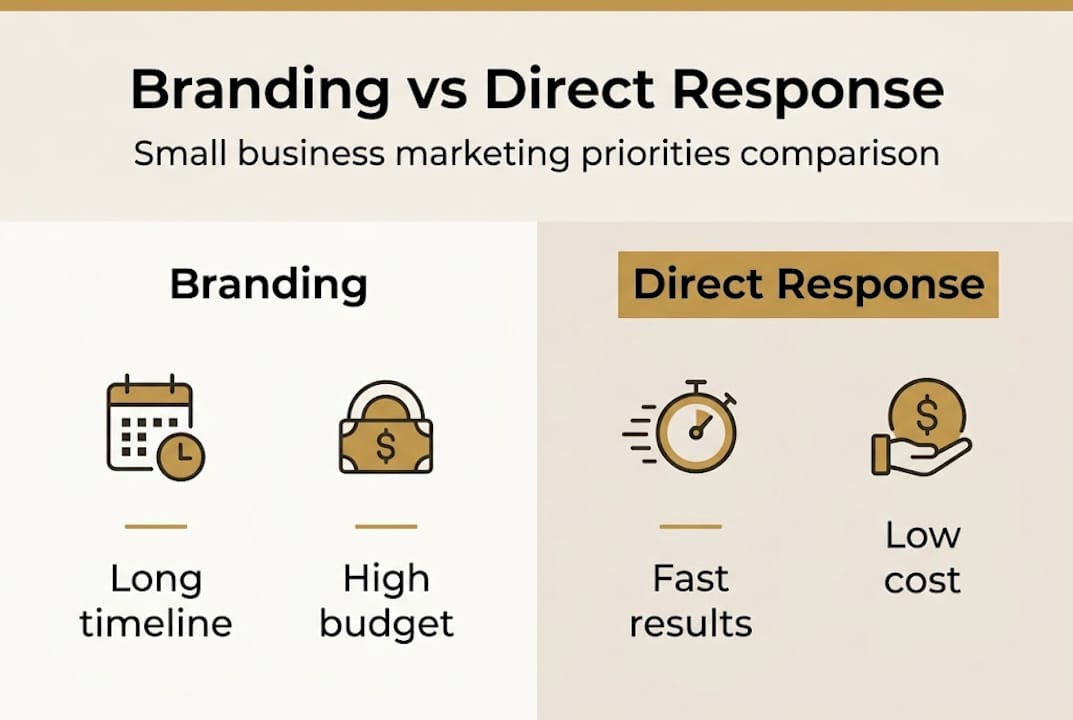
Branding absolutely helps you scale once you've got traction. But you need to survive before you can scale. That's not pessimism. That's math.
Professor Byron Sharp has publicly challenged the 60/40 data quality, pointing out that Binet and Field's conclusions may not apply universally, especially for smaller brands without the distribution and mental availability that big brands enjoy. His critique is blunt: the data is biased, and applying it blindly to small businesses is a mistake.
Here's when to prioritize which approach:
- Prioritize direct response when: You need clients this month, you're testing a new offer, you're entering a new market, or cash flow is tight
- Prioritize branding when: You have consistent revenue, you're defending market position, or you're building for a long-term exit
- Blend both when: You've got a stable DR engine running and want to layer in brand equity over time
The critical pitfall most small business owners fall into is overthinking the 'perfect mix.' While you're debating ratios, your competitor is running a direct response workflow that's stealing your potential clients. Pick a lane. Move fast. Adjust later.
Action steps: Pivoting your marketing to direct response
Enough theory. Here's how you actually make the shift from branding-heavy campaigns to a DR-first approach that generates real results.
- Audit your current spend. Look at every marketing dollar you're spending right now. Label each one as either 'brand' or 'direct response.' Most small business owners are shocked to find 70% or more going to brand activities with no measurable return.
- Define your one core offer. What's the single most valuable thing you can offer a new client right now? Make it specific, time-sensitive, and easy to say yes to.
- Build a simple funnel. Ad or post that hooks attention, a landing page that explains the offer, a clear call-to-action. That's it. Start simple with creating direct response ads before adding complexity.
- Set your tracking. Know your cost per lead, cost per client, and return on ad spend before you launch. If you can't measure it, don't run it.
- Launch, measure, and iterate. Run your campaign for 14 days. Review the numbers. Kill what's not working. Double down on what is.
Pro Tip: Your first DR campaign doesn't need to be perfect. It needs to be launched. A live imperfect campaign beats a perfect one that's still in your head.
Here's what the numbers can look like when you make the switch:
| Campaign type | Avg. time to first lead | Avg. cost per lead | Measurability |
|---|---|---|---|
| Brand awareness | 3 to 6 months | Hard to calculate | Low |
| Direct response | 3 to 14 days | Trackable in real time | High |
| Blended (DR-first) | 7 to 21 days | Medium | High |
For challenger and small brands, prioritizing direct response for immediate market share before scaling brand investment is the proven path. The no-nonsense marketing strategies that actually work for small businesses all share one thing: they start with DR and build from there.
Why conventional wisdom on branding hurts small businesses
Here's the uncomfortable truth most marketing textbooks won't tell you: the obsession with branding is a legacy big-brand game, and it's been sold to small business owners as universal wisdom. It's not.
We've watched entrepreneurs burn through their savings building 'brand presence' while their bank accounts hemorrhaged cash. The 'get famous, then get sales' strategy is a luxury, not a blueprint. When you flip the model and go DR-first, something surprising happens: your brand actually grows as a byproduct. Clients who find you through a direct response campaign and get real results become your loudest advocates. That's organic brand building, earned through action.
The direct response automation results we've seen across dozens of small businesses confirm it: DR-first doesn't just pay the bills faster, it builds credibility faster too. Reframe branding as a future priority. Right now, your job is survival and growth. Direct response is how you get there.
Take the next step: Boost your results with direct response
You now know why branding-first is a slow game that most small businesses can't afford to play. You've got the framework, the comparison, and the action steps. The only thing left is execution.
If you're ready to stop guessing and start generating real leads and clients, Brass Balls marketing solutions offers done-for-you direct response systems built specifically for small business owners and entrepreneurs. No fluff, no brand-speak, just proven funnels and frameworks that work. Whether you want a full agency solution or a self-serve course to unlock small business growth, there's a path that fits your budget and your goals. Take the next step today.
Frequently asked questions
What is the main difference between branding and direct response marketing?
Branding builds long-term reputation and emotional connection, while direct response is engineered for immediate client action and measurable sales. According to Binet and Field's research, large brands optimize for a 60/40 brand-to-activation split, but that model doesn't translate to small business realities.
Why does direct response work better for small businesses?
Direct response delivers leads and revenue quickly without requiring massive budgets or long waiting periods. For small and challenger brands, prioritizing direct response at ratios as high as 95% activation is the fastest path to market share and cash flow.
Should I do any branding at all as a small business?
Yes, eventually, but not before you have consistent cash flow. While over-reliance on short-term tactics can limit long-term growth, most small businesses need to survive first. Direct response now, branding later.
How quickly can I see results from direct response marketing?
Most well-structured direct response campaigns generate leads within 3 to 14 days of launch, with some seeing results within 48 hours depending on the offer and targeting.