

Small business owners face overwhelming choices when it comes to email marketing strategies. With countless tactics promising higher engagement and revenue, determining which practices actually deliver results becomes critical. This guide reveals proven email marketing best practices for 2026, backed by current data showing how smart segmentation, automated flows, and deliverability improvements can transform your campaigns. You'll discover the exact framework successful businesses use to maximize their email ROI and build sustainable revenue streams through strategic email communication.
Table of Contents
- Establishing Criteria For Effective Email Marketing In 2026
- Leveraging Email Flows And Automation For Sustained Revenue Growth
- Smart Segmentation And Personalization Techniques To Increase Engagement
- Ensuring Deliverability And Compliance To Maximize Email Impact
- Comparing Best Practices: Flows, Segmentation, And Deliverability Strategies
- Boost Your Email Marketing With Expert Support
- Frequently Asked Questions
Key takeaways
| Point | Details |
|---|---|
| Email marketing delivers exceptional ROI | Businesses earn an average of $36 for every $1 spent when strategies are executed properly. |
| Automated flows outperform traditional campaigns | Flows generate 41% of total email revenue from just 5.3% of sends with 18× higher revenue per recipient. |
| Segmentation boosts relevance and conversions | Targeting based on behavior and customer journey stage dramatically improves engagement rates. |
| Email authentication is essential for deliverability | SPF, DKIM, and DMARC protocols are now mandatory for reaching inboxes with major email providers. |
Establishing criteria for effective email marketing in 2026
Before diving into specific tactics, you need a framework for evaluating what makes email marketing successful. The foundation starts with clear success metrics: ROI, engagement rates, and conversion percentages. These numbers tell you whether your efforts are generating real business value or just activity.
Email marketing offers directness and control, allowing for personalization and granular data analysis that other channels can't match. This advantage becomes meaningful only when you focus on relevance through personalization and segmentation. Sending generic messages to your entire list wastes the channel's potential and trains subscribers to ignore you.
Automation stands as another critical criterion. Manual campaign management consumes time and limits your ability to scale. Automated workflows handle repetitive communication tasks while delivering personalized messages at optimal moments in the customer journey. This efficiency frees you to focus on strategy and content quality rather than execution mechanics.
Deliverability and authentication form the technical foundation. Your brilliant email content means nothing if it never reaches the inbox. In 2026, proper email authentication isn't optional. Major providers now require SPF, DKIM, and DMARC configuration to accept your messages.
Content quality aligned with customer journey stages completes the criteria. Each email should serve a specific purpose: educating prospects, nurturing consideration, driving purchase decisions, or building loyalty. Random promotional blasts interrupt rather than engage.
Pro Tip: Improving ROI isn't about sending more emails. It's about sending smarter emails. Focus on relevance and timing over frequency. A well-targeted message to 100 engaged subscribers outperforms a generic blast to 10,000 uninterested contacts.
Key criteria for email marketing success:
- Clear ROI and engagement metrics tracking
- Personalization and segmentation capabilities
- Automation infrastructure for scalable workflows
- Proper authentication and deliverability setup
- Quality content mapped to customer journey stages
- Strategic sending frequency based on engagement data
Leveraging email flows and automation for sustained revenue growth
Automated email workflows drive significantly more revenue than one-off campaigns while requiring fewer ongoing resources. This makes automation the highest-leverage best practice for small businesses with limited marketing teams.
Email flows are triggered sequences that respond to specific customer behaviors or timeline events. Welcome flows greet new subscribers and introduce your brand. Abandoned cart flows recover lost sales by reminding shoppers about items left behind. Re-engagement flows reconnect with inactive subscribers before they forget you exist. Post-purchase flows build loyalty and encourage repeat buying.
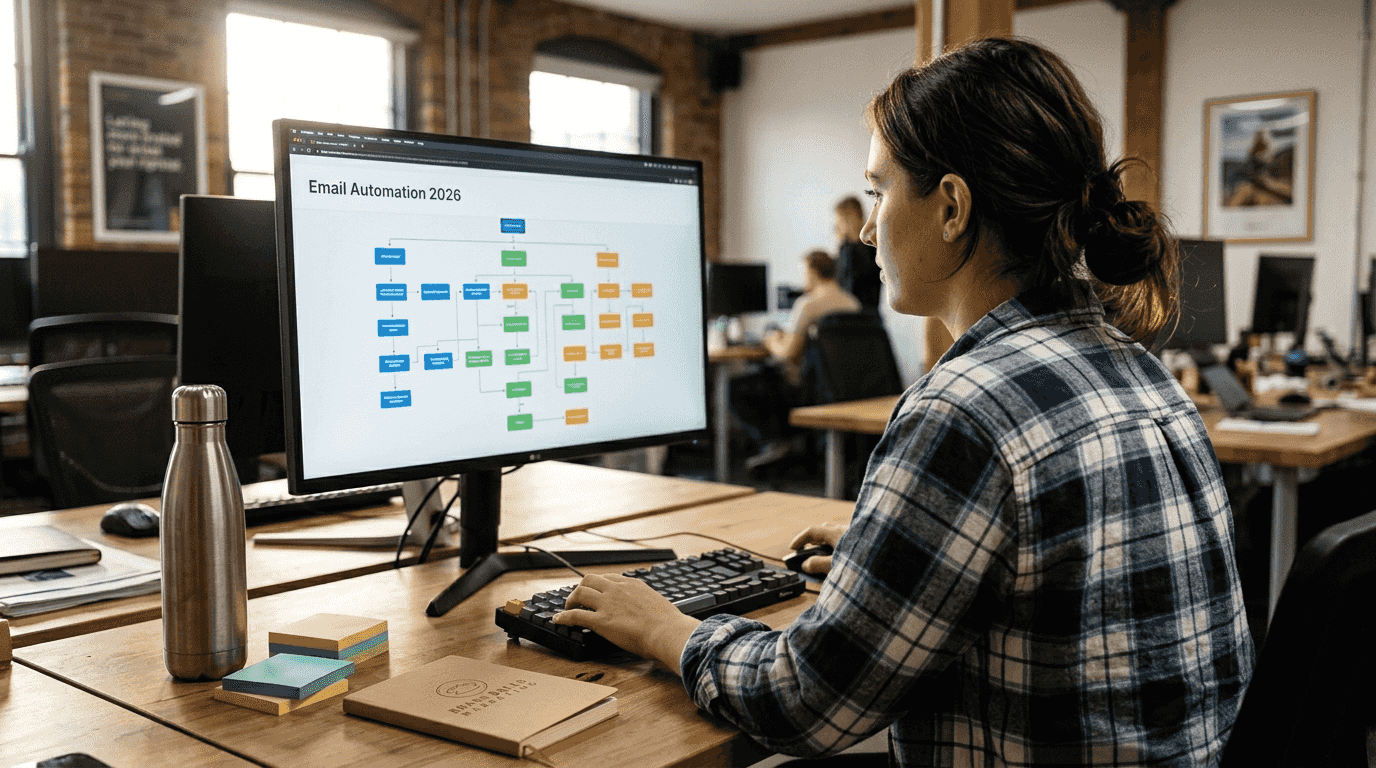
The performance difference between flows and campaigns is dramatic. Flows generate nearly 41% of total email revenue from just 5.3% of sends, with average revenue per recipient nearly 18× higher than campaigns. This efficiency stems from superior relevance and timing. Flows reach people when they're most receptive rather than when you happen to schedule a campaign.
Almost half of flow revenue comes from new customers, highlighting their acquisition power. Welcome sequences convert curious subscribers into buyers. Abandoned cart flows capture fence-sitters ready to purchase. These automated touchpoints work continuously without manual intervention.
Implementing flows requires upfront setup time but pays ongoing dividends. Start with your highest-value sequences: welcome for engagement, abandoned cart for conversion, and re-engagement for list health. Once built, these flows run automatically, generating revenue while you sleep.
Essential automated flows for small businesses:
- Welcome series introducing brand and core offerings
- Abandoned cart recovery with incentive progression
- Browse abandonment for product consideration
- Post-purchase thank you and cross-sell sequences
- Re-engagement campaigns for inactive subscribers
- Win-back flows offering special incentives to churned customers
The scalability advantage is crucial. A five-person marketing team can't manually send personalized messages to thousands of customers at optimal moments. Automation handles this complexity effortlessly, delivering the right message to the right person at the right time without human intervention.
Smart segmentation and personalization techniques to increase engagement
Simple segmentation based on behavior and customer journey stage dramatically improves engagement and conversion rates. Yet many small businesses still blast the same message to everyone, leaving money on the table.
Effective segmentation starts with meaningful criteria. Purchase history reveals customer value and product preferences. Engagement level shows who actively opens and clicks versus who ignores your emails. Demographics provide context for messaging tone and offers. Journey stage determines whether someone needs education, consideration support, or purchase incentives.
Personalize beyond just inserting first names. Dynamic content blocks change email sections based on segment characteristics. Show different product recommendations to high spenders versus bargain hunters. Highlight different benefits to new subscribers versus loyal customers. Adjust send times based on when each segment typically engages.
Sending the same email to everyone is a common mistake leading to decreased engagement. Your most engaged subscribers get annoyed by basic content meant for newcomers. Your newest subscribers feel overwhelmed by advanced offers. Segmentation solves this by tailoring communication to each group's needs and interests.
Behavioral triggers enable powerful segmentation. Someone who browses your pricing page three times shows different intent than someone who only reads blog posts. Someone who opens every email deserves different treatment than someone who hasn't engaged in months. Use these signals to send relevant content automatically.
| Segmentation Type | Criteria | Engagement Impact |
|---|---|---|
| Behavioral | Email opens, clicks, website visits | 40-60% higher open rates |
| Purchase history | Frequency, recency, value | 30-50% higher conversion |
| Lifecycle stage | New, active, at-risk, churned | 25-45% better retention |
| Product interest | Categories browsed, items viewed | 35-55% higher click rates |
Pro Tip: Test micro-segmentation for your highest-value customers. Create ultra-specific segments of 50-200 people based on detailed behavioral and demographic data. Craft highly personalized messages for these groups. The effort investment pays off through dramatically higher conversion rates and customer lifetime value.
Common segmentation strategies:
- VIP customers receiving exclusive early access and premium content
- New subscribers getting educational onboarding sequences
- Engaged readers receiving advanced tips and deeper content
- Inactive subscribers targeted with re-engagement incentives
- Product-specific segments based on purchase or browse history
- Geographic segments for location-relevant offers and events
Ensuring deliverability and compliance to maximize email impact
Even brilliant email content fails if it never reaches the inbox. Deliverability and compliance form the invisible foundation supporting all other best practices.
Email authentication protocols SPF, DKIM, and DMARC are now mandatory for deliverability with major providers. SPF validates that your sending server is authorized to send on behalf of your domain. DKIM adds a digital signature proving your message hasn't been tampered with in transit. DMARC tells receiving servers what to do with messages that fail authentication checks.
Configuring these protocols requires technical setup but protects your sender reputation. Without proper authentication, Gmail, Outlook, and other major providers increasingly route your emails to spam or reject them entirely. This isn't a future concern. It's happening now in 2026.
Compliance with CAN-SPAM and similar regulations protects you legally and maintains subscriber trust. Include a clear unsubscribe link in every email. Honor unsubscribe requests within 10 business days. Use accurate from names and subject lines. Include your physical mailing address. These requirements aren't just legal obligations but best practices for maintaining a healthy, engaged list.
List hygiene prevents deliverability problems before they start. Remove hard bounces immediately. Suppress unsubscribed contacts permanently. Consider removing subscribers who haven't engaged in 12+ months after re-engagement attempts. Sending to inactive addresses damages your sender reputation and wastes resources.
Avoiding spam triggers requires attention to both content and frequency. Excessive exclamation points, all caps subject lines, and misleading claims trigger spam filters. So does sending too frequently to unengaged subscribers. Monitor your spam complaint rate closely. Anything above 0.1% signals problems.
Deliverability best practices:
- Implement SPF, DKIM, and DMARC authentication protocols
- Maintain list hygiene by removing bounces and inactive subscribers
- Honor unsubscribe requests promptly and completely
- Monitor sender reputation scores regularly
- Avoid spam trigger words and excessive promotional language
- Use double opt-in to ensure subscriber intent and list quality
Monitor key deliverability metrics monthly: inbox placement rate, spam complaint rate, bounce rate, and sender reputation score. These indicators warn you of problems before they severely damage your email program. Most email service providers offer deliverability dashboards showing these metrics.
Comparing best practices: flows, segmentation, and deliverability strategies
Understanding how automation flows, segmentation, and deliverability compare helps you prioritize implementation based on your specific business needs and resource constraints.
Top-performing email programs separate themselves through efficiency, not just scale; flows deliver highest revenue per recipient. This efficiency advantage makes automation the top priority for most small businesses seeking maximum return on limited marketing resources.
| Best Practice | Primary Impact | Revenue Boost | Resource Needs | Implementation Time |
|---|---|---|---|---|
| Automated flows | Revenue per recipient | 18× higher than campaigns | Medium setup, low ongoing | 2-4 weeks initial |
| Segmentation | Engagement and conversion | 30-60% improvement | Low setup, medium ongoing | 1-2 weeks |
| Deliverability setup | Inbox placement | Foundation for all results | Low one-time | 1-3 days |
Each best practice serves different strategic needs. Prioritize automation flows when you need scalable revenue growth without adding staff. Focus on segmentation when you have diverse customer types requiring different messaging. Address deliverability first if you're experiencing inbox placement issues or haven't configured authentication.
Ideal scenarios for prioritizing each practice:
- Choose flows first if you're manually sending repetitive emails or missing revenue opportunities from cart abandonment
- Prioritize segmentation if your audience spans multiple customer types with different needs and preferences
- Focus on deliverability if your open rates are declining or you're seeing high spam complaint rates
- Implement all three together if you're building an email program from scratch
The reality is these practices work synergistically. Automated flows become more effective when combined with segmentation. Segmentation means nothing if deliverability problems prevent inbox placement. The most successful email programs integrate all three approaches.
Pro Tip: Start with flows and segmentation before technical optimizations if resources are limited. Build your core automation sequences and segment structure first. Then layer in deliverability improvements. This approach generates revenue faster while you perfect the technical foundation.
Boost your email marketing with expert support
Implementing these best practices transforms email marketing from a cost center into a revenue engine. The challenge lies in execution. Setting up sophisticated automation flows, developing effective segmentation strategies, and configuring technical deliverability protocols requires expertise and time.
Professional email marketing support accelerates your results while avoiding costly mistakes. Expert guidance helps you build automation sequences that convert, create segmentation strategies that resonate with your specific audience, and implement deliverability best practices correctly the first time. The ROI improvement and time savings typically pay for professional services within the first few months. Explore professional email marketing services tailored to small business needs and discover how strategic implementation can multiply your email revenue while freeing your time for other business priorities.
Frequently asked questions
What is the average ROI of email marketing in 2026?
Businesses earn an average of $36 for every $1 spent on email marketing when strategies are executed effectively. This exceptional return makes email one of the highest-performing digital marketing channels available. Your actual ROI depends heavily on strategy quality, list health, segmentation sophistication, and execution consistency. Well-implemented automation flows and segmentation typically achieve even higher returns than the average.
How do automated email flows improve small business marketing?
Flows automate personalized communication at scale, increasing both engagement and revenue without requiring proportional staff increases. They target customers with timely, relevant messages triggered by specific behaviors rather than generic blasts sent on arbitrary schedules. Flows generate nearly 41% of email revenue from only 5.3% of sends and have 18× higher revenue per recipient than campaigns. This efficiency makes automation essential for small businesses seeking maximum marketing leverage.
What are the key email authentication protocols to use?
SPF, DKIM, and DMARC are mandatory for deliverability with major email providers in 2026. SPF validates that your sending servers are authorized to send on behalf of your domain. DKIM adds digital signatures securing message content and proving authenticity. DMARC enforces policies telling receiving servers how to handle messages that fail authentication checks. Implementing all three protocols dramatically improves inbox placement rates and protects your sender reputation from spoofing and phishing attacks.
How often should small businesses send marketing emails?
Sending frequency should match subscriber engagement levels and content value rather than following arbitrary schedules. Highly engaged subscribers tolerate more frequent communication if each message delivers genuine value. Less engaged subscribers need reduced frequency to prevent unsubscribes. Most successful small businesses send 2-4 campaigns monthly plus automated flow messages triggered by behavior. Monitor engagement metrics closely and reduce frequency for segments showing declining open rates. Quality and relevance matter far more than volume.