

TL;DR:
- Entrepreneurs often struggle with chaotic marketing rather than a lack of tactics.
- A structured marketing blueprint ensures consistent leads, measurement, scalability, and confidence.
- Building clear audience, specific offers, and a proven funnel system leads to sustainable growth.
Most entrepreneurs don't have a marketing problem. They have a chaos problem. They're throwing tactics at the wall like spaghetti, posting on social media one week, running a random Google ad the next, maybe sending an email blast when they remember, and wondering why nothing sticks. If that sounds familiar, you're not alone, and you're not broken. You just need a repeatable system that predictably pulls in leads, nurtures them, and converts them into paying clients. That's exactly what this blueprint delivers.
Table of Contents
- Why entrepreneurs need a marketing blueprint
- Preparing your foundation: Tools and requirements
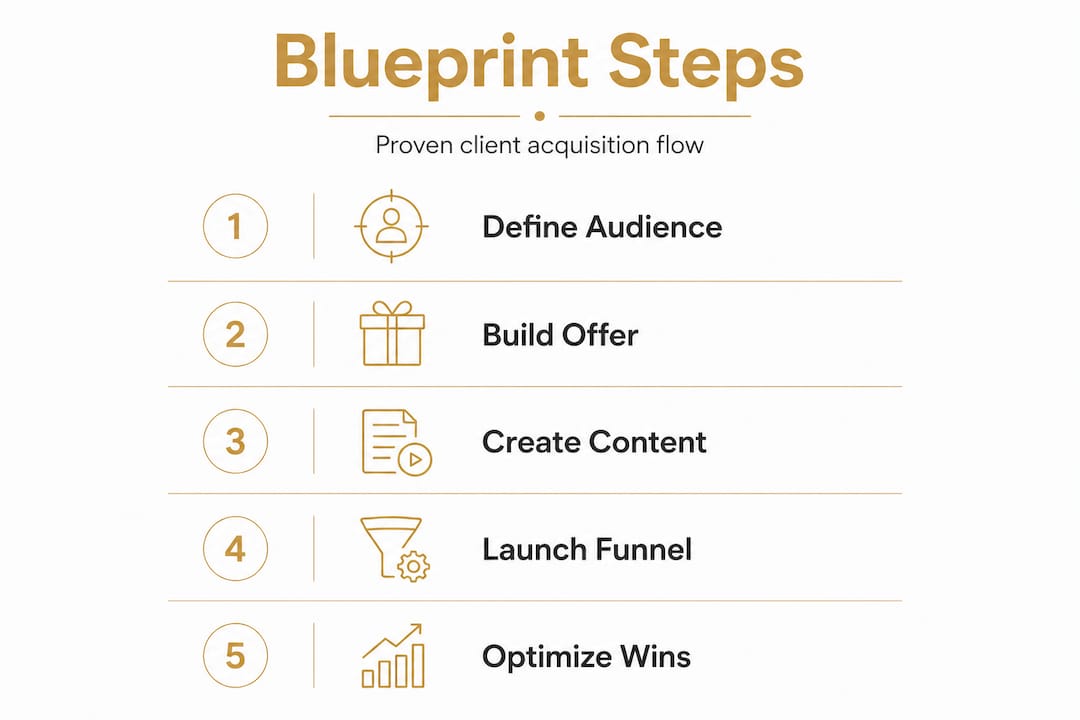
- Step-by-step entrepreneur marketing blueprint
- Avoiding common mistakes and optimizing your blueprint
- The blueprint mindset: Why strategy beats tactics
- Build your winning marketing blueprint today
- Frequently asked questions
Key Takeaways
| Point | Details |
|---|---|
| Blueprints drive growth | A clear marketing system helps entrepreneurs get more clients and revenue predictably. |
| Test and adapt fast | Start with simple tools, launch quickly, and refine based on real performance data. |
| MIFGE boosts conversions | Offering an irresistible free gift in your funnel can dramatically improve signups and sales. |
| Avoid common pitfalls | Follow-up, clarity, and consistent review separate top-performing funnels from the crowd. |
Why entrepreneurs need a marketing blueprint
Let's be honest. Random marketing is the enemy of growth. You can be the most talented person in your industry, but if your marketing looks like a Jackson Pollock painting (chaotic, confusing, and hard to explain), you're leaving money on the table every single day.
A marketing blueprint changes that. It gives you a structured, repeatable process that produces consistent results instead of occasional lucky wins. Think of it like a GPS versus wandering around hoping you'll find your destination. One gets you there predictably. The other burns fuel and frays nerves.
The real power of funnel marketing for revenue is that it turns your marketing into a machine with predictable inputs and outputs. You know what goes in, and you can measure what comes out. That's the difference between a business and a guessing game.
Here's what a structured blueprint actually delivers:
- Consistency: Your message stays on point across every channel and every touchpoint.
- Measurability: You track what works and cut what doesn't, instead of flying blind.
- Scalability: Once the system works, you can pour more fuel on the fire without rebuilding from scratch.
- Confidence: You stop second-guessing every marketing decision because the process guides you.
The benefits of marketing funnels for small businesses go beyond just generating leads. They build relationships, establish authority, and create a buyer journey that feels natural rather than pushy.
One proven framework worth knowing is the Content Launch Funnel. This approach repurposes content into a 4-video series covering Hook-Story, Content, Case Studies, and Offer, paired with a MIFGE (Most Incredible Free Gift Ever) to drive conversions. It's a structured sequence that warms up cold audiences and moves them toward a buying decision without feeling like a used car lot.
| Marketing approach | Results | Scalability | Cost efficiency |
|---|---|---|---|
| Random tactics | Unpredictable | Low | Poor |
| Structured blueprint | Consistent | High | Strong |
| Paid ads only | Fast but fragile | Medium | Expensive |
| Blueprint plus paid traffic | Best of both worlds | Very high | Excellent |
The data speaks clearly. Businesses with documented marketing strategies are significantly more likely to hit their growth targets than those winging it. A system beats hustle every single time.
Preparing your foundation: Tools and requirements
Before you build anything, you need the right foundation. Trying to build a high-converting funnel without the basics in place is like constructing a house on sand. It might look good for a minute, but it won't hold.
Here's what you need before you write a single word of copy or record a single video:
- A clearly defined audience: Not "everyone who might like my product." A specific person with specific problems, desires, and language patterns you can mirror back to them.
- An irresistible offer: Something your audience actually wants, not just something you're proud of creating. There's a big difference.
- A distribution platform: Where will your funnel live? A landing page builder, a website, or a dedicated funnel platform.
- Email or messaging tools: You need a way to follow up. Leads rarely buy on the first touch. Automation is your best friend here.
- Tracking and analytics: If you can't measure it, you can't improve it. Even basic conversion tracking changes everything.
Understanding top marketing strategies before you build saves you from expensive detours. The marketing funnel examples that actually work all share one thing in common: they were built on a clear audience and a compelling offer, not on fancy design or expensive software.

Here's a practical comparison of DIY versus professional tools to help you decide where to invest:
| Tool category | DIY option | Professional option | Best for |
|---|---|---|---|
| Landing pages | Carrd, Mailchimp | ClickFunnels, Leadpages | DIY to start, upgrade when scaling |
| Video hosting | YouTube (unlisted) | Wistia, Vimeo Pro | YouTube works fine early on |
| Email automation | Mailchimp free | ActiveCampaign, Klaviyo | Upgrade when list hits 1,000+ |
| Analytics | Google Analytics | Hotjar, Funnelytics | GA4 is free and powerful |
| CRM | HubSpot free | Salesforce, Pipedrive | HubSpot free is surprisingly capable |
The 4-video content series framework works beautifully with basic tools. You don't need a Hollywood production setup. A decent phone camera, natural lighting, and a clear script will outperform overproduced corporate videos every time, because authenticity converts.
Pro Tip: Start with the simplest tool that gets the job done. Complexity is the enemy of execution. A basic funnel that's live beats a perfect funnel that's still being "optimized" in your head.
With your tools and mindset in place, you're ready to follow the step-by-step marketing blueprint.
Step-by-step entrepreneur marketing blueprint
This is where the rubber meets the road. Follow these steps in order. Don't skip ahead. Each phase builds on the last, and cutting corners here is how you end up with a funnel that looks great but converts like a screen door on a submarine.
-
Define your audience and their burning problem. Write a one-paragraph description of your ideal client. What keeps them up at night? What have they already tried that didn't work? What do they desperately want? This document becomes the foundation of every piece of copy you write.
-
Craft your core offer. Your offer needs to be so specific and so valuable that your ideal client feels stupid saying no. Vague offers get ignored. Specific, outcome-driven offers get bought. "I'll help you get more clients" is vague. "I'll help you land 3 new premium clients in 60 days using a proven follow-up system" is an offer.
-
Build your MIFGE. The Most Incredible Free Gift Ever is the lead magnet that gets people into your funnel. It should deliver a quick win, be directly related to your paid offer, and make prospects think "if the free stuff is this good, the paid stuff must be incredible." A cheat sheet, a mini-course, a swipe file, or a free audit all work well depending on your industry.
-
Create your 4-video content sequence. This is the engine of your funnel. The 4-video series structure breaks down as follows:
- Video 1 (Hook-Story): Grab attention and share a relatable story that positions you as someone who's been where your prospect is now.
- Video 2 (Content): Deliver genuine value. Teach something useful. Build trust and authority.
- Video 3 (Case Studies): Show proof. Real results from real people. Nothing sells like social proof.
- Video 4 (Offer): Make your pitch. By now, your prospect knows, likes, and trusts you. The sale becomes a natural next step.
-
Set up your follow-up sequence. Most people won't buy after watching one video. Build an email sequence of at least 5 to 7 emails that continues the conversation, handles objections, and reinforces the value of your offer. Automation does the heavy lifting so you can focus on delivery.
-
Drive targeted traffic. Organic content, paid ads, partnerships, or referrals. Pick one or two channels and go deep before spreading thin. The goal is to drive client acquisition through a consistent, repeatable traffic source.
"The difference between a business that struggles and one that scales is rarely the product. It's almost always the marketing system behind it."
Looking at proven marketing strategies that work across industries, the pattern is always the same: a clear audience, a compelling offer, a structured funnel, and consistent traffic. That's it. No magic. No secret sauce. Just a system executed with discipline.
| Funnel phase | Goal | Key metric |
|---|---|---|
| Awareness | Get eyeballs on your MIFGE | Traffic and opt-in rate |
| Nurture | Build trust through video content | Video completion rate |
| Conversion | Turn warm leads into buyers | Sales conversion rate |
| Retention | Keep clients and generate referrals | Churn rate and LTV |
Pro Tip: Record your videos in batches. Sit down for one focused afternoon and film all four videos back to back. You'll be in the zone, your energy will be consistent, and you'll stop using "I haven't filmed yet" as an excuse to delay launching.
Even with a strong blueprint, pitfalls can derail results. Here's how to avoid them.
Avoiding common mistakes and optimizing your blueprint
You've built the blueprint. Now let's talk about the landmines most entrepreneurs step on, often repeatedly, before they figure out what went wrong.
The biggest mistakes and how to fix them:
-
No follow-up sequence: This is the number one revenue killer. Most leads need 5 to 12 touchpoints before they buy. If you're not following up, you're handing money to whoever is. Fix it by automating a minimum 7-email sequence the moment someone opts in.
-
Unclear or weak offers: If someone reads your offer and isn't sure what they're getting, what it costs, or what happens next, they'll bounce. Fix it by making your offer crystal clear: what they get, what it costs, what the outcome is, and what the next step is.
-
Skipping the testing phase: Launching a funnel and never checking the numbers is like driving with your eyes closed. Fix it by monitoring your opt-in rate, video completion rates, and conversion rate weekly for the first 30 days.
-
Chasing shiny objects: A new social platform launches, and suddenly everyone abandons their working funnel to chase the next big thing. Don't do this. Fix it by committing to your current system for at least 90 days before evaluating changes.
-
Ignoring segmentation for funnel conversions: Sending the same message to every lead regardless of where they are in the buyer journey is lazy and ineffective. Segment your list based on behavior and tailor your follow-up accordingly.
The marketing tips for growth that actually move the needle all point to one principle: optimize what's working before adding complexity. A funnel that converts at 3% can often be improved to 5% or 6% with minor tweaks to the headline, the offer, or the follow-up sequence. That's doubling your revenue without spending a single extra dollar on traffic.
The Content Launch Funnel approach also emphasizes iteration. Your first funnel won't be perfect. Your second will be better. Your fifth will be a machine. The entrepreneurs who win are the ones who keep refining rather than abandoning ship every time results dip.
Pro Tip: Track your small wins. If your opt-in rate improves from 18% to 22%, celebrate that. Small improvements compound over time into massive results. Don't wait for a home run to feel like you're making progress.
Now that the mechanics are clear, let's step back and consider what separates successful marketers from the rest.
The blueprint mindset: Why strategy beats tactics
Here's an uncomfortable truth most marketing gurus won't tell you: tactics are almost worthless without a strategy to plug them into. You can learn every copywriting trick in the book, master Facebook ads, and know the perfect time to post on Instagram, but if you don't have a coherent system connecting all of it, you're just spinning wheels.
The entrepreneurs who consistently outperform their peers aren't necessarily smarter or more talented. They're more disciplined about reviewing and refining their systems. They treat their marketing blueprint like a living document, not a one-time project.
What separates the grinders from the growers is systems thinking. Instead of asking "what tactic should I try next," they ask "where is my system leaking, and how do I fix it?" That shift in perspective is worth more than any single marketing hack you'll ever learn.
The effective strategies for small business that produce compounding results all share one trait: they're built on a foundation of disciplined iteration. You build, you measure, you improve, you repeat. Over months and years, that process creates a marketing machine your competitors can't easily replicate because it's been tuned specifically to your audience and your offer.
Stop chasing the latest hack. Start building the system that makes hacks irrelevant.
Build your winning marketing blueprint today
You now have the framework. The question is whether you'll implement it or let it collect digital dust like every other free guide you've downloaded. If you're serious about turning your marketing into a predictable client acquisition machine, the fastest path forward is working with people who've already built and tested these systems across dozens of industries.
At Brass Balls, we specialize in done-for-you marketing systems, proven funnel builds, and direct response strategies that actually move the needle for small business owners and entrepreneurs. Whether you want a guided strategy session, a fully built funnel, or the training to do it yourself, we've got the blueprint and the battle scars to back it up. Stop guessing. Start converting. Your next premium client is waiting on the other side of a system that works.
Frequently asked questions
What is the first step in building an entrepreneur marketing blueprint?
Define your target audience and outline their biggest needs before creating any marketing assets. Without this clarity, even the best 4-video funnel structure will miss the mark because your message won't resonate with the right people.
How can I quickly test if my marketing funnel works?
Send targeted traffic to your funnel's entry point and monitor conversions at each stage, paying close attention to opt-in rates and video completion rates. The Content Launch Funnel framework gives you clear checkpoints at each video to identify where prospects are dropping off.
What is a MIFGE and why does it matter?
A MIFGE is the Most Incredible Free Gift Ever, designed to increase your funnel's conversions by creating irresistible value that makes opting in a no-brainer. It's the hook that gets cold prospects into your world so your 4-video sequence can do its job.
How long does it take to see results using this blueprint?
Most entrepreneurs see measurable improvements within 30 to 60 days if they follow and optimize the steps closely. Consistency and daily attention to the numbers during the first 60 days make the biggest difference in how fast results appear.
Do I need expensive tools to start?
No, many basic digital marketing tools are free or low-cost, and you can upgrade as your results grow. Starting simple and executing well beats waiting for the perfect tech stack every single time.
Recommended
- How sales funnels drive client acquisition: 2026 guide
- No-BS marketing strategies to boost client acquisition
- Increase business revenue: proven steps for premium clients
- Why proven marketing strategies drive reliable growth
- How to Get Social Media Management Clients - Fylde Digital - Web Design SEO Social Media