

TL;DR:
- Funnel frameworks are dynamic systems that guide prospects through stages from awareness to purchase, not static diagrams. Small businesses should focus on creating simple, measurable funnels, optimize stages based on data, and own each transition to maximize conversions. Choosing the right funnel model depends on buyer complexity and sales cycle length, with continuous analysis essential for sustained growth.
Most small business owners hear "funnel framework" and picture a boring PowerPoint slide someone drew in a marketing meeting circa 2009. That's not what we're talking about here. Explaining funnel frameworks properly means showing you that these are living, breathing systems that organize every touchpoint between a stranger and a paying client. Get this right, and your marketing stops feeling like throwing darts blindfolded. Get it wrong, and you'll keep spending money on ads that go nowhere, wondering why your leads ghost you harder than a bad Tinder date.
Table of Contents
- Understanding funnel frameworks: the basics and common models
- Key funnel stages and what happens at each
- Measuring and optimizing funnel performance through analysis
- Comparing popular funnel frameworks and choosing the right one
- Applying funnel frameworks to your business: practical steps and tips
- Why conventional funnel wisdom can hold small businesses back
- Enhance your marketing strategy with expert funnel support
- Frequently asked questions
Understanding funnel frameworks: the basics and common models
A funnel framework is simply a map of how people move from "never heard of you" to "take my money." It narrows a wide pool of potential buyers down to actual paying customers, stage by stage. Think of it like a coffee filter. You pour in a lot of water, and only the good stuff makes it through.
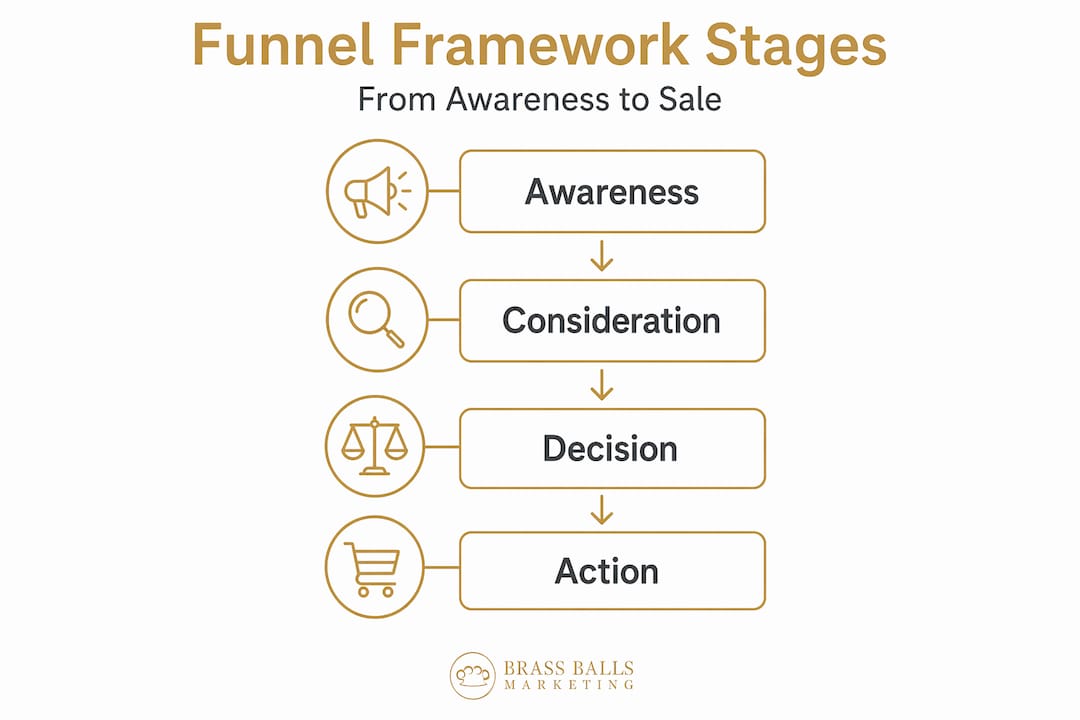
Marketers break the funnel into three core stages that align neatly with how buyers actually think:
- TOFU (Top of Funnel): This is your awareness play. People here don't know you exist yet, or they've just discovered a problem they need to solve. Your job is to show up, be helpful, and earn their attention.
- MOFU (Middle of Funnel): Now they're curious. They're comparing options, asking questions, and looking for reasons to trust someone. Your job here is to become that someone.
- BOFU (Bottom of Funnel): Decision time. They're weighing you against other options, checking your pricing, and looking for that final nudge to commit.
Underneath all of this sits the AIDA model, which has been around since the 1890s and refuses to die because it works. Classic funnels align with AIDA: Awareness, Interest, Desire, Action. It maps the emotional journey a buyer takes, and the TOFU/MOFU/BOFU structure gives you a practical container for each emotional phase.
For a more detailed look at how these stages connect, the mechanics of sales funnel stages are worth exploring before you start building anything.
Key funnel stages and what happens at each
Knowing the names of the stages is one thing. Knowing what to actually do at each one is where most small business owners drop the ball. Let's fix that.
At TOFU, your content should educate and establish authority. Blog posts, short videos, social content, and lead magnets all live here. The goal is not to sell. Pushing a sales pitch at this stage is like proposing on a first date. TOFU establishes authority, MOFU builds deep trust with solution content, and BOFU handles the close. Each stage has its own lane, and crossing them too early kills deals.

At MOFU, realistic benchmarks suggest using a 5 to 7 email nurture sequence, case studies, and comparison content to warm leads before any sales conversation. A good MOFU sequence reads like a conversation, not a catalog. It surfaces objections, tells stories, and demonstrates results without feeling pushy.
At BOFU, you bring out the heavy artillery: demos, free trials, testimonials, FAQ pages, and pricing transparency. Reduce friction everywhere. Every unanswered question at BOFU is a conversion killer.
Here's what separates the winners from the rest:
- Match your content to the buyer's mindset at each stage, not just the stage label
- Use content types matched to each funnel stage to avoid wasting effort on the wrong assets
- Email nurture sequences built for MOFU are one of the highest-ROI activities you can invest in
- Different funnel stages require different psychological approaches, so don't copy-paste messaging across stages
There are also excellent content marketing examples that show how to match content formats to funnel position, which is genuinely useful if you're stuck on what to create.
Pro Tip: If your overall funnel conversion rate is sitting around 3%, you're in normal territory. But your TOFU landing page for a lead magnet should be converting at 20 to 40%. If it's not, fix that page before you touch anything else.
Measuring and optimizing funnel performance through analysis
Here's where funnel frameworks get really interesting, and where most small business owners check out too early. Funnel analysis (tracking how users move through each stage and where they bail) is your biggest lever for improving results without increasing your ad spend.
Funnel analysis tracks user journeys step by step, identifies drop-off points, segments audiences by behavior, and runs experiments to fix bottlenecks. Do this once a month minimum. It's not glamorous, but it's the difference between a funnel that prints money and one that leaks like a broken faucet.
Here's a simple process to follow:
- Map every step of your funnel from first contact to purchase
- Set measurable goals for each step (click rate, email open rate, conversion rate)
- Track percentage of users completing each step versus those who entered it
- Identify the stage with the biggest drop-off rate
- Run one focused experiment to fix that specific step
- Measure the change, lock in the win, then move to the next drop-off
A fully effective funnel approach includes stage entry and exit criteria, handoff instrumentation (meaning you timestamp when a lead moves from one stage to the next), and recurring stall reviews. If a deal or lead sits in one stage for more than 14 days without movement, that's a red flag worth investigating.
| Funnel stage | Common drop-off rate | Optimization tactic |
|---|---|---|
| TOFU landing page | 60 to 80% of visitors leave | Improve headline clarity and load speed |
| MOFU email sequence | 40 to 60% disengage after email 2 | Add storytelling and a strong subject line |
| BOFU offer page | 70 to 90% abandon before purchase | Add testimonials, reduce form friction |
| Checkout or sign-up | 50 to 75% abandon | Offer a guarantee and simplify the process |
Pro Tip: Use funnel optimization techniques to dig into which specific elements are causing drop-offs, and combine this with audience segmentation to find out which types of people are dropping off. Same fix, much sharper results.
Comparing popular funnel frameworks and choosing the right one
Not all funnel frameworks are built the same. Choosing the wrong one is like wearing ski boots to a salsa class. Technically footwear, but wildly inappropriate.
Salesforce uses a TOFU/MOFU/BOFU handoff model designed for long B2B sales cycles with multiple stakeholders. Marketing does the heavy lifting at TOFU and MOFU, then hands off qualified leads to sales at BOFU. It works beautifully for complex products with longer buying cycles, where trust takes time to build.
ClickFunnels promotes a simpler three-stage model built around AIDA and champions the idea of "funnel hacking," which means studying what your market's most successful funnels look like and adapting those techniques. It's faster to deploy and works well for direct-to-consumer offers or service businesses with shorter decision cycles.
| Framework | Best for | Sales cycle | Key strength |
|---|---|---|---|
| Salesforce TOFU/MOFU/BOFU | B2B, complex sales | Long (3 to 12+ months) | Clear marketing to sales handoff |
| AIDA-driven funnel | B2C, service businesses | Short to medium (days to weeks) | Simple and fast to implement |
| Multi-channel funnel | E-commerce, coaching | Varies | Covers multiple touchpoints |
Choosing the right model comes down to three questions:
- How complex is the buying decision for your customer?
- How much sales involvement does your offer require?
- How many touchpoints does your average buyer need before they commit?
Multi-channel funnels integrate content and touchpoints across platforms and can meaningfully increase sales for businesses that have an audience across more than one channel.
Browse funnel framework examples for real-world applications, and if you're still on the fence, this breakdown on choosing the right funnel model will make the decision much clearer.
Applying funnel frameworks to your business: practical steps and tips
Enough theory. Let's talk about what you actually do on Monday morning.
Small businesses should start simple with a lead capture asset, a nurture sequence, and a clear offer as a complete funnel, then optimize over months using real data. You don't need a 47-step funnel. You need something that works and that you can actually measure.
Here's how to build your minimum viable funnel in 48 hours:
- Create a lead magnet that solves one specific problem for your target audience (a checklist, a short guide, a free template)
- Build a simple landing page with a clear headline, three bullet points of benefit, and a single call to action
- Write a 5-email nurture sequence that educates, addresses objections, and leads naturally to your offer
- Set up basic tracking so you know how many people are landing, opting in, opening emails, and clicking your offer
Launching a minimum viable funnel quickly and iterating based on real data leads to faster learning and better results than spending three months planning the perfect funnel that never goes live. Ship it ugly. Fix it fast.
Once it's live, use your conversion benchmarks to identify which stage needs attention first. Always fix the biggest drop-off before touching anything else. That's where your money is leaking.
Running experiments and continuous segmentation is critical because bottlenecks shift over time. What worked six months ago might be the thing killing your conversions today.
Pro Tip: Build your first sales funnel around one offer, one audience, and one traffic source. Then expand. Trying to do everything at once is how funnels die before they ever get a fair shot. Pair it with a solid content strategy to keep each stage fed with the right material.
Why conventional funnel wisdom can hold small businesses back
Here's something nobody tells you when they hand you a funnel diagram: the diagram is almost useless on its own. It's a picture of a concept, not a system you can run. Most small businesses color in the three boxes, nod thoughtfully, and then go right back to posting on Instagram hoping something sticks.
The real problem is that funnels get treated as static labels instead of operational machinery. Funnels need continuous segmentation and experimentation because bottlenecks change. The thing that was strangling your MOFU in January might be fully fixed by March, while a new drop-off quietly appears at BOFU without you noticing. If you're not measuring regularly, you're flying blind.
The other brutal truth? Most funnel failures aren't content problems or traffic problems. They're handoff problems. Nobody owns the transition between stages. A lead warms up nicely through your email sequence, gets to BOFU, and then falls into a black hole because nobody followed up. Defining stage entry and exit criteria, handoff timestamps, and monthly stall reviews turns a funnel from a pretty diagram into a working system that actually closes business.
Here's what we recommend: assign ownership to each funnel stage, timestamp every handoff event in your CRM or tracking system, and schedule a 30-minute monthly review of any lead or deal that has been stalled for 14 or more days. That one habit alone will recover more revenue than most marketing campaigns. For more on turning this into a practice, funnel optimization insights cover exactly how to build that habit into your operations.
Enhance your marketing strategy with expert funnel support
You now know how funnel frameworks work, where they break, and how to build one from scratch. The knowledge is solid. But knowing and doing are two very different animals, and the gap between them is where most small businesses stall out.
If you'd rather skip the trial and error and get a funnel that works from the start, the team at Brassballs specializes in exactly this. From done-for-you funnel builds to funnel audits that reveal exactly where your leads are leaking, to direct response marketing strategies built for small businesses that want real results. Not theory. Not pretty slides. Revenue. If you're serious about building a marketing system that generates clients consistently, this is where you start.
Frequently asked questions
What are the main stages of a marketing funnel?
The main stages are Top of Funnel (TOFU) for awareness, Middle of Funnel (MOFU) for consideration, and Bottom of Funnel (BOFU) for decision and purchase. The funnel maps to awareness, consideration, and decision phases in that order.
How long does a typical B2B buyer stay in the funnel?
B2B buyer journeys typically last three to nine months, sometimes over a year for complex sales involving multiple stakeholders and larger budgets.
What content works best at the middle of the funnel?
MOFU content includes email nurture sequences, case studies, and comparison guides to build credibility and help prospects evaluate their options with confidence.
Why is it important to analyze funnel performance continuously?
Because buyer behavior shifts constantly, funnels require continuous segmentation and experimentation since bottlenecks move around over time, making ongoing analysis essential for sustained results.
What is funnel hacking and how can it help small businesses?
Funnel hacking means researching competitors' funnels to reverse-engineer what works in your market, saving you time and giving you a proven starting point for your own funnel structure.