

TL;DR:
- A high-converting marketing system integrates content, funnels, proof, and retention into a connected cycle.
- Direct response marketing prompts immediate, trackable actions, leading to faster and measurable results.
- Most small businesses fail because they focus on tactics without building an intentional, structured system.
Most small businesses treat marketing like a buffet. A little social media here, a paid ad there, maybe an email blast when sales get slow. The result? Unpredictable revenue, exhausted budgets, and the sneaking suspicion that everyone else figured out some secret you missed. They didn't. The difference between businesses that consistently pull in qualified leads and those that scramble every month isn't luck or a bigger budget. It's the presence of a structured marketing system that combines content, funnels, and retention into one repeatable, trackable machine. That's what we're building in this guide.
Table of Contents
- What makes a marketing system 'high-converting'?
- The four engines of a high-converting system
- Direct response: The core driver for SMB conversions
- Building your high-converting marketing system: Steps and pitfalls
- Why most small businesses get marketing systems wrong
- Take the next step with your marketing system
- Frequently asked questions
Key Takeaways
| Point | Details |
|---|---|
| Systems beat tactics | Consistent, trackable marketing systems produce steady client results while random tactics create unpredictable outcomes. |
| Four core engines | A high-converting system integrates content, funnels, proof, and retention for full-funnel conversion. |
| Direct response is critical | Trackable offers and actions drive better ROI for small businesses than brand awareness alone. |
| Case studies prove success | Businesses using integrated systems have achieved 300%+ revenue growth and multi-fold ROI improvements. |
| Practical steps matter | Building and refining systems with a clear process is more effective than chasing the latest marketing trends. |
What makes a marketing system 'high-converting'?
Here's the thing about scattered marketing tactics: they might look like a system, but they're not. Posting daily on Instagram is a tactic. Running retargeting ads is a tactic. A system is what connects those pieces into a logical sequence that moves strangers into paying clients, repeatedly and predictably.
A high-converting marketing system is one designed around direct, measurable actions. We're talking sales, sign-ups, booked calls. Not vanity metrics like impressions or follower counts. The goal is always conversion, and every moving part should support that goal.
"Marketing without a system is just noise with a budget attached."
Now, what does a properly structured content mix look like? The research is pretty specific about this. A well-designed system allocates content by purpose: roughly 40% awareness content to attract new eyeballs, 35% value content to educate and build trust, and 25% proof content to remove objections and close the gap between interest and action.
| Content type | Purpose | Share of content mix |
|---|---|---|
| Awareness | Attract new prospects | 40% |
| Value/education | Build trust and authority | 35% |
| Proof/social proof | Remove objections, trigger decisions | 25% |
That's not a suggestion. It's a framework. Most small businesses publish 90% awareness content ("Look at us!") and wonder why their audience never buys.
A system also demands a single, compelling call to action (CTA) and a trackable response mechanism. Without these, you can't measure what's working, and you can't improve what you can't measure. If you want to dig deeper into what actually moves the needle, these effective marketing strategies for small businesses are worth your time. And if you're wondering why targeting SMBs works so powerfully as a focused approach, that piece breaks it down clearly.
Bottom line: a high-converting system is intentional, structured, and built around measurable outcomes. Everything else is just hoping for the best.
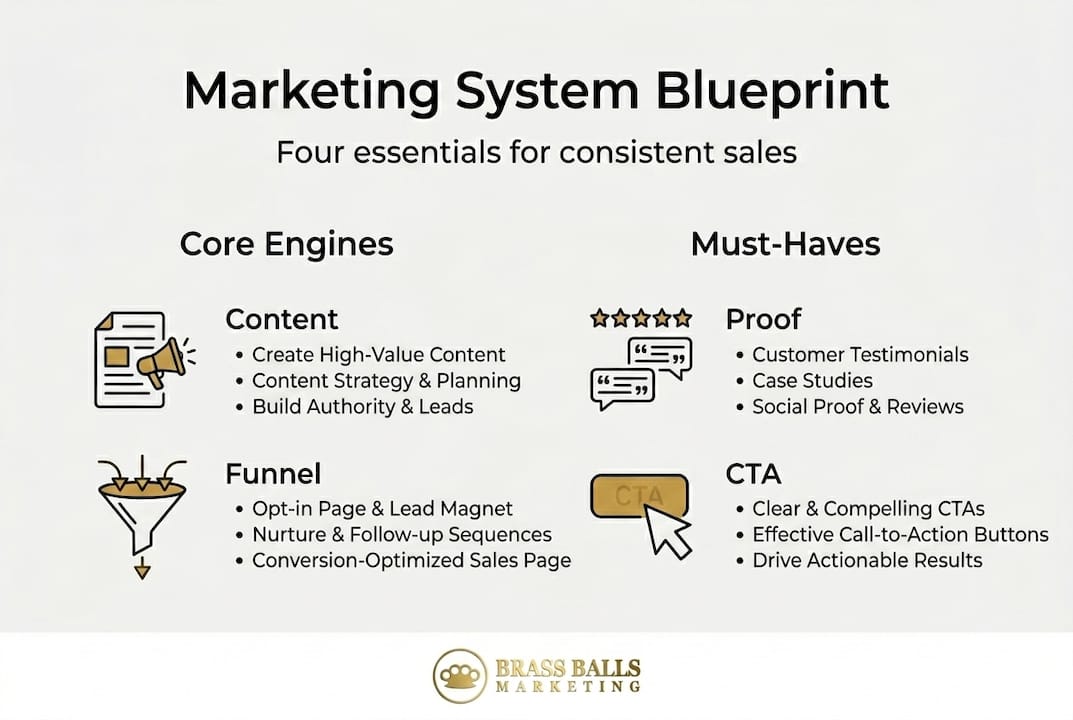
The four engines of a high-converting system
With that definition locked in, let's get under the hood. A properly built marketing system runs on four core engines, each with a distinct role and each feeding the next.
-
Content engine. This is your visibility machine. Blog posts, videos, social content, podcasts. Its job is to attract the right people and warm them up before they ever hit your funnel. Without this engine running, your funnel starves.
-
Funnel engine. Think of this as the three-stage corridor: entry point (lead magnet or opt-in), bridge (nurture sequence or webinar), and conversation (the sales call or checkout page). The funnel's job is conversion, moving a prospect from curious to committed.
-
Conversion system. This is where trust gets pre-built. Testimonials, case studies, before-and-after results, guarantees. Your prospect should arrive at the buying decision already half-convinced. If they need a hard sell at the end, something earlier in the system failed.
-
Retention loop. Most businesses forget this engine completely, which is wild because keeping an existing client costs a fraction of acquiring a new one. The retention loop includes feedback collection, upsells, referral programs, and ongoing value delivery that keeps clients engaged and spending.
These engines don't operate in isolation. Content feeds the funnel. The funnel feeds the conversion system. The conversion system feeds retention. And retention feeds content (hello, testimonials and referrals). It's a flywheel, not a one-way street.
Here's where most small businesses fall flat: they build one engine, usually content or ads, and wait for magic. They pour money into rapid growth marketing strategies without a funnel to capture the interest they generate. That's like running water into a bucket with no bottom.
Pro Tip: Before adding any new marketing tactic to your mix, ask yourself which engine it serves. If the answer is "I'm not sure," don't add it yet. Clarity before complexity.
If you're craving a straight-shooting breakdown of which approaches actually work, the no-BS marketing strategies resource is exactly what it sounds like.
Direct response: The core driver for SMB conversions
Here's a hard truth: brand awareness marketing is a luxury. It works beautifully when you have Coca-Cola's budget and can afford to play the long game. For most small businesses, every marketing dollar needs to produce a trackable result. That's where direct response marketing becomes your best friend.
Direct response is built around one idea: prompt an immediate action. Click this. Sign up here. Book a call. Buy now. Every piece of communication has a clear offer and a single CTA. And because the response is tracked, you always know what's working.
The numbers back this up decisively. Case studies show that a small nutrition clinic achieved 320% revenue growth and a 5.4x ROI using a direct response system. HubSpot users reported 3x more leads and an 83% increase in conversion rates. ClickBank campaigns running direct response frameworks hit 300% ROAS (return on ad spend). These aren't flukes. They're what happens when you stop hoping people will "discover" you and start engineering the path they walk.
Direct response vs. traditional branding: A quick comparison
| Factor | Direct response | Traditional branding |
|---|---|---|
| Goal | Immediate, trackable action | Long-term awareness |
| Measurability | High (clicks, leads, revenue) | Low (impressions, sentiment) |
| Speed to ROI | Fast (days to weeks) | Slow (months to years) |
| Budget fit | SMB-friendly | Requires large spend |
| Optimization | Easy, data-driven | Difficult, subjective |
Key elements every direct response campaign inside your system needs:
- A specific, irresistible offer (not "check us out," but "get your free 30-minute audit")
- One clear CTA per message, not three competing ones
- A trackable response mechanism (unique URL, phone number, or form)
- Copy that speaks directly to a pain point your audience already feels
- A follow-up sequence that keeps the conversation going
If you want to see how this plays out operationally, the direct response workflow breakdown is a solid next read. And if email is part of your mix (it should be), these email marketing strategies for small businesses will sharpen your sequencing game significantly.
Building your high-converting marketing system: Steps and pitfalls
Knowing the theory is one thing. Actually building the machine is another. Here's the practical sequence for putting your system together without losing your mind in the process.
-
Map your audience. Who exactly are you talking to? Not "small business owners," but "solo service providers with under ten clients who are drowning in referral chaos." Specificity is not optional. It's the foundation everything else rests on.
-
Create your content engine. Build a publishing schedule around the 40/35/25 content split. Don't try to be everywhere. Pick two channels, do them well, and stay consistent.
-
Build your funnel. Start simple: one lead magnet, one nurture sequence, one offer page. A well-built sales funnel is the backbone of consistent client acquisition. Complexity can come later.
-
Set up proof. Collect testimonials from day one. Screenshot results. Document case studies. Your conversion system lives or dies on the proof you bring to the table.
-
Establish your retention loop. What happens after someone buys? Map the post-purchase experience: onboarding, check-ins, referral ask, upsell timing.
Where do most businesses drop the ball? Almost always in steps three and four. They build content, run ads, and then send traffic to a generic homepage with no clear offer. Or they have a funnel but zero proof to back up their claims. Both are conversion killers.
Here's a reality check that should motivate you: simple systems consistently generate fifteen to twenty qualified leads per month and deliver 30 to 80% more funnel revenue per visitor. That's not from some elaborate tech stack. That's from getting the basics right and connecting them.

Pro Tip: Don't build your entire system before launching. Launch with a minimal viable funnel (lead magnet plus one follow-up email plus one offer), measure results, then improve. These marketing tips for growth can help you prioritize what to build first.
Why most small businesses get marketing systems wrong
Here's the uncomfortable truth most guides skip: the problem isn't that small businesses lack tactics. It's that they have too many tactics and zero connective tissue holding them together. Chasing the next shiny object, whether it's short-form video, AI-generated content, or some new ad platform, without a system is expensive chaos wearing a strategy costume.
The businesses that actually break through aren't the ones with the cleverest campaigns. They're the ones that made connected decisions about audience, content purpose, and journey placement. That's how momentum builds. Not through hacks, but through intentional architecture.
The hidden cost of tactical marketing is brutal: wasted ad spend, content that gets no traction, leads who ghost you after one touch. Once you switch to direct response automation inside a real system, the fog lifts fast. You stop guessing and start compounding.
Take the next step with your marketing system
You now have the framework. You know the four engines, the content split, the direct response fundamentals, and the pitfalls that sink most SMB marketing efforts. The question isn't whether this works. It's whether you're going to build it or keep patching tactics together and hoping for different results.
If you'd rather skip the trial-and-error phase and work with people who've already built these systems across dozens of industries, Brass Balls expert guidance is worth a serious look. From done-for-you funnels to direct response training and client acquisition frameworks, the tools are there. The only thing left is your decision to use them.
Frequently asked questions
What are the core components of a high-converting marketing system?
A high-converting system includes a content engine for visibility, a lead funnel for conversion, proof elements to pre-build trust, and a retention loop for feedback and growth. Each component feeds the next in a continuous cycle.
How do direct response strategies improve marketing system conversions?
Direct response methods prompt immediate, trackable actions through specific offers and single CTAs, making it far easier to measure what's working and optimize for higher conversion rates over time.
What results have businesses seen with high-converting marketing systems?
Results are concrete: case studies document 320% revenue growth, 5.4x ROI, and 83% higher conversion rates, all achieved through integrated direct response systems rather than scattered tactics.
What are common pitfalls when building a marketing system?
The most common mistakes include skipping proof content, sending traffic to generic pages with no clear CTA, and neglecting the follow-up sequences that turn warm leads into paying clients.