

TL;DR:
- Treat content as a full-funnel sales asset, not just brand awareness.
- Use different content types for each pipeline stage to move leads forward.
- Focus on measuring pipeline influence and conversions over vanity metrics for true ROI.
Most business owners treat content like a billboard on an empty highway: nice to have, vaguely reassuring, and nearly impossible to prove is doing anything. That thinking is costing you real money. Content is not a branding exercise or a "stay visible" tactic. When built deliberately, it is a sales machine that moves strangers into your pipeline, nudges skeptical prospects toward a decision, and keeps paying clients coming back for more. This guide breaks down exactly how to use content at every stage of your funnel, what to measure, and how to start winning premium clients without waiting for a perfect strategy.
Table of Contents
- Why content is essential at every stage of the funnel
- The content-funnel framework: Matching content to every stage
- Measuring content's impact: What works (and what's hard)
- Applying content strategies for better client acquisition
- The uncomfortable truth most experts won't tell you about content and funnels
- Ready to optimize your content funnel?
- Frequently asked questions
Key Takeaways
| Point | Details |
|---|---|
| Content drives revenue | Strategic content supports every funnel stage and directly influences sales outcomes. |
| Measure what matters | Focus on pipeline and conversions over vanity metrics like likes or shares for true impact. |
| Start small, learn fast | Perfection isn't required—use simple tracking and iterative improvement to drive results. |
| Map content to funnel | Align your content types with each stage of the client journey for maximum ROI. |
| Action beats theory | Implement content strategies now and refine as you gather feedback and data. |
Why content is essential at every stage of the funnel
Here is a misconception that trips up even experienced entrepreneurs: content is only useful at the top of the funnel, where you are trying to get eyeballs. Wrong. Dead wrong. Content does the heavy lifting at every single stage, from the moment someone discovers you exist to the moment they renew, refer, or buy again.
Think of your funnel as a relay race. Awareness content is the starting gun. Consideration content hands off the baton. Conversion content crosses the finish line. Retention content convinces your fastest runners to come back and race again next season. If any leg drops the baton, you lose the whole race.
The data backs this up hard. B2B teams are measuring pipeline and conversions, not just page views and social shares, because they have figured out that content influences revenue at every stage. Small business owners and entrepreneurs can absolutely apply the same mindset, even without an enterprise budget.
"Content is not a top-of-funnel luxury. It is a full-funnel sales asset that either earns its place or wastes your time."
Here is a quick breakdown of content types that work at each funnel stage:
| Funnel stage | Goal | Best content types |
|---|---|---|
| Awareness | Get found and trusted | Blog posts, short videos, social content |
| Consideration | Build credibility and preference | Case studies, guides, webinars, email sequences |
| Conversion | Remove friction and drive action | Sales pages, testimonials, FAQs, demos |
| Retention | Deliver value and encourage loyalty | Newsletters, tutorials, exclusive offers, check-ins |
You can explore solid funnel examples for growth to see how real businesses map content to each of these stages, or get a grounding overview with what is a marketing funnel if you want to go back to basics first.
Pro Tip: Before you create any new piece of content, ask yourself which funnel stage it serves. If you cannot answer that in one sentence, you do not have a content strategy. You have a content habit.
The single biggest ROI move for small businesses is repurposing. One in-depth blog post becomes a three-part email sequence. That sequence becomes a short video. That video becomes a paid retargeting ad for your conversion stage. You create once and deploy across the entire funnel. That is how you punch above your weight without burning out your team or your budget.
The content-funnel framework: Matching content to every stage
Now that you understand why content matters across the whole funnel, let us get practical. The goal here is to give you a framework you can actually use, not a theory to admire.

The funnel has five usable stages for content strategy purposes: Awareness, Interest, Decision, Action, and Loyalty. Each stage has a job to do, and the content you serve there should do exactly that job and nothing else.
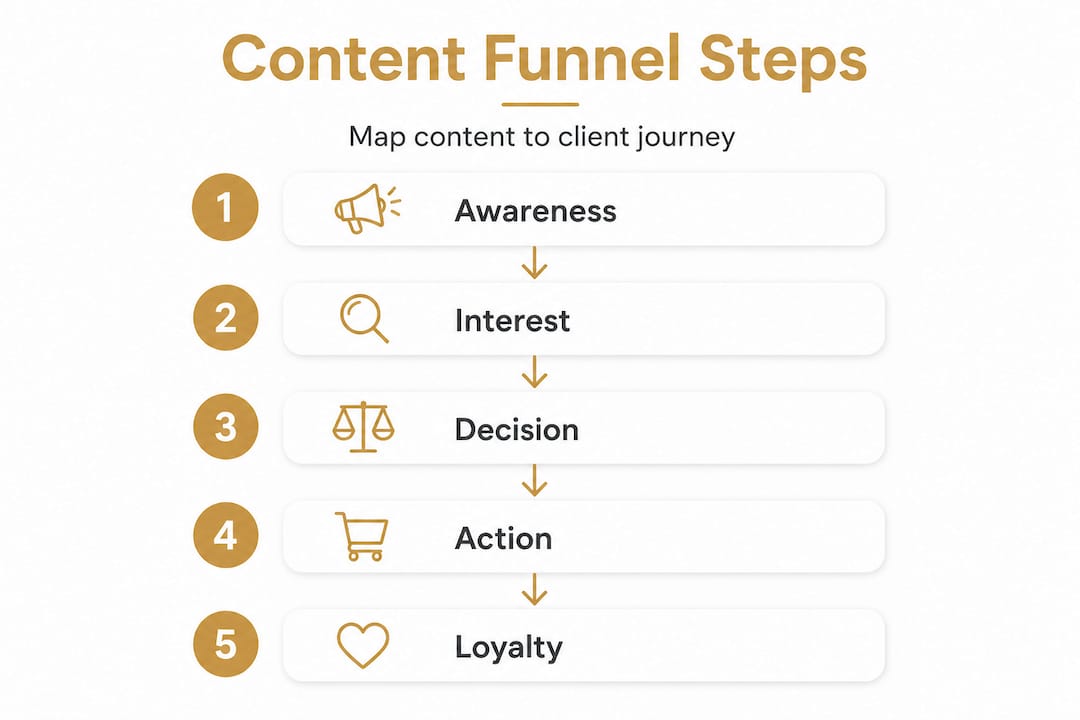
| Stage | Prospect mindset | Content job | Example formats |
|---|---|---|---|
| Awareness | "I have a problem" | Educate and attract | SEO blogs, short-form video, podcasts |
| Interest | "Who can solve this?" | Build trust and authority | Email nurture, guides, webinars |
| Decision | "Is this the right choice?" | Reduce risk and objections | Case studies, testimonials, comparisons |
| Action | "I am ready to buy" | Make it frictionless | Sales pages, demos, limited-time offers |
| Loyalty | "Was this worth it?" | Reinforce the decision | Tutorials, VIP content, referral programs |
Here is a numbered workflow for mapping your existing content to funnel stages:
- Audit what you already have. List every blog post, email, video, and lead magnet you have created in the last 12 months.
- Tag each piece by stage. Be brutal. Most businesses discover they have 80% awareness content and almost nothing for Decision or Loyalty stages.
- Identify the gaps. Where does your funnel leak? Where do leads stall or go quiet? That is where your content is missing.
- Create or repurpose to fill gaps. You do not always need new content. A strong blog post can become a case study with some editing. A testimonial can become a Decision-stage email.
- Assign a measurable action to each piece. Every piece of content should push readers toward a specific next step: subscribe, book a call, download, reply, or buy.
Attribution, meaning knowing which content caused which sale, is genuinely messy. Only 33% use formal attribution models, which tells you that most businesses are still flying partially blind. That is not a reason to panic. It is a reason to be practical. Use UTM parameters on every link you share, and add a simple "how did you hear about us?" field to your intake forms. You will start building directional data fast without needing enterprise-grade software.
The benefits of marketing funnels go way beyond closing a single sale, and email marketing in funnels is one of the highest-leverage channels to master for the Interest and Decision stages specifically.
Pro Tip: Always ask "what action do I want from this content?" before you write a single word. That question forces clarity and aligns your content to funnel objectives instead of just filling a publishing calendar.
Measuring content's impact: What works (and what's hard)
Alright, you have got the framework. Now you need to know if it is working. This is where most entrepreneurs either obsess to paralysis or wave their hands and say "it's all brand building." Neither extreme serves you.
Here is the honest reality: most small businesses start with directional measurement, not perfect attribution. And that is totally fine. Directional measurement means you are tracking signals that point in a direction, even if you cannot draw a straight line from a blog post to a signed contract.
The most useful directional signals to track are:
- Pipeline influenced by content. Did a lead mention your blog, case study, or email before booking a call?
- Direct conversions. Form fills, email sign-ups, and booked discovery calls that originate from specific content pieces.
- UTM-tagged traffic. Which emails, social posts, or ads are actually sending traffic that converts?
- Response rates on nurture emails. Replies and clicks in your email sequence tell you which messages resonate at the Interest and Decision stages.
- Time to close. Do leads who consumed more of your content close faster or at higher prices? Track this manually if your CRM allows.
The Contentful/Benchmarker survey found that formal attribution models are still rare, meaning only a minority of even sophisticated B2B teams have this figured out. So if you are a small business owner worried you are doing it wrong, you are probably doing it about as well as most.
"Aim to be roughly right rather than precisely inactive. Directional attribution beats paralysis every single time."
Start with lead nurturing and tracking fundamentals, and when you are ready to go deeper on connecting content to actual revenue, the sales funnel client acquisition guide gives you a more advanced playbook.
The tools you need to start are not exotic. Google Analytics 4 for website behavior, UTM parameters for campaign tracking, and a basic CRM like HubSpot's free tier or even a well-organized spreadsheet. Add a source field to every intake form and discovery call. Review the data monthly, not hourly. Monthly review keeps you sane and gives patterns enough time to emerge.
Applying content strategies for better client acquisition
You have got the framework, you understand the measurement reality, and now it is time to actually close premium clients with your content. Here is where the rubber meets the road.
Follow this five-step workflow to build or sharpen a content-driven client acquisition system:
- Define your premium client profile. Who specifically do you want to attract? What keeps them up at night? What language do they use to describe their problem? Your content must speak their language before it can earn their trust.
- Create a flagship content asset. This is your anchor: a detailed guide, a case study series, or a signature framework that positions you as the only logical choice. This asset lives at the Interest and Decision stages and does the heavy credibility lifting.
- Build a personalized email sequence behind your lead magnet. Do not dump everyone into one generic nurture track. Segment by problem or industry and serve content that speaks directly to each group's situation.
- Deploy retargeting ads for warm leads. Someone who read your case study but did not book a call is already halfway sold. A retargeting ad showing a relevant testimonial or a compelling offer is a gentle nudge, not a hard sell.
- Create a conversion-stage content bundle. A decision-stage prospect needs social proof, risk reduction, and a clear next step. Package your best testimonials, an FAQ that handles objections, and a low-friction call to action together.
Beyond the workflow, here are the highest-leverage content strategies for premium client acquisition specifically:
- Personalized email sequences that address specific pain points by segment convert dramatically better than generic newsletters.
- Deep-dive case studies with real numbers and named clients remove the "is this legit?" objection before prospects even voice it.
- Video testimonials placed on sales pages and in Decision-stage emails act like a trusted friend vouching for you at exactly the right moment.
- Segmented lead nurture tracks that branch based on behavior (did they open the email? click the case study?) let you serve hyper-relevant content without manual effort.
- Strategic content offers at the Decision stage, like a free audit, a consultation, or a pilot project, give premium clients a low-risk way to experience your value before committing fully.
B2B teams tracking pipeline influenced by content consistently report that measurement expands beyond engagement once you connect content to actual revenue conversations. The mindset shift is simple but powerful: stop thinking of your content as marketing collateral and start treating it as your best salesperson. It works 24 hours a day, does not take sick days, and scales without extra headcount.
For a broader view on how this connects to revenue, the revenue with funnel marketing resource is worth your time, and small business funnel optimization gives you a practical checklist for tightening up the gaps.
Avoid the vanity metric trap. Likes, impressions, and follower counts feel good but pay zero bills. If a piece of content is not moving people toward a conversation, a sign-up, or a sale, it needs to be retooled or replaced. Full stop.
The uncomfortable truth most experts won't tell you about content and funnels
Here it is, plain and unvarnished: the biggest reason most small businesses fail at content-driven funnels is not a lack of strategy. It is a love affair with preparation that never quite ends.
We have seen it a hundred times. Business owner spends three weeks designing the perfect content calendar. Another two weeks debating whether to use video or blog posts. A week tweaking email subject lines. And then... nothing goes live. Or one thing goes live, gets three visitors, and gets declared a failure before the ink is dry.
Here is what years of building real funnels with real clients has taught us: the best content strategy is the one you actually execute and then improve. The data from Contentful's Benchmarker research tells us attribution is still directional even for teams spending serious money, so waiting for a perfect measurement system before launching is a trap.
Hit publish. Track what you can with UTMs and CRM fields. Review monthly. Iterate. That compounding effect of consistent publishing, reviewing, and refining is what separates businesses that grow from ones that stay stuck in the planning stage indefinitely.
The concept of segmentation for conversion is a perfect example. You do not need to build out ten audience segments from day one. Start with two. See which performs better. Refine. Add a third segment when the first two are working. That is iteration, not settling for mediocrity.
Being roughly right and moving beats being precisely correct and paralyzed. Every time. Content that exists and converts imperfectly is infinitely more valuable than the perfect article sitting in your drafts folder.
Ready to optimize your content funnel?
Content strategy only works when it actually gets executed, and execution is a lot easier when you have a proven system behind you. If you have been reading this thinking "I know I need this, I just do not know where to start," that is exactly the gap we exist to close.
At Brass Balls, we build done-for-you marketing funnels and content systems designed specifically for small business owners and entrepreneurs who are serious about attracting premium clients and generating consistent revenue. No fluff, no vanity metrics, no waiting around for perfection. If you are ready to turn your content into a client acquisition machine, come see what we have built for businesses just like yours.
Frequently asked questions
How can small businesses measure the ROI of content in funnels?
Most small businesses measure ROI by tracking conversions, pipeline value, and lead quality, even without formal attribution. Research shows 59% measure direct conversions and 54% track pipeline influenced by content, proving directional measurement is both practical and widely used.
What is the most common mistake businesses make with content funnels?
The most common mistake is obsessing over engagement metrics like likes and shares instead of tracking actual pipeline and conversions. B2B teams measure pipeline influenced by content because that is what actually connects content to revenue.
Can content really move leads through all stages of the funnel?
Yes, strategically designed content addresses a different need at every stage, supporting awareness, trust-building, decision-making, and post-sale retention. Each stage requires different formats and messages, but content is genuinely the engine that moves leads forward at every point.
Do I need advanced analytics tools to measure content-funnel success?
No, most small businesses get actionable data by starting with basic UTM parameters and a simple CRM source field. Even sophisticated teams show only a minority use formal attribution models, so directional data from simple tools is perfectly sufficient to make smart decisions early on.
What type of content works best for acquiring premium clients?
In-depth case studies, video testimonials, and tailored content offers work best for converting high-value leads because they remove risk, establish credibility, and give premium clients a low-stakes way to experience your expertise before fully committing.
Recommended
- How sales funnels drive client acquisition: 2026 guide
- Increase business revenue: proven steps for premium clients
- Why choose funnel marketing: grow your revenue reliably
- Marketing funnel examples to boost business growth
- How to attract premium customers: luxury strategies that work - Corrado Manenti