

TL;DR:
- A great product without a compelling offer is ineffective, as relevant offers significantly influence consumer purchasing decisions.
- Modern, context-driven offers that trigger in real-time and are personalized increase engagement and conversion rates efficiently.
- Businesses should embed automated, behavior-based offers into their marketing systems, focusing on timing and relevance for success.
You've got a great product. Your service is solid. Your clients love you. And yet, the sales aren't rolling in the way they should. Sound familiar? Here's the uncomfortable truth: a great product without a compelling offer is like a Ferrari with no gas. It looks impressive, but it's going nowhere. 7 in 10 consumers change what they buy when presented with a relevant offer. That's not a small tweak in buyer behavior. That's a seismic shift. And if you're not engineering your offers with that kind of leverage in mind, you're leaving serious money on the table.
Table of Contents
- Why offers are a marketing game-changer
- The evolution of offers: From manual to context-driven
- The anatomy of a high-converting offer
- Make your offers count: Timing, delivery, and personalization
- What most guides get wrong about offers in marketing
- Ready to achieve more with your offers?
- Frequently asked questions
Key Takeaways
| Point | Details |
|---|---|
| Offers drive action | Strategic offers are proven to influence buying decisions and increase conversions. |
| Context is critical | Offers perform best when matched to the right moment and channel. |
| Programmatic personalization wins | Automation and personalized delivery make offers more relevant and effective in 2026. |
| Integrated approach works | Embedding offers into customer journeys produces more sustainable results than one-off discounts. |
Why offers are a marketing game-changer
Let's get one thing straight. An offer is not just a discount. Slapping 10% off your service and calling it a promotion is the marketing equivalent of showing up to a knife fight with a spoon. Real offers are strategic instruments. They attract attention, create urgency, differentiate you from competitors, and most importantly, they move people from "maybe" to "yes."
The core function of an offer is to reduce friction. Every buyer has a version of that little devil on their shoulder whispering "wait, think about it, don't rush." A well-crafted offer smacks that devil off the shoulder and replaces it with urgency, clarity, and perceived value. And that's why high-converting offer ideas are one of the most studied elements in direct response marketing.
Here's what a strategic offer actually does for your business:
- Attracts attention in a crowded market where everyone is selling something
- Differentiates your business from competitors who are just listing prices
- Prompts immediate action instead of letting prospects drift into the dreaded "I'll think about it" zone
- Increases average transaction value through smart bundling, upsells, and bonuses
- Builds perceived value so customers feel like they're getting more than they're paying for
- Generates data about what your audience actually responds to, which sharpens your future marketing
"The best offer, delivered at the right moment, wins the sale." This isn't wishful thinking. It's the core principle behind every successful direct response campaign ever built.
Now pair that with effective marketing strategies designed for small businesses in 2026, and you've got a recipe that can genuinely change your revenue trajectory. Not gradually. Fast.
The evolution of offers: From manual to context-driven
Not long ago, running a promotion meant printing flyers, blasting a mass email, or running a weekend special that you hoped someone would notice. That was the era of spray-and-pray marketing. You'd cast a wide net, offer a generic discount, and wait. Sometimes it worked. Often it didn't. And you had no real idea why either way.
That world is gone. Direct response automation has completely reshaped how offers reach buyers and when. We're now in the age of programmatic, context-driven offers that trigger at the exact moment a buyer is most likely to say yes. Think of it like a vending machine that already knows you're hungry before you even reach for your wallet.

Real-time, embedded offers now influence behavior at the moment of decision, not hours or days later. The checkout page, the email opened at midnight, the app notification right after a browse session. That's where modern offers live. And the integration and relevance of those offers are critical to their effectiveness in 2026.
Here's a quick comparison of the old world versus the new:
| Feature | Traditional offers | Modern context-driven offers |
|---|---|---|
| Timing | Scheduled, fixed | Real-time, triggered |
| Targeting | Broad audience | Behavior and intent-based |
| Delivery method | Mass email, print, signage | Embedded at checkout, app, web, POS |
| Personalization | Generic or minimal | Highly personalized |
| Feedback loop | Slow (weeks or months) | Instant analytics |
| Automation | Manual setup required | Programmatic and automated |
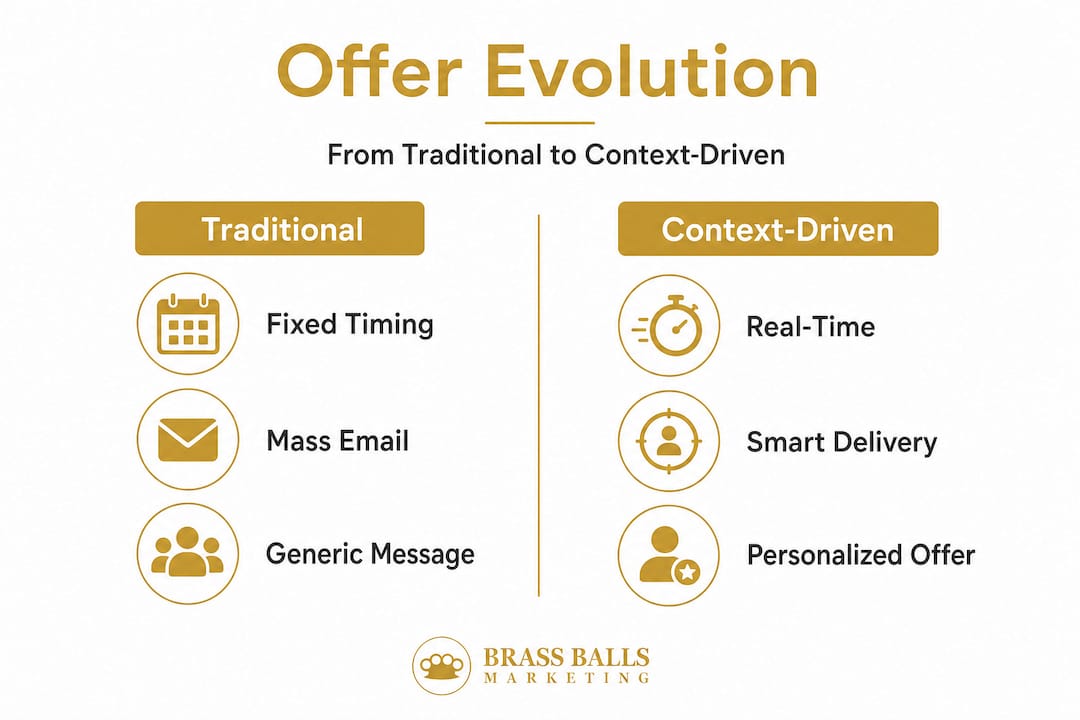
The difference is not subtle. Traditional offers were like shouting into a crowd and hoping the right person heard you. Modern offers are more like whispering exactly what someone needed to hear, right when they needed to hear it. The technology behind this, from AI-driven marketing automation to behavioral triggers, makes it accessible even for small businesses operating with lean budgets.
A solid marketing automation guide can help you bridge the gap between where you are now and where you need to be. The barrier to entry has dropped dramatically. You don't need a Fortune 500 budget to run smart, contextual offers.
Pro Tip: Start small. Pick one stage of your customer journey, say, the moment someone abandons a cart or leaves a landing page, and test a single automated offer there. Measure the conversion lift. Then scale what works. You'll be stunned at what a well-timed "hey, wait, here's something for you" can do.
The anatomy of a high-converting offer
Okay, so you know why offers matter and you've seen how they've evolved. Now let's get surgical. What actually makes an offer convert versus one that dies in silence? It's not magic. It's structure.
Every high-converting offer has five core ingredients, and if even one is missing, the whole thing wobbles:
- Clarity — People should understand your offer in three seconds or less. If they have to think, you've already lost them.
- Relevance — The offer must match what the buyer actually wants right now, not what you think they should want.
- Urgency — A deadline or limited availability creates the psychological nudge to act now rather than later.
- Perceived value — The buyer needs to feel they're getting significantly more than they're paying. Bonuses, bundles, and guarantees do heavy lifting here.
- Simplicity — One clear call to action. Not three options, not a menu of choices. One next step.
Matching the offer to the right context and channel is equally critical. An offer that converts on email might flop on a pop-up. An offer that works on mobile might not land on desktop. Context isn't a nice-to-have. It's the engine.
Here's a look at how different offer types perform across contexts:
| Offer type | Delivery method | Customer response |
|---|---|---|
| Limited-time discount | Email at cart abandonment | High urgency, strong conversion |
| Free bonus with purchase | Checkout page embed | Increases average order value |
| Loyalty reward | App notification | Repeat purchase trigger |
| Free trial or sample | Landing page popup | Top-of-funnel lead generation |
| Bundled package deal | Sales call or proposal | Premium client conversion |
Use these real-world acquisition strategies as your north star when designing offers. The channel and the context should shape the offer, not the other way around.
Use this checklist before you launch any new offer:
- Does it solve a specific, felt pain or desire the customer has right now?
- Is the call to action crystal clear with zero ambiguity?
- Is there a genuine reason to act today rather than next week?
- Does the perceived value feel like a no-brainer deal?
- Is it matched to the channel where your buyer is most engaged?
- Have you tested it with a small segment before going wide?
If you answered no to any of those, go back to the drawing board. Content personalization techniques can also help you tailor each offer to feel more individual, which consistently outperforms one-size-fits-all approaches.
Make your offers count: Timing, delivery, and personalization
You've built a great offer. Now the question is: when does it show up, where does it land, and does it feel like it was made for this specific person? These three variables, timing, delivery, and personalization, are the difference between an offer that converts at 2% and one that converts at 20%.
Offers are most effective when surfaced programmatically in context. Relevance and integration are now imperative. That means your offer strategy can't be an afterthought. It has to be baked into your funnel from the start.
Here's a step-by-step process to get your offer timing and delivery dialed in:
- Map your customer journey. Identify the key decision moments: first visit, email open, cart abandonment, post-purchase. Each one is an offer opportunity.
- Segment your audience by behavior, not just demographics. Someone who has visited your pricing page three times is not the same as someone who just discovered you on social media.
- Set behavioral triggers. Use your CRM or email platform to fire specific offers when a customer takes a defined action, like visiting a page twice or spending more than three minutes on a service description.
- Test your delivery channel. Run the same offer via email, a landing page pop-up, and a retargeting ad. See where it resonates most with your specific audience.
- Automate follow-up sequences. A single offer with no follow-up is a wasted shot. Build a sequence: the initial offer, a reminder, a last-chance message. Advanced automation workflows make this manageable even for solo operators.
- Analyze and iterate. Look at open rates, click-through rates, and conversions. Kill what doesn't work. Double down on what does.
The real magic happens when you combine timing with genuine personalization. Most businesses personalize by slapping someone's first name in a subject line and calling it a day. That's table stakes. Real personalization means your offer reflects what a buyer has actually been doing, browsing, buying, ignoring, and returning to. Check out content personalization trends to see where this is heading in 2026 and beyond.
Email marketing best practices in 2026 heavily favor segmented, behavior-triggered sequences over broadcast blasts. The businesses winning with email right now aren't sending more emails. They're sending smarter ones.
Pro Tip: Build a "behavior bucket" system. Tag your subscribers by what they click, what pages they visit, and what they buy. Then create offers specifically for each bucket. A prospect who keeps reading your case studies needs a different offer than someone who checked your pricing page. Treat them differently, and your conversions will thank you.
What most guides get wrong about offers in marketing
Here's the take you won't get from a generic marketing blog: most small businesses treat offers like a fire extinguisher. They only grab it when things are burning. Revenue dips, so they throw a discount at the problem. Nothing converts, so they slash prices again. It becomes a race to the bottom that chips away at your margins and trains your audience to wait for the sale.
The real leverage in offer-based marketing isn't in the size of the discount. It's in the integration, the repeatability, and the precision of showing up at the exact moment of decision. A 10% discount delivered at the wrong moment does nothing. A free bonus delivered when a buyer is already 80% convinced? That closes the deal.
The businesses seeing the most dramatic results from their offer strategies right now are the ones who've stopped treating offers as isolated events and started treating them as a permanent layer in their marketing system. Offers that trigger automatically. Offers that adapt based on behavior. Offers that feel so perfectly timed they're almost unsettling (in the best way).
The hard-won lesson here is this: chasing bigger and bigger promotions is a losing game. Relevance beats generosity every single time. A perfectly placed, highly relevant offer at a modest discount will almost always outperform a massive discount that lands at the wrong moment for the wrong person.
Conventional wisdom says "run a bigger sale." Experience says build better systems. Invest in understanding where your buyers hesitate, and place a well-crafted, precisely timed offer right there. That's where the money is hiding. Proven acquisition strategies built on this principle consistently outperform the spray-and-pray discount model, quarter after quarter.
The legacy tactics are being replaced. The businesses still running "20% off this weekend only" broadcast blasts to their entire list are quietly losing ground to the ones running contextual, embedded, behavior-triggered offers. 2026 is the year that gap becomes impossible to ignore.
Ready to achieve more with your offers?
If this article lit something up for you, good. That means you're ready to stop leaving money on the table and start building offer systems that actually work. Understanding the theory is step one. Implementing a reliable, repeatable offer engine in your business is where the real revenue growth happens.
At Brass Balls, we specialize in exactly this. No fluff, no generic advice, no "post more on social media" nonsense. We build direct response marketing systems, including high-converting offers, automated funnels, and client acquisition frameworks, that are designed to generate measurable ROI. Whether you want done-for-you implementation or you'd rather learn the playbook yourself through our self-serve courses, we've got the tools to get you there faster. Head over to the site and let's talk about what's actually possible for your business.
Frequently asked questions
What is the role of offers in marketing?
Offers create urgency, attract attention, and drive customers toward a specific purchase decision, making them vital for effective marketing. Offers influence buying behavior at the precise moment of decision, which is where conversion either happens or evaporates.
How do embedded or real-time offers improve results?
Real-time, context-aware offers surface at the exact moment of decision, increasing conversion rates far beyond traditional discounts and static promotions. Embedded, real-time incentives drive behavior change most effectively when matched to the specific context and buyer stage.
What makes an offer "high-converting"?
A high-converting offer is clear, relevant to the customer, time-sensitive, and matches the delivery channel to buyer intent. Offer effectiveness relies on context, timing, and delivery channel working together as a system rather than in isolation.
How can small businesses start using programmatic offers?
Begin with simple automation tools that trigger targeted offers based on customer behavior or transaction stage. Embedded smart offers and automation significantly boost offer relevance and effectiveness, even for businesses with small lists and lean budgets.