

TL;DR:
- Client retention reduces costs and increases revenue, making it essential for business growth.
- Using tools like CRM and feedback loops helps maintain and strengthen client relationships.
- Consistent, personalized communication and proactive reactivation strategies prevent client churn.
You do everything right. Your service is solid, your team delivers, and your clients seem happy. Then one day, quietly, they stop calling. No drama, no complaints. Just gone. And replacing them costs you five times more than it would have cost to keep them. Client churn is the silent killer of small business revenue, and most owners don't realize how deep the wound goes until the pipeline runs dry. This guide gives you a straight-shooting, step-by-step plan to keep your best clients loyal, engaged, and coming back for more.
Table of Contents
- Understanding client retention and its business impact
- Prepare your business: Tools and feedback loops
- Implement proven retention strategies
- Avoid retention pitfalls and revive lapsed clients
- Measure, verify, and optimize your retention results
- What most advice on client retention overlooks
- Take action: Grow your retention and revenue
- Frequently asked questions
Key Takeaways
| Point | Details |
|---|---|
| Retention drives revenue | Keeping current clients costs less and brings more profit than chasing new ones. |
| Feedback is fundamental | Regular surveys and follow-ups help you understand and address client needs. |
| Segment and personalize | Treat high-value clients to special attention and customized reports to maximize loyalty. |
| Revive lapsed clients | Even after months of silence, targeted incentives can bring clients back. |
| Track and optimize | Measure results and adjust strategies routinely for steady improvement. |
Understanding client retention and its business impact
Client retention is exactly what it sounds like: keeping the clients you already have. But the business impact goes way deeper than "nice to have." Think of your client base like a leaky bucket. You can pour new leads in all day, but if the bucket keeps leaking, you're running on a treadmill and getting nowhere fast.
Here's the blunt truth: acquiring a new client costs five to seven times more than retaining an existing one. That's not a motivational poster stat. That's money leaving your business every time a loyal client slips away because you didn't have a system to keep them engaged.
What retention actually means in practice:
- Repeat purchases or renewed contracts from existing clients
- Active referrals from satisfied, long-term relationships
- Upsells and cross-sells that come naturally from trusted clients
- Lower marketing spend because you're not constantly chasing cold leads
The measurable impact is hard to argue with. Take a look at how retention stacks up against acquisition across key business metrics:
| Metric | Retention focus | Acquisition focus |
|---|---|---|
| Cost per client | Low (relationship maintenance) | High (ads, outreach, sales cycles) |
| Revenue predictability | High (recurring patterns) | Low (inconsistent pipeline) |
| Average client lifetime value | Grows over time | Resets with each new client |
| Referral potential | Very high | Minimal |
| Brand trust building | Compounds monthly | Starts from zero each time |
Research consistently shows that acknowledging client input reduces churn by reinforcing that clients matter. It's not rocket science. People stay where they feel valued. They leave when they feel like a transaction.
A 5% increase in client retention can lift profits by anywhere from 25% to 95%. That's not a typo. The math works because retained clients buy more, refer more, and cost less to serve. Long term, your most loyal clients are also your cheapest marketing channel.
With the importance clear, you need to know what it takes to actually improve retention in daily practice.
Prepare your business: Tools and feedback loops
Before you build a retention strategy, you need the infrastructure to support it. Trying to retain clients without the right tools is like trying to bake a cake without a bowl. Messy, frustrating, and you end up with nothing worth eating.
Start with these essential tools:
- A CRM platform (Customer Relationship Management). Something like HubSpot, Zoho, or even a well-organized spreadsheet for very small operations. This is where you track every client interaction, contract renewal date, and communication history.
- An email marketing tool for automated follow-ups and newsletters. Mailchimp, ActiveCampaign, or ConvertKit work well for most small businesses.
- A scheduling or project management tool to track deliverables and deadlines so clients never feel forgotten.
- A feedback collection method like a simple Google Form or a dedicated NPS (Net Promoter Score) tool.
NPS surveys are worth understanding because they're so simple yet so powerful. You ask one question: "On a scale of 0 to 10, how likely are you to recommend us to a friend or colleague?" Responses fall into three groups: promoters (9 to 10), passives (7 to 8), and detractors (0 to 6). Your score tells you exactly where you stand with your client base and where trouble is brewing.
Short NPS surveys sent immediately after a key interaction, combined with closing the loop by acting on the feedback and informing clients what changed, form the backbone of any effective feedback system.
Here's a quick comparison of feedback collection methods so you can pick what fits:
| Method | Effort level | Response rate | Best for |
|---|---|---|---|
| NPS survey (1 question) | Very low | High | Quick pulse checks |
| Email survey (5 questions) | Low | Medium | Quarterly deep dives |
| Phone check-in | Medium | Very high | High-value client relationships |
| In-person review | High | Very high | Key account management |
You can also use marketing funnels for feedback by building automated touchpoint sequences that gather insights at critical stages of the client journey, not just at the end when it's too late.
Pro Tip: Don't just collect feedback and file it away. Tell your clients what you did with it. A simple email that says, "You mentioned onboarding felt rushed, so we've added a welcome call to our process," is worth more loyalty than any discount you'll ever offer.
Once the essentials are set, you're ready to bring in proven retention strategies customized for your clients.
Implement proven retention strategies
Now we get into the good stuff. Knowing why retention matters and having the tools ready is step one. Actually executing strategies that keep clients sticky is where most small businesses either win big or drop the ball entirely.
Step-by-step retention execution plan:
- Segment your clients by value. Not all clients deserve the same level of attention. That sounds harsh, but it's the truth. Your top 20% likely drive 80% of your revenue. Know who they are and treat them accordingly.
- Give high-value clients premium support. Tiered segmentation means your highest-value clients get executive attention, faster response times, and first access to new services.
- Shift from project-based to retainer-based relationships. Retainers create inertia. When a client pays monthly for ongoing value, the barrier to leaving gets higher. Monthly retainers also give you predictable cash flow, which is basically the holy grail for small business owners.
- Send monthly value reports. Show clients exactly what they're getting for their investment. Numbers, results, progress. Don't make them guess whether working with you is worth it.
- Reactivate lapsed clients with targeted incentives. More on this in the next section, but don't write off a quiet client too soon.
"Tiered segmentation, where high-value clients receive executive attention, combined with retainer structures and monthly value reports, are among the most effective client retention strategies for professional service businesses." Client Retention Strategies for Professional Services
The monthly value report deserves more attention because most businesses skip it. Think about it from the client's side. They're paying you every month, and unless you show them what's happening, their brain fills the silence with doubt. A one-page summary of wins, work completed, and next steps keeps you top of mind and positions you as indispensable.

You can use sales funnels for retention by automating your check-in sequences, upsell touchpoints, and value report delivery so nothing falls through the cracks, even when you're busy.
Pro Tip: Personalization multiplies loyalty faster than almost anything else. Use client names in every communication, reference past conversations, and remember details about their business goals. A client who feels genuinely seen is far less likely to shop around.
And don't just try to boost client acquisition strategies while ignoring the clients already paying you. Balancing both is where the real revenue growth lives.
With strong strategies in place, you'll want to avoid common pitfalls and keep your retention efforts on track.
Avoid retention pitfalls and revive lapsed clients
Here's where most businesses quietly leak money without realizing it. They set up a few retention tactics, feel good about themselves, then completely ignore the warning signs until a client is already out the door.
The most common retention mistakes:
- Ignoring silent clients who haven't reached out in weeks
- Inconsistent follow-up that leaves clients feeling forgotten
- Treating every client identically regardless of their value or needs
- Only reaching out when there's a problem or an invoice to send
- Promising more than you can deliver and hoping no one notices
Warning signs of disengagement are usually subtle at first. Response times slow down. Engagement with your emails drops. A client starts asking basic questions they already know the answers to, which means they're quietly evaluating whether to leave.
Monitoring engagement drops, identifying lapsed clients at 60 or more days of silence, tracking no-shows to scheduled calls, and reactivating through targeted incentives can recover between 15% and 25% of at-risk clients. That's real money back in your business with relatively low effort.
Here's a practical table of disengagement signals and what to do about them:
| Warning sign | What it likely means | Your response |
|---|---|---|
| Emails opened but no reply | Passive disinterest | Personal phone call within 48 hours |
| Missed scheduled meetings | Loss of motivation or trust | Reach out with a value-led message |
| 60+ days of silence | High churn risk | Personalized reactivation offer |
| Short, one-word responses | Frustration brewing | Ask directly if something is off |
| Request to "pause" services | Considering exit | Schedule a face-to-face or video review |
For reviving lapsed clients, the approach matters enormously. A generic "we miss you" email reads like spam and gets treated like spam. What actually works is a personalized message that references something specific about their business, acknowledges the gap, and offers a concrete reason to reconnect.
You'll find more tactical guidance in marketing tips for small business growth that covers how to use targeted outreach campaigns to bring quiet clients back into active engagement.
Pro Tip: Timing matters more than most people think. The sweet spot for reactivating a lapsed client is between 30 and 60 days of silence. After 90 days, the emotional connection fades quickly and your reactivation rate drops sharply. Don't wait until they've mentally moved on.
After implementing and adjusting for these factors, it's important to measure results and adjust for even stronger retention.
Measure, verify, and optimize your retention results
You can't manage what you don't measure. And most small business owners skip this step entirely, which is like flying a plane with no instruments and hoping for clear skies.
The key metrics you need to track monthly:
- Client retention rate. The percentage of clients who stay with you over a defined period. Calculate it as: (clients at end of period minus new clients) divided by clients at start of period, times 100.
- Churn rate. The flip side of retention. What percentage of clients left? If this is climbing, something in your system is broken.
- Client lifetime value (CLV). How much revenue does a typical client generate over the full length of your relationship? A rising CLV means your retention strategies are working.
- Engagement rate. Are clients opening emails, showing up to calls, responding to surveys? Engagement is a leading indicator, meaning it tells you where retention is heading before churn actually happens.
- Net Promoter Score. Tracked quarterly, this shows whether your clients are moving toward being advocates or heading for the exit.
Monthly value reports and closing feedback loops are what verify that your retention efforts are actually producing outcomes, not just activity. Activity without results is just busy work.
Set up a simple monthly review process. Pull your metrics, compare to the previous month, identify one thing that improved and one thing to fix. Then adjust, test, and measure again. Retention optimization is not a one-time project. It's a living system.
| Key metric | What it tells you | How often to check |
|---|---|---|
| Retention rate | Overall health of your client base | Monthly |
| Churn rate | Speed of client loss | Monthly |
| Client lifetime value | Long-term revenue potential | Quarterly |
| NPS score | Client sentiment and loyalty | Quarterly |
| Engagement rate | Leading indicator of retention trends | Weekly |
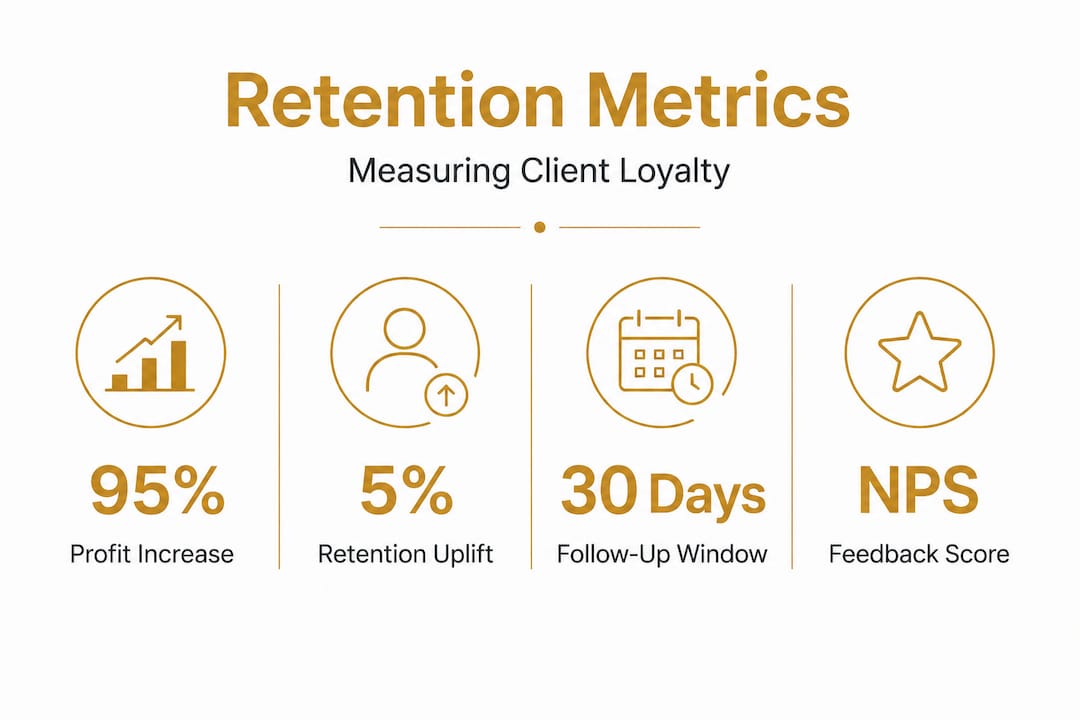
Pairing consistent reliable growth with retention creates a compounding effect. Each retained client becomes easier to serve, more valuable over time, and more likely to send referrals your way.
All these steps prepare the ground for long-term client relationships that fuel healthy business growth.
What most advice on client retention overlooks
Here's the uncomfortable truth that most retention guides won't tell you: one-off gestures don't build loyalty. Sending a birthday card or throwing in a freebie once a year is nice, but it's not a retention strategy. It's a party trick.
Real retention is won or lost in the everyday systems. The automated follow-up that arrives right when a client needs reassurance. The monthly report that shows up without them having to ask. The quick check-in call that happens before a problem becomes a complaint. These aren't grand gestures. They're consistent habits baked into repeatable processes.
Personal connection absolutely matters. But here's the thing: personal connection doesn't scale unless you systematize it. The businesses that win at retention aren't the ones with the most charismatic owners. They're the ones with processes that make every single client feel like the most important client in the room.
Consistency beats intensity every time. One genuinely attentive touchpoint per month, every month, for twelve months builds ten times more loyalty than a flurry of attention followed by two months of silence.
The deeper truth is that great retention transforms clients into advocates. An advocate doesn't just stick around. They bring their network with them. They defend you when someone asks for a recommendation. They become your most cost-effective marketing channel, one that marketing success for small business principles consistently point to as the highest-ROI growth lever available.
Stop trying to impress clients with heroics and start impressing them with reliability. Reliability is rare. Reliability is memorable. And reliability is what turns a client into a long-term advocate who grows your business for you.
Take action: Grow your retention and revenue
You've got the strategy, the tools, and the mindset. Now the question is simple: are you going to implement it, or let another client quietly disappear?
If the idea of building retention systems from scratch feels overwhelming, that's exactly where Brass Balls business growth support comes in. The team specializes in no-BS direct response marketing systems designed specifically for small business owners who are done wasting time on strategies that look pretty but don't actually keep clients or drive revenue. From done-for-you funnels to frameworks that automate your client touchpoints, you'll find effective marketing strategies that make retention a built-in feature of your business rather than an afterthought. Start there and stop watching great clients walk out the door.
Frequently asked questions
What is the most effective client retention strategy for small businesses?
The most effective strategy involves using regular feedback loops, such as short NPS surveys after key interactions, then acting on the results and informing clients about the changes made.
How often should I check in with clients to keep them engaged?
At a minimum, check in monthly or immediately when you notice an engagement drop, a missed meeting, or more than 60 days of silence from a client.
What metrics should I track to measure client retention success?
Focus on repeat business, client tenure, churn rate, and NPS scores. Monthly value reports and closed feedback loops are what confirm your strategies are actually delivering results.
How can I recover clients who haven't engaged for months?
Use personalized outreach that references something specific to their business and pair it with a targeted incentive. Reactivating lapsed clients with this approach recovers between 15% and 25% of at-risk accounts when done within the 30 to 60 day window.