

TL;DR:
- Hybrid print-digital campaigns outperform single-channel marketing by building trust and emotional connection.
- Targeting specific high-value clients with tailored strategies increases premium client acquisition and revenue.
- Regularly measuring and refining hybrid marketing efforts ensures predictable, scalable growth.
Most small business owners are out here throwing marketing spaghetti at the wall and hoping something sticks. Sound familiar? The frustrating truth is that inconsistent revenue isn't a hustle problem. It's a strategy problem. Hybrid print-digital campaigns consistently outperform single-channel approaches by building trust and emotional connection, especially with premium clients who have options and aren't easily impressed. This guide walks you through four proven, practical steps to identify high-value clients, build a hybrid marketing system, craft irresistible offers, and measure results so your revenue growth stops being a guessing game and starts being a system.
Table of Contents
- Identify and target high-value clients
- Build a hybrid print-digital marketing system
- Craft compelling offers and direct response messaging
- Measure results and refine for predictable growth
- Our hard-won lessons: What most revenue guides miss
- Ready to accelerate your business revenue?
- Frequently asked questions
Key Takeaways
| Point | Details |
|---|---|
| Target premium clients | Identify your ideal high-value client profile and focus your marketing efforts for faster revenue growth. |
| Use hybrid marketing | Combine print and digital direct response for higher trust, emotional impact, and predictable returns. |
| Optimize your offer | Craft compelling, premium-positioned offers and messaging to maximize conversions and attract the best clients. |
| Track and refine | Measure results, monitor core metrics, and run regular reviews to drive ongoing, reliable revenue growth. |
Identify and target high-value clients
Here's the cold, hard truth: chasing every possible client is the fastest route to burning out while earning average money. Premium clients, the ones who pay well, refer others, and actually respect your expertise, are a specific type of person. They have distinct characteristics, specific pain points, and they respond to very different triggers than bargain hunters.
So who exactly is a premium client? Think about it this way. They prioritize results over price. They're already investing in solutions. They value expertise and are willing to pay a premium for certainty. They don't ghost you after a proposal. Knowing this changes everything about how you market.
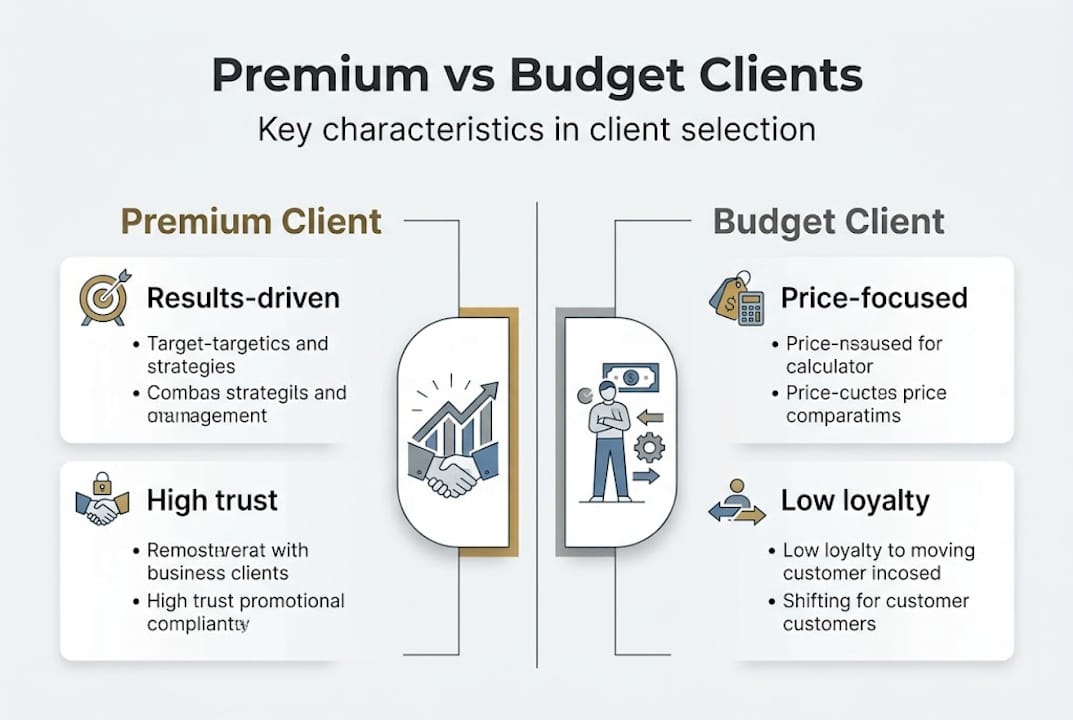
Here's a quick breakdown of what separates premium clients from the rest:
| Characteristic | Premium client | Budget client |
|---|---|---|
| Decision driver | Results and trust | Lowest price |
| Response to marketing | Emotional and logical | Discount-focused |
| Lifetime value | High, with referrals | Low, transactional |
| Communication style | Direct and decisive | Hesitant, slow |
To find and attract these people, you need to do real audience research. Pull your best past clients and identify patterns. What industries are they in? What problems kept them up at night before working with you? What made them choose you over a competitor?
Useful tools for this research include:
- LinkedIn Sales Navigator for B2B targeting by role, company size, and industry
- Google Analytics audience reports to see who's already engaging with your content
- Customer surveys asking your best clients what they value most
- CRM data to identify which client segments generate the most revenue per engagement
Once you have a clear profile, you can explore rapid growth strategies that align with premium client psychology rather than generic mass-market tactics. And here's a counterintuitive insight: direct mail builds trust and emotional resonance with premium audiences in a way that a Facebook ad simply cannot. Physical mail feels intentional. It signals investment. Premium clients notice that.
For businesses that use branded merchandise or print materials, printing for business growth can add a tangible, professional dimension to your outreach that digital alone can't replicate.
Pro Tip: Narrow your targeting until it feels almost too specific. If your ideal client is a 45-year-old female financial advisor in a mid-size city who's frustrated with inconsistent referrals, market to her. Specificity converts. Scattergun wastes budget.
Check out these proven marketing strategies to pair your targeting work with the right channel mix.
Build a hybrid print-digital marketing system
Once you know exactly who you're targeting, the next move is building a system that reaches them through multiple touchpoints without feeling spammy or desperate. That's where the hybrid print-digital model earns its stripes.

The science is clear: hybrid campaigns outperform single-channel marketing by a significant margin. Why? Because different channels do different jobs. Print creates emotional weight and credibility. Digital creates scalability, tracking, and speed. Together, they're a one-two punch that premium clients respond to.
Here's how the two channels stack up:
| Channel | Strengths | Weaknesses |
|---|---|---|
| Print mail | Trust, emotion, tangibility, premium feel | Slower, higher cost per piece |
| Digital (email, ads) | Speed, scale, tracking, retargeting | Lower trust, easy to ignore |
| Hybrid combined | High trust plus scale, superior conversion | Requires coordination |
Setting up an integrated campaign doesn't have to be complicated. Follow this sequence:
- Define your campaign goal. Are you booking discovery calls, selling a specific offer, or reactivating past clients?
- Create your print piece first. A well-designed postcard or letter establishes credibility before your digital follow-up arrives.
- Launch digital retargeting. Use email sequences or social ads to reinforce the message from your print piece within 48 to 72 hours.
- Personalize where possible. Variable data printing lets you customize print pieces with the recipient's name, business, or specific pain point.
- Track response through dedicated landing pages or unique phone numbers so you know exactly which touchpoint drove the action.
For businesses exploring print and digital integration, the key is treating both channels as parts of one conversation, not two separate campaigns running in parallel.
This is the backbone of serious direct response marketing: every touchpoint has a job, every job moves the prospect closer to a yes.
Pro Tip: Send the print piece first. When your email arrives and the prospect already has your letter on their desk, your open rate and response rate spike. Print primes the relationship. Digital closes the loop.
Craft compelling offers and direct response messaging
You've got your targeting dialed in. You've built your hybrid system. Now comes the part that actually makes the cash register ring: your offer and your message.
Direct response marketing lives or dies on three things. A compelling offer. A reason to act now. A clear call to action. Get these right and your campaigns pull results. Get them wrong and even the best targeting in the world won't save you.
Here's what a strong premium offer looks like:
- Specific outcome: Not "marketing help" but "12 new premium clients in 90 days or we work for free"
- Clear value stack: Show everything included so the perceived value dwarfs the price
- Risk reversal: Guarantees, free trials, or pilot programs reduce hesitation for high-ticket buyers
- Scarcity or urgency: Limited spots, a deadline, or a bonus that expires creates real motivation to act
Hybrid campaigns prompt more action and higher perceived value, which means your offer lands differently when it arrives via a premium print piece versus a cold email. The medium reinforces the message.
Warning: Never lead with a discount when targeting premium clients. Discounting signals desperation and attracts the wrong crowd. Premium buyers want to pay for certainty, not bargains. Lead with transformation and results, not price cuts.
To refine your messaging, follow this simple testing process:
- Write two versions of your core message with different headlines or offers.
- Run both versions to a small segment of your list.
- Measure response rates, click-throughs, and booked calls over 7 to 14 days.
- Kill the loser. Scale the winner.
- Repeat the process every 30 to 60 days.
Explore client acquisition strategies that pair sharp messaging with the right targeting, and check out these marketing tips for small business to sharpen your copy before it goes out the door.
Measure results and refine for predictable growth
Here's where most business owners drop the ball. They run a campaign, get some results, and then either declare victory or give up entirely. Neither is the right move. Predictable revenue growth comes from a feedback loop, not a one-time effort.
Hybrid campaigns drive double-digit revenue growth when they're monitored and adjusted consistently. The keyword there is consistently. One review after a campaign launch isn't a system. A monthly review process is.
The metrics that actually matter for premium client acquisition:
- Response rate: What percentage of recipients took the desired action?
- Cost per lead: How much did you spend to generate each qualified inquiry?
- Conversion rate: Of those who inquired, how many became paying clients?
- Average client value: Are you attracting higher-ticket clients over time?
- Client retention rate: Are premium clients staying and referring others?
Tools worth using to track all of this:
- Google Analytics for website traffic and landing page conversions
- HubSpot or a CRM to track leads through your pipeline
- CallRail for tracking phone responses from print campaigns
- Email platform analytics (open rates, click rates, reply rates)
- Simple spreadsheet dashboards for monthly campaign summaries
For deeper guidance on scaling what works, explore marketing strategies for small business and layer in email marketing best practices to keep your digital follow-up sharp.
Pro Tip: Schedule a 60-minute monthly revenue review. Look at what campaigns ran, what the numbers say, and what one change you'll make next month. Compound those small improvements over 12 months and you'll barely recognize your business.
Our hard-won lessons: What most revenue guides miss
Most marketing guides are written by people who've read a lot of other marketing guides. The result? An echo chamber of "post more content," "run Facebook ads," and "optimize your funnel." None of it is wrong exactly. But it misses the point for businesses targeting premium clients.
Here's what we've seen again and again in the real world: premium clients don't respond to the same triggers as mass-market buyers. They're skeptical of digital-only outreach because they're bombarded by it. They respond to things that feel considered, personal, and rare. That's why hybrid print-digital campaigns outperform digital-only by building deeper trust.
The other thing most guides miss? Execution beats theorizing every single time. You can study marketing funnel examples all day long, but the business owners who win are the ones who launch imperfect campaigns, learn fast, and iterate. Done beats perfect. Always.
Ready to accelerate your business revenue?
If you've made it this far, you're clearly serious about building a marketing system that actually works, not just one that looks good on a slide deck. The strategies in this guide are proven. But knowing the steps and executing them with precision are two very different things.
That's where Brass Balls comes in. Our team specializes in done-for-you direct response marketing systems built specifically for small business owners and entrepreneurs who want premium clients and predictable revenue. We've helped businesses across multiple industries see measurable ROI improvements using the exact hybrid frameworks covered here. Book a free discovery call and let's map out what a custom revenue growth system looks like for your business.
Frequently asked questions
What marketing strategies reliably increase business revenue?
Hybrid print-digital campaigns and targeted direct response offers consistently outperform digital-only approaches by combining emotional trust with scalable follow-up.
How can small businesses attract premium clients?
Start by building a detailed high-value client profile, then use emotionally-driven print mail to establish trust before layering in persuasive digital follow-up sequences.
What metrics should I track to grow revenue predictably?
Focus on response rates, cost per lead, conversion rates, average client value, and retention. Monitored hybrid campaigns consistently drive double-digit revenue growth when these numbers guide your decisions.
Is digital-only marketing enough to attract premium clients?
Rarely. Digital-only marketing struggles to build the emotional depth premium clients need before committing. Combining print and digital creates the trust and credibility that converts high-ticket buyers.