

Most small business owners think marketing automation is a complex enterprise tool reserved for companies with massive budgets and dedicated IT teams. The reality? Modern automation platforms are designed specifically for entrepreneurs like you, offering simple, affordable ways to multiply your marketing impact without hiring extra staff. This guide cuts through the confusion to show you exactly what marketing automation is, how it drives measurable revenue growth, common mistakes that sabotage results, and practical steps to implement it successfully in your business starting today.
Table of Contents
- Key Takeaways
- Understanding marketing automation: what it is and how it works
- Benefits and ROI of marketing automation for small businesses
- Common pitfalls and how to avoid marketing automation mistakes
- How to get started: practical steps and tools for small businesses
- Explore Brassballs' marketing solutions to boost your business
- FAQ
Key Takeaways
| Point | Details |
|---|---|
| Definition and uses | Marketing automation is software that automates repetitive marketing tasks such as email campaigns, lead nurturing, social media scheduling, customer segmentation, and analytics based on predefined triggers, rules, or AI decisions. |
| Productivity and ROI | It can raise sales productivity by about 14.5 percent, reduce marketing overhead by about 12.2 percent, and deliver an average ROI of 5.44 for every dollar spent over three years. |
| AI trends boost ROI | AI powered tools can dramatically boost ROI, with studies citing around 353 percent ROI and a 30 percent reduction in customer acquisition costs. |
| Strategy and human oversight | Without a clear strategy and human oversight, automation efforts can backfire, so start with simple integrated workflows and measure results. |
| Starter tools for SMBs | Small businesses should pick simple affordable platforms that integrate with existing CRM and social accounts and start with email automation and lead nurturing. |
Understanding marketing automation: what it is and how it works
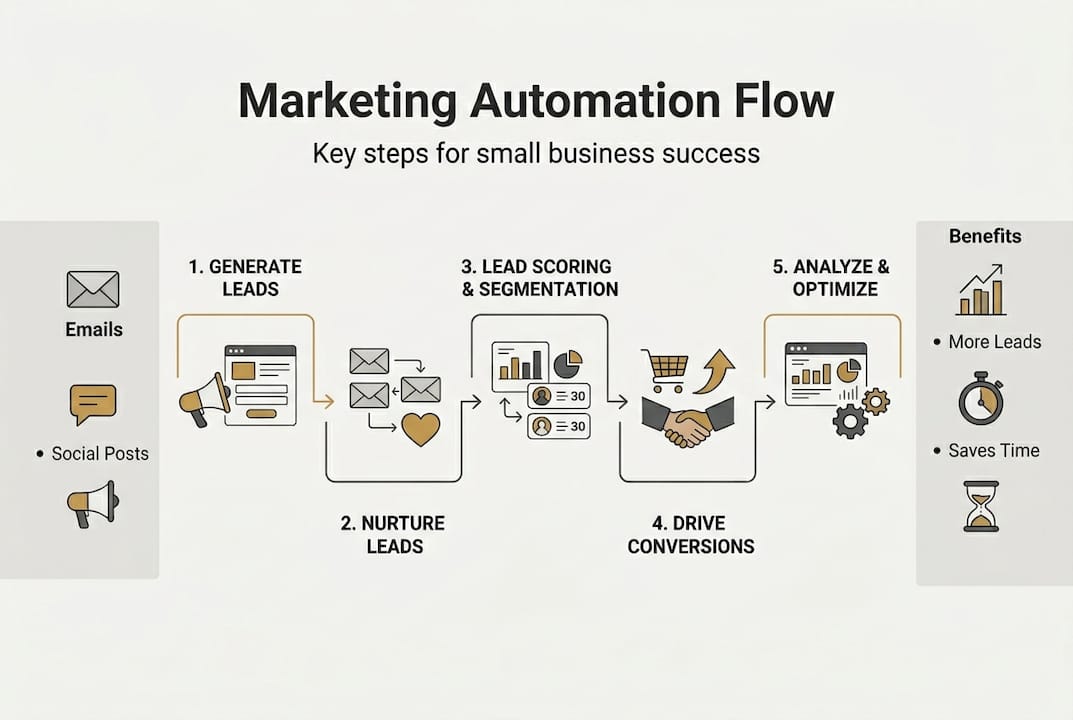
Marketing automation is software that automates repetitive marketing tasks such as email campaigns, lead nurturing, social media scheduling, customer segmentation, and analytics based on predefined triggers, rules, or AI-driven decisions. Instead of manually sending every email or posting to social media daily, you set up workflows once and let the system execute them automatically based on customer behaviors or schedules. This technology transforms how small businesses manage customer relationships by ensuring timely, personalized interactions at scale without constant manual intervention.
The mechanics fall into two categories. Rules-based automation uses fixed trigger and output logic, like sending a welcome email immediately when someone subscribes to your list. AI-assisted automation makes contextual decisions, analyzing customer data to determine optimal send times or personalize content recommendations. For small businesses, the priority is simplicity and cost-effectiveness, focusing on platforms that integrate seamlessly with existing CRM systems and social media accounts.
Key features you will encounter include:
- Email campaign automation that sends targeted messages based on subscriber actions or time delays
- Lead nurturing sequences that guide prospects through your sales funnel with relevant content
- Social media scheduling tools that publish posts across platforms at optimal times
- Customer segmentation that groups audiences by behavior, demographics, or engagement level
- Analytics dashboards that track campaign performance and ROI automatically
These capabilities work together to create a cohesive marketing system. When a prospect downloads your lead magnet, automation can immediately send a thank you email, add them to a nurture sequence, tag them in your CRM, and schedule follow-up tasks for your sales team. This orchestration happens instantly, ensuring no lead falls through the cracks while you focus on strategy and high-value activities. Understanding email marketing best practices helps you maximize these automated workflows.
Benefits and ROI of marketing automation for small businesses
The business case for automation rests on hard numbers. Research shows 14.5% sales productivity increase and 12.2% marketing overhead reduction when companies implement automation systems. For small businesses operating on tight margins, these efficiency gains translate directly to bottom-line profit. The average ROI reaches $5.44 for every dollar spent over three years, making automation one of the highest-return marketing investments available.

AI-powered tools amplify these returns dramatically. Studies document 353% ROI with AI tools like Microsoft Copilot and 30% customer acquisition cost reduction, demonstrating how intelligent automation outperforms traditional rule-based systems. Small business owners typically save 5 to 10 hours weekly on repetitive tasks, freeing time for strategic planning, client relationships, and business development activities that only humans can perform effectively.
| Metric | Impact | Timeframe |
|---|---|---|
| Sales productivity | 14.5% increase | Ongoing |
| Marketing overhead | 12.2% reduction | Annual |
| Revenue growth | 34% increase | Year over year |
| ROI (standard) | $5.44 per $1 spent | 3 years |
| ROI (AI tools) | 353% return | 12 months |
| Time savings | 5 to 10 hours weekly | Ongoing |
Beyond efficiency, automation enhances marketing effectiveness through capabilities impossible to execute manually. Personalization at scale means every subscriber receives content tailored to their interests and behavior, dramatically improving engagement rates. Lead scoring automatically identifies your hottest prospects, ensuring your sales team focuses energy on opportunities most likely to close. Analytics automation surfaces insights about campaign performance in real time, enabling rapid optimization without manual data crunching.
"The true power of marketing automation lies not in replacing human creativity, but in amplifying it by handling the repetitive execution that bogs down small teams."
Additional benefits include:
- Consistent brand messaging across all customer touchpoints without manual coordination
- Improved customer experience through timely, relevant communications triggered by specific actions
- Better sales and marketing alignment with shared data and automated handoffs between teams
- Scalability that lets you serve more customers without proportionally increasing staff
These advantages compound over time. As your automated systems collect more customer data and refine targeting, performance improves continuously. Understanding how sales funnels guide client acquisition helps you structure automation workflows that convert prospects systematically.
Common pitfalls and how to avoid marketing automation mistakes
Automation failures typically stem from strategic errors rather than technical limitations. Common mistakes include forgetting edge cases like overwriting UTM tags, over-automation leading to impersonal interactions, automating without strategy, list hygiene neglect, and information overload. These missteps transform automation from a growth accelerator into a customer relationship liability.
Over-automation creates robotic experiences that alienate prospects. When every interaction feels scripted and impersonal, customers disengage. The solution is maintaining human oversight at critical decision points. Automate the repetitive tasks like sending emails and updating CRM records, but keep humans involved in relationship-building conversations, complex problem solving, and strategic decisions about campaign direction.
List hygiene neglect compounds over time, degrading deliverability and skewing analytics. Dead email addresses, unengaged subscribers, and duplicate records pollute your database, causing automation to waste resources on non-responsive contacts. Implement regular cleaning protocols: remove hard bounces immediately, suppress chronically unengaged subscribers after six months of inactivity, and deduplicate records monthly.
Key pitfalls to watch for:
- Automating before defining clear strategy and goals for what you want to achieve
- Ignoring edge cases in workflow logic that create poor experiences for outlier scenarios
- Setting up complex multi-step sequences without testing each stage thoroughly
- Failing to monitor automation performance and adjust based on actual results
- Overwhelming subscribers with too many automated messages in short timeframes
- Neglecting to update automated content as products, pricing, or messaging evolves
Pro Tip: Start with one or two simple automations like welcome emails and abandoned cart reminders. Master these workflows completely, measuring results and refining messaging before adding complexity. This incremental approach prevents overwhelming your team and ensures each automation delivers proven value before you invest time in the next one.
Information overload happens when automation floods prospects with content faster than they can consume it. Just because you can send daily emails does not mean you should. Respect subscriber attention by spacing communications appropriately and segmenting audiences so people only receive messages relevant to their specific interests. Learn how email marketing drives funnel success through strategic messaging cadence.
How to get started: practical steps and tools for small businesses
Launching automation successfully requires methodical execution focused on quick wins that build momentum. Start small with automations like welcome emails and social scheduling for quick wins, then scale; always define strategy first with human oversight. This approach delivers immediate value while you learn platform capabilities without risking major campaign failures.
Follow this sequence:
- Define your primary marketing goal, whether that is growing your email list, nurturing leads, or re-engaging past customers
- Map your current manual marketing tasks and identify the most time-consuming repetitive activities
- Choose one high-impact automation to implement first, typically welcome email sequences for new subscribers
- Select a tool that integrates with your existing systems and offers the specific features you need
- Build and test your first automation thoroughly with a small segment before rolling out to your full list
- Monitor performance metrics weekly for the first month, adjusting messaging and timing based on open rates and conversions
- Document what works, then add your second automation, gradually expanding your automated marketing system
Tools for small businesses include Mailchimp, HubSpot, and ActiveCampaign for email and CRM automation; Buffer and Hootsuite for social scheduling; integrating multiple tools is best. Each platform offers distinct advantages depending on your specific needs and technical comfort level.
| Tool | Best for | Key features | Starting price |
|---|---|---|---|
| Mailchimp | Email automation beginners | Templates, basic segmentation, analytics | $13/month |
| HubSpot | All-in-one CRM and marketing | Email, social, landing pages, CRM | Free tier available |
| ActiveCampaign | Advanced email sequences | Complex automation, lead scoring, CRM | $29/month |
| Buffer | Social media scheduling | Multi-platform posting, analytics | $6/month |
| Hootsuite | Social media management | Scheduling, monitoring, team collaboration | $99/month |
Pro Tip: Avoid the trap of seeking one perfect all-in-one platform. Most successful small businesses integrate specialized tools that excel at specific functions. Connect your email platform to your CRM, link your social scheduler to your content calendar, and use automation platforms like Zapier to bridge systems. This modular approach gives you best-in-class capabilities for each function.
Measure ROI from day one by tracking time saved, conversion rate improvements, and revenue generated from automated campaigns. Set baseline metrics before implementing automation, then compare performance monthly. This data proves value to stakeholders and guides decisions about where to expand automation next. Explore effective marketing strategies for small businesses to complement your automation efforts with sound strategic foundations.
Explore Brassballs' marketing solutions to boost your business
Implementing marketing automation effectively requires more than just tools, it demands proven strategies and frameworks that convert prospects into paying clients systematically. Brassballs specializes in direct response marketing systems designed specifically for small business owners and entrepreneurs who need results, not theory. Whether you are building your first automated funnel or scaling existing campaigns, Brassballs offers marketing solutions that cut through the noise with no-BS tactics proven to attract premium clients and generate consistent revenue.
The platform provides done-for-you agency services, self-serve courses, and frameworks tailored to diverse industries, all backed by real client success stories demonstrating significant ROI improvements. If you are ready to move beyond frustrating trial and error and implement marketing automation that actually grows your business, explore how Brassballs can accelerate your path to predictable, scalable customer acquisition.
FAQ
What are the best marketing automation tools for small businesses?
Mailchimp, HubSpot, and ActiveCampaign lead for email and CRM automation, offering user-friendly interfaces with robust segmentation and analytics. Buffer and Hootsuite excel at social media scheduling across multiple platforms. Choose based on your primary need: Mailchimp for simplicity, HubSpot for all-in-one functionality, ActiveCampaign for advanced sequences. Explore effective marketing tools to complement your automation strategy.
How much does marketing automation cost for small businesses?
Small business marketing automation solutions typically cost between $20 and $200 per month, depending on features, contact list size, and platform sophistication. Entry-level tools like Mailchimp start around $13 monthly, while comprehensive platforms like HubSpot offer free tiers with paid upgrades. Most businesses find the ROI justifies costs within three to six months through time savings and improved conversion rates.
How can I avoid making marketing automation impersonal?
Include human oversight at critical touchpoints like sales conversations, customer service issues, and relationship-building moments. Use personalization tokens to insert subscriber names, company details, and relevant content based on their specific interests and behaviors. Start small with simple automations, monitor customer responses carefully, and adjust messaging to maintain a conversational tone. Balance efficiency with authentic connection by reserving automated communications for informational content while keeping strategic interactions personal.
What metrics should I track to measure automation success?
Focus on email open rates, click-through rates, conversion rates from automated sequences, time saved on manual tasks, and revenue generated from automated campaigns. Track lead scoring accuracy by measuring how well automated scores predict actual sales. Monitor unsubscribe rates to ensure automation frequency does not overwhelm subscribers. Calculate ROI by comparing automation platform costs against revenue increases and labor savings, aiming for the industry benchmark of $5.44 return per dollar spent over three years.
Can marketing automation work for service-based businesses?
Absolutely. Service businesses benefit enormously from automated appointment reminders, follow-up sequences after consultations, client onboarding workflows, and re-engagement campaigns for past clients. Automation handles administrative communications while you focus on delivering high-value services. Use sequences to educate prospects about your methodology, share case studies, and nurture leads until they are ready to book. The key is maintaining personal touch in actual service delivery while automating the repetitive marketing and administrative tasks surrounding it.