

TL;DR:
- Most small businesses lack a structured marketing approach, relying instead on random tactics and trends. A marketing framework acts as a strategic blueprint, aligning decisions, tactics, and measurements for predictable growth. By diagnosing bottlenecks and customizing frameworks, entrepreneurs can achieve consistent, scalable results instead of wasting resources chasing unmeasurable ideas.
Most entrepreneurs treat marketing like throwing spaghetti at a wall and hoping something sticks. They jump from tactic to tactic, chasing the latest trend, spending money on ads that don't convert, and wondering why their competitors seem to grow while they spin their wheels. Here's the uncomfortable truth: creative ideas alone don't build businesses. Structure does. A marketing framework is a structured approach, a "blueprint," for planning, executing, and analyzing marketing strategies in a repeatable way, and it's the single most underrated weapon in a small business owner's arsenal.
Table of Contents
- What is a marketing framework?
- How frameworks guide marketing: Model vs. execution
- Popular marketing frameworks for small business growth
- Adapting frameworks: Customizing for your business
- Measuring results and optimizing with frameworks
- Most businesses misuse frameworks — here's what actually works
- Ready to put frameworks into action?
- Frequently asked questions
Key Takeaways
| Point | Details |
|---|---|
| Frameworks create structure | A marketing framework gives your business repeatable, organized steps for consistent growth. |
| Guide decisions, not rules | Frameworks help you connect strategy to action by guiding decision-making, not by acting as rigid checklists. |
| Adapt for your business | The best results come from tailoring frameworks to your unique goals, bottlenecks, and customer journeys. |
| Measurement is essential | A good framework links every marketing action to measurable results for ongoing optimization. |
| Frameworks support growth | With the right framework, small businesses can scale client acquisition and revenue with less guesswork. |
What is a marketing framework?
Think of a marketing framework as the architectural blueprint for your entire marketing operation. Without a blueprint, you're just a builder randomly nailing boards together and hoping it resembles a house by the end. With one, every decision has a place and a purpose.
"A marketing framework is a structured approach (a 'blueprint') for planning, executing, and analyzing marketing strategies in a repeatable way." — American Marketing Association
Now, a lot of people confuse a framework with a marketing plan or a marketing strategy. They're related, but they're not the same animal. Your strategy is your "why" and "what," your big-picture thinking about who you serve and how you position yourself. Your plan is the specific actions and timelines. The framework? It's the underlying decision structure that keeps your strategy and plan from drifting apart and becoming strangers. It connects higher-level strategy to tactical execution and measurement through clear KPIs. That's the glue.
You can also think of it this way: strategy tells you to target health-conscious professionals. A framework tells you how to move them from total strangers to paying clients, and how to measure every step in between. The marketing funnel fundamentals that drive awareness through to conversion are typically embedded within a strong framework.
Here's why small businesses in particular benefit from a framework:
- Consistency: Your team (or even just you) knows the decision rules before the fire starts, not during.
- Clarity: You stop asking "what should we post today?" and start asking "where are we losing customers?"
- Scalability: A repeatable system can grow with you without falling apart.
- Measurement: Every stage has a metric, so you know what's working and what's burning your cash.
- Speed: When a new channel or tactic appears, you evaluate it against your framework instead of chasing the shiny object.
If you've ever felt overwhelmed by digital marketing options, a solid framework is basically the filter that keeps you sane.
How frameworks guide marketing: Model vs. execution
Now that we've defined marketing frameworks, it's important to clarify how they fit within day-to-day business activities. Here's a clean analogy to keep it simple.
Think of building a house. The framework is the architectural blueprint. The plan is the project schedule, materials list, and contractor assignments. The tactics are the actual hammers, drills, and paint brushes. You need all three, but without the blueprint, your team ends up rebuilding the same wall four times.

In marketing, tactics connect to goals only when a framework holds them accountable. Without it, "we should run Facebook ads" is a random idea. Inside a framework, Facebook ads become a specific tool for a specific funnel stage, with a specific KPI tied to a measurable outcome. That's a completely different conversation.
The SBA makes this clear: marketing strategy into action requires a plan, but keeping tactics connected to business goals requires a framework. Big difference. The plan executes. The framework governs.
Here are the most common mistakes small businesses make when executing marketing without a framework:
- Running campaigns with no defined success metric
- Changing tactics every month based on gut feel instead of data
- Focusing exclusively on new leads while ignoring retention or referral stages
- Trying to be everywhere at once instead of dominating one funnel stage first
- Having no idea which part of the customer journey is leaking money
Pro Tip: The next time someone pitches you a new marketing tactic, run it through your framework first. Ask "which stage does this serve, what does it measure, and how does it connect to revenue?" If the answer is fuzzy, it's probably not worth your time or budget.
You'll find that learning to optimize your funnel is a lot easier when you have a framework telling you exactly which stage needs the most attention.
Popular marketing frameworks for small business growth
Understanding why frameworks matter, the next question is which ones are most proven for small business growth. Let's cut through the noise.
Lifecycle funnel models like AARRR (nicknamed "Pirate Metrics" because, well, AARRR) are among the most popular and practical for entrepreneurs focused on customer acquisition and revenue growth. The five stages are Acquisition, Activation, Retention, Referral, and Revenue. Each stage has a measurable outcome, which is exactly why it works so well for small businesses who need to see where their money goes.
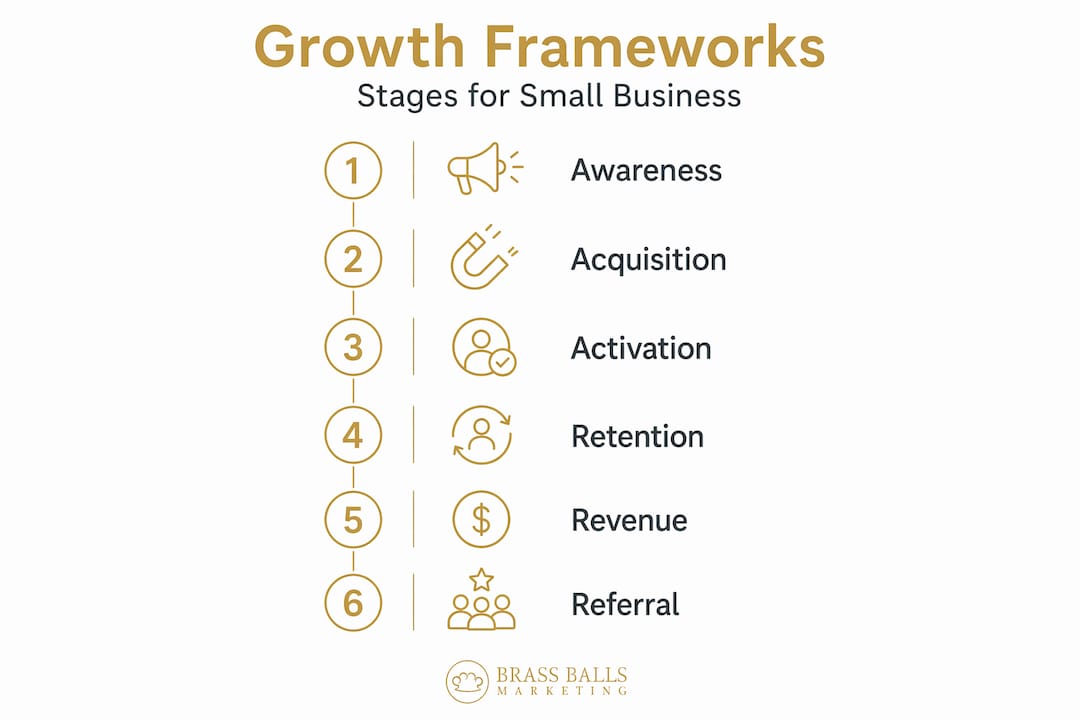
Here's how AARRR compares to two other popular frameworks:
| Framework | Main stages | Best for | Key focus |
|---|---|---|---|
| AARRR (Pirate Metrics) | Acquisition, Activation, Retention, Referral, Revenue | Startups and small businesses | Customer lifecycle and growth metrics |
| STDC (See, Think, Do, Care) | See, Think, Do, Care | Content and awareness-driven businesses | Audience intent and buyer mindset |
| RACE | Reach, Act, Convert, Engage | Digital marketers with multi-channel presence | Full digital customer journey |
Each of these frameworks has strengths. AARRR is brilliant for businesses that need to understand exactly where they're losing customers. STDC works well if content is your primary acquisition channel. RACE gives you a clean overlay for digital campaigns across multiple platforms.
To implement AARRR in your business, follow these steps:
- Define Acquisition. Where do your leads come from? Organic search, paid ads, referrals? Pick your primary channel and set a metric, like cost per lead or number of new visitors.
- Define Activation. What's the first "aha moment" for a new prospect? A free consultation booked, a lead magnet downloaded, or a trial started? Measure the activation rate.
- Track Retention. How many customers come back? Look at repeat purchase rates, subscription renewals, or re-engagement email opens.
- Measure Referrals. Are your happy customers sending you new ones? Net Promoter Score (NPS) and referral tracking reveal this.
- Tie everything to Revenue. At each stage, understand the financial contribution. Which stage, when improved, moves the revenue needle most?
The funnel examples for growth that consistently outperform generic campaigns are the ones built around a framework like AARRR, where every stage has an owner, a metric, and an optimization lever. And using sales funnels strategically within these frameworks is what separates businesses that grow predictably from those that rely on luck.
Adapting frameworks: Customizing for your business
Now that you have a toolkit of frameworks, the next step is making them fit your own goals and customers. Because here's the honest truth: no framework drops out of the sky and fits your business perfectly. Anyone who tells you otherwise is selling something (and probably a bad something).
The underlying logic of targeting, positioning, and funnel stages should remain consistent even as your tactics and channels evolve. Think of it like a skeleton. The bones don't change, but the muscles and movement adapt to the environment. A professional services firm has a very different activation moment than an eCommerce store. A local restaurant's retention strategy looks nothing like a SaaS company's. And that's completely fine, as long as the framework logic guides the adaptation.
Before you customize, ask yourself these five questions:
- Who is my most profitable customer segment, and what stage do they reach before dropping off?
- What does "activation" genuinely mean in my business context?
- Where in the customer journey do I lose the most potential revenue?
- Which stage, if improved by 10%, would have the biggest business impact?
- Am I measuring vanity metrics (likes, impressions) or actual stage progression?
These questions help you stop copying competitor frameworks and start building something that actually reflects your sales cycle. A franchise model, for example, may treat referrals as the highest-value stage. A premium service business might obsess over activation because that's where trust is either built or lost forever.
Pro Tip: Don't start by optimizing the top of your funnel. Start by diagnosing where you're losing customers. Pouring more leads into a leaky funnel is like filling a bathtub with the drain open. Fix the biggest leak first, then open the tap wider.
Understanding segmentation in funnel optimization helps you personalize each framework stage for different audience segments, which dramatically improves conversion rates. And if you're starting from scratch, a clean guide to build your sales funnel will give you the foundation to apply any framework effectively.
Measuring results and optimizing with frameworks
The best frameworks power growth only when they inform what you measure and optimize consistently. A framework with no measurement is just a pretty diagram on a whiteboard. Sad, but true.
Strong frameworks connect strategy to KPIs at every stage, which means you're never guessing what to fix. Here's a practical mapping of common funnel stages to the KPIs that actually matter:
| Funnel stage | Primary KPI | Secondary KPI |
|---|---|---|
| Awareness | Website traffic, ad reach | Cost per thousand impressions (CPM) |
| Consideration | Email sign-ups, content downloads | Time on page, click-through rate |
| Conversion | Sales, booked consultations | Conversion rate, cost per acquisition |
| Retention | Repeat purchases, renewals | Customer lifetime value (CLV) |
| Referral | Referral sign-ups, NPS score | Referral conversion rate |
With this table as your guide, you stop drowning in data and start making decisions. High traffic but low consideration metrics? Your content or offer isn't compelling enough. Strong conversions but terrible retention? Your onboarding or post-sale experience needs work.
Here are practical tips for keeping frameworks and analytics tightly linked:
- Review KPIs weekly by funnel stage, not just total revenue
- Set a single "north star" metric for each stage that everyone on your team tracks
- When you change a tactic, change only one variable at a time so you know what caused the shift
- Build a simple dashboard that maps directly to your framework stages (not just traffic and sales)
- Celebrate improvements at each stage, not just final revenue, because stage wins compound over time
Frameworks also help you spot bottlenecks intelligently. Instead of "our revenue is down," you can say "our activation rate dropped 12% last month," which leads directly to a diagnosis and a fix. That's reliable revenue growth through structure, not through luck. And using the right must-have marketing tools to track these metrics makes the whole process significantly less painful.
Most businesses misuse frameworks — here's what actually works
Having covered frameworks, models, and measurement, let's challenge some common misconceptions about how to use them. Because honestly, most small business owners who adopt frameworks still get this wrong.
The most common mistake? Treating a framework like a rigid checklist. "We did the AARRR thing. Now what?" That mindset turns a powerful decision structure into a dead template. Markets shift. Channels evolve. Buyer behavior changes. What worked in 2023 may be deader than disco in 2026. The framework's logic, targeting, positioning, funnel thinking, and measurement, should remain consistent. But how you execute within each stage should change constantly based on data and real-world feedback.
Here's what actually works, based on the patterns we see repeatedly in businesses that grow predictably. They don't start at the top of the funnel. They start with a ruthless bottleneck diagnosis. They look at their existing framework, find the one stage where the most potential customers are slipping away, and fix that first. Not the flashiest problem. Not the sexiest campaign. The bottleneck.
We once worked with a services business that was obsessed with driving more traffic. Traffic was fine. Their activation rate, meaning the percentage of visitors who booked a consultation, was sitting at 1.2%. After identifying that as the real bottleneck and restructuring the landing page experience to address specific objections, activation jumped to 4.8% in six weeks. Same traffic. Four times the consultations. No new ad spend. That's what framework-driven thinking looks like in practice.
The other thing that separates winners is that they treat frameworks as thinking tools, not gospel. They borrow from AARRR, adapt a stage from RACE, and completely reinvent what "referral" means for their specific business context. Smart business owners who attract premium clients understand that frameworks create the structure within which creativity thrives, not the absence of it.
Stage-by-stage progress is your competitive advantage. Most of your competitors are looking at total revenue and total ad spend. If you're measuring activation rates, retention cohorts, and referral quality separately, you're playing a completely different (and much better) game.
Ready to put frameworks into action?
If you've made it this far, you understand that consistent growth doesn't come from chasing tactics or copying competitors. It comes from building a repeatable structure that connects every marketing move to a measurable outcome. Frameworks aren't just for big corporations with full marketing teams. They're for every entrepreneur who's tired of guessing and ready to grow with intention.
At Brass Balls, we help small business owners and entrepreneurs install exactly this kind of structured thinking into their marketing, from identifying your funnel bottlenecks to building direct response campaigns that convert. Whether you want it done for you or you prefer to roll up your sleeves with our self-serve resources, we've got a path for you. Start by seeing how email drives funnel results at every stage, because email is often the highest-ROI lever inside a well-structured framework. Ready to stop winging it? Let's build something that actually works.
Frequently asked questions
How is a marketing framework different from a marketing plan?
A marketing framework lays out the structure and decision logic, while a marketing plan details specific actions and timelines. As the SBA explains, a plan turns strategy into action, but a framework keeps tactics connected to business goals consistently.
Which marketing framework is best for small businesses?
Lifecycle models like AARRR are especially practical for small businesses focused on client acquisition and revenue growth. Pirate Metrics frameworks help you measure every stage from first contact to referral, which is exactly the visibility small businesses need.
Can I combine different marketing frameworks?
Yes, and skilled marketers do it all the time. Marketing frameworks are decision structures, not rigid checklists, so blending and adapting elements from multiple models to fit your specific business is not just allowed — it's encouraged.
Do marketing frameworks work for non-digital channels?
Absolutely. The structured blueprint approach applies equally to traditional channels like direct mail, events, and print as it does to digital campaigns. The logic of stages, measurement, and optimization transcends the medium.
What's the biggest mistake when using a marketing framework?
Treating it as a one-size-fits-all checklist is the biggest trap. Frameworks are decision structures meant to be adapted as tactics evolve, while the underlying logic of targeting, positioning, and measurement stays consistent.