

You've tried the boosted posts. You've hired the social media guru. You've thrown money at Google ads like confetti at a parade, and your phone still isn't ringing the way it should. Sound familiar? That's the slow bleed of scattered, unmeasured marketing, and it's costing you more than just cash. It's costing you momentum. A direct response workflow flips that script entirely. Instead of hoping your brand awareness eventually trickles down into sales, you build a system that demands a measurable action from every single person who sees your message. This guide walks you through every phase, from setup to optimization, so you can stop guessing and start acquiring clients on purpose.
Table of Contents
- What is a direct response workflow?
- Preparation: Setting up your direct response workflow
- Step-by-step: Creating and launching your direct response campaign
- Tracking, testing, and optimizing your workflow
- Common mistakes in direct response workflows (and how to avoid them))
- What results to expect: Measuring the impact of a direct response workflow
- Accelerate your growth with structured direct response
- Frequently asked questions
Key Takeaways
| Point | Details |
|---|---|
| Measurable marketing | A direct response workflow lets you track results for every campaign you run. |
| Faster client acquisition | Action-focused steps drive leads and sales quickly—perfect for small businesses. |
| Low-cost testing | You can start direct response marketing with a small budget and scale what works. |
| Multi-channel works best | Combining email, SMS, and direct mail raises response and revenue. |
| Continuous improvement | Tracking, testing, and pivoting make your campaigns more profitable over time. |
What is a direct response workflow?
Let's get one thing straight. A direct response workflow is not a vibe. It's not a mood board or a brand story. It's a step-by-step marketing process engineered to trigger fast, measurable actions from your audience, whether that's clicking a link, booking a call, or handing over their email address.
The direct response marketing workflow involves several actionable steps that separate it from the fuzzy world of brand marketing. Brand marketing says, "Hey, we exist, isn't that nice?" Direct response says, "Here's a specific offer, here's why you need it right now, and here's exactly what to do next." One is a billboard. The other is a salesperson who never sleeps.
For small business marketing success, this approach is a game changer because it's lean, trackable, and scalable without a massive budget. The core characteristics of any solid direct response workflow include:
- A clear, irresistible offer
- A strong, specific call to action (CTA)
- Built-in urgency or scarcity
- Measurable outcomes tied to every step
- Follow-up sequences that don't quit
Think of it like Dan Kennedy's methods, which have been generating leads and sales for decades across industries. The marketing system basics are the same whether you're selling coaching, plumbing, or premium dog food. Offer, CTA, urgency, track, repeat.
"Direct response marketing is not about being clever. It's about being clear, compelling, and impossible to ignore."
Preparation: Setting up your direct response workflow
Before you write a single word of copy or set up a landing page, you need to do the boring-but-critical prep work. Skip this and you're basically building a race car without checking if there's fuel in the tank.
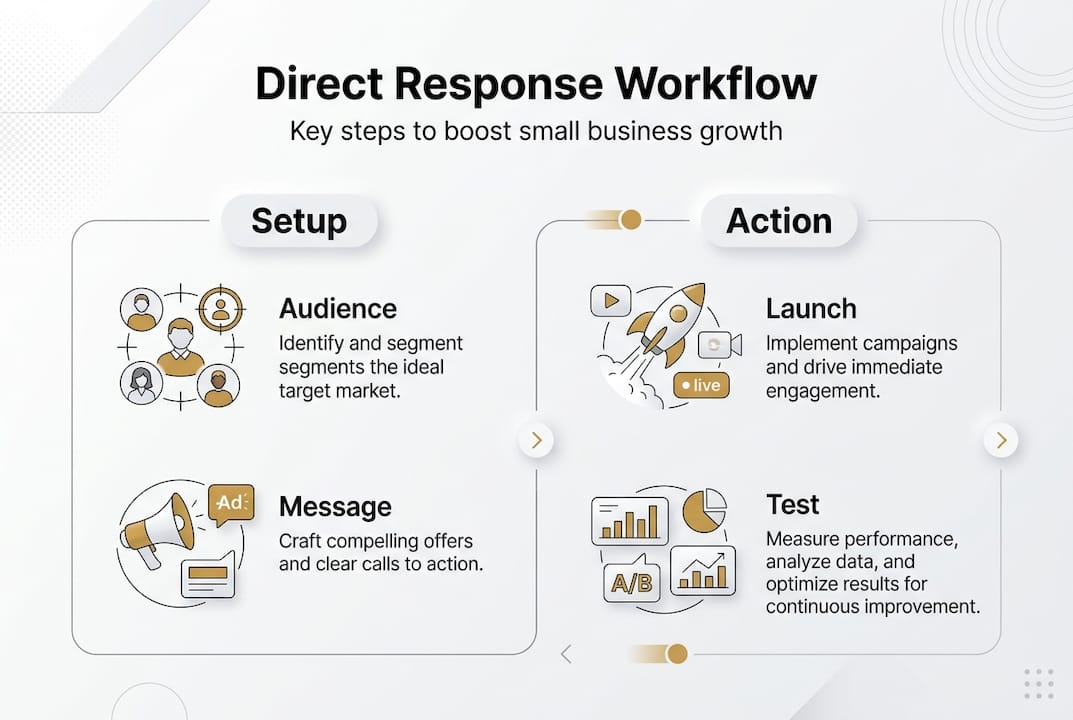
Start by defining your audience with surgical precision. Who are they? What keeps them up at night? What have they already tried that didn't work? The more specific you get, the more your message will feel like it was written just for them, because it was.

Next, develop your offer. Not a "we provide quality services" offer. A real offer with a specific outcome, a deadline, and a reason to act now. Success requires product-market fit and testing small budgets first, so don't blow your whole budget on one untested campaign. Start with $50 to $100 to validate before you scale.
Here's a quick tools checklist to get your workflow ready:
- Landing page builder (ClickFunnels, Leadpages, or even a simple WordPress page)
- Email autoresponder (ActiveCampaign, Mailchimp, or ConvertKit)
- SMS platform if you're going multi-channel (Textmagic, SimpleTexting)
- Tracking software (Google Analytics, UTM parameters, or your CRM)
- A solid direct response guide to keep your strategy grounded
Check out this simple prep framework before launching:
| Prep step | Action required | Time needed |
|---|---|---|
| Audience research | Build a detailed customer avatar | 2 to 3 hours |
| Offer development | Write your core offer with urgency | 1 to 2 hours |
| Channel selection | Choose 1 to 2 channels to start | 30 minutes |
| Tools setup | Configure landing page and autoresponder | 2 to 4 hours |
| Budget allocation | Set test budget of $50 to $100 | 15 minutes |
Pro Tip: Focus your first campaign on your single best-selling product or service. Don't try to market everything at once. One offer, one audience, one channel. Master that before you expand. Check out growth marketing strategies and marketing automation setup to build on this foundation.
Step-by-step: Creating and launching your direct response campaign
Alright, prep is done. Now let's build the thing. The direct response workflow steps cover offer, CTA, channel selection, landing pages, follow-up, tracking, and testing. Here's how to execute each one without losing your mind.
- Craft your offer and CTA. Your offer needs to solve a specific problem with a specific result. Your CTA needs to be one action, stated clearly. "Book your free 20-minute strategy call" beats "Contact us" every single time.
- Select and set up your channels. Email is your workhorse. SMS is your sniper. Direct mail is your secret weapon that most competitors have abandoned. Pick one or two to start.
- Build and optimize your landing page. One page, one goal. No navigation menu. No distractions. Just the offer, the proof, and the CTA. Check out funnel examples to see what high-converting pages actually look like.
- Design your follow-up sequence. Most leads don't convert on the first touch. Build a 5 to 7 step email sequence and layer in SMS nudges. Multi-channel campaigns boost response by 37%, so don't rely on a single message.
- Track, measure, and A/B test everything. Split your list. Test one variable at a time. Subject line, headline, CTA button color. Small changes compound into big results. See direct response stats for benchmarks to measure against.
Here's a quick channel comparison to help you decide where to start:
| Channel | Avg. open rate | Response rate | Best use case |
|---|---|---|---|
| 20 to 40% | 2 to 5% | Nurture sequences, offers | |
| SMS | Up to 98% | 10 to 30% | Urgent offers, reminders |
| Direct mail | N/A | 4.4% avg | Cold outreach, premium offers |
| Paid ads | Varies | 1 to 3% | Top-of-funnel lead gen |
Pro Tip: Personalize your follow-ups with the prospect's name, their specific pain point, or the exact offer they clicked on. Personalized email campaign tips can dramatically lift your response rates.
Tracking, testing, and optimizing your workflow
If you're not measuring it, you're just guessing. And guessing is expensive. Here's what you need to track in every campaign:
- Response rate: How many people took the desired action?
- Conversion rate: Of those who responded, how many became paying clients?
- Cost per lead: Total spend divided by total leads generated
- Campaign ROI: Revenue generated versus dollars spent
Use Google Analytics for web traffic, your CRM for lead tracking, and your email platform's built-in stats for open and click rates. The metrics to track include responses, conversions, and ROI, then A/B test and optimize from there.
Here's a stat worth tattooing on your brain: email ROI delivers $36 for every $1 invested, and SMS open rates hit 98%. These aren't vanity metrics. They're proof that direct response, done right, prints money.
To run an A/B test properly, split your list into two equal groups. Change one variable only, whether that's the subject line, the headline, or the send time. Run the test for enough time to get statistically meaningful data, then roll out the winner.
Pro Tip: Track channel performance weekly, not monthly. Markets shift fast. If something isn't working after two weeks, pivot. Don't wait for a quarterly review to realize you've been burning budget. Explore boost client acquisition and email best practices to sharpen your optimization game. Also check Dan Kennedy's workflow for time-tested optimization principles.
Common mistakes in direct response workflows (and how to avoid them)
Even smart business owners trip over the same landmines. Here are the four biggest workflow killers and how to sidestep them.
- Unclear CTA or weak offer. If your prospect has to think about what to do next, you've already lost them. One CTA. One offer. Crystal clear.
- Skipping follow-up steps. Most sales happen between the 5th and 12th contact. If you send one email and give up, you're leaving serious money on the table.
- Not testing or tracking campaigns. Running the same ad for three months without checking the numbers is like driving blindfolded. Key methodologies always include urgency, instructions, tracking, follow-up, and strong copy.
- Generic, non-personalized messaging. "Dear valued customer" is deader than disco. Use their name. Reference their problem. Make them feel seen.
Fix these with simple checklists and templates for each campaign phase. Before you hit send on anything, run through your checklist. Does it have a clear offer? A single CTA? Urgency? A follow-up plan? If not, fix it first. Check out effective marketing strategies for templates that keep you on track.
"Relentless follow-up and urgency will always outperform passive brand awareness. Always."
What results to expect: Measuring the impact of a direct response workflow
Let's talk numbers, because that's what direct response is all about. Here's what the data says you can realistically expect when you follow the workflow properly:
- Email campaigns: 20 to 40% open rates, 2 to 5% click-through rates, and an ROI of $36 per dollar invested
- SMS campaigns: Open rates up to 98%, response rates of 10 to 30%
- Direct mail: Average response rate of 4.4% with an ROI of $42 for every $1 spent
Here's a benchmark table to keep handy:
| Channel | Expected open rate | Response rate | Typical ROI |
|---|---|---|---|
| 20 to 40% | 2 to 5% | $36:$1 | |
| SMS | Up to 98% | 10 to 30% | High (varies) |
| Direct mail | N/A | 4.4% | $42:$1 |
| Paid ads | Varies | 1 to 3% | 2x to 5x spend |
If you follow the workflow best practices laid out in this guide, here's what you can realistically expect:
- A steady, predictable flow of qualified leads every week
- Lower cost per acquisition compared to untargeted advertising
- Higher conversion rates because your messaging is specific and relevant
- A scalable system that grows as your budget grows
Measurable marketing turns into lasting client acquisition because you know exactly what's working and can double down on it. That's how you grow your business without the guesswork.
Accelerate your growth with structured direct response
You now have the full blueprint. From defining your audience to tracking your ROI, the direct response workflow is the closest thing to a guaranteed system for consistent client acquisition. But knowing the steps and executing them flawlessly are two very different things.
If you want hands-on help building and running a direct response system that actually converts, the team at BrassBalls specializes in exactly that. No fluff, no vanity metrics, just proven funnels and frameworks that bring in premium clients. Whether you want a done-for-you solution or prefer to learn the ropes yourself, explore the business marketing strategies that are working right now for small businesses across industries. Your next client is out there. Let's go get them.
Frequently asked questions
What is the direct response workflow in marketing?
A direct response workflow is a structured, step-by-step process that drives measurable actions, like sign-ups or sales, using clear offers and tracked campaigns.
How can small businesses benefit from direct response marketing?
Small businesses see higher ROI and faster lead generation, especially when campaigns are optimized through ongoing testing and targeted messaging, as outlined in this direct response guide.
What channels work best for direct response workflows?
Email, SMS, and direct mail each deliver strong response rates, but multi-channel campaigns boost response by 37%, making a combined approach the most effective.
How much should I spend to test a direct response campaign?
You can start testing effective direct response campaigns with as little as $50 to $100 to find product-market fit before scaling your budget.