

Most small business owners are one bad marketing decision away from flushing serious cash down the drain. Here's the uncomfortable truth: not all marketing tactics are created equal, and the gap between proven and untested approaches is wider than most people realize. Direct mail generates $253 in revenue per lead compared to just $41 from PPC, which is a 509% difference that should make you stop and think. If you're tired of spinning your wheels on shiny new tactics that promise the world and deliver a participation trophy, this article is your reality check. We'll break down what makes a strategy truly proven, why it matters, and how to put it to work without losing your mind.
Table of Contents
- What makes a marketing strategy 'proven'
- The benefits of using proven strategies
- Proven strategies vs. trendy tactics: A side-by-side look
- How to choose and apply proven strategies in your business
- A fresh perspective: Why the smartest small businesses always value simplicity over hype
- Ready to put proven strategies to work for your business?
- Frequently asked questions
Key Takeaways
| Point | Details |
|---|---|
| Proven beats trendy | Tried-and-tested strategies deliver better ROI and stability than unproven trends. |
| Measure your results | Track ROI and adjust your approach using data, not guesswork. |
| Keep it simple | Simplicity in execution often leads to the most consistent business growth. |
| Start, test, scale | Begin with proven tactics, test on a small scale, and expand what works. |
What makes a marketing strategy 'proven'
Let's cut through the noise. A proven marketing strategy isn't just something that worked once for some guy in a podcast. It's a tactic with a track record of repeatable, measurable results across different businesses, industries, and market conditions. Think of it like a recipe that works every time, not just when the stars align.
Here's what separates a proven strategy from a trendy one:
- Documented results: Real case studies, real numbers, real ROI. Not vanity metrics like likes or impressions.
- Repeatability: It works consistently, not just in one lucky quarter.
- Measurable outcomes: You can tie the strategy directly to revenue, leads, or client acquisition.
- Scalability: It can grow with your business without falling apart.
- Low dependency on luck: The results come from the system, not from timing or chance.
Now, contrast that with the hype train. Every year, there's a new "game-changing" tactic that floods your inbox and social feed. NFT marketing. Metaverse storefronts. AI chatbots that were supposed to replace your entire sales team by Tuesday. Some of these have merit. Most are experiments dressed up as solutions.
"A structured marketing plan with clear ROI measurement is the foundation of sustained revenue growth for small businesses." — SBA marketing guide
The SBA is blunt about this: without structure and measurement, you're just guessing. And guessing with your marketing budget is an expensive hobby.
One of the biggest myths floating around is that newer automatically means better. It doesn't. A tactic that's been around for decades, like email marketing or referral programs, can absolutely outperform a brand-new platform that nobody fully understands yet. The key is evidence. If you can point to consistent, verified results from marketing strategies for small businesses with real data behind them, that's your green light.
Another myth worth busting: proven strategies are boring or outdated. Wrong. They're proven because they tap into human psychology and buying behavior, which hasn't changed as much as the platforms have. People still respond to clear offers, social proof, and a reason to act now. The channel might evolve, but the fundamentals stay rock solid. Learning to improve marketing ROI starts with understanding which strategies have earned their stripes.
The benefits of using proven strategies
Okay, so proven strategies have a track record. But what does that actually mean for your business day to day? Quite a lot, as it turns out.
The first big win is predictability. When you know a strategy works, you can plan around it. You can forecast revenue, set realistic client acquisition targets, and stop playing the marketing lottery every month. That kind of stability is worth its weight in gold when you're running a small operation.

The second win is cost efficiency. Look at this comparison:
| Marketing channel | Revenue per lead | Relative efficiency |
|---|---|---|
| Direct mail | $253 | High |
| PPC (pay-per-click) | $41 | Lower |
| Email marketing | Varies (avg. $36 ROI per $1 spent) | Very high |
| Referral programs | Low cost, high trust | Very high |
The revenue per lead gap between direct mail and PPC is staggering. That's not a small rounding error. That's the difference between a strategy that funds your growth and one that drains your budget while you wait for results that never quite materialize.
The third win is reduced overwhelm. Small business owners are already wearing twelve hats. Adding "figure out the latest social media algorithm" to that list is a fast track to burnout. Proven strategies give you clarity. You know what to do, why you're doing it, and what success looks like. That mental clarity alone is a competitive advantage.
Pro Tip: Before you try anything new, ask yourself: "Can I find three case studies where this worked for a business like mine?" If the answer is no, treat it as an experiment with a capped budget, not your primary growth engine. Lean into rapid growth strategies that have a documented history of results.
Fourth, proven strategies let you build on what works. Once you nail a channel, you can optimize it, automate it, and layer on complementary tactics. That's how you build a real marketing engine, not a collection of disconnected experiments. Exploring marketing funnel examples from businesses similar to yours can show you exactly how these pieces fit together.
Proven strategies vs. trendy tactics: A side-by-side look
Let's get specific. Here's how proven strategies stack up against trendy tactics across the factors that actually matter to your bottom line:
| Factor | Proven strategies | Trendy tactics |
|---|---|---|
| ROI reliability | High, backed by data | Unpredictable, often unproven |
| Upfront cost | Moderate, scalable | Often high for early adopters |
| Client acquisition speed | Consistent and steady | Slow or inconsistent |
| Scalability | Strong, systems-based | Risky, platform-dependent |
| Risk of failure | Low | High |
| Learning curve | Manageable | Steep and changing |
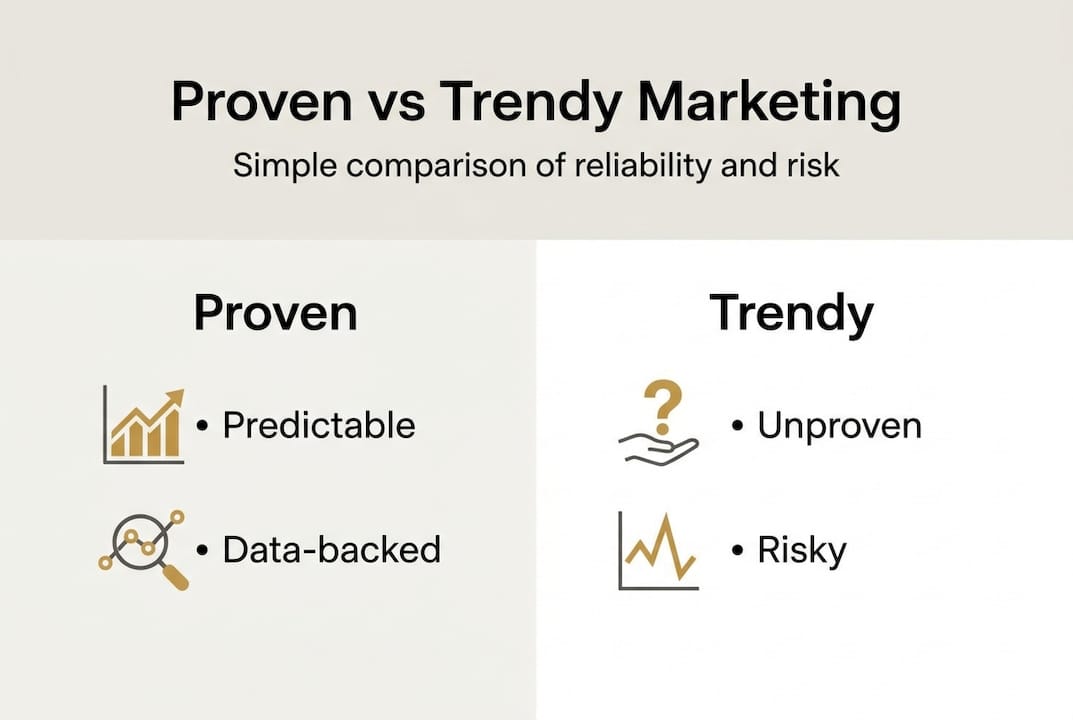
Trendy tactics aren't always bad. But the risk profile is completely different. When you jump on a new platform or format early, you're essentially funding someone else's experiment. Sometimes it pays off. More often, you spend three months learning a new tool, produce mediocre results, and then watch the platform pivot its algorithm and undo everything you built.
The revenue per lead data from direct mail versus PPC is a perfect example of this dynamic. PPC is not a bad tactic, but it's also not a magic wand. The businesses that treat it as their only strategy often end up disappointed.
Here's a simple process to evaluate any new tactic before you commit:
- Find the evidence: Look for case studies with real numbers from businesses your size.
- Check the source: Is this success story from the platform selling you the tactic? Be skeptical.
- Compare to your baseline: How does the projected ROI compare to what your current proven strategies deliver?
- Set a test budget: If you want to try it, cap your spend and define what success looks like before you start.
- Measure and decide: After the test period, compare results honestly. If it doesn't beat your proven methods, move on without guilt.
This is how you stay open to innovation without getting played by the hype cycle. Think of it as building actionable marketing strategies on a foundation of what actually works, with room to test and learn on the edges. That's also why building marketing systems matters so much. Systems protect you from chasing every shiny object that crosses your feed.
How to choose and apply proven strategies in your business
Knowing that proven strategies work is one thing. Figuring out which ones are right for your business is where most people get stuck. Let's fix that.
Start by asking yourself three honest questions:
- Who exactly is my ideal client, and where do they spend their time?
- What's my current marketing budget, and how much can I realistically test?
- Do I have the capacity to execute consistently, or do I need something low-maintenance?
Your answers will point you toward the right starting point. Here's a shortlist of proven strategies worth considering:
- Direct mail: High revenue per lead, tangible, cuts through digital noise
- Email marketing: Low cost, high ROI, great for nurturing and repeat business
- Referral programs: Leverages existing trust, low cost, high conversion
- Content marketing with SEO: Slow to build, but compounds over time
- Networking and partnerships: Relationship-driven, especially powerful in local markets
- Targeted paid ads (with proper funnels): Works when paired with a solid offer and landing page
Once you've picked one or two to focus on, follow this simple execution process. First, define your goal clearly. "Get more clients" is not a goal. "Acquire 5 new clients per month at a cost of under $200 each" is a goal. Second, set up basic tracking so you know what's working. Third, run the strategy consistently for at least 60 to 90 days before drawing conclusions. Fourth, review your numbers and adjust one variable at a time.
The SBA's guidance on measuring marketing ROI reinforces this: structured plans with clear measurement are what separate businesses that grow from those that stagnate. If you're targeting marketing success for your specific audience, clarity and consistency will always beat complexity and volume.
Pro Tip: Start with one proven strategy, not five. Master it, measure it, then add the next layer. Trying to run six channels at once is a great way to do all of them badly. And if you want to save time, look into small business marketing automation to keep your proven systems running without requiring your constant attention.
A fresh perspective: Why the smartest small businesses always value simplicity over hype
Here's something nobody wants to admit: the marketing industry has a vested interest in making things seem complicated. More complexity means more tools to sell, more courses to peddle, and more consultants to hire. But the businesses we see winning consistently aren't the ones running the most sophisticated campaigns. They're the ones who picked two or three things that work and did them relentlessly well.
Complexity is seductive. It feels like progress. But chasing the next big thing is often just procrastination dressed up in a hoodie. The real edge comes from execution, not experimentation. Simple strategies, applied consistently, compound over time in ways that no one-hit-wonder tactic ever will.
If you want proof, look at the businesses that have been quietly growing for years without making noise about their "cutting-edge" approach. They've got a marketing systems guide they actually follow. Less hustle, more smart execution. That's the real secret, and it's been hiding in plain sight the whole time.
Ready to put proven strategies to work for your business?
You now know what separates a proven strategy from a trendy gamble, and you've got a clear framework for choosing and applying the right tactics for your business. The next step is actually doing something with that knowledge.
At BrassBalls, we specialize in no-BS direct response marketing built on strategies that have a track record of delivering real results for small business owners. Whether you need done-for-you support, a self-serve course, or just a clear starting point, we've got the tools and frameworks to help you stop guessing and start growing. No fluff, no hype, just marketing that works.
Frequently asked questions
What defines a 'proven' marketing strategy?
A proven marketing strategy delivers consistent, measurable results across different contexts, supported by real data and case studies, like direct mail's $253 revenue per lead compared to $41 from PPC.
How do I know if a new marketing trend is worth trying?
Test it on a small budget first and compare its ROI against your current methods before scaling, following the structured measurement approach the SBA recommends for small businesses.
Why do proven strategies often outperform new tactics?
Proven strategies are backed by documented results and tested across real business conditions, which means far less risk of costly mistakes compared to unproven alternatives.
Are proven strategies less risky than experimental ones?
Yes, because they rely on repeatable outcomes and actual performance data, which dramatically lowers the chance of wasting your time and budget on something that doesn't deliver.