

You're spending money on marketing, watching the budget drain away, and wondering why the phone isn't ringing. Sound familiar? You're not alone. Most small business owners are stuck in this exact loop, pouring cash into ads, social posts, and email blasts that produce little more than a shrug. The good news is that low ROI isn't a death sentence for your business. It's a solvable problem, and the fix is less about spending more and more about spending smarter. This guide walks you through proven, data-backed steps to turn your marketing from a money pit into a genuine growth engine.
Table of Contents
- Why most small businesses struggle with marketing ROI
- Assess your current marketing ROI and set clear goals
- Prioritize high-impact, low-cost channels
- Step-by-step: Optimize your marketing for maximum ROI
- Avoid common ROI killers and verify your results
- Ready to maximize your marketing ROI?
- Frequently asked questions
Key Takeaways
| Point | Details |
|---|---|
| Benchmark your ROI | Know your current numbers and compare against industry averages before making changes. |
| Focus on proven channels | Email, short video, and AI-boosted content deliver the strongest, most affordable ROI for SMBs. |
| Prioritize planning and measurement | Businesses that carefully plan and track their marketing are much more likely to increase ROI. |
| Automate and review regularly | Use automation and frequent reviews to improve performance over time without wasting budget. |
| Avoid common mistakes | Stay away from unclear goals, ignoring data, and failing to test—these kill ROI quickly. |
Why most small businesses struggle with marketing ROI
Let's be blunt: most small businesses treat marketing like a lottery ticket. They throw money at a channel, hope for the best, and then complain when it doesn't pay off. That's not a strategy. That's wishful thinking with a credit card.
The real culprits behind low ROI are pretty consistent across industries:
- No written plan. Flying by the seat of your pants feels agile, but it's actually chaos. Planners are 6.7x more successful than those who don't plan, yet most SMBs skip this step entirely.
- Budget misallocation. Cheap doesn't mean effective. A $5 Facebook boost might feel affordable, but if it's not converting, it's just expensive confetti.
- Channel confusion. Businesses chase every shiny new platform without understanding which ones actually drive sales for their specific audience.
- Zero tracking. If you're not measuring customer acquisition cost (CAC), conversion rates, and channel performance, you're flying blind.
"The biggest ROI killer isn't a bad ad. It's a business owner who doesn't know what's working and keeps doing it anyway."
Understanding marketing success for small businesses starts with admitting that guesswork is the enemy. Once you accept that, you can start building something that actually works.
To overcome these challenges, you need a clear starting point before investing in new tactics.
Assess your current marketing ROI and set clear goals
Before you optimize anything, you need to know where you stand. Think of this as your marketing health checkup. Painful? Maybe. Necessary? Absolutely.
Here's how to do it in four steps:
- Gather your current data. Pull your ad spend, email open rates, website traffic, and sales numbers for the last 90 days. No cherry-picking.
- Calculate your ROI. The formula is simple: (Revenue from marketing minus marketing cost) divided by marketing cost, multiplied by 100. If you spent $500 and made $1,500, your ROI is 200%.
- Compare against benchmarks. Use real industry data to see where you stand. B2B landing page conversion rates average 13.3%, and CAC for service businesses runs $95 to $185.
- Set SMART goals. Specific, Measurable, Achievable, Relevant, and Time-bound. "Get more leads" is not a goal. "Increase landing page conversions by 15% in 60 days" is.
Here's a quick benchmark reference to calibrate your expectations:
| Metric | SMB benchmark (2026) |
|---|---|
| Google Ads median CTR | 3.2% |
| Google Ads CPC | $1.25 |
| ROAS (paid ads, low budget) | 2.5x to 3.8x |
| Email ROI | $36 per $1 spent |
| B2B landing page conversion | 13.3% |
| CAC (services) | $95 to $185 |
| CAC (SaaS) | $250 to $600 |
Reviewing your numbers against solid marketing strategy benchmarks gives you a reality check and a roadmap. Pair that with sharp client acquisition strategies and you've got a real foundation.
Pro Tip: Always include hidden costs in your ROI calculations. Staff time, software subscriptions, and creative production costs are real expenses. Ignoring them inflates your ROI and leads to bad decisions.
Once goals and baseline metrics are set, it's time to optimize what matters most.

Prioritize high-impact, low-cost channels
Not all marketing channels are created equal. Some are workhorses. Others are show ponies that look great but don't pull the cart. For SMBs with tight budgets, picking the right channels is everything.
The data is pretty clear on which channels punch above their weight:
- Email marketing delivers $36 for every $1 spent. That's not a typo. It's the highest ROI channel available to small businesses, period.
- Short-form video tops channel ROI rankings across platforms. Think TikTok, Instagram Reels, and YouTube Shorts. Low production cost, high engagement, and the algorithm rewards consistency.
- AI-assisted content boosts content ROI by 68%, meaning you can produce more, faster, without sacrificing quality.
Here's a side-by-side comparison to help you prioritize:
| Channel | Avg. ROI | Ease of use | Best for |
|---|---|---|---|
| Email marketing | $36 per $1 | High | Nurturing leads, repeat sales |
| Short-form video | Top-ranked | Medium | Brand awareness, engagement |
| Google Ads | 2.5x to 3.8x ROAS | Medium | Intent-based lead gen |
| Social media (organic) | Variable | High | Community building |
| AI-boosted content | +68% ROI lift | Medium | Scaling content output |
The smartest move? Start with email marketing ROI as your foundation, layer in short video for reach, and use a well-structured marketing funnel to connect the dots between awareness and sale.
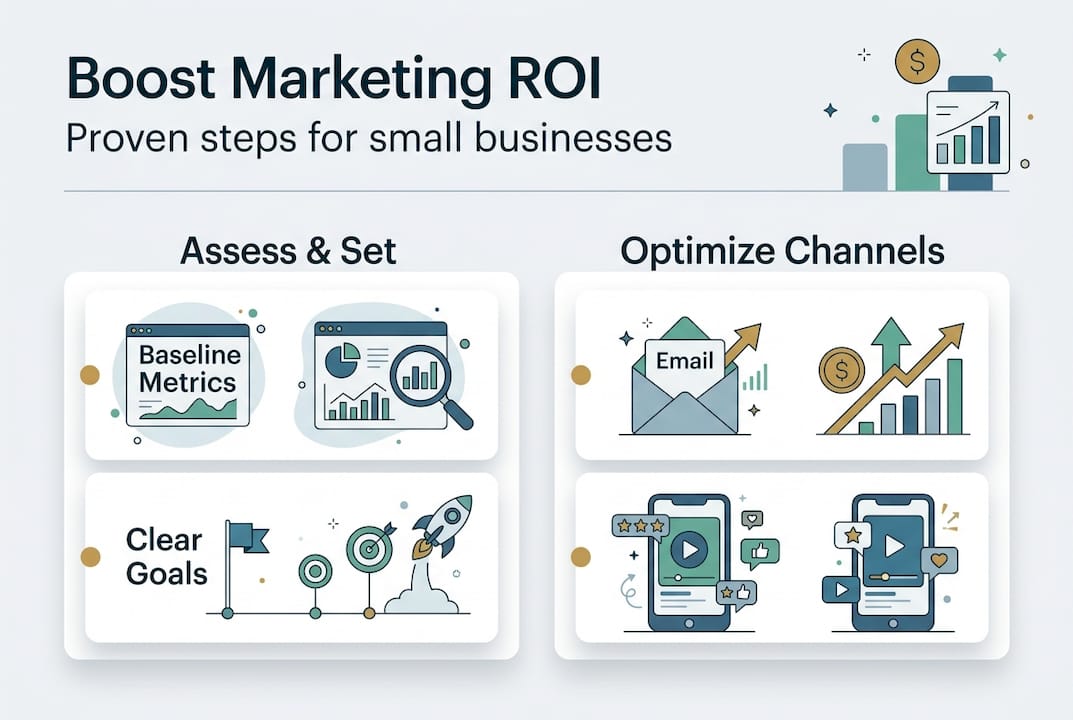
Even businesses spending under $1,000 a year on marketing can win big when they focus on the right channels with a clear plan. Budget size matters less than budget discipline.
Step-by-step: Optimize your marketing for maximum ROI
Okay, you know your numbers. You know your channels. Now let's talk execution. This is where most businesses drop the ball because they either overcomplicate it or give up too soon.
Here's the no-nonsense process:
- Audit everything. Review every active campaign, channel, and piece of content. Kill what isn't converting. Double down on what is.
- Set campaign-level goals. Every campaign needs a specific objective, a target audience, a budget, and a success metric before it launches.
- Plan your content calendar. Consistency beats brilliance. A mediocre email sent every week outperforms a brilliant one sent whenever you feel like it.
- Track metrics weekly. Not monthly. Weekly. Catching a failing campaign after 30 days means 30 days of wasted spend.
- Iterate aggressively. Test one variable at a time, subject lines, headlines, images, CTAs, and let the data tell you what to keep.
The biggest mistake? The "set and forget" approach. You launch a campaign, walk away, and check back in six weeks. By then, you've burned your budget on something that stopped working in week two. Marketing automation tools can handle the repetitive tasks, but you still need to review performance data regularly.
Building a proper marketing system means creating a repeatable process, not a one-time campaign. Businesses that treat marketing as a system rather than a series of random activities are the ones that see compounding returns over time.
Pro Tip: Automate your follow-up sequences, social scheduling, and reporting. Use the time you save to focus on strategy and creative, the two things automation can't replace.
Avoid common ROI killers and verify your results
Even when you're doing most things right, a few sneaky mistakes can quietly drain your ROI. Let's call them out.
The most common ROI killers:
- Weak or missing calls-to-action. If your audience doesn't know what to do next, they'll do nothing. Every piece of content needs one clear next step.
- Not tracking conversions. Clicks and impressions are vanity metrics. Conversions are what pay the bills. Set up proper tracking before you spend a single dollar.
- Copying competitors blindly. What works for them may not work for you. Your audience, offer, and positioning are different.
- Ignoring underperforming campaigns. Hope is not a strategy. If something isn't working after a fair test, cut it.
- Skipping A/B testing. Running one version of an ad or email and calling it done is leaving money on the table.
"In an uncertain economy, efficiency isn't optional. Every dollar needs to work harder, and B2B conversion rates averaging 13.3% show that the bar is achievable with the right approach."
Verifying your results means more than checking if revenue went up. You need to trace that revenue back to specific campaigns, channels, and messages. Use UTM parameters in your links, set up conversion goals in Google Analytics, and review your attribution model regularly.
ROI improvement is not a one-time fix. It's an ongoing practice. The businesses that win are the ones that treat optimization like a habit, not a project. Check out these strategies for rapid growth to keep the momentum going once your baseline is solid.
Ready to maximize your marketing ROI?
You now have the framework: assess your baseline, pick the right channels, execute with a system, and verify relentlessly. That's the playbook. But knowing the steps and actually implementing them are two very different things, especially when you're running a business at the same time.
That's exactly where Brass Balls marketing solutions come in. Whether you need a done-for-you marketing system, a proven funnel built for your industry, or just a no-BS roadmap to follow, the tools and expertise are there to help you move faster and waste less. You can also tap into resources around building a marketing community to connect with other entrepreneurs who are in the trenches with you. Stop guessing. Start growing.
Frequently asked questions
What is a good marketing ROI for a small business?
For paid ads, a ROAS of 2.5x to 3.8x is a solid benchmark for small businesses on limited budgets. Email marketing consistently delivers around $36 return for every $1 spent, making it the gold standard for ROI.
How can I quickly improve my marketing ROI?
Start by shifting budget toward high-ROI channels like email and short-form video, set up conversion tracking for every campaign, and review performance weekly rather than monthly to catch problems early.
Why isn't my marketing producing more leads?
The most common culprits are unclear calls-to-action, no conversion tracking, and targeting the wrong channels for your specific audience. Most SMBs lack consistent plans, which compounds all three problems at once.
What is a realistic marketing budget for small business growth?
66% of SMBs spend under $1,000 per year on marketing, yet strategic planning matters far more than raw budget size. A focused $500 plan beats an unfocused $5,000 spend every single time.
How can I measure if my marketing ROI is improving?
Track your conversion rate, CAC, and ROAS monthly and compare them against industry benchmarks like the 13.3% B2B landing page conversion average. Consistent upward movement in these numbers confirms your optimization efforts are working.