

TL;DR:
- Successful scaling requires establishing a solid foundation with clear business plans, repeatable processes, and proper infrastructure. It involves shifting from founder-led to system-led operations, continuously measuring key metrics, and being adaptable to market signals and internal feedback. Avoiding common pitfalls like neglecting systems and resisting change is crucial for sustainable growth.
You've put in more hours, spent more on ads, and hustled harder than ever, yet the revenue needle barely moved. Sound familiar? That growth ceiling is one of the most frustrating places a business owner can land, and the cruel irony is that working harder without the right systems just makes things worse. This guide cuts through the noise and gives you a clear, evidence-backed roadmap for scaling your small business the right way: preparing your foundation, executing a repeatable process, monitoring what matters, and dodging the landmines that blow up most scaling attempts before they even get started.
Table of Contents
- What to have in place before you scale
- Step-by-step process to scale your small business
- Monitoring progress and optimizing at every stage
- Common mistakes to avoid while scaling
- Our take: The hard truth about scaling small businesses
- Ready to scale? How we can help
- Frequently asked questions
Key Takeaways
| Point | Details |
|---|---|
| Preparation is critical | You need solid systems and clear processes before scaling to keep growth from producing chaos. |
| Switch to repeatable systems | Building repeatable sales and marketing processes is essential for sustainable revenue growth. |
| Track and adapt continuously | Regularly review results and be ready to adjust your approach to overcome plateaus. |
| Leadership drives scale | Founder mindset and willingness to transform teams and strategy are key to scaling success. |
What to have in place before you scale
Here's the thing most entrepreneurs get wrong: they treat scaling like flipping a switch. Just add more marketing, pour more money into ads, and watch the revenue explode. Except it doesn't work that way. Scaling is more like plugging a firehose into your existing plumbing. If the pipes are leaky and the pressure valves are broken, you don't get more water flowing through. You get a very expensive flood.
The SBA advises using a business plan as a roadmap to structure, run, and grow a business through every stage, with clear financial projections and funding requirements mapped out, often across five years. That's not bureaucratic busywork. That's your blueprint for knowing what you're actually scaling toward. Without it, you're sprinting in a direction you haven't confirmed is right.
And the stakes get higher with disorganized operations. As Entrepreneur.com points out, scale is neutral by default, which means bad operating systems spread just as fast as good ones, and they tend to spread faster because chaos moves quicker than discipline. Leadership needs to commit to consistent decisions and reinvest in infrastructure before the growth sprint starts.
Here's what your business needs locked in before you even think about scaling:
- A documented business plan with financial forecasts and clear revenue targets
- Repeatable core processes that don't rely entirely on you showing up every day
- A tech stack that handles volume without constant manual babysitting
- Financial visibility so you know your unit economics cold (cost per acquisition, lifetime value, gross margins)
- A team or contractor network that can absorb increased workload without everything catching fire
| Element | Why it matters for scaling |
|---|---|
| Business plan | Keeps growth efforts aligned to a measurable destination |
| Financial forecasting | Prevents cash flow crises as costs spike before revenue catches up |
| Documented processes | Ensures consistency when new people and systems come in |
| Tech stack | Automates repetitive tasks so your team focuses on high-value work |
| Team readiness | Stops growth from becoming a bottleneck around one person (usually you) |
Pro Tip: Resist the temptation to "figure it out as you go." The businesses that scale fastest are usually the ones that slowed down first to document their systems. Boring? Maybe. Effective? Absolutely.
Once you understand the need for solid groundwork, the next step is a clear process to scale up.
Step-by-step process to scale your small business
Scaling isn't magic. It's a repeatable process built on data, smart sequencing, and a willingness to evolve your approach as things change. Think of it like building a well-oiled machine where every gear turns in sync, instead of a Frankenstein contraption held together with duct tape and optimism.
Inc. makes it brutally clear that many founders hit a ceiling not because the market dried up, but because they never stopped being the primary salesperson. They never built a repeatable sales system. Getting from a solid small business to a genuinely scalable operation means shifting from founder-led everything to system-led everything.
And when your existing playbook stops working, you need the courage to rebuild it. Entrepreneur.com notes that successful scaling often requires transforming your go-to-market strategy entirely, restructuring leadership teams, and evolving organizational design as you move through different revenue thresholds.
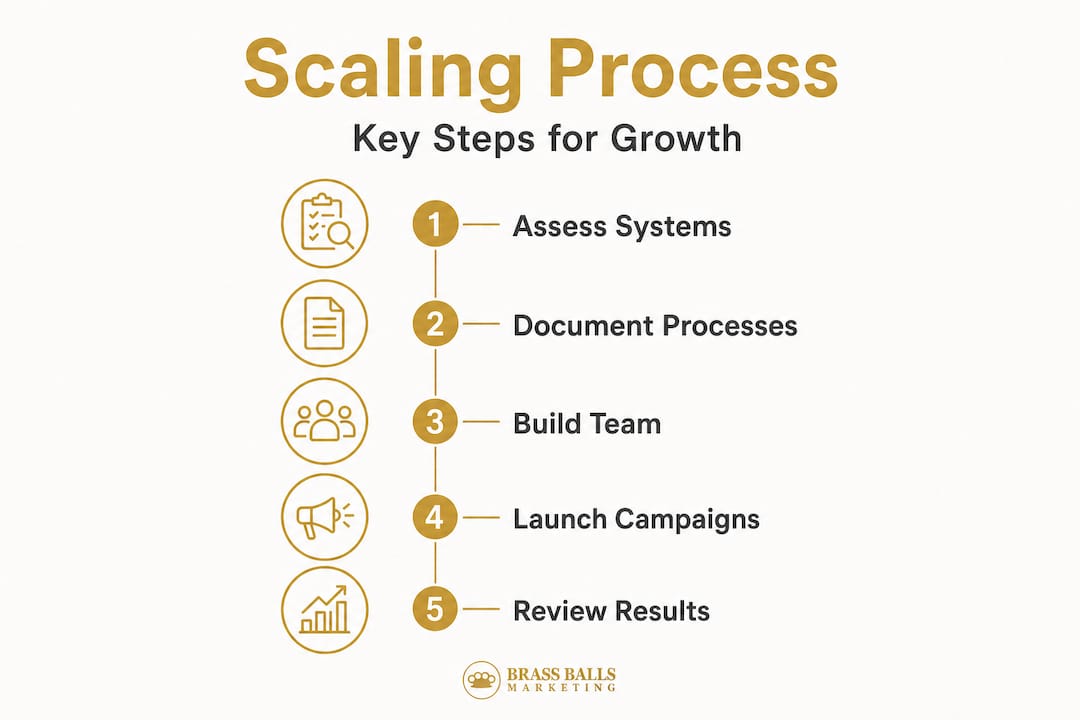
Here's the step-by-step process we recommend:
- Audit your current state. Measure everything: conversion rates, customer acquisition costs, average deal size, churn, margins. You can't improve what you haven't measured.
- Identify what's actually working. Not what you think is working. What the data confirms is generating profit and repeatable results.
- Build or tighten your scalable sales funnels. Document every step a lead takes from first touch to paying customer. Make it transferable.
- Pilot at a small scale. Test your improved systems on a segment before rolling them out everywhere. Validate first, then invest.
- Evaluate results objectively. Kill what didn't work. Double what did. Don't let ego or sunk cost keep you married to failing tactics.
- Invest in infrastructure. This means your high-converting marketing systems, your team, your tools, and the capacity to handle volume.
- Iterate continuously. Scaling isn't a one-time project. It's a permanent operating mode where improvement never stops.
Here's a comparison that illustrates exactly why this process matters:
| Factor | Founder-led sales | Scalable sales system |
|---|---|---|
| Capacity | Limited by founder's time and energy | Grows with team and tools |
| Predictability | Inconsistent, relationship-dependent | Measurable, repeatable pipeline |
| Transferability | Dies when founder steps back | Runs whether or not you're in the room |
| Data quality | Gut-feel driven | Tracked, analyzed, optimized |
| Growth ceiling | Usually hits around $1M to $3M | Can reach $10M and beyond with right structure |
The shift from column one to column two is not comfortable. It requires letting go of control, trusting systems over instincts, and investing before you feel ready. That last part is the one that trips most people up.

With the process detailed, let's look at how to monitor your progress and tackle challenges along the way.
Monitoring progress and optimizing at every stage
You built the systems. You launched the campaigns. Now comes the part that separates serious operators from wishful thinkers: tracking what's actually happening and being willing to change course when the numbers tell you to.
HBR's research on scaling reinforces a key principle: spreading excellence requires leaders to actively manage the habits and systems that made early success possible, rather than assuming momentum will carry itself forward. Growth dilutes quality if you're not paying attention. You have to fight for consistency at every stage.
What specific metrics should you be watching? Here's the shortlist:
- Customer acquisition cost (CAC) trending up without a corresponding lifetime value increase is a red flag
- Lead-to-customer conversion rate dropping signals something is broken in your funnel or your offer
- Average revenue per customer flattening out means it's time to revisit your upsell strategy or pricing
- Employee or contractor utilization spiking past sustainable levels signals you need more capacity before you push harder
- Churn or cancellation rates rising early is often a leading indicator that delivery or product quality is slipping under growth pressure
These indicators are your early warning system. They tell you a plateau is coming before it actually hits, which gives you time to act instead of react. And measuring your marketing ROI properly is what makes all of this possible.
Pro Tip: Put a standing monthly review session on your calendar right now. Thirty minutes to look at your key numbers can save you six months of backtracking. Quarterly deep-dives for strategy adjustments. Monthly check-ins for tactical tweaks. Don't wait until something feels wrong to start measuring.
Businesses that build formal review cycles into their operating rhythm consistently outperform those that fly blind. That's not a soft opinion. That's a pattern backed by research on scaling excellence. Tracking, reviewing, and adjusting isn't administrative overhead. It's a competitive advantage.
Optimizing is only effective if you avoid classic pitfalls, so here's how to sidestep the common scaling mistakes.
Common mistakes to avoid while scaling
Let's be blunt. Most scaling attempts fail not because the market was wrong or the product was bad, but because the business tried to grow using systems and leadership approaches that were never designed for the next level. It's like trying to win a Formula 1 race in a Toyota Camry. Solid car. Wrong race.
Warning: Bad systems scale faster than good ones. Only repeat what's actually working, or you'll just get bigger problems faster.
Entrepreneur.com's research drives home the point that scale is neutral, meaning it amplifies whatever already exists in your operation. Great systems get better. Broken systems get catastrophically worse. And the advice from HR experts at BambooHR via Entrepreneur couldn't be clearer: when what used to work stops working, you have to rebuild your go-to-market approach and your leadership team, not just push harder on the same levers.
Here are the top five mistakes that derail small business scaling:
- Scaling without systems. Trying to grow before you've documented and tested your core processes is like building the second floor before the foundation is dry. Things will crack.
- Ignoring market signals. Your customers are constantly telling you what they need. If you're too busy executing last year's strategy to listen, you'll scale toward a market that's already moved on.
- Underinvesting in infrastructure. Cutting corners on tools, talent, and technology to protect short-term margins is a false economy. It costs far more to fix a broken operation mid-scale than to build it right initially.
- Not updating your team or org structure. The people and structure that got you to $500K are rarely the right people and structure to get you to $5M. That's not a criticism of your team. It's just reality.
- Resisting building repeatable marketing systems. Relying on random acts of marketing instead of engineered, repeatable systems is the most common and most expensive mistake on this entire list.
Avoiding these pitfalls sets you up for sustainable growth. Here's our take on what actually sets successful scalers apart.
Our take: The hard truth about scaling small businesses
We've seen this pattern more times than we can count. A business owner with a genuinely great product or service pours more money into ads, hires a few more people, and waits for growth to happen. Sometimes it does, briefly. Then it stalls. Then the frustration sets in.
Here's what nobody likes to say out loud: scaling is not fundamentally a marketing problem. It's a leadership and systems problem that marketing eventually exposes. You can drive a hundred new leads per day into a broken sales process and all you've done is built a very efficient disappointment machine.
The businesses that break through to the next level share one thing in common. Their leaders are willing to break their own playbook. Not because they're contrarian, but because they pay close enough attention to know when the old approach has reached its ceiling. They don't cling to what worked at stage one when they're clearly operating at stage three. They adapt.
The rapid growth strategies we've seen work best are never the flashiest. They're the ones built on boring, repeatable systems that just work, day after day, without requiring heroic effort from the founder. That's the goal. Not grinding harder. Building smarter.
Adaptability isn't a soft skill. It's the actual competitive moat for small businesses trying to scale in a market that moves fast and rewards whoever responds fastest. If you're not ready to rebuild when the signals say it's time, the effort you pour into scaling can and will work against you.
Ready to scale? How we can help
Scaling your business doesn't have to feel like pushing a boulder uphill alone. If you're sitting with solid demand but a marketing system that can't keep up, or you're tired of guessing which levers to pull next, that's exactly the problem we exist to solve.
At Brass Balls, we specialize in direct response marketing and high-converting sales funnels built specifically for small business owners ready to grow without the chaos. Whether you want a done-for-you solution or prefer to learn the system yourself through our courses, we have a path for you. No fluff, no generic advice, no recycled PowerPoints. Just proven frameworks and client acquisition systems that have delivered real, measurable results for businesses across industries. If you're serious about scaling and want a team in your corner, start by exploring what we offer at brassballs.co.za and find the right fit for where you are right now.
Frequently asked questions
What is the first step in scaling a small business?
Start by documenting and optimizing your core business processes so growth amplifies strengths, not weaknesses. The SBA recommends a structured business plan as your starting point for building that foundation.
How do I know my business is ready to scale?
You're ready when you have consistent demand, structured processes, and enough resources to handle more volume without things falling apart. As Entrepreneur.com notes, leadership must be committed to consistent decisions and infrastructure investment before scaling begins.
What's the biggest reason scaling efforts fail?
Most failures come from scaling disorganized operations or refusing to adapt the sales and leadership approach to new growth stages. Inc. points out that founders who never build a repeatable sales system almost always hit a ceiling they can't break through.
How often should you review your scaling strategy?
Review your strategy at least quarterly and dig deeper after major milestones to catch plateaus early and course-correct fast. Research on scaling excellence consistently shows that formal review cycles are a key differentiator for businesses that sustain growth over time.