

You know that feeling when you spend three hours on a discovery call, craft a custom proposal, follow up four times, and then the prospect ghosts you because they never had the budget? Yeah. That's not bad luck. That's a lead qualification problem. Most small business owners treat every inquiry like a golden ticket, chasing warm bodies instead of real buyers. The result? A pipeline full of maybes, a calendar full of wasted calls, and a revenue number that refuses to budge. This guide gives you the exact frameworks, steps, and mindset shifts to filter out the tire-kickers and spend your energy on prospects who are actually ready to buy.
Table of Contents
- What is lead qualification and why it matters
- Getting ready: Setting up your lead qualification process
- Step-by-step: How to qualify leads effectively
- Troubleshooting: Common mistakes and how to avoid them
- Verifying success: Tracking results and optimizing lead qualification
- Our take: Lead qualification is more than formulas
- Next steps: Accelerate your lead qualification success
- Frequently asked questions
Key Takeaways
| Point | Details |
|---|---|
| Prioritize quality leads | Spend your efforts on prospects who match your ICP and have real buyer intent. |
| Use frameworks flexibly | Adapt BANT, MEDDIC, and CHAMP models to your unique business situation. |
| Early disqualification matters | Remove non-fits quickly to maintain a healthy sales pipeline and avoid wasted effort. |
| Optimize with feedback | Regularly review outcomes and adjust your qualification process for continuous improvement. |
| Human touch is essential | Combine automated scoring with intuition and team input to capture the best leads. |
What is lead qualification and why it matters
Lead qualification is the process of figuring out whether a prospect is worth your time before you invest serious effort in them. Simple concept. Wildly underused.
At its core, lead qualification involves assessing prospects on fit, budget, authority, need, timeline, and engagement using frameworks like BANT, MEDDIC, and CHAMP to help small businesses prioritize high-potential leads. Think of it as a bouncer at the door of your sales process. Not everyone gets in.
Here's a quick breakdown of the three most popular frameworks:
| Framework | Best for | Core focus |
|---|---|---|
| BANT | Early-stage small businesses | Budget, Authority, Need, Timeline |
| CHAMP | Service-based businesses | Challenges, Authority, Money, Prioritization |
| MEDDIC | Complex B2B sales | Metrics, Economic buyer, Decision criteria |
For most small business owners, BANT is the starting line. It's simple, fast, and cuts through noise quickly. CHAMP flips the script by leading with the prospect's challenges rather than their budget, which often feels more natural in a conversation. MEDDIC is the gladiator of frameworks, built for bigger deals with multiple stakeholders.
Why does this matter for your revenue? Because chasing unqualified leads is like pouring water into a bucket with holes. You can pour faster, but you're still losing water. Prioritizing qualified leads means your marketing strategies for client acquisition actually convert, and your sales cycle gets shorter.
One critical note: rigid frameworks can miss modern buyer behavior. Buyers today do most of their research before talking to you. Supplement any framework with engagement signals from your digital lead generation channels, like email opens, page visits, and content downloads.
"The goal of lead qualification isn't to close everyone. It's to close the right ones faster."
Getting ready: Setting up your lead qualification process
Now that you've got a grasp on lead qualification's importance and frameworks, it's time to lay the groundwork for your process.
Before you ask a single qualifying question, you need to know who you're qualifying for. That means building an Ideal Customer Profile (ICP), which is a detailed description of the type of business or person most likely to buy from you, stay with you, and refer others. Without an ICP, your qualification criteria are just guesses.
Here's a simple setup checklist:
- Define your ICP: Industry, company size, revenue range, pain points, decision-making style
- Build buyer personas: The actual humans inside those companies who make or influence buying decisions
- Set up a CRM: Tools like HubSpot or Pipedrive let you track leads, log interactions, and flag qualification status
- Create a qualification checklist: A short list of must-have criteria every lead needs to meet before moving forward
- Assign roles: Who qualifies leads? Sales? Marketing? A dedicated SDR (Sales Development Rep)?
The lead qualification steps that work best follow this sequence: define your ICP and personas, generate and classify leads as MQL (Marketing Qualified Lead) or SQL (Sales Qualified Lead), apply framework questions, score and route leads, and disqualify non-fits early.

| Stage | Action | Owner |
|---|---|---|
| Lead capture | Collect contact and intent data | Marketing |
| MQL classification | Score based on ICP fit | Marketing |
| SQL conversion | Apply qualification framework | Sales |
| Disqualification | Remove non-fits from pipeline | Sales/Marketing |
Common mistakes here include skipping the ICP entirely, using vague criteria like "interested," and letting leads sit in the pipeline long after they've gone cold. Your marketing funnel examples only work when the leads entering them are actually worth nurturing.
Pro Tip: Disqualify early and disqualify often. A bloated pipeline feels good emotionally but kills your focus. If a lead doesn't meet your core criteria within two touchpoints, move on. Your effective marketing strategies deserve better than a pipeline full of maybes.
Step-by-step: How to qualify leads effectively
With your process established, let's walk through exactly how to qualify leads step by step.
Step 1: Run a discovery conversation. Before any framework, have a genuine conversation. Ask open-ended questions. Listen more than you talk. You're gathering raw intel here.
Step 2: Apply your qualifying questions. Based on your chosen framework, ask targeted questions. For BANT: "What budget have you allocated for this?" For CHAMP: "What's the biggest challenge driving this decision?" For MEDDIC: "Who else is involved in the final decision?"
Step 3: Score the lead. Lead scoring assigns points based on demographics, firmographics, behavior, and intent to prioritize leads, and it's perfect for small businesses scaling beyond gut instinct. You can use explicit data (job title, company size) and implicit data (pages visited, emails opened) to build a score.
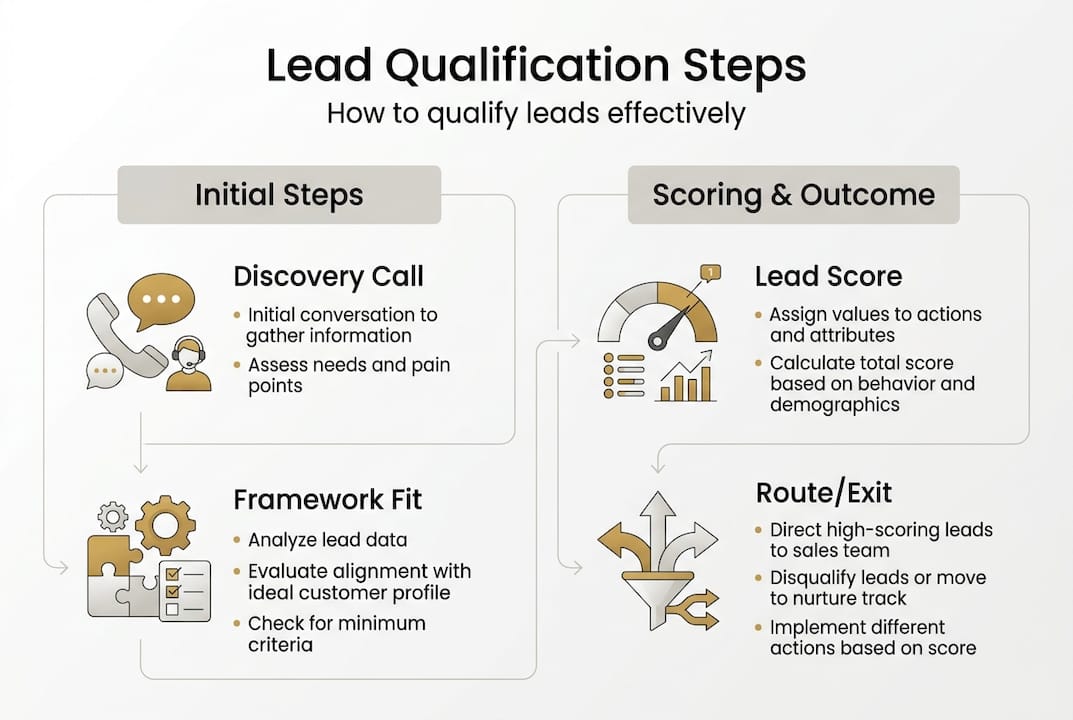
Step 4: Route or disqualify. High score? Move to proposal. Medium score? Nurture with content. Low score? Politely exit and redirect your energy.
Step 5: Document everything. Log your notes in your CRM. This data becomes gold when you review your process later.
Understanding marketing funnel roles helps you see where qualification fits in the bigger picture. Businesses that implement lead scoring see measurably better outcomes, and improving marketing ROI becomes a natural byproduct of qualifying smarter.
Pro Tip: Don't rely only on what prospects say. Behavioral data tells you what they do. A lead who visits your pricing page three times is more serious than one who says "I'm very interested" and never clicks anything.
Troubleshooting: Common mistakes and how to avoid them
Even the best lead qualification process can stumble, so let's address common pitfalls and practical fixes.
Here are the biggest mistakes small business owners make with lead qualification:
- Using outdated frameworks rigidly: BANT was built in the 1960s. Buyer behavior has changed. Use frameworks as guides, not gospel.
- Skipping early disqualification: Letting weak leads linger wastes everyone's time. 98% of MQLs may never result in closed business, so disqualify early to focus on quality and avoid pipeline gaps.
- Sales and marketing working in silos: If marketing is sending leads that sales keeps rejecting, you have a misalignment problem. Fix the criteria together.
- Chasing volume over quality: More leads is not always better. Ten highly qualified leads beat a hundred lukewarm ones every single time.
- No feedback loop: If you're not reviewing why deals closed or fell apart, you're flying blind.
"Quality over quantity isn't just a saying. In sales, it's the difference between a thriving pipeline and a very busy calendar with nothing to show for it."
On the AI front: automated qualification tools are genuinely useful for targeting small businesses at scale, but AI enhances rather than replaces human judgment, especially for edge cases where context and nuance matter. Your marketing automation guide can help you figure out where automation fits without removing the human touch that closes deals.
Verifying success: Tracking results and optimizing lead qualification
Once you've qualified and closed leads, it's essential to review and optimize your process for even greater results.
Tracking your lead qualification performance is not optional. It's where compounding improvement lives. Here's what to monitor:
- Lead-to-opportunity conversion rate: How many qualified leads become real sales opportunities?
- Opportunity-to-close rate: Of those opportunities, how many actually close?
- Sales velocity: How fast are qualified leads moving through your pipeline?
- Lead quality score over time: Is your average lead quality improving or declining?
- Disqualification rate: Are you cutting non-fits early enough?
Closed-loop feedback between sales and marketing is the engine of continuous improvement. When sales reports back on why leads converted or didn't, marketing can refine targeting criteria. This loop, when done consistently, delivers compounding results rather than one-time wins.
| KPI | What it tells you | How to track |
|---|---|---|
| Lead-to-opportunity rate | Quality of incoming leads | CRM pipeline reports |
| Close rate | Effectiveness of qualification | Sales dashboard |
| Sales cycle length | Efficiency of the process | CRM time-in-stage data |
| Disqualification rate | Pipeline hygiene | Weekly pipeline review |
Your email marketing funnel success and overall sales funnel client acquisition both improve dramatically when you feed them better-qualified leads. Review your KPIs monthly, tweak one variable at a time, and track the impact. Small adjustments compound into massive results over time.
Our take: Lead qualification is more than formulas
Here's some hard-earned perspective about what actually separates high-performing small businesses from the rest.
Frameworks are tools, not answers. BANT won't tell you that a prospect is emotionally ready to buy. MEDDIC won't pick up on the hesitation in someone's voice when they mention their boss. That's your job.
The businesses we see winning consistently aren't the ones with the fanciest CRM or the most sophisticated scoring model. They're the ones who treat qualification as an ongoing conversation, not a one-time checklist. They review their process monthly, not quarterly. They ask their sales team what's actually happening in calls, not just what the data says.
AI is a useful co-pilot here, but it's still flying a plane it doesn't fully understand. It misses context. It misses nuance. It can't tell the difference between a prospect who's genuinely busy and one who's stringing you along. Human oversight isn't optional. It's the whole game.
The real secret? Continuous tuning delivers exponential growth. Not a new framework. Not a shinier tool. Just consistent, honest review of what's working and what isn't. Explore no-BS client acquisition strategies that pair well with a sharp qualification process.
Pro Tip: Schedule a 30-minute monthly team review specifically for lead qualification. Look at wins, losses, and disqualifications together. The patterns you find will be worth more than any framework you buy.
Next steps: Accelerate your lead qualification success
You've got the frameworks, the steps, the KPIs, and the mindset. Now it's time to put it all to work.
At Brass Balls, we specialize in no-BS marketing systems built specifically for small business owners who are done wasting time on the wrong prospects. Our lead generation solutions are designed to attract, qualify, and convert premium clients using proven direct response funnels and frameworks. Whether you want a done-for-you system or prefer to learn the ropes yourself through our courses, we've got the tools to help you build a pipeline that actually performs. Stop chasing maybes. Start closing the right clients, faster.
Frequently asked questions
What is the best lead qualification framework for small businesses?
BANT is a popular starting point, but CHAMP and MEDDIC offer better flexibility for service-based or complex sales environments. Supplement any framework with behavioral and intent data for the sharpest results.
How soon should I disqualify low-quality leads?
Disqualify as early as possible, ideally within the first two touchpoints. 98% of MQLs may never close, so protecting your pipeline from bloat is a revenue decision, not just a time management one.
What tools can help automate lead qualification?
CRMs, lead scoring platforms, and AI-based tools can handle a lot of the heavy lifting, but AI needs human oversight for edge cases where context and nuance are critical to making the right call.
How do I measure the success of my lead qualification process?
Track conversion rates, sales velocity, and lead quality scores consistently. Use closed-loop feedback between sales and marketing to refine your criteria and improve results over time.