

TL;DR:
- Most small business marketing efforts often focus on vanity metrics that do not generate revenue. Results-oriented marketing aligns every activity with specific outcomes like sales and customer lifetime value, ensuring measurable growth. It requires continuous assessment, courage to cut ineffective strategies, and proper data tracking to truly drive business success.
Most small business owners have been there: you post consistently, your website traffic looks decent, and your follower count keeps climbing. Feels good, right? Except the phone isn't ringing, the inbox is quiet, and revenue stubbornly refuses to budge. The uncomfortable truth is that outcome-based marketing is about aligning your marketing work to defined business outcomes like revenue, qualified leads, and customer lifetime value improvements, not the impressions and clicks that look impressive in reports but pay exactly zero bills. If you're ready to stop celebrating the wrong wins and start building a marketing engine that actually grows your business, this guide is your roadmap.
Table of Contents
- What is results-oriented marketing?
- Why chasing vanity metrics holds businesses back
- How results-oriented marketing drives measurable ROI
- Designing a results-oriented marketing funnel
- Pitfalls and real-world obstacles to outcome marketing
- Our take: What most guides miss about results-oriented marketing
- Ready to put results first? Work with a true partner
- Frequently asked questions
Key Takeaways
| Point | Details |
|---|---|
| Focus on true outcomes | Real growth comes from measuring revenue-driving results, not just marketing activity. |
| Beware vanity metrics | Surface-level numbers can mislead; always link actions to sales or leads. |
| Build optimized funnels | Sales funnels that measure each stage help connect marketing to business growth. |
| Track and adapt constantly | Continual measurement and adjustment give small businesses a real advantage. |
| Systemize for success | Robust tracking and process alignment prevent outcome marketing from becoming guesswork. |
What is results-oriented marketing?
Let's cut through the noise. Results-oriented marketing means every dollar you spend, every piece of content you create, and every campaign you launch has one job: move the needle on outcomes that actually matter to your business. We're talking revenue, qualified leads, cost per acquisition (CAC), and customer lifetime value (LTV). Not impressions. Not likes. Not "brand awareness" that somehow never converts to a single paying customer.
The contrast with traditional, activity-based marketing is stark. Traditional marketing culture celebrates busyness. Three blog posts a week? Great. Five hundred new Instagram followers? Champagne. But as any honest marketer will tell you, these outputs are just inputs to the real game. Small business marketing success depends on connecting those activities to outcomes your bank account can recognize.
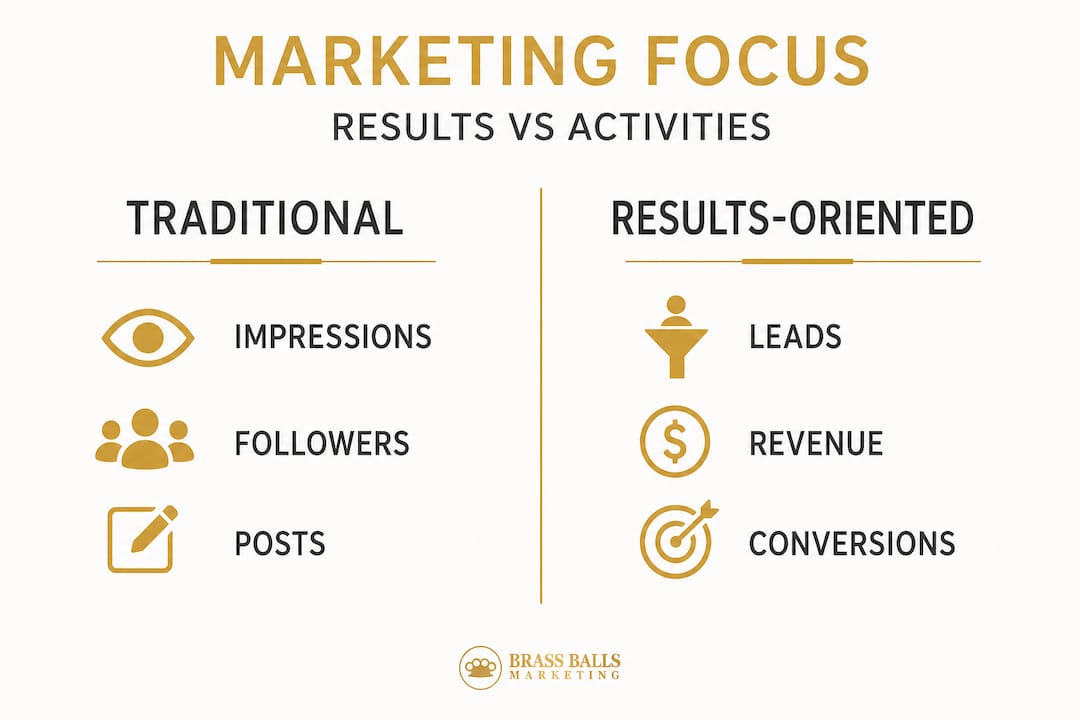
Here's a quick look at the difference:
| Output metric | Outcome metric |
|---|---|
| Website page views | Leads generated per visit |
| Social media followers | Qualified inquiries from social |
| Email open rate | Revenue attributed to email campaigns |
| Ad impressions | Cost per acquisition (CAC) |
| Blog posts published | Organic leads from search |
| Time on page | Conversion rate improvement |
The design and marketing decisions you make every day should be filtered through one lens: "Does this move me closer to a specific business outcome?" If the honest answer is "not really," it's time to reassign that budget or bandwidth.
Common misconceptions worth killing right now:
- More activity equals more results. It doesn't. A plumber who runs one hyper-targeted ad campaign generating 20 qualified leads beats the competitor posting five times a day on Facebook with zero conversions.
- Vanity metrics indicate health. Viral posts are exciting, but if they don't attract buyers, they're entertainment, not marketing.
- You need a massive budget to measure outcomes. You don't. Even basic tools can track leads, bookings, and revenue back to specific campaigns.
Why chasing vanity metrics holds businesses back
Vanity metrics are the junk food of the marketing world. They taste great in the moment, look impressive on a dashboard, and provide zero nutritional value. We're talking about follower counts, raw traffic numbers, video views, and email list size when none of those numbers are connected to whether you're actually making money.
Here's the trap in vivid detail. A boutique fitness studio invests in social media management for six months. Followers grow from 800 to 5,000. Engagement is solid. The agency reports "great results." But membership sign-ups are flat, revenue hasn't moved, and the studio owner is paying a monthly retainer for what amounts to a very expensive popularity contest.

This is the direct response marketing argument in a nutshell: if your marketing can't be traced directly to a revenue or lead outcome, you're flying blind.
Common vanity metrics and why they mislead:
- Page views: High traffic with poor conversion means your offer, targeting, or copy is broken. Traffic is not the goal.
- Social media followers: Followers don't equal buyers. A list of 10,000 unqualified followers is worth less than 200 people who are actively in the market for your service.
- Email open rates: Opens tell you your subject line worked. They don't tell you if anyone bought anything.
- Ad reach/impressions: Reaching a million people who don't care about your offer is a spectacular waste of money.
- Time on page: People can spend five minutes on your page reading every word and still not convert. Engagement isn't the outcome.
"You must distinguish 'output' from 'outcome.' If you optimize for deliverables like posts and traffic without tying them to revenue-driving outcomes, you can end up with misleading 'success' and wrong decisions." — Pavithra Charan
Pro Tip: When reviewing a marketing report, ask one brutal question for every metric listed: "What business decision does this number inform?" If no one can answer that clearly, it's a vanity metric dressed up as insight.
The consequences for small businesses are brutal and practical. Wasted ad spend. Strategies built on faulty data. Competitors who track outcomes properly eat your lunch because they know exactly what's working and double down on it. You can't out-budget them if you're not even measuring the right game.
How results-oriented marketing drives measurable ROI
Here's where it gets good. When you align marketing activities to real business outcomes, you're no longer guessing. Every improvement compounds. And for small businesses operating on tighter budgets, this precision is not optional. It's a survival skill.
SMB marketing benchmarks show that small businesses have less time and budget to experiment, meaning funnel conversion improvements act as powerful ROI multipliers. A 10% improvement in your lead-to-client conversion rate doesn't just improve that one metric. It means every dollar you were already spending suddenly works harder without spending more.
Let's make that concrete with a simple example. Say you spend $1,000 per month on ads. Your current funnel converts 1% of leads to paying clients. Improving conversion to just 2% doubles your return from the same ad spend. That's the power of improving marketing ROI through outcome-focused refinement rather than just throwing more money at traffic.
Here's how to tie your marketing actions directly to revenue:
- Map your funnel stages. Awareness, consideration, conversion. Assign one specific outcome metric to each stage.
- Install tracking at every stage. Use UTM parameters, form completions, booking confirmations, and CRM tagging to capture data.
- Identify your biggest drop-off point. Where are people leaving your funnel? That's your highest-leverage improvement opportunity.
- Test one change at a time. Changing the headline, the offer, or the call to action one at a time tells you exactly what's driving improvement.
- Calculate revenue attribution. Connect closed sales back to specific campaigns or channels so you know which ones deserve more budget.
The benefits of marketing funnels for small businesses are grounded in this exact logic: a structured funnel forces you to define what success looks like at every step, making it impossible to hide behind vanity metrics.
An ROI-focused web design approach reinforces this thinking. Your website isn't a digital brochure. It's a conversion machine, and every element should serve the outcome of turning visitors into leads or buyers.
| Funnel stage | Activity metric (misleading) | Outcome metric (useful) |
|---|---|---|
| Awareness | Ad impressions | Cost per click to landing page |
| Consideration | Website sessions | Lead magnet downloads / opt-ins |
| Conversion | Landing page views | Form submissions / booked calls |
| Retention | Email opens | Repeat purchase rate / LTV |
Designing a results-oriented marketing funnel
Now we get practical. If results-oriented marketing is the philosophy, the funnel is the vehicle. A well-designed conversion funnel measures success with both quantitative data (the numbers) and qualitative data (what people actually say and feel) at every stage from awareness through consideration to conversion.
Core elements of a results-oriented funnel:
- A specific, measurable goal for each stage. Not "increase awareness." Something like "generate 50 opt-ins per week from paid social."
- A clear offer that solves one problem. Funnels collapse when the offer is vague or tries to do too much.
- Tracking infrastructure. Google Analytics goals, CRM pipeline stages, or even a simple spreadsheet. You can't improve what you don't measure.
- A feedback loop. Surveys, sales call notes, and customer service conversations are qualitative gold. They tell you why numbers move.
Step-by-step guide to mapping outcomes at each funnel stage:
- Awareness stage: Define how many qualified people you need entering the funnel each week to hit your revenue target. Work backward from your close rate.
- Consideration stage: Measure lead quality, not just quantity. Are the people opting in actually in your target market? Track lead-to-call-booked rate.
- Conversion stage: Track offer acceptance rate, proposal close rate, and average deal size. These are the numbers that connect directly to revenue.
- Post-conversion: Measure LTV and referral rate. Happy clients who refer others are your lowest-cost acquisition channel. Track this obsessively.
Pro Tip: Don't sleep on qualitative data. After every lost deal, send a one-question email: "What stopped you from moving forward?" The answers will improve your funnel faster than any A/B test.
For funnel optimization to work at the small business level, you need simplicity. A three-step funnel you actually track beats a sophisticated twelve-step sequence that nobody monitors. Look at marketing funnel examples in your niche to benchmark what "good" looks like before you build your own.
If your funnel has a landing page, check out this service website conversion guide for practical guidance on making every page element work toward your outcome goals.
Pitfalls and real-world obstacles to outcome marketing
Let's be real. Shifting to results-oriented marketing sounds clean in theory and gets messy in practice. Here are the potholes you're most likely to hit.
Common implementation challenges:
- Data silos. Your ad platform data, website analytics, and CRM don't talk to each other, making attribution a guessing game.
- Attribution gaps. A client who found you on Instagram, Googled you a week later, clicked a retargeting ad, and then called from a referral. Which channel gets credit?
- CRM hygiene. If your customer relationship management system is a graveyard of outdated contacts and untagged leads, your "outcome" data is garbage.
- Misaligned sales teams. Marketing generates leads. Sales closes them. If these teams aren't sharing data and definitions of a "qualified lead," you'll measure completely different things.
As outcome-based marketing pitfalls illustrate, if you cannot connect marketing events to pipeline and revenue due to attribution gaps or poor CRM hygiene, your outcome marketing devolves into guesswork with better-sounding vocabulary.
And there's a legitimate counterpoint worth taking seriously. Outcome-based media buying isn't always scalable across all channels, especially when measurement infrastructure isn't solid enough to attribute results accurately at larger budgets.
Pro Tip: When full attribution is impossible, use proxy metrics. In the early stages of a funnel, qualified opt-in rate or booked-call rate is a reliable leading indicator of eventual revenue. It won't be perfect, but it's infinitely better than tracking impressions.
Practical solutions that actually work:
- Cross-functional alignment: Get sales and marketing in the same room monthly. Agree on what a qualified lead looks like. Document it.
- CRM hygiene sprints: Set aside time quarterly to clean up your CRM. Tag leads by source, quality, and outcome. This pays dividends fast.
- Qualitative measurement: Sales funnel segmentation combined with regular client feedback loops lets you understand the "why" behind your numbers, not just the "what."
Our take: What most guides miss about results-oriented marketing
Here's the part most articles skip. True results-orientation isn't just a measurement upgrade. It requires courage. The courage to look at a campaign you've been running for six months, admit it's not producing outcomes, and cut it. Even if you love it. Even if your team worked hard on it. Even if it gets good engagement.
Most small businesses we work with have at least one sacred cow in their marketing. A newsletter nobody reads. A social channel they maintain out of habit. An ad format they believe in despite zero attribution to revenue. Results-orientation forces the honest conversation.
The hard-won lesson? This is a practice, not a setup. You don't install outcome-based marketing and walk away. You review it, question it, and refine it continuously. Small business marketing strategies that stand the test of time are built on this discipline of ruthless, ongoing optimization.
Here's the contrarian insight that'll make some people uncomfortable: sometimes you should run activity-heavy campaigns without expecting immediate outcome results. Testing a new channel, entering a new market, or learning what messaging resonates with a new audience all require an "experiment" phase where activity is the point. The key is to consciously label it as a learning phase with a defined end date and success criteria, rather than letting it drift on indefinitely because the follower count looks nice.
The businesses we see crush it with results-oriented marketing do one thing differently from everyone else. They review their numbers weekly, make one hypothesis about what would improve outcomes, test it, and report back. Small bets, fast cycles, no ego about what the data shows.
Ready to put results first? Work with a true partner
You've just taken in a lot. Outcome metrics, funnel stages, attribution pitfalls, the courage to cut what doesn't work. That's the honest picture of what results-oriented marketing actually demands.
If you're ready to stop running marketing on vibes and start building systems that generate real, attributable revenue, we'd love to help you get there. At Brass Balls, we specialize in no-BS direct response marketing and digital sales funnels built specifically for small business owners who are done with pretty reports and ready for actual growth. Check out our marketing tips for growth to see exactly how our approach turns these principles into revenue-driving systems for businesses like yours. The playbook is there. The results are real. The question is whether you're ready to measure what actually matters.
Frequently asked questions
What's the biggest difference between results-oriented and traditional marketing?
Results-oriented marketing focuses on real business outcomes like revenue or lead quality, not just activity or traffic numbers that look impressive but don't connect to growth.
How can small businesses track the impact of their marketing efforts more effectively?
Use a clear conversion funnel and measure key metrics like leads, cost per acquisition, and customer lifetime value at each stage to link actions to revenue rather than surface-level activity.
What are common pitfalls to avoid when shifting to outcome-based marketing?
Failing to connect results to actual revenue, poor CRM hygiene, and missing attribution infrastructure can all cause outcome marketing to become expensive guesswork without the right systems behind it.
Is results-oriented marketing suitable for every type of small business?
Most small businesses benefit significantly from focusing on measurable outcomes, though businesses with longer sales cycles or niche markets may need to lean on proxy metrics and qualitative data while building out fuller attribution systems.