

TL;DR:
- Scalable sales funnels rely on automation, data, and seamless integration to handle increased leads effortlessly.
- Fixing leaks and optimizing each stage are essential before expanding traffic to ensure sustainable growth.
- Most small businesses fail to scale effectively by increasing leads without improving underlying systems.
Most small business owners build a sales funnel once, cross their fingers, and wonder why it collapses the moment things get busy. The truth is, a basic funnel is like a garden hose — great for watering one plant, useless when you need to irrigate a field. Sales pipeline stages reveal that one-size-fits-all funnels rarely hold up under pressure. Scalable sales funnels are different. They are built on automation, smart data, and integrated systems that grow with you. This article breaks down exactly how to build one that actually works.
Table of Contents
- What makes a sales funnel scalable?
- Unpacking the stages of a scalable sales funnel
- The mechanics: Tools and systems for scalable funnels
- Fixing leaks and optimizing for growth
- Why scalable sales funnels are misunderstood — and what works
- Implement scalable sales funnels with expert guidance
- Frequently asked questions
Key Takeaways
| Point | Details |
|---|---|
| Scalability is system-based | Sales funnel scalability depends on automation, integration, and actionable data. |
| Stages drive efficiency | Each funnel stage—from awareness to retention—should be optimized and automated for smooth growth. |
| Fix leaks before scaling | Repair weak points in your funnel before investing in additional traffic or marketing spend. |
| Tools boost conversion | Using CRMs, email automation, and lead scoring maximizes your sales funnel’s effectiveness. |
| Optimize with metrics | Focus on metrics like conversion rates and ARR to guide your scaling decisions. |
What makes a sales funnel scalable?
Now that we've established why scalable sales funnels matter, let's break down exactly what sets a scalable funnel apart from the rest.
Scalability, in funnel terms, means your system can handle ten times the leads without you working ten times as hard. It is not about hustle. It is about architecture. A scalable funnel runs on automation, integrates your tools seamlessly, and uses data to make decisions so you don't have to make every call manually.
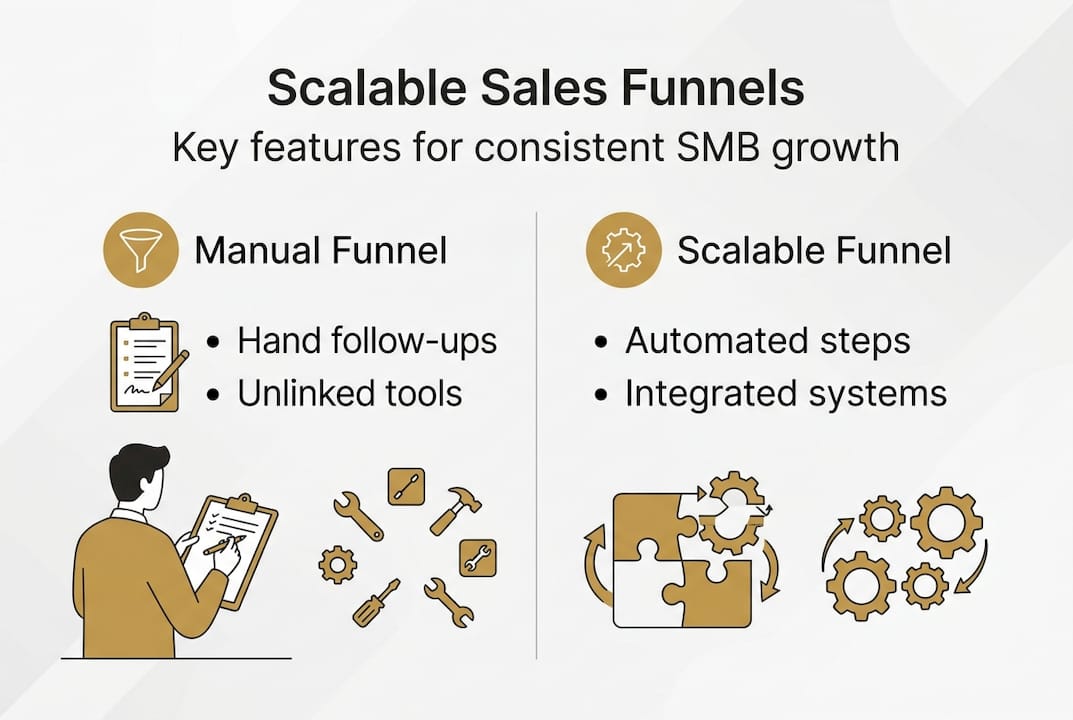
Here is the blunt truth: most small business funnels are held together with duct tape and good intentions. Someone fills in a form, a team member manually follows up three days later, and half the leads have already gone cold. That is not a funnel. That is a leaky bucket.
Scalable funnels share a few non-negotiable traits:
- Automation at every touchpoint: Follow-ups, nurture sequences, and qualification happen without manual input.
- CRM integration: All lead data lives in one place, visible to everyone who needs it.
- Data-driven decision making: Conversion rates, drop-off points, and lead quality are tracked and acted on.
- Consistent lead scoring: Not every lead is worth your time. A scalable funnel knows the difference.
As HubSpot's pipeline guide recommends, start lean with a CRM, fix leaks before driving more traffic, and use AI and data for lead qualification. This is the foundation of how sales funnels drive client acquisition at scale.
| Feature | Manual funnel | Scalable funnel |
|---|---|---|
| Lead follow-up | Done by hand, often late | Automated, instant |
| Data visibility | Scattered across spreadsheets | Centralized in CRM |
| Lead qualification | Gut feel | AI and scoring rules |
| Capacity | Limited by team size | Grows with demand |
| Conversion tracking | Rarely measured | Tracked and optimized |
Pro Tip: Before you add more traffic or spend more on ads, audit your current funnel. Fix the leaks first. A broken funnel with more leads is just a faster way to waste money.
Unpacking the stages of a scalable sales funnel
With a clear understanding of scalability, let's walk through each core stage and how automation and integration make them scalable.
Every funnel has stages. The difference between a scalable one and a fragile one is what happens between those stages. Automation and integration are the connective tissue that keeps leads moving forward without you pushing each one by hand.
Here are the five core stages of a scalable sales funnel, as outlined by HubSpot:
- Awareness: Prospects discover you through ads, content, SEO, or referrals.
- Interest: They engage with your content, sign up for a lead magnet, or follow your brand.
- Consideration: They compare options, read reviews, and consume more of your material.
- Intent and purchase: They take action, whether that is booking a call, signing up, or buying.
- Retention and expansion: You keep them happy, upsell, and turn them into referral machines.
Check out these marketing funnel examples to see how real businesses apply each stage. And if you want to go deeper on personalizing each stage, segmentation optimizes sales funnels in ways that generic messaging simply cannot.
| Funnel stage | Automation tool | Integration point |
|---|---|---|
| Awareness | Ad retargeting, SEO tools | Analytics platform |
| Interest | Email opt-in sequences | CRM lead capture |
| Consideration | Lead scoring, drip emails | CRM and email platform |
| Intent and purchase | Booking automation, cart tools | Payment and CRM sync |
| Retention | Onboarding sequences, upsell flows | Customer success tools |
"Digitization and sales engagement platforms boost B2B collaboration, efficiency, and cost reduction across every funnel stage."
The magic happens when each stage feeds seamlessly into the next. No manual handoffs. No leads falling through the cracks. Just a system that runs like a well-oiled machine while you focus on the work that actually needs your brain.
The mechanics: Tools and systems for scalable funnels
With the funnel stages clear, here's how small businesses can use tools and systems to actually make their sales funnels scalable.

Having a funnel map on a whiteboard is cute. Having one that actually runs on autopilot is better. The tools you choose are the difference between a funnel that scales and one that gives you a headache every time a new lead comes in.
The core stack for a scalable funnel looks like this:
- CRM (Customer Relationship Management): HubSpot, Zoho, or Pipedrive to centralize all lead and customer data.
- Email automation: ActiveCampaign, Mailchimp, or Klaviyo to send the right message at the right time without lifting a finger.
- Chatbots: Tools like ManyChat or Intercom to qualify leads 24/7, even when you are asleep.
- Lead scoring: Built into most CRMs, this ranks leads by behavior and fit so your team focuses on the best ones.
- Landing page builders: Unbounce or ClickFunnels to create conversion-optimized pages fast.
Marketing automation for small businesses is no longer optional. It is the engine that keeps your funnel running when you step away. Pair that with solid email marketing best practices and you have a nurture machine that converts while you sleep.
Here is a real workflow example. A lead downloads your free guide (awareness). Your CRM tags them and triggers a five-email nurture sequence (interest and consideration). After email three, if they click your pricing page, their lead score jumps and your sales team gets an alert (intent). The whole thing runs without a single manual task.
According to HubSpot's 2025 sales data, AI-driven pipeline generation, buyer self-research, and annual recurring revenue (ARR) are the top trends shaping how scalable funnels perform in 2026. Ignoring these is like showing up to a gunfight with a spoon.
Pro Tip: Use AI and behavioral data to qualify leads before your sales team ever picks up the phone. You will cut wasted time in half and close more deals with less effort.
Fixing leaks and optimizing for growth
After setting up your funnel's systems, making it truly scalable means constantly fixing leaks and optimizing for better results.
Here is a fun analogy. Imagine your funnel is a swimming pool. You keep filling it with water (leads), but the water level never rises. That is because there are cracks in the bottom. More water will not fix cracks. Fixing the cracks will.
Common funnel leaks that kill growth:
- Slow follow-up: Leads go cold within hours. If your response time is measured in days, you are losing business.
- Weak lead magnets: If your free offer is not genuinely valuable, people opt in and immediately disengage.
- No nurture sequence: Leads who are not ready to buy today need to hear from you regularly or they forget you exist.
- Poor qualification: Sending unqualified leads to your sales team wastes everyone's time and tanks morale.
- Confusing landing pages: If visitors cannot figure out what to do in five seconds, they leave.
Using segmentation for funnel conversions is one of the most effective ways to plug these leaks. When you segment by behavior, industry, or intent, you send the right message to the right person at the right time. That alone can double your conversion rates without spending an extra cent on traffic.
The sales pipeline guide from HubSpot is clear: start lean, fix leaks before adding traffic, and use AI and data for qualification. If you need a structured process for this, a solid qualify leads guide will walk you through exactly how to filter the good from the not-yet-ready.
Pro Tip: Run a funnel audit every 90 days. Look at where leads drop off, which emails get ignored, and which pages have high exit rates. Then fix one thing at a time. Small, consistent improvements compound into massive results.
Why scalable sales funnels are misunderstood — and what works
Now that you know what a scalable funnel looks like and how to optimize it, let's get real about what most small businesses get wrong.
The conventional wisdom goes like this: more traffic equals more business. So business owners dump money into ads, drive a flood of leads into a broken funnel, and then scratch their heads when revenue does not budge. Sound familiar?
Here is the uncomfortable truth. Most SMBs try to scale by stuffing more leads into the top of the funnel while ignoring the broken systems underneath. It is like pressing harder on the gas when your car has a flat tire. You are not going anywhere faster.
Scalable growth comes from fixing what is broken before you amplify it. It comes from building systems that work without you, not from grinding harder. The businesses that win are the ones that treat their funnel like a product, constantly testing, iterating, and improving.
If you want to see how sales funnels client acquisition actually works in practice, stop chasing volume and start chasing efficiency. Quality over quantity is not just a cliche here. It is the actual strategy.
Implement scalable sales funnels with expert guidance
If you are ready to put these strategies into action with professional support, here is where you can find more resources and guidance.
Building a scalable sales funnel on your own is absolutely possible. But it is a lot faster when you have a proven framework and someone in your corner who has done it before. At Brass Balls, we specialize in no-BS, direct response marketing systems built specifically for small business owners and entrepreneurs who are done playing guessing games with their revenue.
Whether you want done-for-you funnel builds, self-serve training, or just a clear roadmap to follow, we have got options that fit where you are right now. Explore our marketing strategies for small businesses and take the next step toward a funnel that actually scales. Your future customers are already out there. Let's make sure they find you.
Frequently asked questions
How do I know if my sales funnel is scalable?
Your funnel is scalable if it handles more leads and revenue without requiring excessive manual work, relying instead on automation and data-driven systems that run independently of your daily involvement.
What tools can I use to automate my sales funnel?
Popular options include CRMs like HubSpot for automation, email platforms like ActiveCampaign, chatbots like ManyChat, and lead scoring tools built into most modern CRMs.
How do I fix leaks in my sales funnel?
Identify where leads drop off using your CRM data, apply segmentation to personalize messaging, and fix leaks before traffic by optimizing each stage before spending more on advertising.
What metrics matter most when scaling a sales funnel?
Focus on lead conversion rates, customer acquisition cost, and ARR as top metric rather than raw traffic volume, since these tell you whether your funnel is actually producing profitable growth.