

Most small business owners think funnel optimization means tweaking a landing page headline or changing a button color. That's a costly misconception. Real funnel optimization is a comprehensive strategy that examines every stage of your customer journey, from initial awareness through final purchase. Businesses optimizing full funnels see 15-30% higher ROI compared to those focused on isolated conversion tactics. This guide explains what funnel optimization actually involves, shows you industry benchmarks for measuring success, and provides practical steps to implement strategies that boost client acquisition and revenue without increasing your marketing spend.
Table of Contents
- Key Takeaways
- Understanding funnel optimization and why it matters
- Common funnel benchmarks and what success looks like for small businesses
- Common pitfalls to avoid and strategies to optimize your funnel effectively
- Implementing funnel optimization for your small business: practical steps and tools
- Boost your funnel optimization with expert marketing solutions
- Frequently asked questions
Key Takeaways
| Point | Details |
|---|---|
| Full funnel definition | Funnel optimization is a holistic strategy that improves every stage of the customer journey from awareness to purchase. |
| ROI uplift across funnel | Businesses optimizing entire funnels see 15 to 30 percent higher ROI than those focusing on isolated tactics. |
| Benchmarks guide success | Knowing industry benchmarks helps you set realistic goals and identify where your funnel needs the most attention. |
| Avoid common pitfalls | Avoid focusing on single page tweaks and instead identify bottlenecks at each funnel stage to create sustainable growth. |
| Audit and optimize steps | Apply a practical checklist to audit your funnel from awareness to purchase and implement iterative improvements. |
Understanding funnel optimization and why it matters
Funnel optimization is the systematic process of improving every stage of your customer journey, from the moment someone discovers your business through awareness channels to the point they become a paying customer. Unlike basic conversion rate optimization that focuses on single pages or elements, funnel optimization takes a holistic view of how prospects move through your entire sales process.
This approach integrates multiple data-driven methodologies. You analyze user behavior through heatmaps that show where visitors click and scroll. Session recordings reveal exactly where prospects get confused or frustrated. A/B testing validates which messages, offers, and page layouts actually drive action. Psychological motivators like social proof, scarcity, and trust signals reduce resistance at critical decision points.
The results speak for themselves. Businesses optimizing full funnels see 15-30% higher ROI compared to companies that only tweak individual landing pages. Amazon sellers have doubled conversion rates without increasing traffic by systematically removing friction at each funnel stage. That's the power of thinking beyond isolated tactics.
"Funnel optimization isn't about making one page perfect. It's about creating a seamless journey where each stage naturally leads to the next, removing every obstacle between discovery and purchase."
Effective funnel optimization addresses specific bottlenecks:
- Awareness stage issues like unclear value propositions that fail to capture attention
- Interest stage problems such as missing information that prevents prospects from evaluating your solution
- Decision stage friction including complicated forms, unclear pricing, or lack of trust signals
- Action stage barriers like confusing checkout processes or unexpected costs
Small businesses gain the most from funnel optimization because you typically have limited marketing budgets. Getting more value from existing traffic costs nothing compared to paying for new visitors. When you understand sales funnel segmentation, you can personalize the journey for different prospect types, multiplying your conversion improvements across audience segments.
Common funnel benchmarks and what success looks like for small businesses
Knowing what good performance looks like helps you set realistic goals and identify where your funnel needs the most attention. Industry benchmarks vary significantly based on your business model, sales cycle length, and average transaction value.

SMB conversion benchmarks show ecommerce shops typically convert 1.5-3% of visitors to customers, while SaaS and service businesses see 1-5% overall conversion rates. These numbers seem small, but they represent the final step in a multi-stage process. Breaking down your funnel into stages reveals where improvements create the biggest impact.
| Business type | Visitor to lead | Lead to customer | Overall conversion |
|---|---|---|---|
| Ecommerce | 2-5% | 20-40% | 1.5-3% |
| SaaS | 5-15% | 15-25% | 1-5% |
| Professional services | 8-15% | 15-30% | 2-6% |
| B2B products | 3-10% | 10-20% | 0.5-2% |
Lead generation funnels operate differently than direct ecommerce sales. You first convert visitors into leads through content offers, free trials, or consultations. Then you nurture those leads through email sequences, sales calls, or product demonstrations before they become customers. Understanding both conversion points matters.
B2B funnels add complexity with longer sales cycles requiring adjusted expectations for marketing qualified leads and sales qualified leads. A B2B software company might see 10% of website visitors become MQLs, 30% of MQLs become SQLs, and 25% of SQLs close as customers. That's a 0.75% overall conversion rate, which sounds terrible until you realize the average deal value is $50,000.
Your funnel benchmarks should account for:
- Average transaction value (higher prices typically mean lower conversion rates)
- Sales cycle length (complex purchases take more touchpoints)
- Market maturity (established categories convert better than new solutions)
- Traffic quality (targeted visitors convert better than broad audiences)
Use these benchmarks as starting points, not absolute targets. A well-optimized funnel in a challenging market might perform below average benchmarks but still deliver excellent ROI. Focus on improving your own baseline performance rather than obsessing over industry averages. Track your digital lead generation benchmarks consistently to measure progress over time.
Common pitfalls to avoid and strategies to optimize your funnel effectively
Small businesses make predictable mistakes that sabotage funnel performance. Recognizing these pitfalls helps you avoid wasting time and money on ineffective optimization efforts.
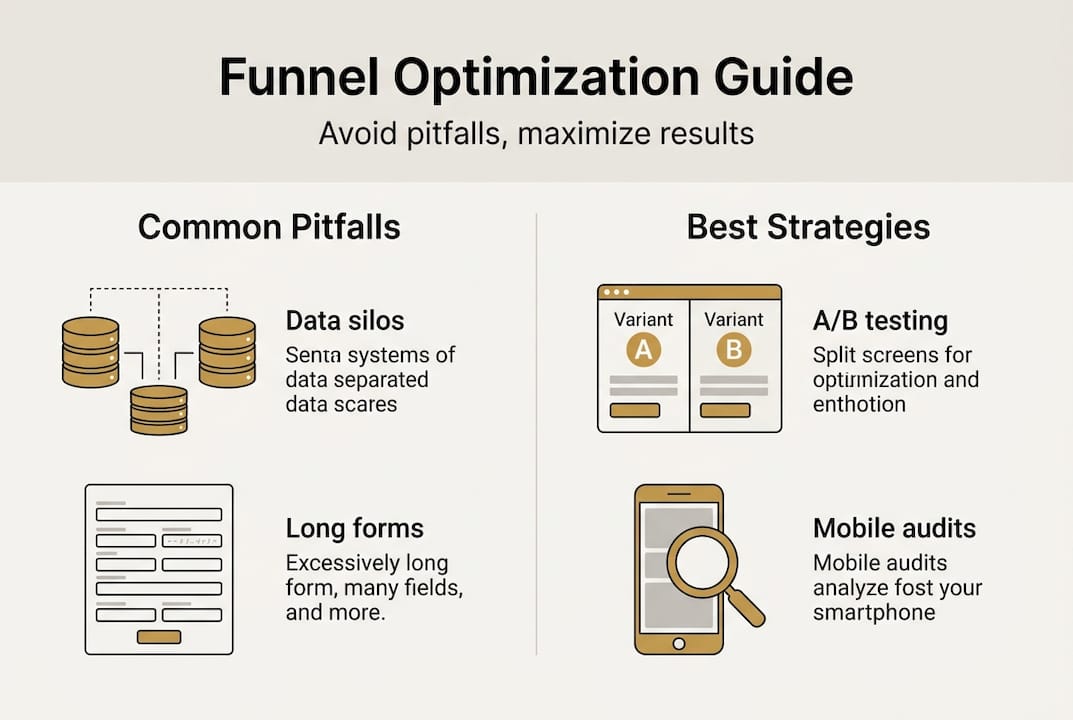
The biggest mistake is creating data silos where your analytics, CRM, and marketing platforms don't communicate. You can't optimize what you can't measure accurately. Avoid fragmented data and vanity metrics by ensuring every funnel stage tracks consistently across tools. Vanity metrics like page views or social media followers feel good but don't predict revenue. Focus on conversion rates, customer acquisition cost, and lifetime value instead.
Another critical error is funnel imbalance. Businesses often over-invest in bottom-of-funnel tactics like retargeting ads while neglecting top-of-funnel lead generation. This creates short-term wins but dries up your pipeline within months. Conversely, flooding your funnel with unqualified leads wastes sales resources on prospects who'll never buy. Balance matters.
Here's how to optimize effectively:
- Conduct regular funnel audits using Google Analytics to identify the biggest drop-off points between stages
- Prioritize fixes based on traffic volume and conversion impact, not personal preferences
- Test one variable at a time so you know what actually drives improvements
- Simplify forms by removing unnecessary fields that create friction
- Add social proof like customer testimonials and case study results at decision points
- Create mobile-specific experiences since mobile users behave differently than desktop visitors
Quick wins deliver immediate results while you work on larger optimizations. Simplifying a seven-field form to three fields often doubles conversion rates overnight. Adding a testimonial video to your pricing page can lift purchases by 20-30%. Testing different calls-to-action through A/B testing reveals which language resonates with your audience.
Pro Tip: Mobile conversion rates often run 50-70% lower than desktop, so audit your mobile funnel separately. Check load times, button sizes, and form usability on actual phones, not just responsive design previews. Small friction points that seem minor on desktop become deal-breakers on mobile.
Integrating email marketing best practices into your funnel optimization ensures leads don't go cold between stages. Automated email sequences keep prospects engaged while they evaluate your solution, addressing objections and building trust without requiring manual follow-up.
Implementing funnel optimization for your small business: practical steps and tools
You don't need expensive enterprise software to start optimizing your funnel. Free and affordable tools provide everything small businesses need to identify problems and test solutions.
Follow this step-by-step framework:
- Map your complete customer journey from first touchpoint through purchase and identify every stage where prospects must take action
- Install Google Analytics with goal tracking for each funnel stage so you can measure conversion rates accurately
- Add heatmap and session recording tools like Microsoft Clarity (free) to see exactly how visitors interact with your pages
- Calculate conversion rates between each funnel stage and compare them to industry benchmarks to find your biggest opportunities
- Prioritize optimization efforts on high-traffic stages first since improvements there affect more prospects
- Create hypotheses for why drop-offs occur at problem stages, then design tests to validate your theories
- Run A/B tests on one element at a time, ensuring you have enough traffic for statistical significance before declaring winners
- Implement winning variations, then move to the next highest-impact opportunity
Prioritize high-traffic stages first because a 10% improvement on a page with 10,000 monthly visitors delivers far more customers than a 50% improvement on a page with 200 visitors. Focus your limited time where it creates the biggest business impact.
Psychological motivators amplify your optimization efforts. Social proof works because prospects trust other customers more than your marketing claims. Scarcity creates urgency when genuine (fake countdown timers backfire). Authority signals like certifications, press mentions, and expert credentials reduce perceived risk. Reciprocity makes prospects more likely to buy after receiving valuable free content.
Your testing timeline depends on traffic volume. A site with 10,000 monthly visitors can run meaningful A/B tests in 1-2 weeks. A site with 1,000 monthly visitors needs 6-8 weeks for reliable results. Don't stop tests early because one variation pulls ahead initially. Statistical significance matters.
Pro Tip: Document every test with screenshots, hypothesis, results, and insights gained. This testing library prevents repeating failed experiments and helps new team members understand what works for your specific audience. Patterns emerge over time that inform your client acquisition strategies across all marketing channels.
Funnel optimization isn't a one-time project. Markets shift, competitors evolve, and customer preferences change. Build optimization into your regular marketing system by scheduling quarterly audits and maintaining an ongoing testing calendar. Continuous improvement compounds over time, creating sustainable competitive advantages.
Boost your funnel optimization with expert marketing solutions
You now understand what funnel optimization involves and how to implement it systematically. But doing it yourself takes time you might not have while running your business. Professional support accelerates results by applying proven frameworks to your specific situation.
Expert marketing solutions streamline funnel audits by quickly identifying your highest-impact opportunities. Instead of spending weeks learning analytics tools and testing methodologies, you get data-driven recommendations backed by experience across hundreds of funnels. Implementation happens faster because professionals know which tactics work for businesses like yours.
Brassballs specializes in expert digital marketing solutions that help small businesses improve client acquisition and revenue growth through proven funnel strategies. Whether you need done-for-you marketing systems or want to learn frameworks you can apply yourself, professional marketing support delivers the no-BS guidance that transforms struggling funnels into revenue machines. The ROI on expert help typically pays for itself within the first optimized campaign.
Frequently asked questions
What is funnel optimization in digital marketing?
Funnel optimization is the systematic improvement of every stage in your customer journey, from initial awareness through final purchase. It combines data analysis, A/B testing, and psychological motivators to reduce drop-offs and increase conversion rates. Unlike isolated page tweaks, funnel optimization examines how prospects move through your entire sales process to identify and fix bottlenecks.
How can small businesses measure funnel optimization success?
Track conversion rates at each funnel stage, particularly visitor-to-lead and lead-to-customer transitions. Compare your performance against industry benchmarks for ecommerce (1.5-3% overall), SaaS (1-5%), or services (2-6%) to gauge where you stand. Monitor customer acquisition cost and lifetime value to ensure optimizations improve profitability, not just conversion rates. Review digital lead generation benchmarks regularly to set realistic goals.
What are common funnel optimization mistakes to avoid?
Avoid siloed data systems that prevent accurate measurement across your funnel stages. Don't focus exclusively on bottom-of-funnel tactics while neglecting top-of-funnel lead generation, as this creates pipeline problems within months. Balance investments across all funnel stages for sustained growth. Stop chasing vanity metrics like page views that don't predict revenue. Apply email marketing best practices to keep leads engaged between funnel stages.
What tools can help with funnel optimization for small businesses?
Google Analytics provides free goal tracking and conversion rate measurement across funnel stages. Heatmap tools like Microsoft Clarity show where visitors click and scroll on your pages. Session recording software reveals exactly where prospects get confused or frustrated. A/B testing platforms validate changes before full deployment, ensuring you implement improvements that actually work. These tools give you professional-grade insights without enterprise software costs.