

TL;DR:
- Lead nurturing builds relationships to convert cold contacts into paying clients effectively.
- Consistent, personalized follow-up and multichannel strategies significantly increase sales conversion rates.
- Most small businesses fail at nurturing due to early abandonment and lack of personalization.
You could be sitting on a goldmine of leads right now and still watching your sales flatline. That stings. 79% of leads never convert without a proper nurturing strategy in place, which means most businesses are basically filling a bucket with a hole in it. More leads won't fix a broken follow-up process. What actually moves the needle is lead nurturing: a deliberate, relationship-building approach that turns cold contacts into paying clients. In this article, you'll learn exactly what lead nurturing is, why it matters more than most small business owners realize, and the practical strategies you can start using today.
Table of Contents
- What is lead nurturing and why does it matter?
- How lead nurturing works: From contact to conversion
- Common challenges and mistakes in lead nurturing
- Practical lead nurturing strategies for small businesses
- What most small businesses get wrong about lead nurturing
- Boost your client conversions with expert help
- Frequently asked questions
Key Takeaways
| Point | Details |
|---|---|
| Lead nurturing defined | Building relationships with leads increases the chance they'll become paying clients. |
| Higher conversion rates | Nurtured leads are more likely to buy, spend more, and convert faster. |
| Cost-effective channels | Email marketing delivers the highest ROI for nurturing leads. |
| Avoid common pitfalls | Personalization beats generic messages and automation can prevent lost opportunities. |
| Focus on quality | A well-nurtured, targeted list often outperforms a large unfocused one. |
What is lead nurturing and why does it matter?
Lead nurturing is the process of building relationships with potential clients at every stage of the marketing funnel, from the moment they first hear about you to the moment they hand over their credit card. It's not about bombarding people with emails or following up every 48 hours until they block your number. It's about showing up with the right message at the right time, consistently and with genuine value.
Think of it like dating. You wouldn't propose on the first date (and if you do, good luck with that). You build trust, demonstrate your value, and let the relationship develop naturally. Lead nurturing works the same way.
Here are the core elements that make it work:
- Timely follow-up: Reaching out within the first hour of a lead showing interest increases conversion chances dramatically.
- Segmented messaging: Not every lead has the same problem. Grouping leads by behavior, interest, or stage means your messages actually land.
- Multichannel approach: Email, social media, phone, retargeting ads. Meeting leads where they already are beats waiting for them to come to you.
- Relevant content: Educational, helpful, problem-solving content builds authority and keeps you top of mind.
"Companies excelling at lead nurturing generate 50% more sales-ready leads at 33% lower cost." That's not a marginal gain. That's a structural competitive advantage.
For small business owners who feel like their sales funnels aren't converting, lead nurturing is often the missing piece. It bridges the gap between someone who's mildly interested and someone who's ready to buy. And when you combine it with solid client acquisition strategies, the results compound fast.
The bottom line: lead nurturing isn't optional if you're serious about growth. It's the engine that keeps your pipeline warm.
How lead nurturing works: From contact to conversion
Understanding the concept is one thing. Knowing how it actually plays out in practice is where most small business owners get stuck. Let's break it down.
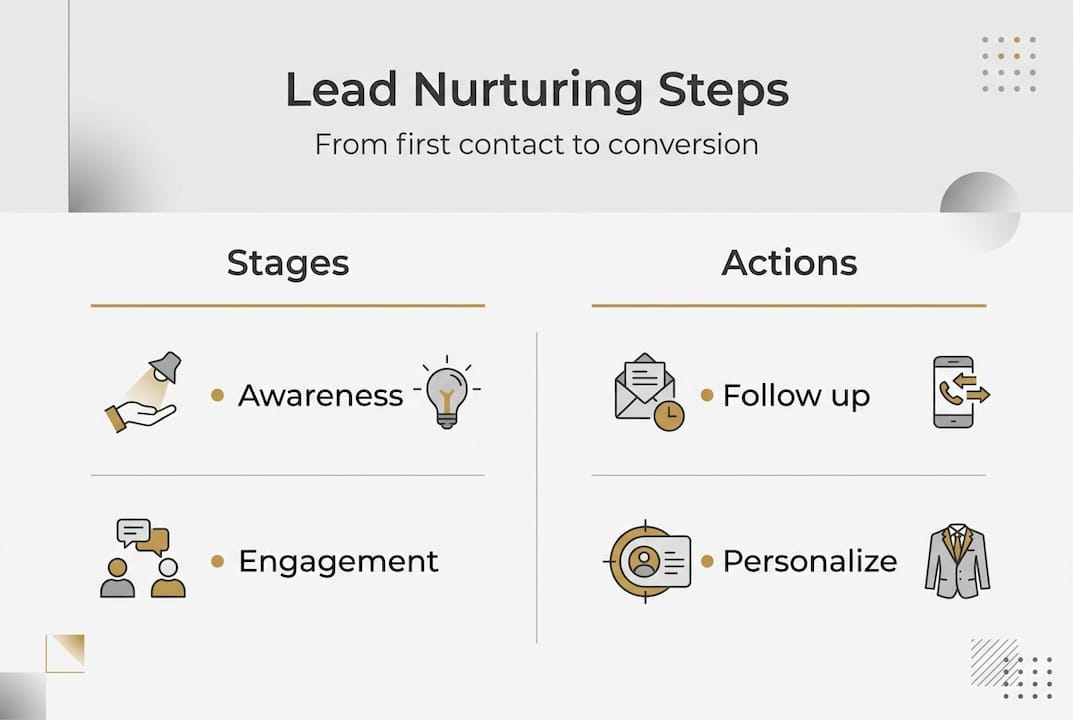
Nurtured leads are genuinely different animals. They make 20% more sales opportunities, spend 47% more per purchase, and convert 23% faster than leads that never received consistent follow-up. That's not a small edge. That's the difference between a thriving business and one that's constantly chasing new leads just to stay afloat.
Here's a simple model to follow:
- Capture: Collect contact information through lead magnets, forms, landing pages, or direct outreach.
- Qualify: Not every lead deserves equal attention. Qualifying leads early saves time and focuses your energy on the people most likely to convert.
- Educate: Share content that solves real problems your leads are facing. Case studies, how-to guides, short videos, and FAQs all work well here.
- Personalize: Use what you know about each lead to tailor your messaging. A lead who downloaded a pricing guide needs a different message than one who just signed up for a newsletter.
- Convert: Once a lead is engaged and trust is established, make a clear, compelling offer with a specific call to action.
Here's a quick look at how nurturing changes the numbers:
| Metric | Without nurturing | With nurturing |
|---|---|---|
| Conversion rate | ~2-3% | ~10-15% |
| Average deal size | Baseline | Up to 47% larger |
| Time to convert | Slower | 23% faster |
| Cost per lead | Higher | Up to 33% lower |
The pattern is clear. Nurturing doesn't just improve one metric. It improves all of them simultaneously.

Pro Tip: Use a simple CRM or email automation tool to track when leads open emails, click links, or revisit your website. These engagement signals tell you exactly when to follow up, so you're not guessing or annoying people with random check-ins.
Common challenges and mistakes in lead nurturing
Now that you know how the process works, let's talk about where it breaks down. Because it does break down, for most small businesses, more often than it should.
50% of leads are qualified but not yet ready to buy, and 48% require long-cycle nurturing before they convert. Translation: patience isn't just a virtue here, it's a strategy.
Most business owners give up after two or three follow-ups. They assume silence means disinterest. It usually just means the timing isn't right yet. The leads who ghost you in month one sometimes become your best clients in month four.
Here are the most common lead nurturing mistakes and how to fix them:
- Giving up too early: Set a minimum of 7 to 10 touchpoints before writing a lead off. Most sales happen after the fifth follow-up.
- Zero personalization: Blasting the same generic email to your entire list is the marketing equivalent of yelling into a crowd. Segment and personalize.
- Only sending promotional content: If every message is a pitch, people tune out fast. Mix in educational content, tips, and genuine value.
- Ignoring list hygiene: Old, unresponsive contacts drag down your email deliverability. Clean your list regularly and re-engage or remove dead contacts.
- No clear next step: Every piece of nurturing content should have one clear action you want the lead to take. Confusion kills conversions.
The fix for most of these? Smart automation. Marketing automation workflows let you stay consistent without burning out, and direct response automation ensures your follow-ups are triggered by behavior, not just a calendar.
Pro Tip: Set up a simple re-engagement sequence for leads that haven't responded in 60 days. A short, honest email asking if they're still interested often reactivates leads you thought were gone for good.
Practical lead nurturing strategies for small businesses
Okay, enough about what goes wrong. Let's talk about what actually works, especially when you're running a small business without a massive marketing budget or a team of 20.
First, let's talk email. It's not glamorous, but email ROI sits at $36 to $42 for every $1 spent. That's not a typo. No other channel comes close for consistent, scalable lead nurturing. Pair that with email marketing best practices and you've got a machine that works while you sleep.
Here's how different channels stack up for nurturing:
| Channel | Cost | Reach | Personalization | Best for |
|---|---|---|---|---|
| Very low | High | High | Long-term nurturing | |
| Phone/SMS | Medium | Medium | Very high | Warm, high-intent leads |
| Social media | Low to medium | Very high | Low to medium | Awareness and retargeting |
| Paid retargeting | Medium to high | High | Medium | Re-engaging cold leads |
Email wins for most small businesses because it's cheap, scalable, and personal when done right. Check out small business email strategies for a deeper look at building sequences that convert.
Here are the strategies that consistently deliver results:
- Automated email sequences: Set up a 5 to 7 email welcome series for every new lead. Introduce yourself, solve a problem, share proof, and make an offer.
- Personalized follow-ups: Reference something specific about the lead's situation or behavior. "I noticed you downloaded our pricing guide" beats "Hey there" every single time.
- Timely touchpoints: Follow up within the first hour of a new lead coming in. Speed signals professionalism and seriousness.
- Multichannel retargeting: Use Facebook or Google retargeting ads to stay visible to leads who've visited your site but haven't converted.
- Value-first content: Send tips, case studies, and short how-to content before you ever pitch. Build the relationship before you ask for the sale.
Small, consistent efforts done well will always outperform a massive, untargeted campaign. You don't need to reach everyone. You need to reach the right people, repeatedly and meaningfully.
What most small businesses get wrong about lead nurturing
Here's the uncomfortable truth: most small business owners treat lead nurturing like a volume game. More leads in, more money out. So they chase every inquiry, blast their list weekly, and wonder why their conversion rate looks like a flatline.
The real leverage isn't in the size of your list. It's in the quality of your relationships. A focused list of 200 well-nurtured leads who know, like, and trust you will consistently outperform a bloated database of 5,000 people who barely remember signing up.
We've seen it firsthand. Business owners who shift from "spray and pray" to intentional, personalized follow-up almost always see conversion rates jump, often without spending a single extra dollar on ads. The no-nonsense marketing strategies that actually work are rarely the flashiest ones.
Automation is a tool, not a replacement for genuine connection. Use it to stay consistent, but let your personality and real value do the heavy lifting.
Pro Tip: Pick your top 20 most promising leads right now and send each one a genuinely personalized message this week. Not a template. A real, specific message. Watch what happens.
Boost your client conversions with expert help
Lead nurturing done right is one of the highest-leverage moves a small business can make. It costs less, converts better, and builds the kind of client relationships that stick around for years. But setting up the right sequences, automations, and messaging frameworks takes time and expertise most business owners simply don't have.
That's exactly where Brassballs marketing solutions come in. Whether you need a done-for-you system, a proven funnel framework, or just a clear roadmap to stop losing leads, the team at Brass Balls has built and tested what actually works for small businesses and entrepreneurs. No fluff, no guesswork, just results-focused marketing that fills your pipeline and keeps it warm.
Frequently asked questions
What is lead nurturing in simple terms?
Lead nurturing means building relationships with potential clients through relevant, personalized communication until they're ready to buy.
Why should small businesses care about lead nurturing?
Nurturing leads can generate 50% more sales-ready leads at 33% lower cost compared to ignoring them, making it one of the most cost-effective growth strategies available.
What is the best channel for lead nurturing?
Email marketing is the top performer for ROI, returning $36 to $42 for every $1 spent, making it the go-to channel for consistent, scalable nurturing.
How long does it take for a lead to convert?
Nearly half of leads require long-cycle nurturing, so conversions can range from a few days to several months depending on the client's buying journey and decision timeline.