

Most small business owners throw money at random marketing tactics hoping something sticks. What they miss is that direct response marketing delivers ROI between 85-112%, crushing digital advertising returns. The secret? A marketing system that organizes your efforts into a repeatable, scalable process. This guide shows you exactly how to build one that drives predictable growth without burning through your budget.
Table of Contents
- Understanding Marketing Systems: What They Are And Why They Matter
- Direct Response Marketing: The Engine Inside Your Marketing System
- Nailing Your Positioning And Customer Journey For Scalable Growth
- Testing, Optimization, And Automation: Refining Your Marketing System
- Discover Tailored Marketing Solutions For Your Business
- Frequently Asked Questions
Key takeaways
| Point | Details |
|---|---|
| Marketing systems create predictable growth | An organized process turns scattered tactics into reliable customer acquisition machines. |
| Direct response marketing drives immediate results | Clear calls to action and measurable outcomes deliver fast ROI that outperforms traditional channels. |
| Positioning multiplies effectiveness | Strong market positioning makes your marketing efforts 3-30x more effective across all channels. |
| Testing lowers costs while improving results | Data-driven optimization can cut cost per lead in half while doubling response rates. |
| Small budgets work with smart systems | Automation and targeted tactics let you compete without enterprise-level spending. |
Understanding marketing systems: what they are and why they matter
A marketing system is an organized, repeatable process for attracting and converting customers. Think of it as your business's growth engine, not a collection of random tactics.
Most small businesses operate without systems. They try Facebook ads this month, email marketing next month, maybe some SEO sprinkled in. This scattered approach creates three major problems.
First, you can't track what actually works. Second, you waste time reinventing the wheel every campaign. Third, you miss the compounding benefits of optimization.
Marketing automation increases efficiency by 15% by standardizing your customer acquisition process. Here's what a proper system captures:
- Repeatable customer journey stages from first contact to sale
- Automated follow-up sequences that nurture leads without manual work
- Standardized messaging frameworks that convert consistently
- Data collection points that reveal what drives revenue
- Testing protocols that improve performance over time
Systems beat tactics every time. A mediocre system optimized over six months crushes brilliant one-off campaigns. Why? Because systems learn, adapt, and compound.
Your marketing system becomes an asset. New team members plug into existing frameworks. Scaling doesn't mean starting from scratch. You simply feed more leads into a machine you know converts.
Direct response marketing: the engine inside your marketing system
Direct response marketing is advertising designed to provoke immediate, measurable action. Unlike brand awareness campaigns, you know within hours if it worked.
Every direct response piece includes three core elements. First, a crystal-clear call to action telling people exactly what to do next. Second, urgency that motivates action now instead of later. Third, tracking mechanisms that measure every dollar spent and earned.
Direct response campaigns generate results within hours, not weeks. You launch a landing page with a targeted offer, drive traffic, and watch conversions roll in. No guessing.
The tactics work across channels. Email sequences with compelling subject lines and strong offers. Landing pages optimized for single conversions. Retargeting ads that bring back interested prospects. Direct mail pieces with personalized URLs for tracking.
Here's how to execute your first direct response campaign:
- Identify your ideal customer's biggest pain point right now
- Create one specific offer that solves that pain immediately
- Build a simple landing page focused solely on that offer
- Write copy that speaks directly to the pain and presents your solution
- Add urgency through limited-time bonuses or deadline-driven pricing
- Drive targeted traffic through paid ads or email to qualified prospects
- Track every metric: clicks, conversions, cost per lead, revenue per customer
Pro Tip: Start with $50-$100 test budgets to validate your offer and messaging before scaling. Most campaigns fail because businesses scale too fast before optimization.
The beauty of direct response is accountability. You invest $500 and generate $2,000 in sales, or you don't. That clarity lets you kill what doesn't work and double down on winners.
Nailing your positioning and customer journey for scalable growth
Positioning is how your business occupies unique mental real estate in your market. It's not what you do, it's why someone chooses you over every alternative.

Weak positioning sounds like everyone else. "We provide quality service." "We're the trusted choice." These phrases mean nothing because they apply to every competitor. Strong positioning stakes a specific claim nobody else can make.
Proper positioning multiplies marketing effectiveness by 3-30x because it makes every dollar work harder. Here's the difference:
| Weak Positioning | Strong Positioning |
|---|---|
| Generic messaging that applies to any business | Specific value proposition that excludes competitors |
| Attracts price shoppers looking for deals | Attracts ideal customers willing to pay premium prices |
| 1-3% conversion rates on cold traffic | 8-15% conversion rates with targeted messaging |
| High customer acquisition costs | Lower costs through better message-market match |
| Competes on features and price | Competes on unique outcomes and transformation |
Your customer journey maps every touchpoint from initial awareness to repeat purchase. Optimizing each stage dramatically improves conversion rates and customer lifetime value.
The five critical stages you must map:
- Awareness: How prospects first discover your business and what problem you solve
- Consideration: What information they need to evaluate you against alternatives
- Purchase: The exact steps and friction points in your buying process
- Onboarding: How new customers experience initial value and success
- Retention: Ongoing engagement that leads to referrals and repeat business
Consistent messaging aligned with positioning transforms the journey. When prospects hear the same unique value at every touchpoint, trust compounds. When messaging shifts randomly, confusion kills conversions.
Map your current journey honestly. Where do prospects drop off? What questions go unanswered? Which touchpoints create frustration? Fix those breaks and watch your conversion rates climb.
Testing, optimization, and automation: refining your marketing system
Continuous improvement separates amateur marketers from professionals. Testing reveals what actually works, not what you think should work.
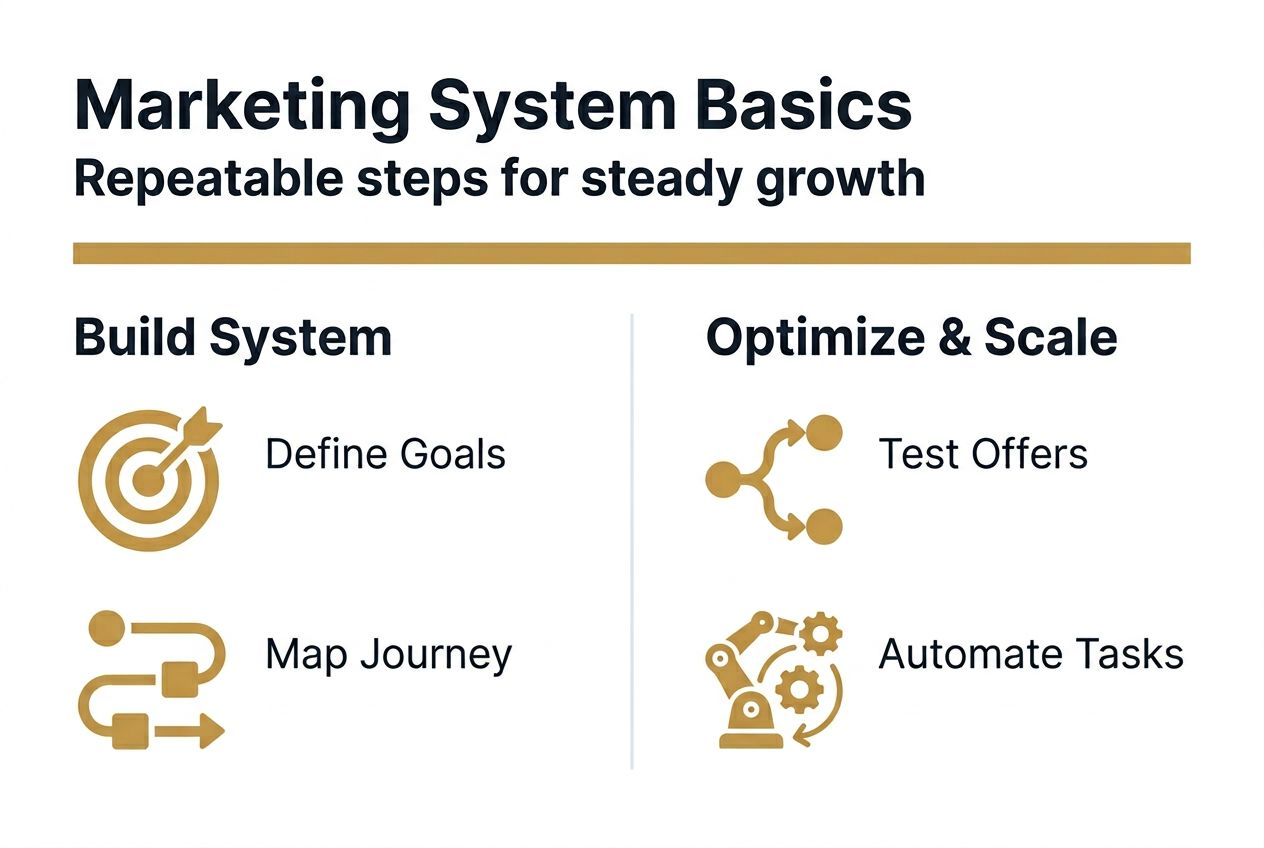
A/B testing compares two versions to find winners. Test one variable at a time: headlines, calls to action, button colors, offer positioning, page layouts. Isolating single variables reveals true performance drivers instead of creating confusing multivariate chaos.
Start with high-impact elements. Your headline determines if people read further. Your call to action determines if they convert. Your offer determines if they buy. Test these before obsessing over button colors.
Automation amplifies your testing wins. Once you discover a high-converting sequence, automation delivers it consistently to every prospect. Benefits multiply:
- Saves 10-15 hours weekly on manual follow-up tasks
- Enables personalized targeting based on behavior and interests
- Delivers consistent messaging that converts at scale
- Nurtures leads automatically until they're ready to buy
- Tracks engagement data that reveals optimization opportunities
Doubling response rates cuts cost per lead roughly in half. This math changes everything. Here's real data:
| Metric | Before Optimization | After Optimization | Improvement |
|---|---|---|---|
| Response Rate | 2.1% | 4.3% | 105% increase |
| Cost Per Lead | $47 | $23 | 51% decrease |
| Conversion Rate | 8% | 14% | 75% increase |
| Customer Acquisition Cost | $588 | $164 | 72% decrease |
Pro Tip: Focus on improving response rates instead of just generating more leads. A 2% response rate on 10,000 prospects (200 leads) costs less and converts better than 1% on 20,000 prospects (same 200 leads) because you're targeting better.
Optimization never stops. Markets shift. Competitors adapt. Customer preferences evolve. Your marketing system must evolve faster. Test weekly, analyze monthly, pivot quarterly.
Discover tailored marketing solutions for your business
Building an effective marketing system from scratch takes time and expertise most small business owners don't have. You need proven frameworks, not trial and error.
Brassballs specializes in marketing solutions for small businesses that deliver measurable growth without the complexity. We integrate direct response strategies, automation tools, and conversion optimization into complete systems tailored to your industry and goals.
Our approach eliminates guesswork. You get proven funnels that convert, messaging frameworks that resonate with your ideal customers, and data dashboards that show exactly what's working. No fluff, no theory, just systems that generate revenue.
Whether you need done-for-you implementation or prefer learning through our self-serve courses, we meet you where you are. The result? Predictable client acquisition that scales as your business grows.
Pro Tip: Schedule a consultation to discuss your specific challenges and discover which marketing system components will drive the fastest results for your business right now.
Frequently asked questions
What is a marketing system?
A marketing system is an organized, repeatable process that attracts, converts, and retains customers predictably. Unlike random marketing tactics, systems standardize your approach, capture performance data, and improve through testing. Think of it as your customer acquisition machine that runs consistently whether you're personally involved or not.
How does a marketing system differ from traditional marketing?
Traditional marketing focuses on brand awareness and reach without direct measurement. Marketing systems prioritize measurable actions, immediate responses, and clear ROI tracking. Traditional campaigns might build recognition over months, while systems generate leads and sales within days through targeted direct response tactics that demand action.
What are the first steps to building a marketing system?
Start by mapping your current customer journey from awareness to purchase. Identify where prospects drop off and what questions remain unanswered. Then implement one direct response funnel: a targeted landing page with a specific offer, traffic source, and follow-up sequence. Test, measure, optimize, then scale what works before adding complexity.
Do I need a big budget for marketing automation?
No, many automation tools offer free tiers or affordable plans under $50 monthly. Email automation, basic CRM functions, and landing page builders cost less than hiring part-time help. Start small with one automated sequence, like a welcome series for new subscribers, and expand as you see returns.
How long before I see results from a marketing system?
Direct response campaigns within your system can generate leads within hours of launch. However, building a complete optimized system typically takes 90-180 days. You'll see early wins quickly, but compounding benefits like lower acquisition costs and higher lifetime value emerge after several testing cycles refine your approach.
Can small businesses compete with larger companies using marketing systems?
Absolutely, and often more effectively. Small businesses move faster, test quicker, and personalize better than large competitors. Marketing systems level the playing field by letting you automate what enterprises staff heavily, target more precisely than broad campaigns allow, and optimize based on direct customer feedback large companies miss.