

TL;DR:
- Building and owning an email list offers greater control and higher ROI than social media channels.
- Email marketing delivers an average ROI of $36 to $42 per dollar, outperforming SEO and social media.
- Effective list building requires organic growth, segmentation, automation, and consistent engagement.
If you're pouring money into social ads and watching the results flatline, you're not alone. Most small business owners chase every shiny marketing channel and end up with a whole lot of effort and not much to show for it. Here's the thing: email marketing ROI averages $36 to $42 for every $1 spent, which makes most other channels look like a bad investment by comparison. Your email list isn't just another tactic. It's the one marketing asset you actually own, control, and can build a real business on. This article breaks down why that matters and how to do it right.
Table of Contents
- Why an email list is your most valuable asset
- Unmatched ROI: How email marketing powers business growth
- Segmentation and automation: Making your list work for you
- Building your list the right way: Dos and don'ts
- What most small business owners get wrong about email lists
- Ready to build your best marketing asset?
- Frequently asked questions
Key Takeaways
| Point | Details |
|---|---|
| Own your audience | Building your own email list means you control communication with your customers, unaffected by social platform changes. |
| Best-in-class ROI | Email marketing delivers higher returns per dollar spent than social or SEO channels, with real tracking and attribution. |
| Segmentation supercharges results | Targeted emails based on subscriber behavior and engagement can increase opens, clicks, and revenue dramatically. |
| Organic growth wins | Building your list organically protects deliverability and long-term profitability, while buying lists hurts your reputation. |
Why an email list is your most valuable asset
Let's talk ownership for a second. You don't own your Instagram followers. You don't own your Facebook page reach. Those platforms do. And they can change the rules on you overnight, throttle your reach with an algorithm update, or straight-up suspend your account with zero warning. That's a terrifying position to be in if your business depends on those audiences.
Your email list is different. As email list ownership confirms, building your own list gives you control that social media simply cannot match. Nobody can take it from you. Nobody can charge you more to reach your own subscribers. That's a powerful distinction.
And the reach is real. Over 90% of adults use email, making it one of the most reliable ways to get in front of people regardless of what any social platform decides to do next. Compare that to organic Facebook reach, which has dropped to an almost laughable 2 to 5% of your followers on a good day.
Here's a quick side-by-side to put it in perspective:
| Feature | Owned email list | Social media followers |
|---|---|---|
| Ownership | You | The platform |
| Algorithm control | None (you're in charge) | Fully at platform's mercy |
| Reach reliability | High | Low to medium |
| Account suspension risk | None | Real and common |
| Monetization flexibility | Full | Limited |
And what can you actually do with a well-built list? A lot more than just send newsletters. You can nurture cold leads into paying clients, automate follow-up sequences, segment by behavior or interest, retarget past buyers, and launch new offers directly to people who've already said yes to hearing from you. That's a marketing engine, not just a mailing list.
For more on how this fits into a bigger picture, the email list benefits for small businesses go hand in hand with building a proper marketing funnel.
One stat worth noting: a typical email list naturally decays by around 2% per month as people change jobs, switch emails, or just lose interest. That's why actively growing your list isn't optional. It's ongoing maintenance for a living asset.
Unmatched ROI: How email marketing powers business growth
With ownership and control established, it's time to quantify why this channel is so profitable. The numbers are genuinely hard to argue with.
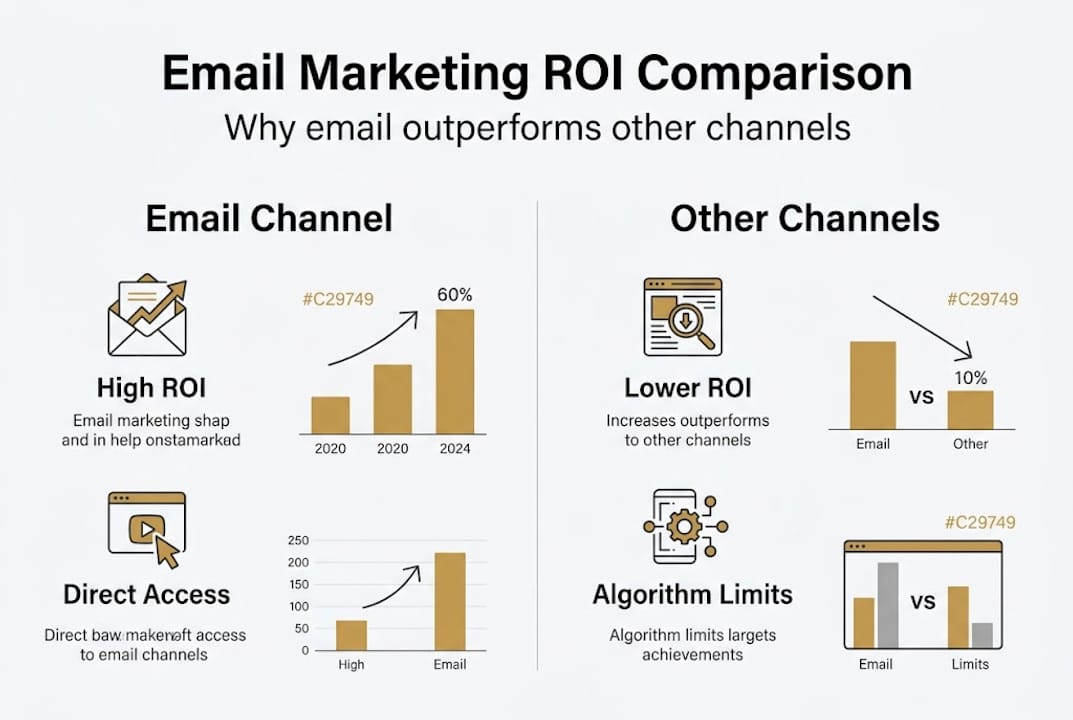
Email marketing ROI sits at $36 to $42 for every dollar spent. SEO comes in at around $22. Social media? About $10. That's not a small gap. That's email lapping the competition twice before social media even finishes its morning coffee.
Let's look at this across channels:
| Channel | Average ROI per $1 spent |
|---|---|
| Email marketing | $36 to $42 |
| SEO | $22 |
| Social media | $10 |
Average email benchmarks show open rates between 21% and 43% and click-through rates of 2% to 3.5%. Top performers push well past those numbers through personalization and smart segmentation. For B2C ecommerce specifically, ROI can climb to $45 to $72 per dollar spent when campaigns are dialed in.
"Email remains the most direct, cost-effective channel because you're communicating with people who already opted in. That intent makes every dollar go further than any paid ad or social post ever could."
That's the crux of it. People on your list chose to be there. There's no algorithm in between you and them. No bidding war. Just a direct line to someone who's already shown interest.
Pro Tip: Don't blast your entire list every time. Focus your campaigns on your most engaged segment first. These subscribers boost your open rates, which signals to email providers that your content is worth delivering. More inbox placement equals more revenue.
Looking to squeeze more out of your email efforts? The email marketing growth strategies we cover go deeper on what moves the needle, and if you want to connect the dots to your overall numbers, check out improve marketing ROI for a broader view.
Segmentation and automation: Making your list work for you
Now that the value is clear, let's explore how to turn your email list into a smart, revenue-generating system. Raw subscriber count means nothing if you're sending the same generic email to everyone. That's how you get ignored.

Email segmentation by behavior, demographics, and engagement can boost open rates by 30 to 46%, click rates by 50 to 101%, and revenue by up to 760%. Let that number sink in. Seven hundred and sixty percent more revenue from the same list, just by sending the right message to the right people.
Here are some segmentation approaches that actually work:
- New subscribers who just joined and need a welcome sequence
- Repeat buyers who are ready for upsell or loyalty offers
- Inactive subscribers who need a re-engagement campaign or should be pruned
- High-engagement readers who open everything and are prime candidates for premium offers
- Interest-based groups based on which lead magnet or product category they came through
Automation makes all of this scale without you needing to personally send every email. A welcome sequence goes out the moment someone joins. A cart abandonment email fires after 24 hours. A win-back campaign triggers after 90 days of silence. You build it once and let it work.
Another underrated advantage: precise revenue tracking from opt-in lists means you can see exactly which email drove which sale. No guessing. No vanity metrics like reach or impressions. Just actual dollars attributed to specific campaigns.
Pro Tip: Don't overcomplicate segmentation out of the gate. Start with three broad buckets: new, active, and inactive. Run that for a few months, see what the data tells you, then layer in more specific segments as you grow.
For a deeper look at how this fits into your sales process, segmenting email lists for more sales is worth a read, along with email best practices to boost revenue for the tactical details.
Building your list the right way: Dos and don'ts
To harness these advantages, you need to build your list following best practices that protect your reputation and ROI. And yes, that means resisting the temptation to buy a list.
Purchased lists lead to open rates below 10%, bounce rates that can hit 30% annually, spam complaints that damage your sender reputation, and potential blacklisting from email providers. You'd basically be paying money to actively hurt your marketing. Hard pass.
"Using a purchased list is the fastest way to burn your sender reputation to the ground. You'll spend months trying to repair what took seconds to break."
Instead, build organically. Here's a simple five-step plan:
- Create a lead magnet that solves a specific problem your ideal client has (a checklist, guide, template, or mini-training works well)
- Set up opt-in forms on your website, landing pages, and anywhere your audience hangs out online
- Write compelling CTAs (calls to action) that spell out exactly what someone gets by subscribing
- Launch a welcome email sequence that delivers value immediately and starts building trust before you ever make an offer
- Send consistently on a schedule your audience can expect, whether that's weekly or twice a month
The welcome sequence point is critical and often skipped. The moment someone opts in is the peak of their interest in you. Miss that window and you miss the best shot at building a relationship.
Remember that 2% monthly decay rate we mentioned earlier. Even a healthy, well-run list shrinks if you're not actively adding new subscribers. Growth isn't a one-time task. It's a continuous part of running a marketing-savvy business.
For a broader look at how email fits into your full acquisition system, email marketing for funnel success connects the dots between list building and converting subscribers into paying clients.
What most small business owners get wrong about email lists
Here's the uncomfortable truth nobody likes to say out loud: most people who start an email list do it wrong, get discouraged, and quit before it has a chance to work.
The biggest mistake? Expecting quick wins. Email is a relationship channel. It rewards consistency over bursts of effort. The business owners who win with email are the ones still showing up in the inbox six months later, not the ones who sent three emails and gave up when nobody bought immediately.
The second mistake is obsessing over list size instead of list quality. A thousand engaged subscribers who open and click will out-earn a list of ten thousand people who ignore everything you send. And a bloated list of unengaged contacts actually hurts your deliverability, which means fewer of your emails reach the people who do care.
As ROI tracking research points out, poor execution including no segmentation and bought lists yields low results, and around 21% of businesses still don't measure email ROI accurately. That's a fixable problem.
Pro Tip: Every quarter, review your list and prune anyone who hasn't opened an email in 90 to 180 days. It feels counterintuitive to delete subscribers, but a cleaner list protects your deliverability and makes your numbers actually meaningful.
Treat email like a conversation, not a broadcast. The businesses that get this right, especially using the marketing strategies that work built around relationships, consistently outperform those chasing the next shiny channel.
Ready to build your best marketing asset?
You've seen the numbers. You know why owned audiences beat rented ones every time. And you know the difference between list building that actually works and the shortcuts that blow up in your face.
The next move is yours. If you want no-BS guidance on building a marketing system that generates real, consistent revenue, learn more at Brassballs and see how we help small business owners cut through the noise. For practical tactics you can start using today, our email strategies for small businesses will give you a solid running start without the overwhelm.
Frequently asked questions
Why is an email list better than social media followers?
An email list gives you direct, algorithm-free access to your audience, so list ownership means you're never one platform policy change away from losing everything you've built.
How much ROI does email marketing generate compared to other channels?
Email marketing delivers $36 to $42 for every dollar spent, which is two to four times more than SEO and significantly more than social media's $10 average return.
Can I buy an email list to get started faster?
Purchased lists cause low open rates, high bounce rates, and spam complaints that can get your domain blacklisted, making organic list building the only smart option.
How do I keep my email list healthy and engaged?
Regularly prune inactive contacts and use engagement segmentation to separate your best customers from cold subscribers, which protects your deliverability and keeps your metrics honest.