

You're posting on social media, running ads, sending emails, and hustling like your business depends on it (because it does). Yet somehow, the results feel like a slot machine: occasionally exciting, mostly frustrating, and completely unpredictable. Sound familiar? Most small business owners aren't failing because they lack effort. They're failing because they're stacking tactics on top of tactics with no real system holding it all together. This guide breaks down what a marketing system actually is, why it beats random tactics every single time, and how you can build one that generates consistent clients and revenue without losing your mind in the process.
Table of Contents
- What is a marketing system and why does it matter?
- Marketing systems vs. tactics: Key differences and risks
- How marketing systems drive consistency and growth
- Essential components of an effective marketing system
- How to start building your own marketing system
- Streamline your marketing with expert support
- Frequently asked questions
Key Takeaways
| Point | Details |
|---|---|
| Systems drive growth | Marketing systems create steady, predictable results unlike scattered tactics. |
| Avoid random acts | Pure tactics without systems waste resources and rarely scale effectively. |
| Essential system elements | A strong marketing system includes strategy, processes, automation, and measurement. |
| Start small, iterate | Begin building your system with simple steps and improve over time for lasting benefits. |
What is a marketing system and why does it matter?
Let's cut through the noise. A marketing system basics is not a fancy spreadsheet or a stack of apps you never open. It's a structured, repeatable process that attracts the right people, nurtures them until they're ready to buy, and converts them into paying clients, on autopilot as much as possible.
Think of it like a vending machine. You put in the right inputs (traffic, content, follow-up), and out comes a predictable output (leads, sales, revenue). Tactics, on the other hand, are like throwing coins at a wall and hoping one sticks. Sometimes it works. Usually it doesn't.
As Salesforce points out, pure tactics without strategy lead to random acts, while strategy without systems remains unexecuted. That's the trap most small business owners fall into: great ideas, zero infrastructure to make them work consistently.
"Strategy without systems remains unexecuted." That's not just a clever quote. It's the reason your marketing feels like running on a treadmill.
A solid marketing system includes:
- A clear lead capture mechanism (landing pages, opt-in forms, lead magnets)
- A nurture sequence that builds trust over time (email, retargeting, content)
- A qualification process to filter serious buyers from tire-kickers
- A conversion pathway with clear calls to action and follow-up
- A measurement dashboard so you know what's working and what's burning cash
Without these pieces working together, you're not marketing. You're just making noise.
Marketing systems vs. tactics: Key differences and risks
With a clear definition in mind, let's dig into how marketing systems actually stack up against common tactics and why that matters for growing your business.
| Factor | Marketing system | Random tactics |
|---|---|---|
| Consistency | Predictable, repeatable results | Hit-or-miss outcomes |
| Scalability | Grows with your business | Hits a ceiling fast |
| Time investment | Front-loaded, then automated | Constant manual effort |
| ROI tracking | Built-in measurement | Guesswork at best |
| Burnout risk | Low (systems do the heavy lifting) | High (you do everything) |
Relying only on tactics is like building a house with no blueprint. You might nail a few boards together, but eventually the whole thing wobbles. The empty tactics pitfall is real: wasted ad spend, inconsistent lead flow, and a business owner who's exhausted from doing everything manually.
Here's a simple framework to shift from chaos to system:
- Audit your current marketing. List every tactic you're using. Ask: does this connect to a larger strategy or is it just activity for activity's sake?
- Identify the gaps. Where do leads fall through the cracks? After the first email? After a discovery call? Find the leak.
- Map the customer journey. Know exactly how a stranger becomes a paying client, step by step.
- Plug in repeatable processes. Replace one-off actions with documented, repeatable workflows.
- Measure and adjust. Set simple KPIs and review them monthly. No data, no direction.
Pro Tip: Do a 30-minute marketing audit right now. Write down every marketing activity you did last month. Circle the ones that directly generated a lead or sale. Everything else is a candidate for cutting or systematizing.
How marketing systems drive consistency and growth
Understanding the downsides of disorganized tactics, it's time to see how systems actually deliver dependable growth and free up your time.

| Metric | Systematized marketing | Non-systematic approach |
|---|---|---|
| Lead conversion rate | 15-30% improvement | Baseline, inconsistent |
| Client retention | Higher (consistent follow-up) | Lower (leads go cold) |
| Time spent on marketing | Reduced after setup | Ongoing manual effort |
| Revenue predictability | High | Low to moderate |
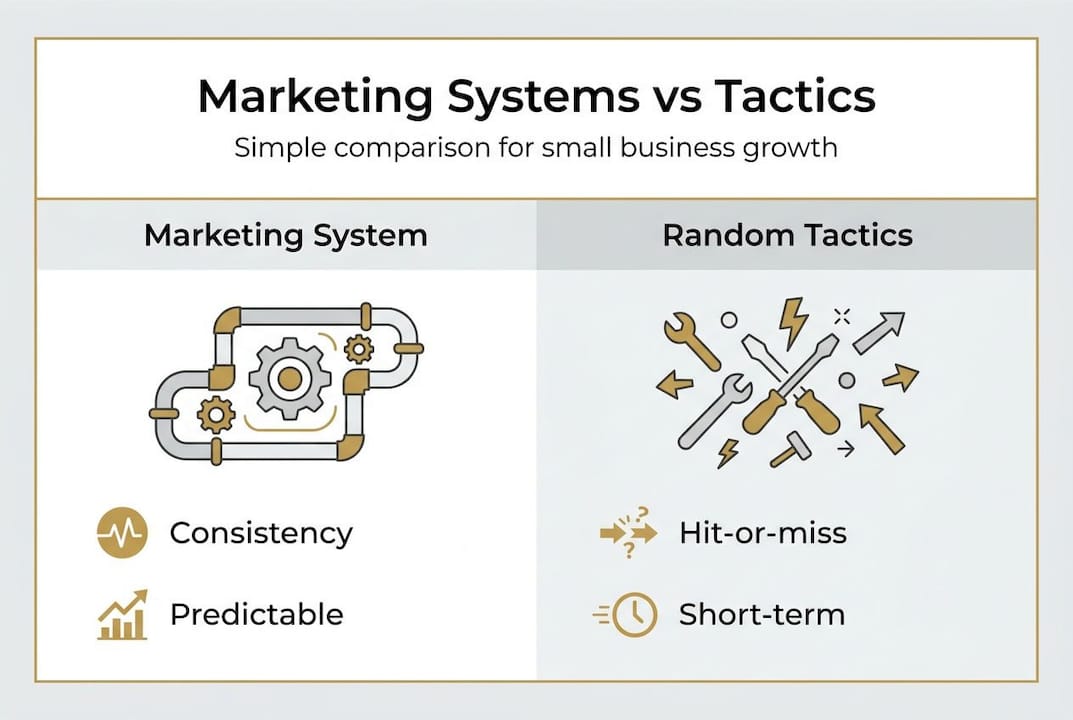
The strategy vs. tactics research makes it clear: strategy without execution infrastructure stays stuck on the whiteboard. Systems are that infrastructure.
Here are the top three ways marketing systems eliminate inefficiency and boost ROI:
- Automation removes repetition. Follow-up emails, appointment reminders, and lead nurturing sequences run without you lifting a finger. You set it up once, it works forever.
- Consistency builds trust. Prospects who hear from you regularly are far more likely to buy when they're ready. Sporadic outreach makes you forgettable.
- Data drives smarter decisions. When you track every step, you stop guessing and start optimizing. You put more money into what works and kill what doesn't.
Explore system-driven growth strategies and marketing funnel frameworks to see how real businesses have applied these principles. You can also dig into case studies in systems that show the before-and-after impact of going from scattered tactics to a real system.
Essential components of an effective marketing system
Now that you've glimpsed the payoff, let's outline exactly what goes into a true marketing system so you know what to prioritize.
Every effective marketing system is built in layers. Skip a layer and the whole thing leaks. Here's what you need:
- Lead capture: Landing pages, opt-in forms, and lead magnets that pull the right people into your world. No capture, no pipeline.
- Lead nurturing: Email sequences, retargeting ads, and content that keeps you top of mind. This is where most businesses drop the ball.
- Lead qualification: A process (survey, application, discovery call) that filters serious buyers from people just browsing.
- Conversion mechanism: A clear, low-friction path to purchase or booking. Confusion kills conversions.
- Measurement and optimization: Analytics, tracking links, and regular reviews. If you can't measure it, you can't improve it.
For the tech side, check out this automation tools overview to find tools that fit your budget and skill level. And don't underestimate the power of community marketing elements or a well-built email automation role in keeping your pipeline warm.
Pro Tip: Don't let shiny software syndrome derail you. Start with one simple tool that handles email automation and a basic landing page. Master that before adding complexity. A simple system you actually use beats a sophisticated one collecting digital dust.
The strategy-to-system connection is non-negotiable: even the best tools fail if there's no clear strategy behind them. Build the strategy first, then choose the tools that support it.
How to start building your own marketing system
With all the pieces clear, here's how to confidently take action and start your own system for consistent marketing wins.
Building a marketing system doesn't require a massive budget or a team of ten. It requires clarity, consistency, and a willingness to document what works. Here's your five-step starting point:
- Audit your current marketing. Pull together everything you're doing right now. Identify what's generating leads and what's just keeping you busy. Be brutally honest. Most business owners discover they're spending 80% of their time on activities that produce 20% of their results.
- Map your customer journey. Trace the exact path a new client takes from first hearing about you to handing over money. Write it down. Every step. You'll spot gaps immediately.
- Build your lead capture foundation. Set up a simple lead generation guide process: a landing page, a compelling offer, and an opt-in form. This is your system's front door.
- Create a basic nurture sequence. Write five to seven emails that educate, build trust, and move prospects toward a buying decision. Schedule them to go out automatically after someone opts in.
- Set your measurement baseline. Decide on three to five KPIs you'll track monthly: leads generated, email open rates, conversion rate, cost per lead, and revenue from marketing activities. Review them, adjust, and repeat.
The strategy-without-systems trap is real and it's expensive. Every month you operate without a system is a month of leads slipping through the cracks and revenue left on the table. Start small, stay consistent, and build from there.
Streamline your marketing with expert support
Ready for next steps or specialized support? Building a marketing system from scratch is absolutely doable, but it's a lot faster when you're not figuring it out alone. If you're tired of piecing together tactics that don't connect and you want a proven framework that actually generates consistent clients, it's time to look at what's already working.
At BrassBalls, we specialize in done-for-you marketing systems and direct response strategies built specifically for small business owners and entrepreneurs. Whether you want a fully built funnel, expert coaching, or a self-serve course that walks you through every step, we've got marketing system solutions that cut the guesswork and get you results. No fluff, no jargon, just systems that work.
Frequently asked questions
What is a marketing system for a small business?
A marketing system is a set of connected processes and tools that attract, nurture, and convert leads in a repeatable way, removing the guesswork from client acquisition. Unlike one-off tactics, it runs consistently whether you're actively working or not.
How do marketing systems help with client acquisition?
They create a predictable pathway from stranger to paying client, so your revenue doesn't depend on luck or hustle spikes. When the system is running, leads keep flowing even on your days off.
What's the difference between a marketing tactic and a marketing system?
A tactic is a single action with a short-term goal, like running one Facebook ad. A marketing system is an organized set of actions working together, like that ad feeding into a landing page, then an email sequence, then a sales call, all tracked and optimized.
Can I create a marketing system without expensive software?
Absolutely. Simple tools and clearly documented processes can form a powerful system. Automation helps scale it, but a well-mapped manual process is still miles ahead of random, disconnected tactics.
How do I know my marketing system is working?
You'll see steady lead flow, smoother client onboarding, and predictable revenue instead of wild monthly swings. Track your KPIs monthly and look for consistent improvement over time rather than overnight miracles.