

TL;DR:
- Structured funnel marketing increases leads and revenue compared to scattered tactics.
- Funnels guide prospects through awareness, interest, and decision stages with measurable results.
- Simplify, test, and iterate your funnel to avoid common pitfalls and improve performance.
Most small business owners are out here throwing marketing spaghetti at the wall, hoping something sticks. One week it's Facebook ads, the next it's a random email blast, then a desperate Instagram post at 11 PM. Sound familiar? Here's the thing: 129% more leads after 12 months is what structured funnel marketing delivers, versus the feast-or-famine chaos of scattered tactics. This guide breaks down exactly what funnel marketing is, why it works, where most people trip up, and how you can build a system that generates leads and revenue like clockwork. No fluff, no hype train. Just the real stuff.
Table of Contents
- What is funnel marketing and how does it work?
- The business benefits of choosing funnel marketing
- Common pitfalls and how to avoid them
- Practical steps to build and optimize your funnel
- Why most funnel advice misses the mark—and what really works
- Take the next step with expert funnel help
- Frequently asked questions
Key Takeaways
| Point | Details |
|---|---|
| Structured growth | Funnels provide a roadmap to convert leads into loyal customers more predictably. |
| Measurable results | Funnel analytics help you pinpoint what works and where to improve for better ROI. |
| Common pitfalls | Avoid isolated optimization, vanity metrics, and overly complex stages for better performance. |
| Practical steps | Start simple, track key metrics, and optimize your funnel monthly for steady results. |
What is funnel marketing and how does it work?
Now that we've previewed why funnel marketing deserves a closer look, let's start with the basics.
Funnel marketing is a structured framework that guides potential customers through a deliberate sequence of stages, from first discovering your brand all the way to buying from you and coming back for more. Think of it like a well-designed pipeline rather than a garden hose with holes in it. Every step has a purpose, and every piece of content or touchpoint is designed to move someone closer to a decision.
Understanding what a marketing funnel is gives you the foundation to build something that actually scales. Here's the classic breakdown:
- Top of funnel (TOFU): This is awareness territory. People are discovering you for the first time. Blog posts, social content, and short videos live here.
- Middle of funnel (MOFU): Now they're interested. They want more. Webinars, email sequences, lead magnets, and case studies do the heavy lifting.
- Bottom of funnel (BOFU): Decision time. Free trials, demos, testimonials, and direct offers close the deal.
Here's a quick look at how the stages stack up:
| Funnel stage | Goal | Typical content |
|---|---|---|
| Top (TOFU) | Build awareness | Blog posts, social ads, videos |
| Middle (MOFU) | Nurture interest | Emails, webinars, lead magnets |
| Bottom (BOFU) | Drive conversion | Offers, demos, testimonials |
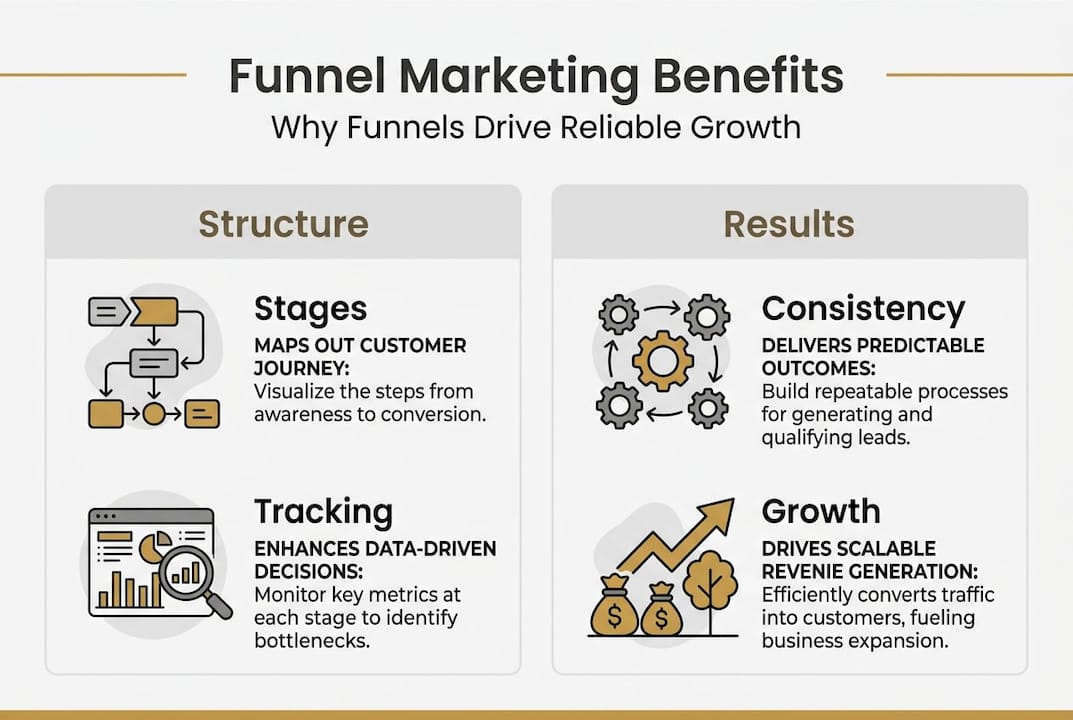
The big distinction worth making: a funnel is not the same as a customer journey. A customer journey maps how someone experiences your brand. A funnel is your operational system for moving them through that experience. As funnels provide measurement despite non-linear journeys, they give you data and control that vague journey maps simply can't.
Without a funnel, you're guessing. With one, you're tracking, testing, and improving.
Pro Tip: Don't build a 12-step funnel with 47 email sequences before you've made a single sale. Start with three stages and three pieces of content. Simple wins. You can always add complexity once you know what's working.
The business benefits of choosing funnel marketing
Understanding how funnels are structured sets the stage for considering their direct impact.
Let's talk results, because that's what you're here for. Funnel marketing isn't just theoretically elegant. It delivers measurable, repeatable business outcomes when done right.

Businesses that commit to structured funnels see 3x more inbound leads in six months and close 94% more deals compared to those relying on ad hoc campaigns. That's not a rounding error. That's a business transformation.
Here's why funnels create such a dramatic difference:
- Consistency: Every lead gets the same quality experience, not just the ones who caught you on a good day.
- Nurture at scale: You can educate and build trust with hundreds of leads simultaneously, without burning out your sales team.
- Predictable revenue: When you know your conversion rate at each stage, you can forecast income with real confidence.
- Smarter spend: You stop wasting budget on channels that don't convert and double down on what works.
Let's compare funnel marketing against the typical ad hoc approach:
| Factor | Funnel marketing | Ad hoc campaigns |
|---|---|---|
| Lead quality | High, pre-qualified | Variable, often cold |
| Consistency | Systematic, repeatable | Unpredictable |
| Data insights | Stage-by-stage metrics | Limited, surface-level |
| ROI visibility | Clear and trackable | Murky at best |
| Scalability | Designed to scale | Hits a ceiling fast |
Looking at marketing funnel examples from real small businesses shows a consistent pattern: the ones growing steadily aren't running more ads. They're running smarter systems. And scalable sales funnels are exactly what separate the businesses that plateau from those that keep climbing.
"The difference between a business that grows and one that grinds is usually a system, not more hustle."
Funnels give you that system. They turn your marketing from a coin flip into a calculated play.
Common pitfalls and how to avoid them
While the benefits are real, funnel marketing isn't magic. Avoiding common mistakes is critical.
Here's the uncomfortable truth: most funnels fail not because the concept is flawed, but because of entirely avoidable execution errors. Knowing what these are before you build saves you a mountain of wasted time and money.
Common funnel mistakes include siloed optimization, chasing vanity metrics, and overcomplicating the stages. Let's break those down:
- Treating each stage in isolation. You obsess over top-of-funnel traffic while ignoring why leads are dropping off at the middle stage. Every stage affects the next. Optimize the system, not just the parts.
- Chasing vanity metrics. Page views and follower counts feel good but don't pay bills. Focus on metrics that actually indicate buying intent: email open rates, click-through rates, and conversion rates.
- Overcomplicating the funnel. Seven landing pages, four tripwires, and a partridge in a pear tree. Complexity is the enemy of execution. If your team can't explain your funnel in two minutes, it's too complicated.
- Skipping the testing phase. Launching a funnel and assuming it'll work without A/B testing headlines, offers, or email subject lines is like driving blindfolded and hoping for the best.
- Ignoring funnel leaks. A leak at the MOFU stage can tank your entire revenue pipeline. Small business marketing tips consistently point to regular audits as the single best habit for keeping funnels healthy.
"A poorly designed funnel doesn't just fail to convert. It actively trains your audience to ignore you."
The fix for most of these problems? Simplify, measure honestly, and improve your marketing ROI by focusing on one core metric per stage before adding more complexity.
Pro Tip: Use a single analytics dashboard that shows your funnel from top to bottom. When you can see all stages at a glance, bottlenecks become obvious fast. Google Looker Studio is free and does the job well.
Practical steps to build and optimize your funnel
With pitfalls in mind, here's how you can set your funnel up for consistent success.
Building a funnel that actually works isn't a weekend project, but it's also not rocket science. It's a process. Here's a practical sequence to follow:
- Map your customer journey. Before you write a single word of copy, understand how your ideal client moves from problem-aware to solution-ready. Driving client acquisition starts with knowing exactly who you're talking to and what they need to hear at each stage.
- Create stage-specific content. TOFU content educates. MOFU content builds trust. BOFU content converts. Don't use a blog post where a case study belongs. Map customer journey and create stage-specific content including lead magnets and email sequences tailored to each phase.
- Set up your tracking. Install analytics on every page. Track opt-in rates, email open rates, and conversion rates at minimum. You can't fix what you can't see.
- Launch and watch. Don't wait for perfection. Get it live, then use your funnel optimization guide to identify where people are dropping off and why.
- Optimize iteratively. Change one element at a time. Test a new headline. Try a different offer. Tweak your email subject line. Stacking too many changes at once makes it impossible to know what moved the needle.
Here are the must-have tools to support your funnel:
- An email marketing platform for email marketing for funnels (ActiveCampaign, Mailchimp, or ConvertKit all work)
- A landing page builder (ClickFunnels, Leadpages, or even a well-configured WordPress site)
- Analytics (Google Analytics 4 plus your email platform's built-in reporting)
- Audience segmentation for funnel conversions to make sure the right message hits the right person at the right time
Pro Tip: Block 30 minutes every month to review your funnel analytics. Look for the stage with the biggest drop-off and focus your next optimization effort there. Patch the biggest leak first, always.
Why most funnel advice misses the mark—and what really works
These practical steps can transform your approach, but it's vital to understand what industry advice often gets wrong.
Here's the dirty secret about most funnel advice floating around the internet: it's built for software companies or e-commerce brands with massive budgets, not for small business owners trying to grow without a full marketing department.
The generic advice pushes you toward elaborate multi-step funnels with automated sequences for every micro-behavior. It sounds impressive. In practice, it paralyzes most business owners before they ever launch anything.
What actually works? Embarrassingly simple funnels, run with relentless consistency. A two-step opt-in leading to a five-email nurture sequence and a clear offer outperforms a 20-step automation maze every single time, because it actually gets finished and launched.
The best funnels we've seen are built on three things: real feedback from real customers, honest measurement of what's converting, and the discipline to optimize results over appearances. Your funnel doesn't need to look pretty. It needs to work.
Start simple. Use your lead qualification guide to filter for buyers, not browsers. Then improve what you've got rather than chasing the next shiny funnel template. Iteration beats perfection every single time.
Take the next step with expert funnel help
If you're ready to see how funnel marketing can accelerate your growth, here's how to take action.
Reading about funnels is one thing. Actually building one that brings in consistent, qualified leads is another beast entirely. That's where having a proven team in your corner makes all the difference.
At Brass Balls, we specialize in no-BS, direct response marketing systems built specifically for small business owners and entrepreneurs. Whether you want a done-for-you solution or prefer to learn the ropes yourself, we've got you covered. Our frameworks are tested, our results are real, and we don't do cookie-cutter. If you're serious about building a funnel that actually converts, explore your options with professional funnel support and let's build something that works for your business, not someone else's.
Frequently asked questions
What is the main advantage of funnel marketing over traditional tactics?
Funnel marketing gives you a structured, measurable way to nurture leads and drive predictable results, unlike traditional tactics that rely on guesswork. Because funnels provide measurement even through non-linear customer journeys, you always know where to improve.
How do I know if my funnel is working?
Track core metrics like lead flow, conversion rates, and deals closed at each stage to measure funnel performance. Businesses using structured funnels see 94% more deals closed, which gives you a solid benchmark to aim for.
What are the top mistakes to avoid in funnel marketing?
Avoid siloed optimization, tracking only vanity metrics, and overcomplicating funnel stages. Common funnel pitfalls consistently come down to these three errors, and fixing them usually produces an immediate improvement in results.
How often should I optimize my sales funnel?
Review your funnel analytics at least monthly to identify and fix any leaks or bottlenecks. The goal is to optimize iteratively using analytics so small improvements compound into significant revenue gains over time.