

TL;DR:
- Marketing training builds trust and improves client retention for small businesses.
- It provides practical frameworks for messaging, funnels, and direct response strategies.
- Ongoing training is essential for continuous growth and adapting to market changes.
Most small business owners think they can wing it when it comes to marketing. Natural charm, a decent product, and word-of-mouth will carry the day, right? Wrong. Marketing training enhances B2B relationship quality with SMEs by building trust, especially in transactional contexts where clients are making real buying decisions. That's not a soft, feel-good finding. That's a direct line between structured learning and revenue. This guide breaks down exactly why marketing training is one of the highest-leverage investments you can make, and how to stop leaving client acquisition to chance.
Table of Contents
- Why marketing training is a game changer for small businesses
- Direct response strategies: How training increases client acquisition
- The ripple effect: Enhanced marketing elevates all business operations
- Practical steps: Getting started with effective marketing training
- The real reason most businesses struggle: The overlooked value of ongoing training
- Take the next step: Invest in your marketing success
- Frequently asked questions
Key Takeaways
| Point | Details |
|---|---|
| Builds lasting client trust | Marketing training strengthens relationships that drive repeat business and referrals. |
| Boosts immediate client acquisition | Direct response strategies learned through training help win new clients quickly. |
| Improves business-wide growth | Skills gained in marketing training create a positive ripple effect throughout your company. |
| Makes your business adaptable | Continuous learning enables faster adaptation to new marketing channels and trends. |
Why marketing training is a game changer for small businesses
Let's be blunt: most small business owners are guessing. They're running ads based on gut feel, writing copy that sounds good to them, and wondering why their pipeline looks like a ghost town. Marketing training flips that script entirely.
The evidence is hard to ignore. Training builds trust and positive emotions in business relationships, increasing the quality and retention of B2B clients. Trust isn't just a warm fuzzy feeling. It's the mechanism that keeps clients coming back and referring others.
Here's what skilled marketing training actually delivers:
- Clarity on your ideal client so you stop chasing everyone and start attracting the right people
- Proven frameworks for messaging that resonates instead of rambles
- Funnel-building skills that turn cold strangers into paying clients systematically
- Data literacy so you can read your numbers and make decisions that actually move the needle
- Confidence to execute campaigns without second-guessing every word
Think of untrained marketing like trying to build a house without blueprints. You might get four walls up, but the roof is probably going to leak. Training gives you the blueprint.
| Business outcome | Without training | With training |
|---|---|---|
| Client acquisition rate | Inconsistent, reactive | Predictable, proactive |
| Client retention | Low, price-dependent | High, trust-driven |
| Campaign ROI | Unknown or poor | Measured and improving |
| Team alignment | Scattered efforts | Unified strategy |
"The businesses that invest in understanding their clients win. The ones that assume they already do, lose."
Building marketing systems for growth becomes far easier when you have the foundational knowledge to design them intentionally. And when you pair that knowledge with solid client acquisition strategies, you're not just growing. You're compounding.
Direct response strategies: How training increases client acquisition
Understanding why training matters leads to practical strategies. Here's how training enhances direct response marketing in ways that actually show up in your bank account.
Direct response marketing is the opposite of brand awareness fluff. Every piece of content, every ad, every email is designed to trigger a specific, trackable action: a click, a sign-up, a purchase, a call. No action means no result. Simple as that.
SMEs who leverage digital marketing training report improved transactional outcomes and trust-based relationships. That's not theory. That's trained business owners outperforming their untrained competitors in real markets.
Here's how training builds your direct response muscle:
- Value-driven messaging: You learn to lead with what the client gets, not what you do. Big difference.
- Irresistible calls-to-action: Training teaches you to write CTAs that feel like the obvious next step, not a pushy sales grab.
- Funnel architecture: You understand how to move someone from curious stranger to paying client through a logical sequence of touchpoints.
- Offer construction: You learn to package your services so the price feels like a bargain compared to the value.
- Testing and iteration: Trained marketers test, measure, and improve. Untrained ones repeat the same mistakes and call it bad luck.
| Metric | Untrained approach | Trained approach |
|---|---|---|
| Lead conversion rate | 1-2% | 5-10%+ |
| Cost per acquisition | High and unpredictable | Optimized and declining |
| Client lifetime value | Low | Significantly higher |
| Campaign repeatability | Rare | Systematic |
Pro Tip: Before you run your next campaign, write down the single action you want your prospect to take. If you can't state it in one sentence, your campaign isn't ready yet.
Applying training to improving marketing ROI is where the rubber meets the road. Combine that with staying current on marketing tips for 2026 and you have a serious competitive edge.
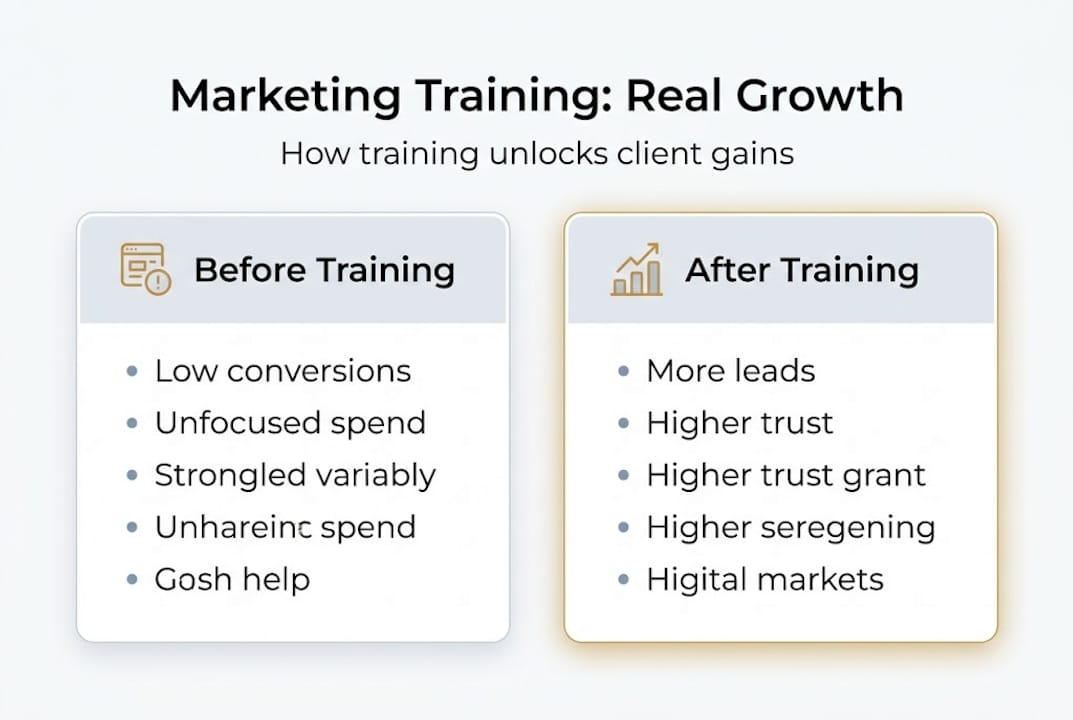
The ripple effect: Enhanced marketing elevates all business operations
Direct response gains are just the beginning. Here's the part most people miss: marketing training doesn't just improve your campaigns. It improves your entire business.
When you understand how to communicate value clearly, that skill bleeds into everything. Your team pitches better. Your customer service feels more intentional. Your partnerships are stronger because you know how to frame mutual benefit.

Trust and emotions fostered through client training support broader business success, not just individual campaign wins. When clients trust you, they spend more, complain less, and refer more. That's a business transformation, not just a marketing win.
Here's what the ripple effect looks like in practice:
- Team performance: When your team understands the marketing strategy, they align their daily actions with it. Less confusion, more momentum.
- Customer service quality: Trained marketers understand client psychology, which makes every client interaction more empathetic and effective.
- Operational efficiency: You stop wasting budget on tactics that don't work and double down on what does.
- Scalability: You build repeatable systems instead of one-off campaigns, which means growth doesn't require proportionally more effort.
- Partnership quality: Vendors, collaborators, and referral partners respond better to businesses that communicate clearly and professionally.
Pro Tip: Map out your client journey from first contact to repeat purchase. Every gap you find is a place where marketing training can plug a leak and improve your bottom line.
This is exactly why marketing automation for business becomes so powerful once you have the foundational knowledge. You're not automating chaos. You're automating a system that works. And understanding the marketing funnels benefits helps you see where automation fits into your broader growth engine.
Practical steps: Getting started with effective marketing training
Knowing the why and how is critical. Here's how to put that insight into practice starting now, without getting overwhelmed or wasting money on the wrong programs.
Step one is honest self-assessment. Before you invest in any training, you need to know what's actually broken. Vague frustration is not a strategy.
- Identify your core client acquisition challenge. Is it traffic? Conversions? Retention? Referrals? Name the specific bottleneck.
- Audit your current marketing. What are you doing now? What's working, even a little? What's a complete waste of time and money?
- Set a measurable goal. "Get more clients" is not a goal. "Increase monthly leads by 30% in 90 days" is a goal.
- Research training programs with proven results. Look for programs that have worked in real, transactional small business contexts, not just theory-heavy academic courses.
- Apply immediately. Don't finish a course and then plan to implement. Apply each module as you learn it.
- Measure and adjust. Track your results weekly. If something isn't moving the needle after a fair test, adjust.
When evaluating a training program, look for these green flags:
- Real case studies from businesses similar to yours
- Specific frameworks you can apply immediately, not just concepts
- Community or mentorship so you're not implementing alone
- Focus on direct response rather than vanity metrics like followers and impressions
- Transparent results from past participants
Programs proven to improve results in real, transactional small business contexts bridge theory and practice in a way that actually changes your revenue. Don't settle for anything less.
Once you've chosen a program, explore strategies for rapid growth to complement what you're learning and accelerate your results.
The real reason most businesses struggle: The overlooked value of ongoing training
Here's the contrarian take nobody wants to hear: the problem isn't that small business owners don't know enough about marketing. It's that they think they already know enough.
They take one course, read a few blog posts, and declare themselves done. Marketing becomes a checkbox, not a practice. Meanwhile, the market shifts, platforms change, and client expectations evolve. And those business owners are still running 2021 playbooks in 2026.
The businesses that consistently outperform their competitors aren't just smarter. They're more committed to learning. A training mindset, the belief that there's always something sharper to learn, is as valuable as any single tactic you'll ever pick up.
Building a marketing community insights network around you accelerates this. You learn faster when you're surrounded by people who are also in the game, testing, failing, and winning in real time.
Ongoing training isn't an expense. It's the competitive moat that keeps getting deeper while your competitors stand still.
Take the next step: Invest in your marketing success
You've seen the data, the frameworks, and the ripple effects. Now it's time to stop reading and start doing. The gap between knowing and implementing is where most businesses lose.
At Brass Balls marketing training resources, we specialize in no-BS direct response marketing that actually moves the needle for small business owners and entrepreneurs. Whether you're starting from scratch or trying to fix a funnel that's leaking clients, we have the tools, training, and community to help you get there faster. If you're serious about understanding why targeting small businesses is a high-leverage strategy, start by exploring what we offer and take the first step toward predictable client growth.
Frequently asked questions
How does marketing training differ from general business training?
Client training in digital marketing enhances relationship quality with SMEs specifically through client acquisition skills, campaign execution, and digital strategy, while general business training covers broader management topics like finance and operations.
What are the first steps to find reputable marketing training?
Start by identifying your specific client acquisition bottleneck, then look for programs with proven results in real small business environments rather than theory-heavy academic courses.
Can marketing training really improve client trust?
Yes. Recent research confirms that training builds trust and positive emotions in B2B relationships, which directly improves client retention and referral rates.
How soon can small businesses see results from marketing training?
Many business owners see improved lead generation, conversions, and client retention within weeks when they apply training methodically to their active campaigns rather than waiting until they feel "ready."