

TL;DR:
- Most small business owners lack confidence due to strategy gaps, not effort.
- Overwhelm results from managing too many channels, tools, and priorities without focus.
- Simplifying tactics and building focused systems can reduce stress and boost results.
If 73% of small business owners lack confidence in their marketing strategy, you're not behind. You're in the majority. Most entrepreneurs aren't failing because they lack hustle. They're drowning because nobody handed them a map. Every week brings a new platform, a new tactic, a shiny new tool that promises to be the silver bullet. Spoiler: it never is. This guide cuts through the noise. We're going to break down exactly why marketing overwhelm happens, what it does to your business, and how to simplify your approach so you actually start seeing results instead of just spinning your wheels.
Table of Contents
- Understanding marketing overwhelm: What it really means
- Root causes of marketing overwhelm for small businesses
- The impact: From burnout to business roadblocks
- How to break free: Simple strategies for focus and results
- What most guides miss about marketing overwhelm
- Finding the right support for sustainable results
- Frequently asked questions
Key Takeaways
| Point | Details |
|---|---|
| Overwhelm defined | Marketing overwhelm stems from trying to do too much without a clear strategy. |
| Too many tools hurt | Adding more tools often increases confusion and workload instead of simplifying marketing. |
| Burnout is real | Marketing overload can lead to business stagnation, impaired mental health, and burnout. |
| Focus is key | Choosing a few high-impact channels and KPIs boosts results and reduces stress. |
| Systems simplify success | Building routines and automating where possible leads to sustainable, consistent growth. |
Understanding marketing overwhelm: What it really means
Now that you know marketing overwhelm is so common, let's clarify what it actually looks and feels like. Because here's the thing: most people confuse being busy with being productive. Those are not the same animal.
Marketing overwhelm is the feeling of being buried alive under an avalanche of choices, tools, platforms, content calendars, and competing priorities. It's not just stress. It's the specific paralysis that sets in when you have fifteen tabs open, three half-finished campaigns, and zero clarity on what to actually finish first. Marketing overwhelm stems primarily from managing too many channels and tactics without a clear strategy holding them together.
Here are the most common symptoms you should recognize:
- Decision fatigue: Every choice feels like a major commitment, so you avoid deciding altogether
- Task hopping: You start something, get distracted by a new idea, and nothing ever gets finished
- Chronic stress: Marketing feels like a fire you're always fighting rather than a system running for you
- Inconsistent output: Some weeks you post everywhere, other weeks you go completely dark
- Diminishing confidence: You start questioning whether marketing even works for you
"Ambition without focus isn't drive. It's just expensive chaos."
The difference between being genuinely busy and being overwhelmed is focus. A busy business owner has a lot on their plate but knows what they're working toward. An overwhelmed one is running fast without knowing where the finish line is. Building marketing systems for growth is exactly how you replace that chaos with something that actually compounds over time.
Ambition is not the villain here. The villain is trying to do everything because it all sounds important. When every channel and tactic feels equally urgent, nothing gets your full attention. And half-attention gets you half-results at best.
Root causes of marketing overwhelm for small businesses
With overwhelm defined, let's dig into the specific causes and how today's business landscape amplifies the problem.
The top reasons small business owners hit the overwhelm wall aren't random. They follow a very predictable pattern:
- No clear strategy: When you don't have a defined plan, every new tactic looks like the missing piece
- Too many channels at once: Trying to win on Instagram, LinkedIn, email, TikTok, and Google simultaneously is a recipe for mediocrity everywhere
- Trend chasing: Jumping on every platform or format that gets buzz leads to scattered messaging and wasted energy
- Tool overload: The average business today uses over 120 different software tools, many of which overlap or underdeliver
- Fuzzy targeting: Not knowing exactly who your customer is means your content tries to speak to everyone and resonates with no one
- No KPIs: Without clear metrics, you can't tell what's working, so you second-guess everything
73% of small business owners lack confidence in their marketing effectiveness. That's not a skill gap. That's a strategy gap. And the tool industry loves to exploit it.
Here's a quick look at the "more is better" myth versus what actually works:
| More is better myth | What actually works |
|---|---|
| Be on every platform | Dominate 1-2 channels |
| Use every available tool | Consolidate into a lean stack |
| Post daily on everything | Post consistently where it matters |
| Track all metrics | Track 3-5 key KPIs only |
| Chase every trend | Build a repeatable system |
Experts debate AI and automation's role constantly. Some say automate everything to scale. Others warn that stacking automation tools on top of a broken strategy just automates your confusion. Both camps have a point. The truth is, tools only help when your strategy is already sound. Without that foundation, you're just adding more noise. Chasing improving marketing ROI becomes nearly impossible when you have no baseline to measure from, and effective marketing strategies always start with clarity, not complexity.
The impact: From burnout to business roadblocks
Understanding the causes makes it clear why the effects can't be ignored. Here's what marketing overwhelm actually does to business owners and their companies.

Let's get real for a second. This isn't just about feeling a bit frazzled. The consequences of sustained marketing overwhelm are measurable, serious, and often irreversible if left unchecked.
| Impact area | What happens |
|---|---|
| Marketing results | Inconsistent output leads to poor reach and weak conversion |
| Business growth | Stagnation because energy is spent firefighting, not building |
| Mental health | Chronic stress, anxiety, and loss of motivation |
| Decision making | Fatigue causes avoidance, poor choices, or total paralysis |
| Team dynamics | Confusion trickles down, affecting staff and contractors |
88% of entrepreneurs struggle with mental health, and 34% experience full-blown burnout. Marketing overload is a significant contributor. This isn't a weak-mindset problem. It's a structural problem, and the structure is broken.
"Burnout doesn't announce itself. It shows up as procrastination, cynicism, and the sudden belief that nothing you do will ever work anyway."
The emotional toll is real. Decision fatigue kicks in early when you're juggling too many marketing choices. Once your mental bandwidth is burned up, you stop making strategic decisions and start making reactive ones. That's when you waste money on ads that aren't ready, hire the wrong contractors, or just give up on marketing entirely for weeks at a stretch.
Pro Tip: If you notice you're starting a lot of marketing tasks but finishing almost none of them, that's not laziness. That's overwhelm. The fix isn't to push harder. It's to narrow your focus dramatically.
Knowing how to target the right customers early on can cut your workload in half because you stop trying to be everywhere and start showing up precisely where your ideal clients already are. Similarly, building a marketing community around your brand reduces the pressure of constantly generating cold leads from scratch.
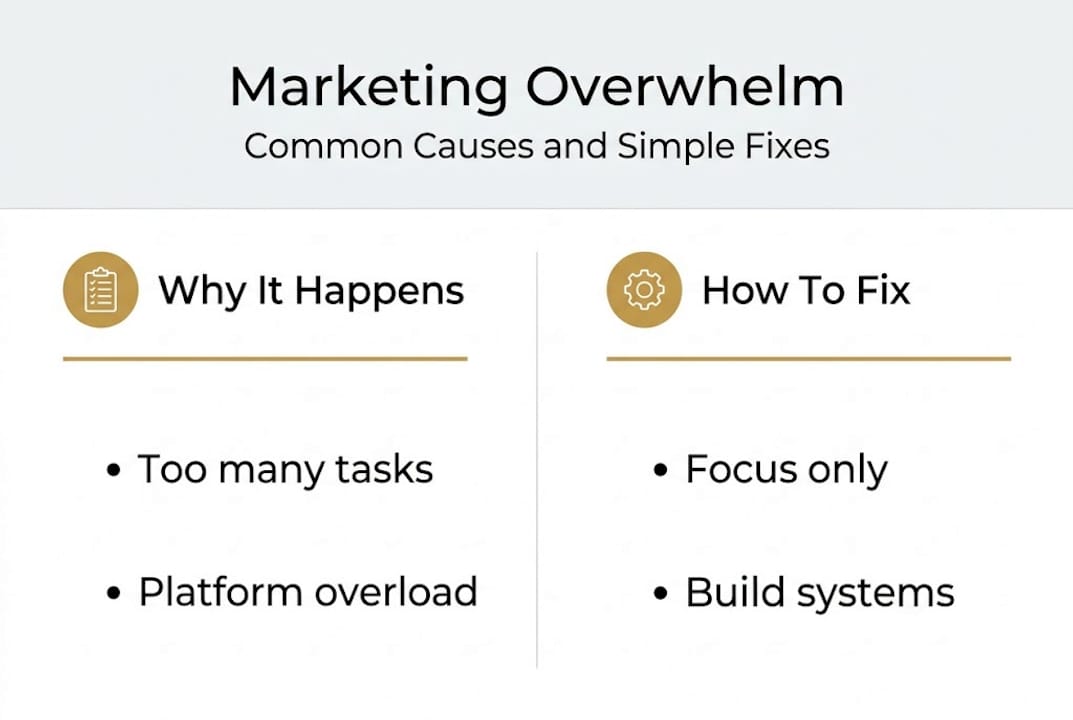
How to break free: Simple strategies for focus and results
The good news is, marketing overwhelm isn't a life sentence. Here's how to regain control and drive results with less stress.
Simplification isn't giving up. It's getting strategic. Here's a framework you can actually use:
- Pick your primary channel. Where does your target audience actually hang out? Go there first, go deep, and get results before expanding anywhere else.
- Batch your content creation. Set aside one block of time per week to create content for the whole week. It saves mental energy and keeps your output consistent.
- Repurpose ruthlessly. One blog post becomes a newsletter, three social posts, and a short video. That's not lazy. That's smart content strategy.
- Automate the repetitive stuff. Email sequences, appointment reminders, follow-ups. These should not require your daily attention. Explore marketing automation workflows to get these running on autopilot.
- Cut your tool stack. Pick tools that do multiple jobs. If you're using six tools for tasks one platform could handle, you're creating unnecessary complexity.
- Track only the numbers that matter. Revenue, leads, conversion rate, and customer acquisition cost. Everything else is vanity until those four are dialed in.
- Delegate or outsource. The DIY trap is real. Your time has a dollar value. If a task can be done by someone else for less than what your time is worth, it should be.
Pro Tip: The 2026 small business marketing environment rewards specialists, not generalists. The business that does one thing exceptionally well in marketing will outperform the one trying to do everything average every single time.
Building systems beats grinding every time. When you have a repeatable process, your marketing doesn't collapse every time life gets busy. Check out this guide to marketing automation to understand how to build sequences that work while you focus on actually running your business.
What most guides miss about marketing overwhelm
With practical strategies in hand, let's look at what really separates those who conquer overwhelm from those stuck in the cycle.
Here's the uncomfortable truth most listicles won't tell you: overwhelm often looks like doing everything right. You're active on social media. You're running ads. You're writing emails. You're showing up. And yet results are flat. Sound familiar?
The problem isn't effort. It's the absence of disciplined simplicity. Simplicity is actually harder than complexity. Anyone can add more tools, more channels, more tactics. It takes real courage and conviction to say no to 90% of opportunities and go all-in on the 10% that actually drives results.
Experts continue to debate unified platforms versus tool stacking, but the businesses winning consistently aren't the ones with the most sophisticated tech stacks. They're the ones with the clearest strategy and the discipline to stick to it. Chasing strategies for rapid growth is tempting, but rapid growth built on a chaotic foundation collapses fast.
The mindset shift you need is this: marketing is not a volume game. It's a precision game. Less, but better, will outperform more, but scattered, every single time.
Finding the right support for sustainable results
If you're ready to break the overwhelm cycle for good, the right partner can make all the difference.
Small business owners are not supposed to be full-time marketers. You built a business to do what you're great at, not to spend half your week arguing with ad dashboards and second-guessing your content calendar. Getting expert support doesn't mean giving up control. It means getting your time and clarity back.
At Brass Balls, we specialize in cutting through the noise with no-BS direct response marketing systems built specifically for entrepreneurs like you. Whether you need a done-for-you funnel, a proven acquisition strategy, or just a clear solutions for simplifying marketing that doesn't require a full-time marketing team to operate, we've got you covered. Stop grinding alone. Start building a marketing machine that actually runs.
Frequently asked questions
What are the most common signs of marketing overwhelm?
Frequent switching between marketing tasks, unfinished campaigns, and feeling stressed about marketing decisions are classic signs. Overwhelm stems from managing too many channels without a clear strategy to connect them.
Does using more marketing tools help or hurt?
Using too many tools typically creates more confusion and workload rather than relief. Consolidating your stack or automating strategically is far more effective than adding tools on top of a shaky foundation.
How can I measure if my marketing is effective without overwhelm?
Track only a few essential KPIs tied directly to your business goals. Revenue, leads, and conversion rate are enough to start. Everything else is noise until those core metrics are under control.
Is burnout from marketing real for entrepreneurs?
Absolutely. 34% of entrepreneurs experience burnout, and marketing overload is one of the leading contributors. It's a structural problem, not a personal failing.
Recommended
- Why build marketing systems: consistent growth for small business
- Proven steps to improve marketing ROI for small businesses
- Master marketing automation workflows to boost small business growth
- What is a marketing funnel and how it boosts sales in 2026
- Emotional Overload and Why It Happens — Caia Evergreen