

TL;DR:
- Most small businesses succeed by building measurable, repeatable marketing systems instead of relying on sparks of genius. These systems guide prospects through structured processes, enabling predictable growth, easier scaling, and consistent lead flow. Emphasizing data collection, continuous improvement, and disciplined execution helps businesses avoid common pitfalls and achieve long-term success.
Most small business owners secretly believe their next marketing breakthrough is one clever idea away. Maybe a viral post, a catchy slogan, or a perfectly timed campaign. That's a seductive story, but it's also the reason so many businesses run on a revenue rollercoaster, flush one month and scrambling the next. The truth is that direct-response approaches are built to be measurable and repeatable, which makes scaling acquisition efforts far easier than chasing the next big idea. Systems, not sparks of genius, are what actually build predictable growth.
Table of Contents
- The essence of marketing systems and why they scale
- Measurability: The engine of scalable client acquisition
- Repeatability and process: The scalable advantage
- Continuous improvement: The feedback loop that powers real growth
- From small wins to scale: How to apply marketing systems in your business
- The uncomfortable truth: Why most small business marketing never scales
- Ready to scale your marketing? Start building your system today
- Frequently asked questions
Key Takeaways
| Point | Details |
|---|---|
| Systems over randomness | Marketing systems enable consistent growth by replacing random efforts with structured processes. |
| Measurability drives scale | Tracking metrics in every step allows for smarter optimization and confident scaling. |
| Process beats creativity | Repeatable procedures consistently outperform one-off campaigns for expansion. |
| Continuous improvement | Scalable systems rely on ongoing testing and data-driven tweaks to power long-term growth. |
| Start small, think big | Begin with one measurable funnel and improve over time for sustainable scaling. |
The essence of marketing systems and why they scale
To lift the curtain on scalable growth, let's define what a marketing system actually is and why having one changes everything for small businesses.
A marketing system is a set of interlocking processes that guides prospects through every stage from first hearing about you to handing over their credit card. Think of it like a well-designed assembly line. Every station has a job, every output feeds the next stage, and the whole thing runs whether the owner is in the building or not. Contrast that with ad-hoc marketing, where every campaign is basically improvised from scratch, and you can see why one scales and the other doesn't.
The key difference comes down to structure. Ad-hoc marketing relies on individual effort, inspiration, and timing. A marketing system relies on process. When you document, test, and repeat a process, you can hand it off, automate it, and optimize it over time.
"Direct-response approaches are built to be measurable and repeatable, which makes scaling acquisition efforts easier than trying to scale 'brand-only' activity." This insight captures why systems beat vibes every single time.
Core components of a scalable marketing system:
- A clear, defined offer that solves a specific problem for a specific audience
- A lead generation mechanism (paid ads, organic content, referrals) that runs consistently
- A nurture sequence that moves cold prospects toward a buying decision
- A conversion point, such as a call, a sales page, or a checkout sequence
- A follow-up process for leads who didn't convert the first time
- Tracking and reporting at every stage
| Marketing systems | Ad-hoc marketing |
|---|---|
| Repeatable and documented | Recreated for each campaign |
| Measurable at every stage | Results are hard to attribute |
| Scalable with added budget or traffic | Effort-intensive to scale |
| Trainable and delegable | Relies on one person's knowledge |
| Optimizable over time | Starts fresh each time |
| Predictable pipeline of leads | Inconsistent lead flow |
The table above isn't just academic. It's the difference between a business that grows and one that grinds.
Measurability: The engine of scalable client acquisition
Now that we know what a marketing system is, let's dive into the secret sauce that makes scaling possible: measurability.
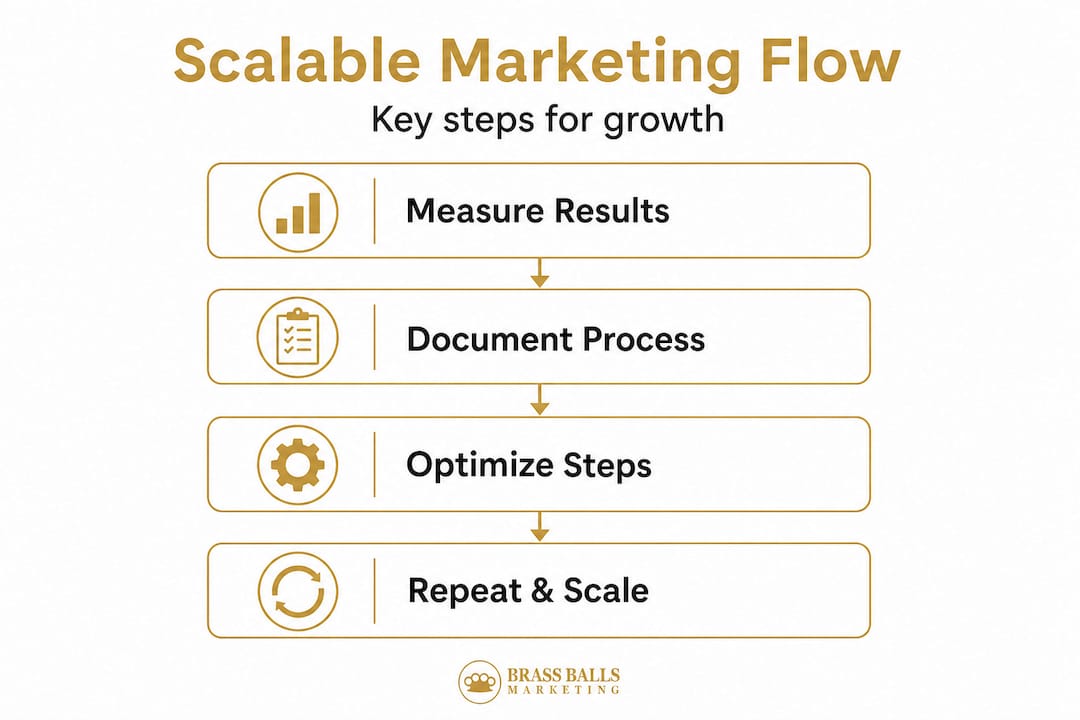
Here's the blunt reality. What you can't measure, you can't scale. If you're running Facebook ads and you have no idea what your cost per lead is, you're essentially flying blind and hoping the landing is soft. Direct-response systems solve this by providing real-time feedback on every step of the funnel, so you know exactly where to invest more and where to fix leaks.
The benefits of marketing funnels for small businesses become immediately obvious when you see the data flowing. Instead of guessing which ads "seem to be working," you know precisely which ad drove a lead at what cost, which email converted that lead to a booking, and what your overall cost per acquisition looks like.
Example funnel metrics you should be tracking:
| Metric | What it measures | Why it matters |
|---|---|---|
| Impressions | How many people saw your ad | Reach and audience size |
| Click-through rate (CTR) | % of viewers who clicked | Ad relevance and appeal |
| Cost per lead (CPL) | Ad spend divided by leads | Lead generation efficiency |
| Lead-to-call conversion rate | % of leads who book | Nurture sequence effectiveness |
| Call-to-sale conversion rate | % of calls that close | Sales process quality |
| Cost per acquisition (CPA) | Total spend divided by clients | Overall system efficiency |
| Customer lifetime value (CLV) | Revenue per client over time | Scalability and profitability |
Pro Tip: Set up your tracking infrastructure before you spend a single dollar on traffic. Google Analytics, a simple CRM, and UTM parameters on all links cost almost nothing but give you the data you need to make smart decisions from day one.
Here's how to establish basic measurability in your marketing system, step by step:
- Map your funnel stages. Write out every step a prospect takes from seeing your ad to becoming a paying client.
- Assign a metric to each stage. Every transition point needs a number attached to it.
- Choose your tracking tools. Even a simple spreadsheet beats guessing. CRM software, email analytics, and ad dashboards are your friends.
- Set a baseline. Run your system for 30 days without changing anything, just to establish your starting numbers.
- Review weekly. Block 30 minutes every week to look at your numbers and spot patterns.
- Identify your biggest leak. Find the stage with the worst conversion rate and focus your optimization there first.
Using a good funnel optimization guide makes this process far less intimidating. Once you see the numbers, they stop feeling like math homework and start feeling like a treasure map.
Repeatability and process: The scalable advantage
Measurability sets the foundation, but to truly scale, you need every campaign to be built on repeatable, proven processes.
Think about what it would mean if every time you wanted to generate 10 new leads, you had to invent a brand new campaign from scratch. That's exhausting, expensive, and wildly inconsistent. Now imagine you have a documented process that reliably generates leads at a known cost. You want 20 leads this month instead of 10? You double the budget and run the same proven system. That's the scalable advantage.

Direct-response approaches make it easier to scale acquisition efforts precisely because they're built around replicable frameworks rather than one-off creative experiments. The creative still matters, but it operates within a structure.
Business benefits of standardized marketing systems:
- Predictable lead flow: You know roughly how many leads to expect each month based on your inputs.
- Less trial and error: Proven processes don't require you to reinvent the wheel every quarter.
- Easier to delegate: When the process is documented, you can train a team member or a freelancer to run it.
- Lower cost per acquisition over time: Optimization compounds, so your system gets cheaper to run the better you understand it.
- Faster scaling: Adding budget to a proven system produces proportional results rather than chaos.
- Reduced stress: Predictability is the antidote to the panic that comes with unpredictable cash flow.
Pro Tip: When you find a campaign that works, document every detail including the ad copy, the targeting, the landing page, the follow-up sequence, and the results. Don't just copy it. Archive it and use it as your benchmark for every future campaign.
Building systems that support consistent growth is not glamorous work. It's disciplined, methodical, and frankly kind of boring compared to the excitement of chasing a viral moment. But boring and profitable beats exciting and broke every time. And for those who want to go deeper on why direct response outperforms branding for small businesses, the evidence is pretty overwhelming once you see it laid out.
Continuous improvement: The feedback loop that powers real growth
Having documented processes is powerful, but the real multiplier comes from how systems empower you to improve what's already working.
A marketing system without a feedback loop is like a car without a steering wheel. You'll move, but not necessarily in the right direction. The feedback loop is what transforms a decent system into a compounding growth machine. Every cycle through the loop gives you sharper data, better-performing assets, and lower acquisition costs.
"Prioritize building a measurable funnel with a stable offer and next step, then invest in the feedback loop, the data plus experimentation cadence, that makes each iteration better."
Here's a simple framework for implementing that feedback loop in your own business:
- Measure: Capture data at every funnel stage using the metrics you've already set up.
- Analyze: Look at your weekly numbers and identify where the biggest performance gaps are.
- Hypothesize: Form a specific guess about what change could improve a weak stage. "If I change the headline on my landing page, I expect CTR to increase."
- Test: Run an A/B test on that single element. Change one variable at a time to keep your data clean.
- Review results: After sufficient data, compare the control against the test variant.
- Implement and repeat: Roll out the winner and move to the next hypothesis.
Let's make that concrete. Say you're running an email sequence to warm up leads before a sales call. You notice your open rate is decent but your click-through rate is terrible. That's a specific problem. You test two different calls-to-action in the email body. One uses urgency, one uses curiosity. After 200 sends, the curiosity version gets 2.4x the clicks. You implement it, move on to testing your subject lines next, and within three months your entire sequence is performing at a level you couldn't have engineered through guessing alone.
Browse some real marketing funnel examples and you'll see this pattern again and again. The businesses generating consistent revenue aren't using magic. They're using feedback loops. And if you want to multiply the impact of that loop, pairing it with automation for small businesses means you can run more tests, faster, without burning yourself out.
From small wins to scale: How to apply marketing systems in your business
Understanding why systems scale leads naturally to the question: what exactly should you do next to create a scalable marketing operation?
The answer is simpler than most people expect. You don't need a sophisticated tech stack or a six-figure ad budget. You need to start small, prove the concept, document everything, and then expand. Direct-response approaches make it easier to scale acquisition because they reward focus and iteration over complexity and volume.
The core sequence for getting started:
- Define your offer clearly. One specific service or product, one specific audience, one specific problem it solves.
- Choose a single traffic source. Pick one lead generation channel and go deep before you go wide.
- Build a simple funnel. A lead magnet or ad, a landing page, an email sequence, and a conversion step.
- Measure from day one. Implement tracking before you launch.
- Run for 60 days without changing the offer. Gather real data before you make significant changes.
- Optimize the weakest link. Use your data to find the leak and fix it.
- Scale what works. Increase budget or traffic once your cost per acquisition is acceptable.
Sounds reasonable, right? Unfortunately, most small businesses never get there because they fall into predictable traps. If you're serious about using funnels to grow revenue reliably, you need to actively avoid these pitfalls.
Key pitfalls to avoid:
- Chasing every new marketing trend before your core system is proven
- Changing your offer or messaging before you have enough data to justify it
- Skipping the tracking setup because it feels technical or overwhelming
- Trying to run five different traffic sources at once and mastering none
- Optimizing for vanity metrics like followers and impressions instead of leads and revenue
- Neglecting segmentation for conversion because it seems complicated
The businesses that break through are the ones that treat their marketing like a scientist treats an experiment. Controlled, documented, and relentlessly focused on what the data actually says.
The uncomfortable truth: Why most small business marketing never scales
With the how-to in mind, let's address the real reason most small businesses get stuck and what you can do differently.
Here's something I've noticed again and again: most business owners don't fail at marketing because they lack creativity or budget. They fail because they're emotionally addicted to novelty. A new platform launches, they jump on it. Someone at a networking event raves about a tactic, they try it next week. A competitor does something interesting, they copy it immediately. The result is a scattered mess of half-executed campaigns that generate exactly zero compounding momentum.
Systems feel slow. They feel rigid. They don't give you the dopamine hit that comes from launching a shiny new campaign. But that discomfort is precisely where growth lives. The discipline to build a process, measure it honestly even when the results are humbling, and keep improving it methodically is what separates businesses that scale from businesses that spin their wheels indefinitely.
There's also a measurement problem that's frankly a little uncomfortable. Most small business owners avoid detailed tracking because the numbers reveal what isn't working, and that's confronting. It's much easier to believe your brand is "building awareness" than to face the reality that your landing page converts at 1.2% when the industry average is 4%. But the business owners who look at the hard numbers and act on them are the ones who compound their way to real, durable growth.
The other thing worth saying plainly: great systems create freedom, but only for those who stick with them long enough to let them mature. Most people bail at the 45-day mark when results are modest and the system feels clunky. The ones who push through to 90 days, then 180, start to see the compounding effect that makes the whole effort worthwhile. Building a strong email funnel is a perfect example, slow to build, but devastating for competitors once it's running.
Ready to scale your marketing? Start building your system today
If you're serious about growth and ready to escape the rollercoaster of unpredictable marketing, expert help is available. Building a scalable direct-response marketing system from scratch is absolutely doable, but it's a lot faster when you're working from proven frameworks instead of figuring it all out through trial and error.
At Brass Balls, we specialize in cutting through the noise and building marketing systems that actually generate consistent clients and revenue for small business owners. Whether you want done-for-you solutions, self-serve courses, or just a clearer picture of where your current marketing is leaking, we've got the tools, frameworks, and no-BS expertise to move the needle fast. Stop guessing and start scaling.
Frequently asked questions
What makes a marketing system scalable?
A marketing system is scalable when it's built on measurable, repeatable processes that can be optimized and expanded without sacrificing quality or control. Unlike brand-only marketing, direct-response systems give you data at every stage, so scaling means multiplying what already works.
How do I know if my small business needs a marketing system?
If your results fluctuate month to month or you can't predict how many leads or sales you'll get, your business would benefit from a marketing system. Inconsistent revenue is almost always a symptom of inconsistent, undocumented marketing processes.
Is direct-response marketing better for scaling than brand marketing?
Yes, direct-response approaches are easier to scale for small businesses because every action is tied to a measurable outcome, which makes optimization straightforward. Brand marketing builds awareness over long time horizons, which is a luxury most small businesses can't afford while they're still trying to hit consistent monthly revenue targets.
What's the first step to creating a scalable marketing system?
Start by identifying your main offer and outlining every step a prospect takes from discovery to sale, then measure each step. As the principle goes, prioritize building a measurable funnel with a stable offer before investing heavily in optimization or scaling.