

TL;DR:
- Personalized marketing goes beyond simple name inserts by using customer data to tailor messages based on behavior and intent. It drives significant revenue, enhances customer loyalty, and improves engagement while reducing ad waste. Small businesses should focus on connecting their data sources, starting with simple triggers and lifecycle segmentation to build effective, scalable personalization strategies.
Most small business owners think personalizing their marketing means swapping in a customer's first name and calling it a day. That's not personalization. That's mail merge with a marketing budget attached. The real answer to why personalize marketing goes much deeper, touching every dollar you spend, every email you send, and every customer you either keep or lose to a competitor who figured this out before you did. This article breaks down what genuine personalization looks like, what it's worth to your bottom line, and exactly how to start doing it right.
Table of Contents
- What is personalized marketing and how does it differ from segmentation?
- The measurable business benefits of personalizing your marketing
- Common pitfalls and what most small businesses miss about marketing personalization
- How to start personalizing your marketing with limited resources
- Personalized marketing channels and tactics small businesses should prioritize
- Why most advice misses the mark on personalization — and what small businesses really need to focus on
- How our solutions help small businesses personalize marketing for growth
- Frequently asked questions
Key Takeaways
| Point | Details |
|---|---|
| True personalization definition | Marketing personalization tailors messages and experiences to individual preferences and intent using connected customer data. |
| Revenue impact | Effective personalization can boost small business revenue by up to 40% through higher engagement and conversions. |
| Common pitfalls | Disconnected data and surface-level personalization limit results and can alienate customers. |
| Practical personalization start | Begin with behavioral triggers and unify data to gain quick wins without complex infrastructure. |
| Channel focus | Email, website, SMS, and ads deliver the greatest impact when coordinated for personalization. |
What is personalized marketing and how does it differ from segmentation?
Here's where most people get tangled up. Segmentation and personalization sound like cousins, but they behave very differently at the family reunion.
Segmentation means grouping your audience by shared characteristics. Age, location, purchase history, industry. You write one message for each group and blast it out. It's smarter than a single generic blast, sure. But it's still a group message, not a personal one.
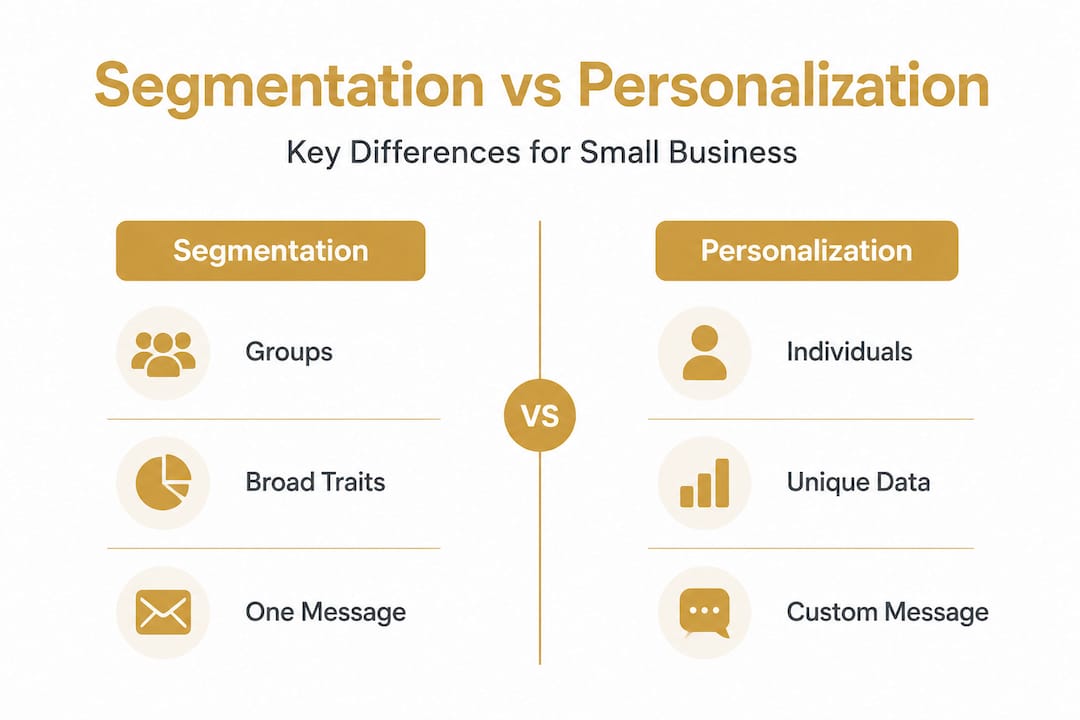
Personalized marketing, on the other hand, uses real customer data to tailor messages and offers to individual preferences and intent. Think of segmentation as sorting your contacts into buckets. Personalization is when you talk to each person like you actually know them. As marketing personalization experts define it, true personalization moves beyond one-size-fits-all by responding to what each individual actually does, not just who they are on paper.
Here's what separates surface-level from real personalization:
- Demographics-only segmentation: "Women aged 25 to 35 in Johannesburg" get the same email
- Behavioral personalization: The customer who viewed your pricing page three times in two days gets a targeted follow-up offer within 24 hours
- Intent-based personalization: Someone who searched "best CRM for small business" sees an ad specifically addressing CRM switching costs
Why does this matter for you specifically? Because the direct response marketing benefits you're chasing, higher click rates, more calls booked, better conversion rates, only show up when your message hits the right nerve at the right moment. Personalization is what puts your message in front of the nerve. And when you pair it with personalized content strategies proven to boost engagement, you stop guessing and start connecting.
The measurable business benefits of personalizing your marketing
Let's talk numbers, because that's what moves the needle for business owners making real decisions.
Stat worth pinning to your wall: Companies that nail personalization generate roughly 40% more revenue than competitors still broadcasting generic messages.
That's not a rounding error. That's a business model difference.
Here are the concrete benefits that make personalization one of the highest-return activities you can invest time in:
- Revenue growth: Better message relevance means higher conversion rates, bigger average order values, and more frequent purchases
- Customer loyalty: Brands that excel at personalization are 71% more likely to report improved customer loyalty. That's repeat business without paying to reacquire those customers
- Improved engagement: Personalized emails consistently outperform generic ones on open rates and click-through rates, sometimes by margins of 2x or more
- Reduced wasted ad spend: When you target behavior and intent instead of broad demographics, your ad dollars go to people who are actually ready to buy
The loyalty angle is particularly underrated for small businesses. Customer acquisition is expensive. Keeping a customer through relevant, timely, personalized communication is much cheaper. If you want to improve marketing ROI without doubling your budget, retention through personalization is one of the most direct paths there. Pair that with customer retention strategies built around individual value, and you've got a compounding machine, not a leaky bucket.
Common pitfalls and what most small businesses miss about marketing personalization

You know what's funny? Most small business owners who say personalization doesn't work for them are actually doing it wrong. Not because they're not trying, but because they're missing the structural foundation that makes it actually work.
The two biggest traps:
Trap 1: Collecting data without connecting it. The root cause of personalization failures is disconnected data across marketing, commerce, and service systems. You might have purchase history in your ecommerce platform, email behavior in your email tool, and service notes in a spreadsheet. None of them talk to each other, so your "personalized" messages are built on a partial picture and feel like it.
Trap 2: Thinking first names are personalization. "Hi First Name], here's 10% off!" is [no longer what customers expect. They want you to recognize where they are in their buying journey. A new subscriber should not get the same message as someone who bought from you twice and then went quiet for three months. Context matters more than a name.
More pitfalls worth calling out:
- Treating personalization as a campaign tactic instead of a system
- Personalizing one channel (email) while ignoring others (your website, your ads)
- Using personalization to push a sale before you've delivered any value
Pro Tip: Before you spend another dollar on personalization tools, audit your data sources. Can your email platform see what pages someone visited on your website? Can your CRM see what emails they opened? If not, fix the plumbing before turning on the tap.
The marketing automation guide on our blog is a solid starting point for understanding how to connect these systems without needing an IT department.
How to start personalizing your marketing with limited resources
Good news. You don't need a Fortune 500 budget to start doing this right. You need a plan and a willingness to start small and build.
Here's a practical sequence that works for lean teams:
- Centralize your customer data first. Even a simple CRM that connects to your email platform is a massive step up from siloed spreadsheets. Know who bought what, when they last engaged, and what they looked at.
- Set up behavioral triggers. Behavioral triggers like cart abandonment or browsing history produce quick wins before you build toward full 1:1 personalization. Start there.
- Segment by lifecycle stage. New subscriber, first-time buyer, repeat buyer, lapsed customer. Each group needs a different message. This is still grouping, but it's grouping with context.
- Personalize the subject line and opening hook. Reference what they actually did. "You checked out our consulting packages" beats "Here's what we offer" every single time.
- Measure, adjust, then expand. Track open rates, clicks, and conversions by segment. Double down on what's working before adding complexity.
Here's a comparison to show where your effort is best spent early on:
| Personalization tactic | Difficulty | Cost | Expected impact |
|---|---|---|---|
| Behavioral trigger emails | Low | Low | High |
| Lifecycle stage messaging | Low | Low | High |
| Dynamic website content | Medium | Medium | High |
| Predictive product recommendations | High | High | Very high |
| Full 1:1 AI personalization | High | High | Very high |
Pro Tip: Pick one trigger to start. Cart abandonment or post-purchase follow-up sequences are the easiest to build and often deliver the fastest ROI. Don't try to build a jet engine when a go-kart will win the race you're in right now.
Check out these marketing tips for small businesses for more actionable starting points tailored specifically to your growth stage.
Personalized marketing channels and tactics small businesses should prioritize
Not every channel deserves equal attention when you're starting out. Here's the honest breakdown.
Personalized experiences work best when delivered through coordinated channels including email, website content, mobile push notifications, paid ads, and SMS. Coordinated is the key word there. A customer who gets a personalized email and then lands on a generic homepage feels the disconnect immediately.
The channels worth prioritizing for most small businesses:
- Email: Highest ROI per dollar spent, easiest to personalize with behavioral triggers, and you own the channel (no algorithm can cut your reach). Email marketing advantages for small businesses are well-documented and very real.
- Website personalization: Showing different content, offers, or CTAs based on where someone came from or what they've done on your site before can significantly lift conversions without extra ad spend.
- SMS: High open rates and direct. Best used for time-sensitive, genuinely relevant messages. Abuse it and people unsubscribe faster than you can say "opt-out."
- Paid social and search: Retargeting based on behavior (not just demographics) is one of the most effective forms of why use personalized advertising for small businesses. You show up exactly when someone is already thinking about what you offer.
Here's how the main channels compare for small businesses specifically:
| Channel | Personalization ease | Cost to start | Best use case |
|---|---|---|---|
| High | Low | Nurture sequences, triggers | |
| SMS | Medium | Low to medium | Reminders, flash offers |
| Website | Medium | Medium | Landing page customization |
| Paid social ads | Medium | Medium to high | Retargeting warm audiences |
| Paid search | Low | Medium | Intent-based keyword targeting |
The tactic that surprises most people? Triggered emails based on specific page visits. If someone reads your pricing page, that's a buying signal. A same-day follow-up email addressing their likely objections is personalized marketing in action. Not creepy. Just smart.
Why most advice misses the mark on personalization — and what small businesses really need to focus on
Here's the uncomfortable truth nobody in the personalization space wants to say out loud: most personalization advice is written for companies with a full marketing team, a data warehouse, and a six-figure tech stack. That's not you, and it's probably not even the goal.
The real importance of targeted marketing for small businesses isn't about matching the sophistication of a massive brand. It's about being the business that actually remembers its customers. The one that sends a relevant message at the right time instead of blasting the same promotion to everyone every Tuesday.
Personalization only works when your data is connected. Fragmented systems cause experiences that don't feel personal, they just feel like you tried. And customers can tell. So instead of chasing every shiny personalization tactic, invest first in connecting your data sources into a single view of each customer.
What I've seen work consistently for small businesses is this: focus on lifecycle awareness over data volume. Knowing that a customer bought six months ago and hasn't been back is worth more than knowing their exact browsing path through your website. Act on the simple signals first. Build your customer retention strategies around life stages and milestones, not just campaign calendars.
The businesses winning with personalization right now aren't necessarily using the fanciest tools. They're using consistent, connected, context-aware messaging. That's attainable for any small business willing to fix the data foundation first and resist the urge to skip that step in favor of a flashier tactic.
How our solutions help small businesses personalize marketing for growth
Now that you understand why personalization works and what stands between you and real results, here's the part where we stop talking theory.
At Brass Balls, we've spent years building no-BS marketing systems for business owners who are tired of generic tactics and ready to actually grow. Our personalized marketing solutions are built specifically for small businesses and entrepreneurs who need connected, conversion-focused systems without the enterprise price tag. Whether you want a done-for-you funnel that segments and personalizes automatically, or you want to learn the frameworks yourself, we've got the tools and support to make personalization actually work for your business. Book a consultation and let's build something that actually converts.
Frequently asked questions
What is the difference between segmentation and personalization in marketing?
Segmentation divides your audience into groups with shared characteristics, while personalization tailors content and messages to individuals based on their specific behaviors and preferences.
How does personalized marketing improve customer loyalty?
Personalized marketing makes customers feel recognized and understood, which builds trust and repeat purchasing behavior. Brands excelling at personalization are 71% more likely to report improved customer loyalty.
Can small businesses implement personalization without big budgets?
Absolutely. Starting with behavioral triggers like cart abandonment or post-visit follow-ups can produce strong results before you need to invest in complex tools.
Why do many personalization strategies fail?
Most fail because the data sitting behind the strategy is fragmented. The root cause of personalization failures is disconnected data across marketing, commerce, and service systems, which makes personalized experiences feel hollow.
Which marketing channels are best for personalization?
Email consistently delivers the highest ROI for personalization, but personalized experiences across email, website content, SMS, and paid ads work best when coordinated together into a consistent customer journey.