

Most marketing agencies overlook small businesses, assuming they lack budget or commitment. Yet 54% of SMBs manage marketing alone while 70% struggle to generate leads and 73% lack confidence in their marketing efforts. This creates a massive, underserved market hungry for affordable, proven strategies. Small businesses represent over 33 million potential clients in the US alone, many actively seeking marketing help but finding few agencies willing to serve them. Direct response marketing offers the perfect solution for this segment, delivering measurable results on modest budgets while building long-term client relationships that drive consistent revenue for your agency.
Table of Contents
- Key Takeaways
- Understanding the small business market and its challenges
- Why direct response marketing fits small business needs perfectly
- The economic opportunity: sheer size and accessibility of small business segment
- Tailoring marketing tactics: personalization and addressing SMB pain points
- Boost your marketing success with Brassballs' expertise
- FAQ
Key Takeaways
| Point | Details |
|---|---|
| Large SMB market | Small businesses represent a large, underserved market hungry for affordable, proven marketing strategies. |
| Direct response benefits | Direct response delivers measurable results on modest budgets with trackable calls to action that generate immediate outcomes for SMBs. |
| Personalization matters for SMBs | Marketing should address common SMB pain points with tailored messages that highlight clear ROI and practical steps. |
| Measured trust leads to retention | When value and proven results are clear, SMB buyers become optimistic, loyal clients who refer others. |
Understanding the small business market and its challenges
Small business owners wear multiple hats daily. They handle operations, customer service, accounting, and somehow squeeze in marketing between meetings. Most lack formal marketing training and operate without dedicated marketing staff or agencies.
This reality creates significant struggles. Lead generation challenges affect 70% of small businesses, making customer acquisition their top concern. Without consistent leads, revenue becomes unpredictable and growth stalls. Many owners know they need better marketing but feel overwhelmed by options and unsure where to start.
Confidence gaps compound these challenges. When 73% of SMB decision-makers lack confidence in their marketing abilities, they either avoid marketing altogether or waste money on ineffective tactics. They see competitors succeeding online but struggle to replicate those results. Time scarcity makes everything worse since developing comprehensive marketing plans requires hours most owners simply don't have.
Common SMB marketing pain points:
- Inconsistent lead flow causing revenue unpredictability
- Limited understanding of which channels deliver best ROI
- No time to learn complex marketing platforms or strategies
- Budget constraints preventing investment in expensive agencies
- Difficulty measuring marketing effectiveness and tracking results
- Overwhelm from constantly changing digital marketing landscape
These challenges create substantial demand for simple, effective marketing services. Small businesses need solutions that work quickly, cost reasonably, and deliver measurable results without requiring extensive training or ongoing management. They want partners who understand their constraints and deliver proven systems rather than experimental strategies.
The knowledge gap presents opportunity for marketers offering no-bs marketing strategies boost client acquisition through straightforward, results-focused approaches. When you solve real problems with clear value, SMBs become loyal, long-term clients who refer others facing similar challenges.
Statistic: 54% of small businesses manage all marketing activities internally without agency support, creating a massive underserved market for marketing services.
Why direct response marketing fits small business needs perfectly
Direct response marketing solves the exact problems small businesses face. Unlike brand awareness campaigns requiring months to show results, direct response generates immediate, trackable outcomes. Every email, landing page, or direct mail piece includes clear calls-to-action designed to prompt specific responses you can measure.
This approach requires smaller initial investments than traditional marketing. While brand campaigns often demand five-figure budgets, direct response tests start at $50-$100 with email marketing generating $36 return for every dollar spent. For SMBs operating on monthly marketing budgets under $1,000, this affordability makes professional marketing accessible rather than aspirational.
Measurability builds confidence quickly. When business owners see exactly how many people opened emails, clicked links, and converted to customers, marketing stops feeling like guesswork. They understand what's working and can justify continued investment based on concrete data rather than vague promises about brand equity.
Key advantages of direct response for SMBs:
- Immediate feedback on campaign performance within days, not months
- Low barrier to entry allowing testing before major investment
- Clear attribution connecting marketing spend directly to revenue
- Scalability starting small and expanding successful campaigns gradually
- Personalization capabilities addressing specific customer segments effectively
Email marketing particularly shines for small businesses. ROAS can reach $42:$1, outperforming most traditional channels while requiring minimal technical expertise. You can segment audiences, test subject lines, and refine messaging based on real performance data. Direct mail with personalized offers also delivers strong results, especially for local service businesses targeting specific neighborhoods or demographics.
The test-and-scale model reduces risk dramatically. Rather than committing entire budgets to unproven strategies, SMBs invest small amounts in multiple approaches. Successful campaigns receive more budget while underperformers get cut quickly. This agile methodology aligns perfectly with how small business owners think about resource allocation.
Pro Tip: Start SMB clients with a single, simple campaign focused on their biggest pain point. Once they see results, they'll trust you with expanded services and larger budgets.
Quick wins matter enormously for time-strapped owners. When you deliver measurable results within 30-60 days, you prove value and build relationships that lead to long-term retention. Small businesses become advocates, referring other owners and providing testimonials that attract similar clients. The email marketing best practices you implement for one client become templates for rapid deployment across your entire SMB portfolio.
Statistic: Direct response email campaigns generate $36-$42 return on every dollar invested, making them the highest-ROI channel for budget-conscious small businesses.
The economic opportunity: sheer size and accessibility of small business segment
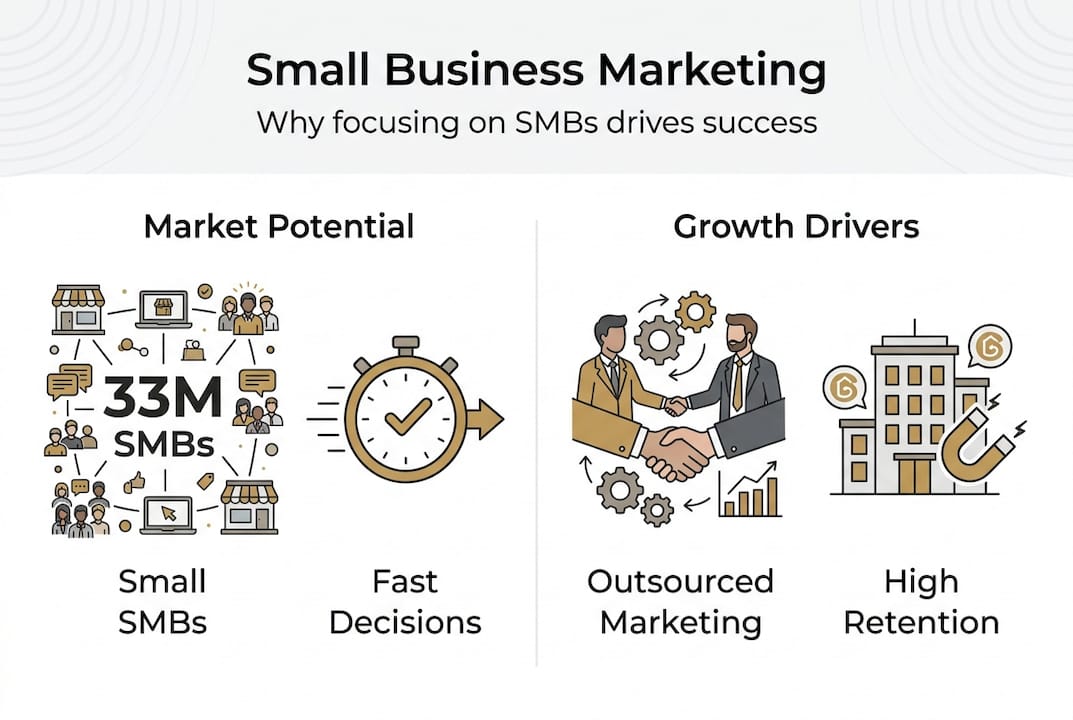
The numbers tell a compelling story. Over 33 million SMBs operate across the United States, representing an enormous addressable market. This isn't a niche segment but rather the backbone of the American economy, spanning every industry and geographic region.
More than half these businesses outsource marketing functions, indicating both willingness to invest and recognition they need external expertise. They're not trying to handle everything internally because they prefer it but because they haven't found affordable, trustworthy partners. When you position yourself as that partner, you tap into latent demand waiting for the right solution.
| Business Size | Number of Businesses | Marketing Outsourcing Rate | Avg Annual Marketing Spend |
|---|---|---|---|
| Micro (1-9 employees) | 28.5 million | 48% | $400-$800 |
| Small (10-49 employees) | 4.2 million | 62% | $2,000-$5,000 |
| Medium (50-99 employees) | 620,000 | 71% | $10,000-$25,000 |
Budget allocation patterns reveal strategic opportunities. Most SMBs spend modestly on marketing, with many allocating under $1,000 monthly. Rather than viewing this as limitation, recognize it as competitive advantage. Large agencies ignore this segment because individual client values seem small. But volume changes everything.

Acquiring 50 clients spending $500 monthly generates $25,000 in recurring revenue. Scale to 200 clients and you've built a $100,000 monthly revenue stream. The math works because acquisition costs stay low when you target a defined segment with specific pain points. Your messaging resonates consistently, referrals flow naturally, and retention rates climb as clients see sustained results.
Why the SMB segment offers superior economics:
- Massive volume compensates for modest individual client spend
- High retention when you deliver consistent value and results
- Lower acquisition costs due to focused targeting and referrals
- Scalable service delivery through templates and systematized processes
- Cross-sell opportunities as clients grow and need expanded services
Accessibility matters as much as size. Small business owners make decisions quickly without lengthy approval processes or procurement departments. When you demonstrate clear value, they can commit immediately. This velocity allows rapid portfolio growth compared to enterprise sales cycles stretching months or quarters.
The retention potential transforms economics further. SMBs that find marketing partners delivering real results stick around for years. They're not constantly seeking the next shiny agency or renegotiating contracts. Stability and predictability matter more than marginal cost savings. Build trust and prove value, and you create annuity-like revenue streams that compound over time.
Digital lead generation small business guide strategies you implement become increasingly efficient as you refine approaches across dozens or hundreds of similar clients. Templates, playbooks, and proven campaigns reduce delivery costs while maintaining quality, improving margins as your SMB portfolio expands.
Tailoring marketing tactics: personalization and addressing SMB pain points
Generic marketing fails with small businesses because they've seen it all before. Mass emails promising revolutionary results get deleted immediately. Cold calls following scripts get hung up on. SMB owners developed strong filters for inauthentic outreach because they're bombarded daily with irrelevant pitches.
Personalization breaks through these filters. Tailored direct mail and offers increase response rates by approximately 45% compared to generic campaigns. When your message demonstrates understanding of their specific industry, challenges, and goals, recipients pay attention. They recognize you've done homework and might actually help rather than waste their time.
Addressing pain points directly creates immediate relevance. If you're targeting dental practices, lead with solutions for patient acquisition and appointment booking. For contractors, focus on project pipeline consistency and seasonal revenue smoothing. Speaking their language about their problems positions you as insider who gets it rather than outsider selling generic services.
| Generic Approach | Personalized Approach | Impact on Response |
|---|---|---|
| "Grow your business with digital marketing" | "Get 15 qualified roofing leads monthly with our proven system" | 3x higher open rates |
| "We help companies succeed online" | "HVAC companies using our funnel book 40% more service calls" | 4x higher click rates |
| "Marketing solutions for all businesses" | "Dental practices fill schedules with our patient acquisition system" | 5x higher conversion |
Segmentation amplifies personalization effectiveness. Rather than treating all SMBs identically, group them by industry, revenue stage, geographic market, or specific challenges. Create messaging variants addressing each segment's unique circumstances. A startup's lead generation needs differ dramatically from an established business seeking customer retention improvements.
Steps to implement effective SMB personalization:
- Research target industries thoroughly to understand common pain points and seasonal patterns
- Develop segment-specific messaging highlighting relevant case studies and results
- Create landing pages and email sequences tailored to each segment's language and priorities
- Use dynamic content showing prospects examples from their specific industry
- Follow up with personalized outreach referencing their business circumstances and challenges
Balancing automation with human touch optimizes results. AI tools help personalize at scale by inserting company names, industries, and other variables into templates. But authentic personalization requires human insight about what truly matters to each prospect. Review AI-generated content to ensure it sounds natural and addresses real concerns rather than surface-level details.
Direct response tactics work best when personalized carefully. Email campaigns should reference specific challenges your research revealed about their industry. Direct mail pieces might include localized data or examples from nearby businesses. Even automated sequences benefit from segmentation ensuring recipients see content matching their stage, industry, and needs.
Pro Tip: Create industry-specific case studies showcasing results for businesses similar to your prospects. Nothing builds credibility faster than proof you've solved their exact problem before.
The segmentation optimizes sales funnels by ensuring each prospect receives messaging addressing their specific situation. Generic funnels convert at 2-3% while segmented, personalized funnels often hit 8-12% because every touchpoint feels relevant and valuable. This efficiency matters enormously when targeting price-sensitive SMBs where acquisition costs directly impact profitability.
Testing personalization elements reveals what resonates most. Try different pain points in subject lines, vary case study industries in email bodies, and experiment with specificity levels in calls-to-action. Small businesses respond best to concrete, specific promises backed by proof rather than vague aspirational messaging. Show them exactly what they'll get and how quickly they'll see results.
Boost your marketing success with Brassballs' expertise
Small business marketing doesn't need to be complicated or expensive to work. You've seen how direct response strategies deliver measurable results on modest budgets, addressing the exact challenges SMB owners face daily. The question becomes how to implement these proven tactics quickly and effectively without trial-and-error wasting time and money.
Brassballs specializes in direct response marketing systems built specifically for small businesses and the agencies serving them. We provide tested frameworks, ready-to-deploy campaigns, and expert guidance that helps you acquire clients faster and deliver results that keep them long-term. Our approach combines lead generation with conversion optimization, ensuring you don't just attract prospects but turn them into paying customers consistently. Whether you need done-for-you solutions or self-serve training to build your own systems, Brassballs marketing solutions give you everything required to succeed in the massive, underserved SMB market. Stop guessing and start implementing strategies proven across thousands of small business campaigns.
FAQ
Why are small businesses a worthwhile target for marketers?
Small businesses represent over 33 million potential clients in the US alone, with more than half actively outsourcing marketing services. They face significant lead generation challenges and lack marketing confidence, creating enormous demand for affordable, effective solutions. The volume and accessibility of this segment, combined with high retention rates when you deliver results, make SMBs exceptionally valuable long-term clients despite modest individual budgets.
How does direct response marketing benefit small businesses specifically?
Direct response delivers immediate, measurable results on budgets as low as $50-$100, making professional marketing accessible to resource-constrained SMBs. Email campaigns generate $36-$42 return per dollar invested, providing quick ROI proof that builds confidence. The test-and-scale approach reduces risk while clear attribution connects spending directly to revenue, eliminating the guesswork that makes traditional marketing feel overwhelming to small business owners.
What are practical marketing tactics to attract and retain SMB clients?
Start with personalized email and direct mail campaigns featuring clear calls-to-action addressing specific industry pain points like lead generation or appointment booking. Segment your audience by industry, business stage, and challenges to ensure messaging resonates authentically. Begin with small test budgets proving value quickly, then scale successful campaigns as clients gain confidence. Bundle lead generation with conversion tools providing comprehensive support that keeps clients long-term.
How much should small businesses budget for marketing?
Most small businesses allocate $400-$5,000 annually depending on size, with many spending under $1,000 monthly. Direct response strategies work effectively at these budget levels because they focus on high-ROI channels like email marketing rather than expensive brand campaigns. Starting with modest investments and scaling based on proven results allows SMBs to grow marketing spending as revenue increases, creating sustainable growth without financial strain.
What makes personalization so effective for small business marketing?
Personalized campaigns increase response rates by approximately 45% because they demonstrate genuine understanding of specific challenges rather than generic promises. Small business owners receive countless irrelevant pitches daily and developed strong filters for inauthentic outreach. When your messaging references their industry, addresses their exact pain points, and provides relevant proof through similar case studies, you break through those filters and earn attention as a credible partner rather than another vendor.