

TL;DR:
- Educational marketing builds trust and authority, leading to increased sales and customer loyalty.
- Engaging useful content attracts pre-qualified buyers, reducing sales friction and churn.
- Consistent, impactful content and community-building turn passive viewers into loyal brand advocates.
Forget pushy ads and cold-call vibes. There's a smarter play that actually makes people want to buy from you, and it starts with teaching them something useful. Educational marketing makes consumers 131% more likely to purchase after engaging with your content. That's not a rounding error. That's a completely different business. If you're a small business owner tired of shouting into the void with ads that get ignored, this approach is the quiet giant you've been sleeping on. This guide breaks down what educational marketing is, why it works, and how you can use it today.
Table of Contents
- What is educational marketing and why does it work?
- Key benefits of educational marketing for small businesses
- How to implement educational marketing: Best practices and tools
- Measuring and optimizing educational marketing results
- The overlooked power of education-first marketing
- Grow your business with smarter marketing strategies
- Frequently asked questions
Key Takeaways
| Point | Details |
|---|---|
| Drives more sales | Educational marketing prompts customers to buy by building genuine expertise and trust. |
| Boosts client loyalty | Sharing knowledge keeps customers confident, reduces churn, and increases repeat business. |
| Low-cost authority | Blogs, videos, and guides let you compete without a huge budget or ad spend. |
| Simple to start | Launching with basic tools and step-by-step guides makes educational marketing accessible for everyone. |
What is educational marketing and why does it work?
Educational marketing is exactly what it sounds like. Instead of leading with a sales pitch, you lead with value. You teach your audience something genuinely useful, and in return, they start to trust you. Trust turns into preference. Preference turns into sales. It's like being the smartest person at the dinner party without being insufferable about it.
At its core, educational marketing means creating content like guides, blogs, tutorials, webinars, and tools that solve your audience's real problems. No bait-and-switch. No fake urgency. Just genuine, useful information that makes people's lives easier. According to solid research, educational content builds trust and positions small businesses as credible experts by providing value upfront, rather than pushing a product.
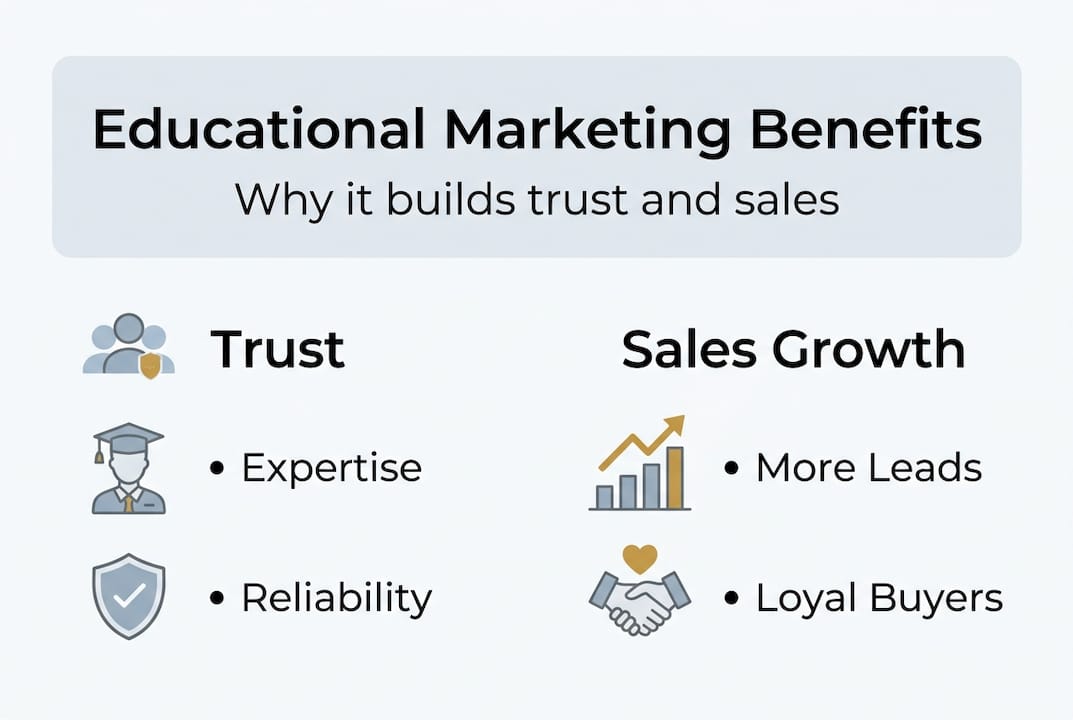
Here's why this matters so much for small businesses specifically. You probably can't out-spend the big guys on ads. But you absolutely can out-teach them. When someone reads your blog post, watches your how-to video, or downloads your checklist, they're spending time with your brand. That's a relationship, not a transaction.
Key benefits of the educational approach:
- You build authority in your niche without needing a massive ad budget
- You attract buyers who are already interested and pre-sold on your expertise
- You reduce the sales friction because educated prospects have fewer objections
- You create content that keeps working for you long after it's published
- You differentiate yourself from competitors who are still just yelling "buy now"
"The brands winning right now aren't the loudest. They're the most helpful. Education is the new currency of trust."
This is a foundation worth building on. For a deeper look at marketing success for small businesses, it's clear that trust-based approaches consistently outperform pure promotional tactics.
Key benefits of educational marketing for small businesses
Understanding the mechanics is crucial, but let's get specific about the results you can actually achieve.
The numbers tell a compelling story. Consumers who engage with educational content are 131% more likely to buy compared to those who only see traditional ads. That's not just a slight edge. That's a fundamental shift in how people make buying decisions.

Beyond acquisition, educational marketing reduces churn and builds loyalty by giving customers the knowledge they need to actually succeed with your product or service. When people feel confident using what they bought from you, they stick around. And they tell their friends.
| Metric | Before educational marketing | After educational marketing |
|---|---|---|
| Lead quality | Mixed, many unqualified | Higher intent, pre-educated |
| Customer churn | Higher due to confusion | Lower, confident customers |
| Sales conversion rate | Relies on pressure tactics | Natural, trust-driven |
| Customer lifetime value | Single transactions | Repeat buyers and referrals |
The four big wins for small businesses:
- Trust and credibility: You become the go-to expert in your space, which means people choose you over cheaper options because they believe in your authority.
- Better client acquisition: Educated prospects come in warmer. They already know who you are and what you do, so the sales conversation is shorter and less awkward.
- Higher spending per customer: When customers understand the full value of what you offer, they're more willing to invest in premium options or add-ons.
- Repeat business and referrals: A customer who learned something valuable from you is a customer who comes back and sends their colleagues your way.
Pro Tip: The most underrated benefit is what educators call the "confidence effect." When your content helps customers succeed, they associate that success with you, not just themselves. That's a loyalty driver most businesses completely miss.
If you're looking to improve marketing ROI in a sustainable way, educational marketing is one of the highest-leverage moves available. It's also worth exploring marketing strategies for 2026 to see how education-first tactics fit the current landscape.
How to implement educational marketing: Best practices and tools
Now that we know the upside, let's focus on how you can put educational marketing into action today.
The good news is that you don't need a Hollywood production budget or a team of 20 to get started. You need a clear understanding of your audience's questions, a format that works for you, and the consistency to keep showing up.
The smartest move is to create educational content like playbooks, micro-learning modules, and expert-paired guides, then distribute them through SEO-optimized blogs, email sequences, and social channels. That's your trust-building engine at the top of the funnel.
For entrepreneurs just starting out, blogs and videos are the low-cost entry point that builds real authority, especially when combined with freemium offers or lead magnets in competitive niches.
| Content type | Effort level | Cost | Best audience fit |
|---|---|---|---|
| Blog posts | Medium | Low | SEO seekers, researchers |
| Short videos | Medium | Low to medium | Visual learners, social users |
| Webinars | High | Low to medium | B2B, high-value service clients |
| Checklists and guides | Low | Very low | Practical, action-oriented buyers |
| Email courses | Medium | Low | Warm leads, nurture sequences |
Where to distribute your educational content:
- Your own blog (this is the anchor, own it)
- Email newsletters to your existing list
- LinkedIn and Facebook for professional and community audiences
- YouTube for searchable how-to content
- Pinterest and Instagram for visual or lifestyle-adjacent businesses
- Podcast appearances or your own show for longer-form authority building
Pro Tip: Don't try to master every format at once. Pick the one channel where your ideal clients already hang out and dominate that before expanding. A great blog beats five mediocre social channels every time.
Pair your content with real customer stories or collaborations with recognized experts in your field. This adds social proof and increases the perceived credibility of everything you publish. For ideas on scaling up, check out proven marketing strategies and rapid business growth strategies to complement your educational approach.
Measuring and optimizing educational marketing results
Even great educational content only pays off if you measure and strengthen results. Here's how.
The most common mistake small businesses make is publishing content and then crossing their fingers. Hope is not a strategy. You need to track what's working, cut what isn't, and double down on the stuff that moves the needle.
The metrics that actually matter:
- Engagement rate: Are people reading, watching, or sharing your content? Low engagement means the topic or format needs work.
- Lead quality and volume: Are your educational pieces attracting the right kind of inquiries, not just tire-kickers?
- Conversion rate from content: How many people who consumed your content went on to buy or book a call?
- Customer churn rate: Are educated customers staying longer? This is one of the clearest signs the strategy is working.
- Content-assisted revenue: Use UTM parameters and simple tracking to connect specific pieces of content to actual sales.
Steps to keep improving over time:
- Review your top-performing content every 90 days and update it with new data or examples.
- Survey your customers and ask which content helped them most in their decision to buy.
- A/B test your headlines, formats, and calls to action to see what resonates.
- Build feedback loops by asking your audience what questions they still have after reading.
- Use marketing automation tips to deliver the right content to the right person at the right time in their journey.
"Customer education isn't just a marketing tactic. It's a retention machine. Customers who understand your product stay longer, spend more, and complain less."
This lines up perfectly with what research shows: long-term loyalty grows when you equip customers with knowledge that builds their confidence. That confidence reduces friction at every stage of the relationship.
Don't overlook the power of automation here. Drip email sequences, smart content recommendations, and retargeting based on content consumed are all ways to scale your educational efforts without burning out. For no-fluff guidance on building this out, explore no-BS client acquisition tactics that pair well with an educational content engine.
The overlooked power of education-first marketing
Here's the uncomfortable truth most marketing advice won't tell you. Educational marketing isn't just a nice-to-have strategy for the content-curious. In 2026, it's one of the most powerful competitive weapons a small business can wield, and most businesses are barely scratching the surface.
The mistake we see over and over is businesses chasing content volume instead of content impact. They publish five blog posts a week that nobody reads instead of one genuinely useful guide that changes how someone thinks about their problem. Quantity without quality is just noise with a content calendar.
The real magic happens when you go further than just publishing. When you build a marketing community around your educational content, inviting customers to co-create, share their results, and ask questions, you turn passive readers into active evangelists. That's a flywheel, not just a funnel.
The businesses that win aren't the ones with the biggest ad budgets. They're the ones their audience trusts most. You don't out-spend the competition. You out-teach them.
Grow your business with smarter marketing strategies
If this got your brain firing, you're just getting started. Educational marketing is one piece of a bigger, smarter system that gets you premium clients consistently without the guesswork or the spray-and-pray tactics.
At Brass Balls, we've built a no-BS approach to marketing that puts strategies like this to work inside proven funnels and frameworks. Whether you want to dig deeper into email marketing strategies or explore the full playbook, we've got resources designed specifically for entrepreneurs who are serious about growth. Head over and discover more strategies that can accelerate your results starting today. No fluff, no filler, just what works.
Frequently asked questions
What types of businesses benefit most from educational marketing?
Service-based, consulting, online retail, and local businesses all see strong results because educational content builds trust and turns skeptical prospects into confident buyers across virtually every industry.
How quickly can you see results from educational marketing?
Most businesses start seeing improvements in engagement and lead quality within two to four months, though compounding results from SEO and referrals build significantly over six to twelve months.
Is educational marketing expensive for small businesses?
Not at all. Blogs and videos are low-cost starting points that build real authority, and many entrepreneurs see strong returns before spending a cent on paid distribution.
What's the biggest mistake to avoid with educational marketing?
Chasing content volume over genuine value is the trap most businesses fall into. Publishing content that doesn't actually solve your audience's real problems is just expensive noise.
Recommended
- Why proven marketing strategies drive reliable growth
- Build a marketing community to grow your small business
- Why build marketing systems: consistent growth for small business
- Marketing automation for small businesses: boost growth
- Digitálna agentúra PROGNESSA: Ako získať viac zákazníkov a zvýšiť predaj online