

TL;DR:
- A marketing guide provides clear structure and focus for small business marketing efforts.
- It emphasizes measuring key metrics like CAC, LTV, and ROI to improve results.
- Regular review and adaptation of the guide help sustain growth and maximize marketing ROI.
You're running ads, posting on social, sending emails, handing out flyers, and somehow still wondering where your next client is coming from. Sound familiar? Scattered marketing is like throwing spaghetti at a wall and hoping the noodles spell out 'revenue.' It wastes your time, burns your budget, and leaves you with zero clarity on what's actually working. A well-built marketing guide fixes all of that. It gives your efforts structure, your money a purpose, and your results something to measure against. This article breaks down exactly why marketing guides matter, how they drive real ROI, and how you can start using one today.
Table of Contents
- What is a marketing guide and why does it matter?
- How marketing guides drive measurable results
- Comparing traditional tactics vs. guide-driven marketing
- Practical steps to start using a marketing guide today
- What most small businesses miss about marketing guides
- Take your marketing to the next level
- Frequently asked questions
Key Takeaways
| Point | Details |
|---|---|
| Guides create structure | Marketing guides turn scattered efforts into a focused, step-by-step plan for growth. |
| Trackable ROI | With guides, you can measure what’s working and double down on high-performing strategies. |
| Cost and time savings | Using a guide helps you avoid wasting money and time on ineffective or high-cost tactics. |
| Adapt to business needs | Guides are flexible, enabling you to adjust as your goals or the market shifts. |
What is a marketing guide and why does it matter?
A marketing guide is not a 40-page corporate document that collects digital dust. Think of it as your business's GPS for getting clients. It maps out where you're going, which roads to take, and flags detours when something isn't working. Simple, practical, and built for action.
At its core, a solid marketing guide covers what's often called the 5Ps framework:
- Product: What exactly you're selling and why people should care
- Price: How you position your pricing relative to your market
- Place: Where your clients find you (social, search, referrals, etc.)
- Promotion: The specific channels and tactics you use to reach them
- People: Who your ideal clients are and what makes them tick
Without these five pillars nailed down, your marketing is basically guesswork with a logo slapped on it. And guesswork is expensive.
Here's what most small business owners don't realize: the real enemy isn't a bad product or a weak offer. It's scattered effort. You try everything and master nothing. A guide forces you to choose, commit, and measure. That's where the magic happens.
"A marketing guide enables measurability and ROI focus, which is crucial for businesses with limited budgets and time, by prioritizing high-ROI channels like content marketing over scattered efforts."
The best part? You don't need a marketing degree to build one. You need clarity on your goals, honesty about your resources, and a framework that keeps you focused. That's exactly what building marketing systems is all about. When paired with proven marketing strategies, a guide becomes your most powerful competitive weapon. Even Forbes recognizes that small business marketing strategies that are structured consistently outperform reactive, ad-hoc approaches.
How marketing guides drive measurable results
With a basic understanding of what marketing guides are, let's see how they unlock real, measurable business results.
A guide without numbers is just a wish list. The power is in the measurement. When you set baselines, meaning what your metrics look like before you run any campaign, you finally have something to compare against. No more gut-feel marketing. No more "I think this is working."
Here are the metrics every small business should be tracking:
| Metric | What it measures | Why it matters |
|---|---|---|
| CAC (Client Acquisition Cost) | Cost to land one new client | Tells you if your spend is sustainable |
| LTV (Lifetime Value) | Total revenue per client | Shows the real return per relationship |
| Lead volume | New inquiries per period | Indicates top-of-funnel health |
| Conversion rate | Leads turned into clients | Reveals where deals break down |
| Campaign ROI | Revenue vs. spend per channel | Identifies your best performers |
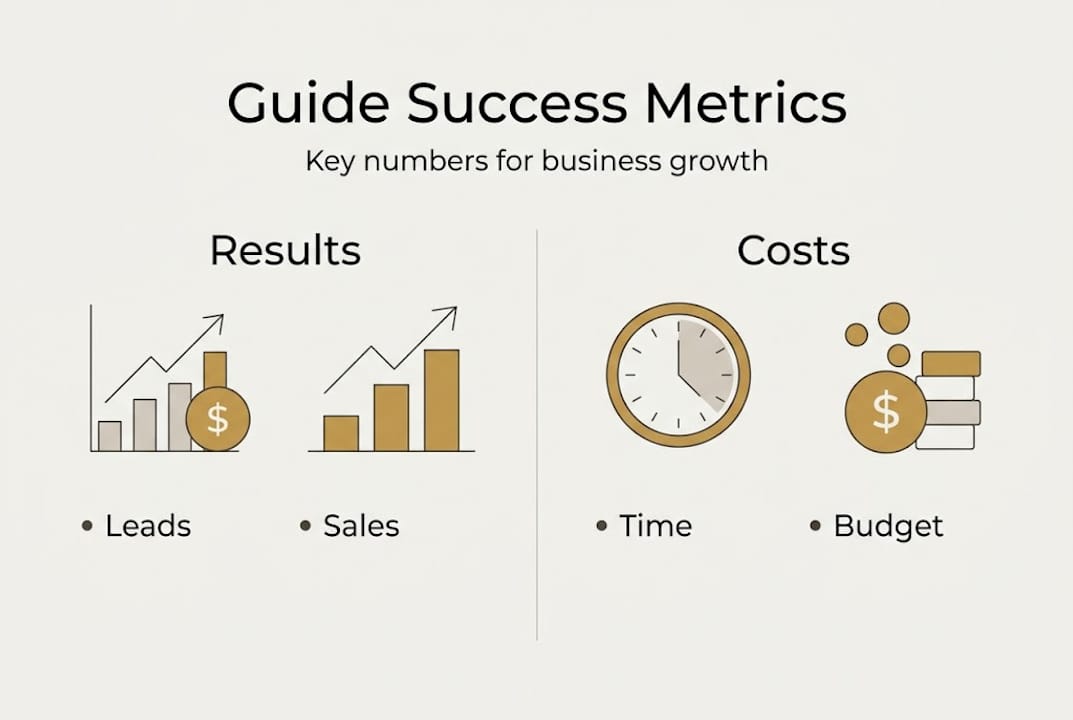
A marketing guide that includes 90-day calendars and CAC/LTV forecasts gives you a structured way to run, review, and refine every campaign. Think of it as a quarterly report card for your marketing.
Here's a simple process to follow:
- Set your baseline. Before launching any campaign, document your current leads, conversions, and costs.
- Choose your channels. Pick two or three max. Focus beats volume every time.
- Run a 90-day cycle. Give every tactic at least one quarter before judging it.
- Review your numbers. Compare actual results to your goals. No emotions, just data.
- Double down or cut. Scale what works. Drop what doesn't. Repeat.
Pro Tip: Don't fall into the tool overload trap. You don't need six dashboards and a BI tool to track results. A simple spreadsheet with your top five metrics, reviewed monthly, beats fancy software that nobody opens. Focus on improving marketing ROI by keeping your measurement simple and consistent. And if you want to automate parts of this, explore marketing automation for growth without over-engineering it.
Comparing traditional tactics vs. guide-driven marketing
To make these advantages concrete, let's compare the old way to the new, guide-driven model.
Traditional marketing is like fishing with a net full of holes. You invest time and money, but most of it slips through. A guide-driven approach is the net repair job that actually keeps the fish in.

| Factor | Traditional approach | Guide-driven approach |
|---|---|---|
| Targeting | Broad, hope-based | Specific, data-backed |
| Measurement | Hard to track | Built-in metrics |
| Budget use | Reactive spending | Planned allocation |
| Content | One-off campaigns | Ongoing, compounding |
| Channels | Scattered (print, flyers) | Focused (digital, SEO) |
As Forbes notes, traditional tactics like flyers are hard to measure, while digital and content-led strategies compound over time and can be tracked in real-time. That's not a small advantage. That's a structural shift in how you compete.
Here's what guide-driven marketing actually gives you:
- Cost savings: You stop spending on channels that don't convert
- Time efficiency: Every action has a purpose, no more random posting
- Real ROI: You know exactly what each dollar is doing
- Compounding growth: Content and SEO build equity that ads can't buy
"Content marketing compounds. Every blog post, video, or guide you publish keeps working for you long after you've moved on to the next project. Ads stop the moment you stop paying. That asymmetry is why guide-driven businesses win long-term."
This is especially relevant for budget-conscious businesses. Check out effective strategies for 2026 and strategies for rapid growth that align with this guide-driven thinking.
Practical steps to start using a marketing guide today
Ready to put these ideas into action? Here's how to get started with a marketing guide right now.
You don't need to wait for a perfect moment or a bigger budget. The best marketing guide is the one you actually build and use. Here's how to do it without overthinking:
- Define your 5Ps. Write one to two sentences on each: product, price, place, promotion, people. Keep it tight. If you can't summarize each one clearly, your marketing will be muddy.
- Pick your top two channels. Where do your best clients actually hang out? Go there. Stop spreading yourself thin across every platform.
- Build a 90-day calendar. Map out your content, campaigns, and outreach for the next three months. Weekly is fine. Daily is better. But something on paper beats nothing every time.
- Set up simple measurement. Use a spreadsheet. Track leads, conversions, CAC, and campaign spend. Nothing fancy needed at the start.
- Review and adjust. At the end of each 90-day block, review what worked, what flopped, and what surprised you. Then update your guide accordingly.
The SBA confirms that guides work because they force you to prioritize high-ROI channels over scattered efforts, especially when your time and budget are limited. This is not optional advice. It's survival strategy for small businesses.
Pro Tip: Treat your guide like a living document, not a stone tablet. Revisit it every quarter. Business goals shift, client behavior changes, and new channels emerge. A guide that adapts keeps you ahead. A guide that gathers dust is just procrastination in disguise.
For more on boosting client acquisition and how to increase premium client revenue, there are proven frameworks that plug directly into this approach.
What most small businesses miss about marketing guides
Here's the uncomfortable truth: most business owners who build a marketing guide treat it like a compliance form. They fill it in, file it away, and never look at it again. Then they wonder why nothing changed.
A guide is not a checklist. It's an adaptive framework. The difference matters more than most people think. A checklist gets done and forgotten. A framework gets tested, challenged, and improved over time. That shift in mindset is what separates businesses that grow from ones that plateau.
The real edge a marketing guide gives you is the ability to test, learn, and double down on what works. You run a campaign, you measure the result, and you make a smarter decision next time. That's not rocket science, but it requires you to actually review your ROI improvement lessons and adjust your approach each quarter.
The businesses that win are the ones that treat their guide like a sparring partner, pushing back, questioning assumptions, and forcing better decisions. Set and forget is for slow cookers, not marketing strategies.
Take your marketing to the next level
If this article lit a fire under you, good. But reading about marketing guides and actually building one that drives results are two very different things. Most business owners know what to do. The gap is in the doing.
At BrassBalls, we specialize in no-BS, direct response marketing systems built specifically for small business owners and entrepreneurs. Whether you want done-for-you solutions or prefer to learn the frameworks yourself, there's a path that fits where you are right now. Stop guessing. Stop wasting budget on tactics that don't move the needle. Start with a system that's built to deliver measurable results and premium clients. Your next step is one click away.
Frequently asked questions
What makes a marketing guide different from a general marketing plan?
A marketing guide is focused on actionable steps, tracking ROI with 90-day cycles, and adapts quarterly, while a general plan is broader and less practical for day-to-day execution.
How do marketing guides help with a limited budget?
They force you to focus only on high-ROI channels like content marketing, so you stop wasting money on tactics that don't convert.
How do I measure if my marketing guide is working?
Track leads, sales, and client acquisition cost against your set campaign baselines, then review and adjust every quarter.
Can marketing guides work for service businesses, not just product companies?
Absolutely. Service businesses use guides to set clear goals, schedule consistent campaigns, and focus budget on the channels where high-ROI effort pays off most.