

Most small business owners think sales funnels are just simple paths that push prospects toward a purchase. That's a costly misconception. Real funnels are dynamic systems that guide potential clients through carefully designed stages, each one filtering and nurturing leads to maximize revenue. When you understand how funnels actually work, you unlock a proven framework for predictable client acquisition and sustainable growth. This guide breaks down the mechanics, reveals optimization tactics backed by data, and shows you exactly how to build funnels that convert.
Table of Contents
- Understanding Sales Funnels And Their Stages
- How Funnels Shape And Optimize Your Client Acquisition Strategy
- Addressing Funnel Complexities And Maximizing Conversions
- Practical Steps For Small Businesses To Implement Effective Sales Funnels
- Boost Your Client Acquisition With Expert Marketing Support
Key takeaways
| Point | Details |
|---|---|
| Funnels filter prospects through stages | Sales funnels move leads from awareness to retention, narrowing gradually to focus on qualified buyers. |
| Targeted value at each stage boosts conversions | Providing relevant content and offers at awareness, interest, decision, and action stages lowers acquisition costs. |
| Mid-funnel improvements drive significant revenue gains | Optimizing nurturing sequences can increase revenue by 12-18% according to 2025 benchmarks. |
| Modern buyer journeys are nonlinear | Today's prospects loop through stages unpredictably, requiring diverse content and real-time strategy adjustments. |
| Retention maximizes profitability | Keeping existing clients costs less than acquiring new ones, making post-purchase engagement critical for small businesses. |
Understanding sales funnels and their stages
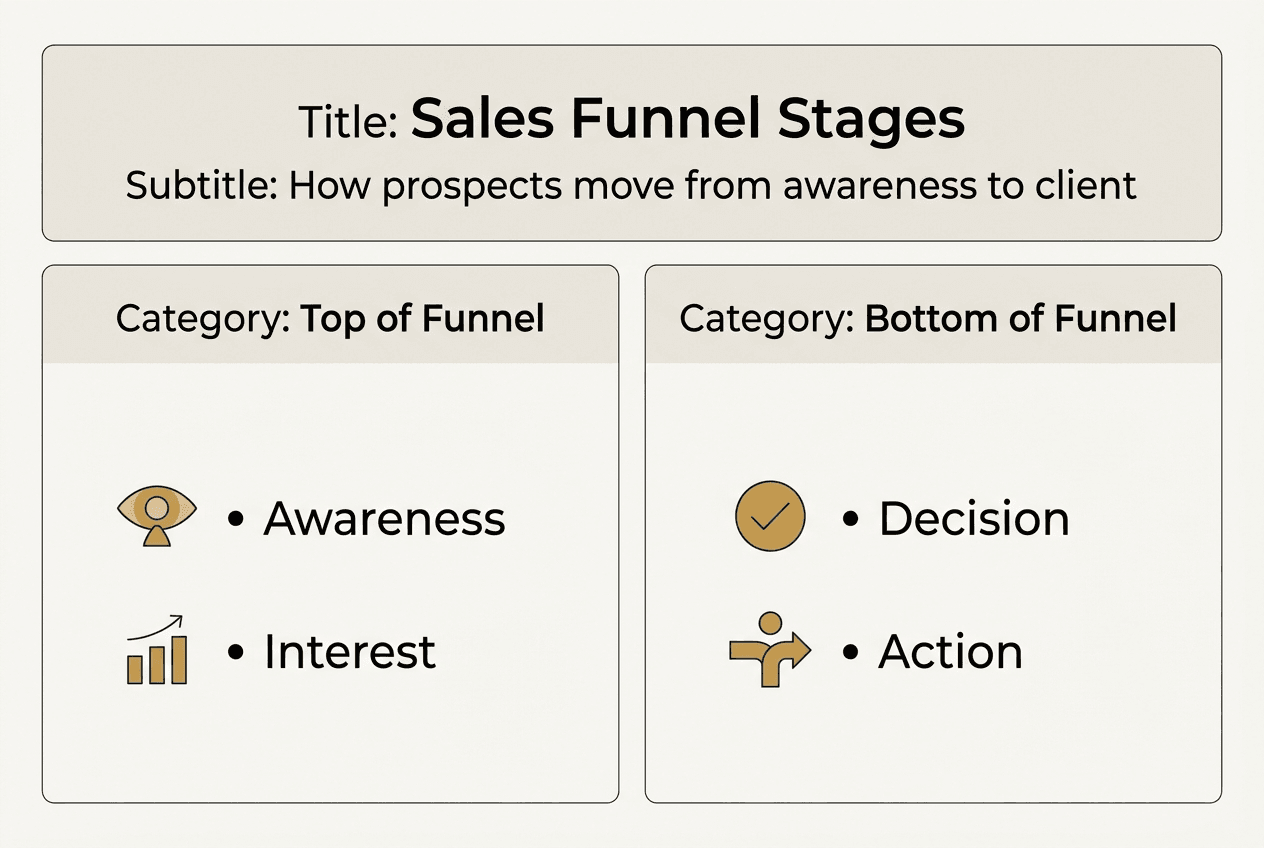
A sales funnel is a structured framework that maps how prospects move from first discovering your business to becoming loyal clients. The funnel concept gets its name from the shape it creates: wide at the top where many people enter, narrow at the bottom where fewer convert. Typical stages include awareness (TOFU), interest or consideration (MOFU), decision (BOFU), action or conversion, and retention, each serving a distinct purpose in guiding client acquisition.
TOFU stands for Top of Funnel, where prospects first become aware of your solution. MOFU is Middle of Funnel, where they evaluate options and build interest. BOFU means Bottom of Funnel, the decision point before purchase. Understanding these acronyms helps you communicate clearly about funnel strategy and align your team around client acquisition goals.
As prospects progress through each stage, the numbers naturally decrease. Not everyone who sees your ad will click through. Not everyone who visits your site will subscribe. This filtering process is intentional, focusing your resources on the most qualified leads who are genuinely interested in what you offer.
| Funnel Stage | Description | Example Activities |
|---|---|---|
| Awareness (TOFU) | Prospects discover your brand | Social media ads, blog posts, SEO content |
| Interest (MOFU) | Leads evaluate your solution | Email sequences, webinars, case studies |
| Decision (BOFU) | Prospects compare options | Pricing pages, testimonials, demos |
| Action | Conversion happens | Purchase, signup, booking |
| Retention | Clients stay engaged | Follow-up emails, loyalty programs, upsells |
This staged approach makes client acquisition more efficient because you deliver the right message at the right time. Someone just learning about their problem needs educational content, not a hard sales pitch. Someone ready to buy needs clear pricing and guarantees, not generic awareness content. No-BS marketing strategies recognize this distinction and tailor messaging accordingly.
Retention often gets overlooked, but it's the stage that determines long-term profitability. Acquiring a new client costs five times more than keeping an existing one. Smart small businesses build retention tactics directly into their funnels from day one, ensuring client acquisition efforts compound over time rather than requiring constant new lead generation.
How funnels shape and optimize your client acquisition strategy
Funnels work by providing targeted value at each stage: ads and content for awareness, nurturing via email and landing pages for interest, testimonials and pricing for decision, CTAs and guarantees for action. This systematic approach transforms random marketing activities into a cohesive client acquisition machine. Each touchpoint serves a specific purpose, moving prospects closer to conversion while filtering out poor fits.
At the awareness stage, your goal is visibility and education. You run targeted ads, publish helpful blog content, and optimize for search terms your ideal clients use. The messaging focuses on problems and possibilities, not your product. You're building trust and positioning yourself as a credible resource.
Interest and consideration require deeper engagement. This is where email marketing best practices become critical. You nurture leads with sequences that address objections, share success stories, and demonstrate expertise. Landing pages capture contact information in exchange for valuable resources like guides or tools. The relationship deepens as prospects see you understand their challenges.

Decision stage content removes final barriers. Testimonials from clients in similar situations build social proof. Detailed pricing eliminates confusion. Comparison charts show why your solution beats alternatives. Risk reversal tactics like guarantees or free trials make the choice easier. Every element answers the question: why should I buy from you today?
Action requires crystal-clear calls to action. Your checkout process should be frictionless. Your booking calendar should be simple. Your signup forms should ask only essential questions. Remove every possible point of friction that could derail a ready buyer.
Tools like ClickFunnels and AI-assisted copywriting platforms automate much of this process. You can build landing pages without developers, write email sequences with AI support, and track performance with built-in analytics. Automation lets small businesses compete with larger competitors by scaling personalized nurturing without proportional cost increases.
Pro Tip: Focus your energy on nurturing mid-funnel leads rather than constantly chasing new top-funnel traffic. Prospects who've already shown interest convert at much higher rates, delivering better ROI for your client acquisition budget.
A multi-channel approach spanning the full funnel produces the best results. Your awareness efforts might include paid ads, SEO, and social media. Interest nurturing could combine email, retargeting, and content upgrades. Decision stage tactics might use webinars, consultations, and case studies. Digital lead generation works best when channels reinforce each other, creating multiple touchpoints that build familiarity and trust.
Tailoring messaging to buyer personas at each stage multiplies effectiveness. A startup founder needs different proof points than an established business owner. A technical buyer cares about different features than an executive buyer. Segment your funnel communications based on who you're talking to, and watch conversion rates climb.
Addressing funnel complexities and maximizing conversions
Traditional AIDA (Attention, Interest, Desire, Action) funnels assume a linear path, but modern buyer journeys rarely work that way. Prospects loop back to earlier stages, consult multiple stakeholders, and research across numerous channels before deciding. Non-linear journeys demand diverse content, real-time data, and multi-persona messaging, forcing small businesses to rethink how they approach client acquisition.
| Aspect | Linear Funnel Model | Nonlinear Funnel Model |
|---|---|---|
| Buyer path | Straight progression through stages | Loops, jumps, and revisits common |
| Content needs | Stage-specific messaging | Flexible content for multiple entry points |
| Decision makers | Single buyer assumed | Multiple stakeholders involved |
| Tracking complexity | Simple stage-by-stage metrics | Complex attribution across touchpoints |
| Client acquisition approach | Push prospects forward | Support self-directed research |
This complexity means you need to diagnose and fix funnel leaks constantly. A leak is any point where prospects drop off at higher-than-expected rates. Maybe your awareness content attracts the wrong audience. Maybe your pricing page confuses visitors. Maybe your email sequences feel too aggressive. You won't know until you test.
A/B testing reveals what works. Test different headlines, offers, email subject lines, and call-to-action buttons. Heatmaps show where visitors click and scroll, exposing usability problems. Analytics track conversion rates at each stage, highlighting where to focus improvement efforts. Small tweaks compound into significant gains when you test systematically.
Mid-funnel optimization deserves special attention because improvements drive 12-18% revenue lift. Most businesses obsess over top-funnel traffic or bottom-funnel conversion tactics, neglecting the crucial nurturing phase where prospects decide whether you're worth their time. Better mid-funnel performance means more qualified leads reaching your sales team and higher win rates on proposals.
Best practices for mid-funnel conversion include:
- Segment email lists based on behavior and interests, not just demographics
- Provide educational content that solves real problems without requiring a purchase
- Use retargeting to stay visible as prospects research alternatives
- Offer low-commitment next steps like assessments or consultations
- Share specific success stories that match prospect situations
Pro Tip: Prioritize retention strategies to lower new client acquisition costs and boost profitability. A 5% increase in retention can increase profits by 25-95%, making it one of the highest-leverage activities for small businesses.
Automation tools and AI play growing roles in optimizing funnel copy and sequences. AI can analyze winning email subject lines and suggest variations. It can personalize landing page content based on referral source. It can score leads based on engagement patterns, helping you prioritize follow-up. These technologies level the playing field, giving small businesses capabilities that once required large marketing teams.
Integrating your funnel with your sales pipeline creates alignment between marketing and sales efforts. When both teams see the same data and understand how leads progress, handoffs become smoother and fewer opportunities slip through the cracks. Tools that connect marketing funnels to sales pipelines eliminate silos and improve overall client acquisition efficiency.
Practical steps for small businesses to implement effective sales funnels
Building an effective funnel doesn't require a massive budget or technical expertise. Small businesses should start with a simple 4-5 stage funnel and focus on leak detection and retention to maximize ROI. Here's how to get started:
-
Map out a simple funnel fitting your products or services. Identify the typical path prospects take from discovering you to becoming clients. Don't overcomplicate it. Four or five stages are enough.
-
Use free or low-cost tools to build funnel components. Platforms like Mailchimp offer free email marketing tiers. WordPress with landing page plugins costs minimal. Google Analytics tracks performance without charge. Start lean and upgrade as you prove ROI.
-
Track performance and detect leaks via analytics and A/B testing. Set up conversion tracking at each stage. Monitor where drop-offs occur. Test different approaches to improve weak points systematically.
-
Prioritize mid-funnel nurturing to increase conversions. Create email sequences that educate and build trust. Develop content that addresses common objections. Make it easy for interested prospects to learn more without pressure.
-
Implement retention-focused tactics like follow-up emails and loyalty offers. Don't abandon clients after the first purchase. Build post-purchase sequences that onboard, educate, and identify upsell opportunities.
Messaging personalization and content diversification increase effectiveness across all stages. Speak directly to different customer segments. Create content in multiple formats (articles, videos, infographics) to match different learning preferences. The more relevant your communications feel, the higher your conversion rates climb.
Integrating marketing funnels with sales pipelines creates seamless customer journey tracking. When marketing knows which leads sales is pursuing and sales understands which campaigns generated leads, both teams work more efficiently. This integration prevents leads from falling through cracks and provides data to optimize spending.
Cost-saving benefits add up quickly. Automated email sequences replace manual follow-up. Landing pages convert visitors without sales calls. Retargeting keeps you visible without expensive broad advertising. A well-designed funnel reduces your cost per acquisition while increasing conversion rates, delivering compound returns.
Continuous improvement cycles separate winning funnels from mediocre ones. Review performance monthly. Identify the biggest bottlenecks. Test solutions. Implement winners. Repeat. Small businesses that treat funnels as living systems rather than set-it-and-forget-it campaigns consistently outperform competitors.
Leverage internal resources and referenced guides for deeper learning. You don't need to become a funnel expert overnight. No-BS marketing strategies focus on what actually works, cutting through hype to deliver practical tactics you can implement immediately.
Boost your client acquisition with expert marketing support
Building effective sales funnels takes time, testing, and expertise you might not have in-house. That's where specialized support makes the difference. BrassBalls focuses exclusively on helping small businesses and entrepreneurs design and optimize sales funnels that drive predictable client acquisition. We've helped businesses across industries implement proven frameworks that generate consistent revenue streams without the guesswork or wasted ad spend.
Our approach cuts through marketing complexity to focus on what actually converts. Whether you need done-for-you funnel creation or training to build your own, we provide the strategies, tools, and support to accelerate growth. Stop spinning your wheels on tactics that don't deliver. Explore how BrassBalls can transform your client acquisition and start seeing the results your business deserves.
FAQ
What is the difference between a sales funnel and a sales pipeline?
A sales funnel maps the buyer journey from awareness to purchase, focusing on marketing stages and prospect behavior. A sales pipeline tracks specific deals through your sales process, showing where opportunities stand and forecasting revenue. Both are complementary tools for client acquisition. The funnel helps marketing attract and qualify leads, while the pipeline helps sales close deals efficiently.
How can small businesses identify leaks in their sales funnels?
Use A/B testing, heatmaps, and analytics to identify where prospects drop off at higher-than-expected rates. Track conversion rates between each funnel stage to spot bottlenecks. Regular analysis reveals whether your awareness content attracts the right audience, your nurturing builds sufficient trust, or your offers overcome objections effectively. Testing different approaches systematically helps you fix leaks and improve overall funnel performance.
What are effective strategies to nurture mid-funnel leads?
Personalize messaging using buyer personas and segment your email lists based on behavior and interests. Nurturing leads with personalized content and email sequences boosts revenue 12-18% according to recent benchmarks. Provide educational resources that solve real problems, share relevant case studies, and use retargeting to stay visible during the research phase. Strategic email marketing that educates rather than pushes builds trust and moves prospects toward decisions naturally.
How long should a sales funnel be for a small business?
Funnel length depends on your product complexity and price point. High-ticket services might require months of nurturing across multiple touchpoints. Lower-priced products can convert in days or weeks. Most small businesses succeed with 4-5 stage funnels that guide prospects from awareness to retention without overwhelming them. Start simple, track performance, and add stages only when data shows prospects need additional nurturing before converting.
What tools do small businesses need to build effective sales funnels?
You can start with free or low-cost platforms like Mailchimp for email marketing, WordPress with landing page plugins for web pages, and Google Analytics for tracking. As you scale, consider dedicated funnel builders like ClickFunnels or integrated CRM systems that combine email, landing pages, and analytics. The best tools match your technical skills and budget while providing the tracking and automation capabilities you need to optimize client acquisition systematically.