

Most small businesses watch up to 90% of their leads disappear through generic sales funnels that treat every prospect identically. This massive loss happens because standard funnels ignore critical differences in customer behavior, motivation, and readiness to buy. Segmentation transforms this reality by dividing your audience into meaningful groups and tailoring each funnel stage to their specific needs. When you deliver the right message to the right person at the right time, conversion rates jump dramatically. This article reveals how segmentation turns leaky funnels into precision conversion machines that capture more clients and generate consistent revenue.
Table of Contents
- Why Standard Funnels Lose Leads And How Segmentation Solves This
- Core Segmentation Strategies To Tailor Your Funnel
- How Segmentation Improves Funnel Performance: Evidence And Impact
- Implementing Segmentation In Your Sales Funnel: Practical Steps For Small Businesses
- Optimize Your Funnels With Expert Segmentation Support
- Frequently Asked Questions
Key takeaways
| Point | Details |
|---|---|
| Segmentation cuts lead loss | Personalized funnels reduce leakage to 50-60% compared to 80-90% in standard funnels. |
| Conversion rates increase substantially | Companies using segmented funnels see 20-30% higher conversion rates and faster sales cycles. |
| Email performance improves dramatically | Segmented campaigns generate significantly higher revenue and open rates than generic broadcasts. |
| Small businesses see quick wins | Even basic segmentation produces meaningful results without requiring massive datasets or complex tools. |
Why standard funnels lose leads and how segmentation solves this
Standard sales funnels operate on a dangerous assumption: every prospect wants the same information in the same order. This one size fits all approach creates friction at every stage. A 25 year old entrepreneur researching marketing automation needs different touchpoints than a 55 year old business owner looking to modernize their approach. When your funnel ignores these distinctions, prospects bounce.
The numbers tell a brutal story. A standard funnel that takes all clients through identical stages loses 80-90% of leads before reaching a purchase decision. That means for every 100 people entering your funnel, only 10 to 20 actually convert. The rest abandon ship because your messaging misses their specific pain points, your offers arrive at the wrong time, or your content fails to address their unique concerns.
Segmentation flips this equation by acknowledging that different customers need different journeys. A personalized funnel reduces leakage to 50-60%, immediately doubling or tripling your effective conversion rate. This happens because segmented funnels remove unnecessary friction. When you guide a price sensitive customer through value focused messaging while showing a premium buyer exclusive benefits, both groups feel understood.
Consider these critical differences segmentation addresses:
- Behavioral patterns: Active researchers need detailed content while ready buyers want quick purchase paths
- Purchase history: First time visitors require trust building while repeat customers seek efficiency
- Engagement levels: Highly engaged prospects respond to direct offers while cold leads need nurturing sequences
- Decision making speed: Some segments convert in days while others need weeks of touchpoints
"The fundamental problem with generic funnels is they optimize for the average customer, who doesn't actually exist. Real people have specific needs, timelines, and objections that demand tailored responses."
Segmentation transforms your funnel from a leaky pipe into a precision instrument. By acknowledging and responding to customer differences, you create pathways that feel personal and relevant. This relevance keeps prospects engaged, builds trust faster, and moves them toward purchase decisions without the resistance that kills conversions in standard funnels. The result is a marketing system that actually boosts client acquisition instead of wasting your advertising budget on prospects who were never properly qualified or nurtured.

Core segmentation strategies to tailor your funnel
Effective segmentation starts with choosing the right framework for dividing your audience. Three primary approaches dominate modern funnel optimization: demographic, behavioral, and psychographic segmentation. Demographic segmentation groups customers by age, location, income, or business size. Behavioral segmentation tracks actions like purchase history, website engagement, and email responses. Psychographic segmentation digs into values, motivations, and lifestyle preferences.
The most powerful framework for small businesses is RFM segmentation, which bases groupings entirely on purchase behavior. RFM stands for Recency, Frequency, and Monetary value. This approach cuts through demographic noise to focus on what actually predicts future purchases: past buying patterns.
| RFM Component | What It Measures | Why It Matters |
|---|---|---|
| Recency | Days since last purchase | Recent buyers are warmer leads and more likely to convert again |
| Frequency | Number of purchases in period | Frequent buyers show loyalty and respond to different messaging |
| Monetary | Total spending amount | High value customers justify premium nurturing and exclusive offers |
Scoring each customer on these three dimensions creates distinct segments. A customer who bought recently, purchases frequently, and spends heavily gets your VIP treatment. Someone who bought once six months ago needs reengagement campaigns. A frequent buyer with low spend might respond to upsell offers. This precision lets you allocate marketing resources where they generate the highest return.
Technology has democratized sophisticated segmentation. Advanced data tools and AI enable real-time segmentation that updates as customer behavior changes. Modern CRMs automatically track engagement signals and adjust segment assignments without manual intervention. This means your funnel adapts to each prospect's current state, not outdated assumptions.
Key segmentation methods to implement:
- Purchase behavior: Group by buying frequency, average order value, and product preferences
- Engagement scoring: Track email opens, website visits, content downloads, and social interactions
- Funnel stage: Separate awareness stage prospects from consideration and decision stage leads
- Customer lifecycle: Distinguish new prospects, active customers, and lapsed buyers
- Source channel: Segment by how they found you since different channels attract different buyer types
Pro Tip: Start with purchase behavior segmentation if you feel overwhelmed by options. Create just three groups based on customer value: high spenders, moderate buyers, and one time purchasers. Build different funnel paths for each group and measure results. This simple approach delivers quick wins that justify investing in more sophisticated segmentation later.
The beauty of modern segmentation is you don't need a data science degree. Tools integrated with your digital lead generation system handle the heavy lifting. Focus on defining meaningful segments that align with how your customers actually behave, then let automation apply the right funnel experience to each group.
How segmentation improves funnel performance: evidence and impact
The business case for segmentation rests on hard numbers that show dramatic improvements across every funnel metric. Companies that adapt funnels to segments reduce sales cycles by 35-40% and increase conversion rates by 20-30%. These aren't marginal gains. A 30% conversion increase means three additional customers for every ten who previously slipped through your funnel.
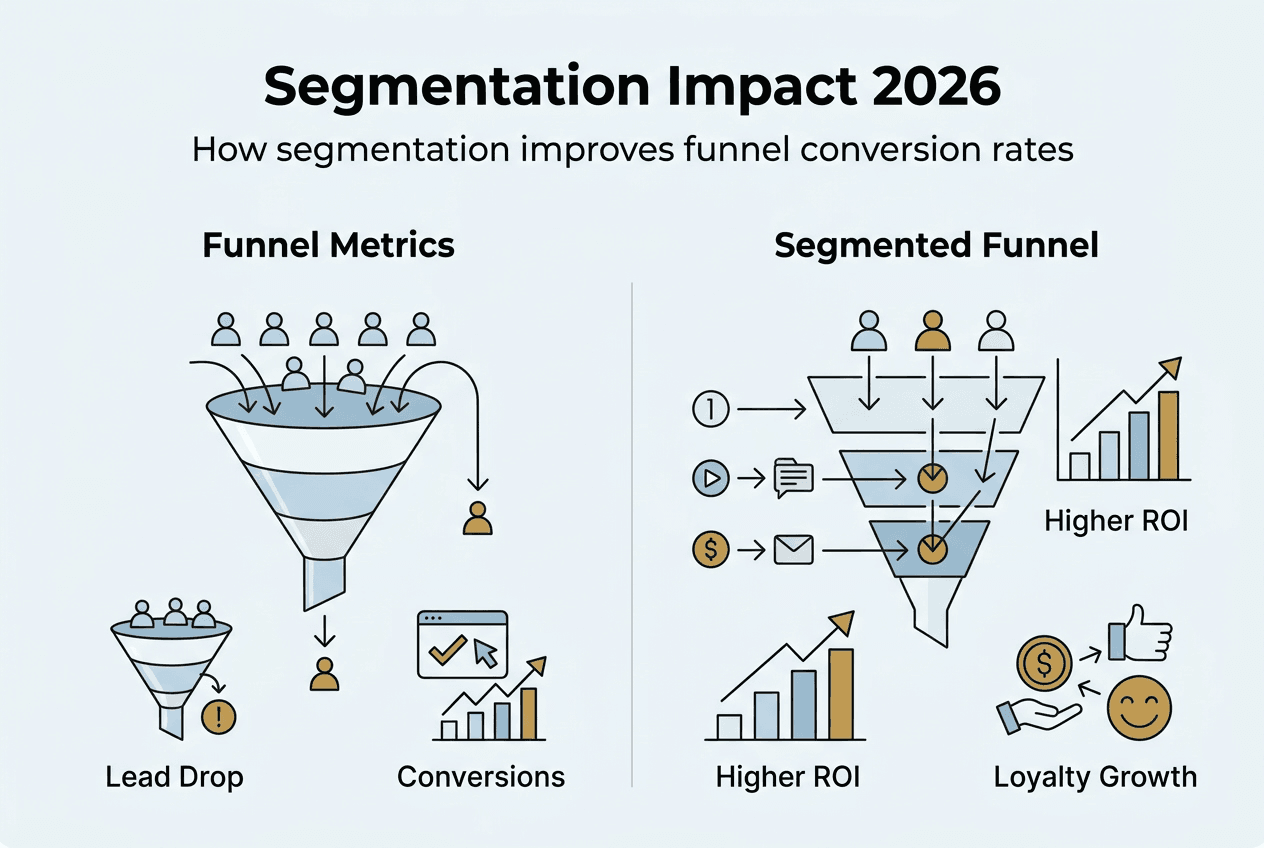
Email marketing provides the clearest proof of segmentation power. Segmented campaigns generate significantly higher revenue and open rates compared to generic broadcasts. When you send targeted messages based on customer behavior and preferences, people actually read them. Open rates climb because subject lines speak to specific interests. Click rates jump because offers match where prospects are in their buying journey.
The revenue impact extends beyond immediate conversions. Customer loyalty grows when messages align to individual values and needs. A customer who receives relevant recommendations and timely offers develops trust in your brand. This trust translates into repeat purchases, higher lifetime value, and referrals that bring new prospects into your funnel.
| Metric | Non-Segmented Funnel | Segmented Funnel | Improvement |
|---|---|---|---|
| Lead to customer conversion | 10-20% | 25-35% | 2-3x increase |
| Sales cycle length | 45-60 days | 28-35 days | 35-40% faster |
| Email open rate | 15-20% | 28-35% | 60-80% higher |
| Customer lifetime value | Baseline | 25-40% higher | Sustained growth |
These improvements compound over time. A funnel that converts 30% instead of 15% doesn't just double your customer acquisition. It also reduces your cost per customer by half, letting you reinvest savings into reaching more prospects. Faster sales cycles mean your team closes more deals in the same timeframe. Higher email engagement keeps your brand top of mind without increasing send frequency.
Key funnel improvements from segmentation:
- Reduced abandonment: Relevant messaging keeps prospects engaged through each stage
- Faster decisions: Tailored content addresses specific objections without overwhelming with irrelevant information
- Higher average order value: Targeted upsells and cross sells match customer capacity and interest
- Improved retention: Personalized post purchase experiences encourage repeat business
- Better resource allocation: Focus premium support and offers on high value segments
"Segmentation transforms marketing from a numbers game into a precision instrument. Instead of blasting the same message to everyone and hoping something sticks, you deliver exactly what each customer needs to move forward. The efficiency gains are staggering."
The impact reaches beyond marketing into operations and customer service. When you understand segment characteristics, you can predict support needs, inventory requirements, and seasonal patterns. This intelligence lets you prepare resources before problems arise, creating smoother customer experiences that reinforce loyalty.
Small businesses see particularly strong results because segmentation helps compete against larger competitors with bigger budgets. By focusing limited resources on the most promising segments and delivering highly relevant experiences, you punch above your weight class. Your email marketing best practices become more effective than a competitor's generic campaigns despite their larger list size.
Implementing segmentation in your sales funnel: practical steps for small businesses
Transforming theory into results requires a systematic approach that fits within small business constraints. Follow these steps to integrate segmentation without overwhelming your team or budget:
- Identify your most valuable segments by analyzing existing customer data for patterns in purchase behavior, engagement, and lifetime value.
- Map current funnel stages and identify where different segments experience friction or drop off at higher rates.
- Create segment specific content and offers that address unique pain points, objections, and motivations for each group.
- Set up tracking to measure conversion rates, time to purchase, and revenue per segment so you can validate improvements.
- Test one segment at a time, starting with your highest value group to maximize learning and revenue impact.
- Refine segments based on performance data, splitting or combining groups as patterns emerge from real world results.
- Scale successful approaches to additional segments once you've proven the model with your priority group.
Pro Tip: Begin with your most engaged and valuable segment for fastest results. These customers already show buying intent and higher conversion potential. A targeted funnel for this group delivers quick wins that fund expansion to other segments. Don't try to segment everyone at once.
Set measurable goals before launching segmented funnels. Define success metrics like conversion rate improvement, sales cycle reduction, or email engagement increases. Track these numbers weekly to catch problems early and double down on what works. Small businesses can't afford long testing periods, so focus on metrics that show results within 30 to 45 days.
Customize messaging and offers to match segment characteristics. A price sensitive segment responds to value propositions and payment plans. A premium segment wants exclusive access and white glove service. A time pressed segment needs quick decision making paths with minimal steps. Match your funnel experience to what each group actually values.
Technology makes implementation manageable even for small teams. Modern CRMs automatically assign segment tags based on behavior rules you define. Email platforms send different sequences to different segments without manual intervention. Landing page builders let you create segment specific versions that display based on how prospects arrived. These tools handle the complexity while you focus on strategy.
Continually refine your segments as you gather more data. Initial groupings based on assumptions will need adjustment once real behavior patterns emerge. A segment you thought was price sensitive might actually prioritize convenience. Another group might respond better to social proof than feature lists. Let data guide evolution of your segmentation strategy.
Even basic segmentation produces meaningful results for small businesses without requiring sophisticated tools or massive datasets. Start simple with three to five segments based on observable behavior. Build targeted funnels for each group. Measure results and iterate. This pragmatic approach delivers improvements without the paralysis that comes from trying to implement complex segmentation frameworks.
Integrate segmentation into your broader marketing system rather than treating it as a standalone tactic. Segmentation should inform ad targeting, content creation, product development, and customer service approaches. When every part of your business recognizes and responds to customer differences, the compounding effect accelerates growth beyond what any single tactic achieves.
Optimize your funnels with expert segmentation support
Segmentation transforms sales funnels from generic pipelines into precision conversion systems, but implementation challenges can slow progress. Getting expert guidance accelerates results and helps avoid costly mistakes that waste time and budget. Brassballs specializes in direct response marketing strategies that help small businesses build high converting funnels tailored to their specific customer segments.
Our proven frameworks take the guesswork out of segmentation by applying battle tested approaches that work across industries. We help you identify your most valuable segments, map optimized funnel paths, and implement tracking that shows exactly what drives revenue. Whether you need done for you solutions or training to build capabilities in house, we provide practical strategies that deliver measurable results. Explore our client acquisition strategies and email marketing techniques to see how segmentation fits into a complete marketing system that generates consistent growth.
Frequently asked questions
What is segmentation in sales funnels?
Segmentation divides your customer base into distinct groups based on shared characteristics like behavior, demographics, or purchase patterns. This lets you tailor funnel experiences to match what each group actually needs instead of forcing everyone through identical stages. The result is higher conversion rates because messaging and offers align with specific motivations and objections.
How does segmentation increase sales funnel conversion rates?
Segmentation targets the right audience with relevant offers at the right time, dramatically reducing drop offs at each funnel stage. Personalized funnels remove unnecessary steps and content that don't apply to specific segments, speeding up decision making. When prospects see messaging that speaks directly to their situation, they move forward faster with less friction.
Can small businesses benefit from segmentation without large datasets?
Yes, even basic segmentation based on simple data like purchase history or email engagement yields substantial results. Starting small with three to five segments helps optimize limited budgets by focusing resources on the most promising customer groups. This approach improves customer relationships and conversion rates without requiring sophisticated analytics or massive customer databases.
What segmentation tools can small businesses use in 2026?
Modern CRMs and AI platforms offer user friendly segmentation features that automate the heavy lifting of grouping customers and triggering appropriate funnel experiences. Many affordable tools provide real time segmentation based on behavior and preferences, updating as customer actions change. Popular options integrate with email platforms and landing page builders to deliver seamless segmented experiences without technical complexity.