

Many small business owners think marketing is just posting ads and hoping for sales. That confusion costs them thousands in wasted spend and missed opportunities. Marketing is actually a strategic system that guides prospects from first contact to purchase, and the marketing funnel is your roadmap for that journey. Understanding this framework helps you attract better clients, close more deals, and grow revenue predictably. This guide breaks down what marketing funnels are, how each stage works, and practical steps to build one that transforms your business in 2026.
Table of Contents
- What Is A Marketing Funnel?
- Core Components And Why Each Stage Matters
- Common Types Of Marketing Funnels And How To Choose The Right One
- How To Build And Optimize Your Marketing Funnel In 2026
- Boost Your Marketing Funnel Success With BrassBalls
- Frequently Asked Questions
Key takeaways
| Point | Details |
|---|---|
| Marketing funnels map customer journeys | They illustrate how prospects move from awareness through interest and decision to final purchase action. |
| Each stage needs tailored tactics | Awareness requires different messaging than decision stages, and personalization increases conversion rates. |
| Small businesses boost revenue by optimizing | Focusing on all funnel stages instead of just advertising improves client acquisition and sales results. |
| Multiple funnel types exist | Lead generation, sales, webinar, and product launch funnels each serve different business goals and audiences. |
| Regular monitoring identifies leaks | Tracking metrics at each stage reveals where prospects drop off so you can fix problems quickly. |
What is a marketing funnel?
A marketing funnel is a strategic model that shows how potential customers progress toward buying your product or service. Think of it as a visual representation of your customer journey, starting wide at the top with many prospects and narrowing as people move closer to purchase. The funnel shape reflects reality: not everyone who becomes aware of your business will buy, but those who do follow a predictable path.
The concept helps you understand where prospects are in their buying journey so you can deliver the right message at the right time. No-BS marketing strategies to boost client acquisition emphasize this alignment between customer needs and your marketing efforts. Without this framework, you waste resources talking about features to people who don't even know they have a problem yet.
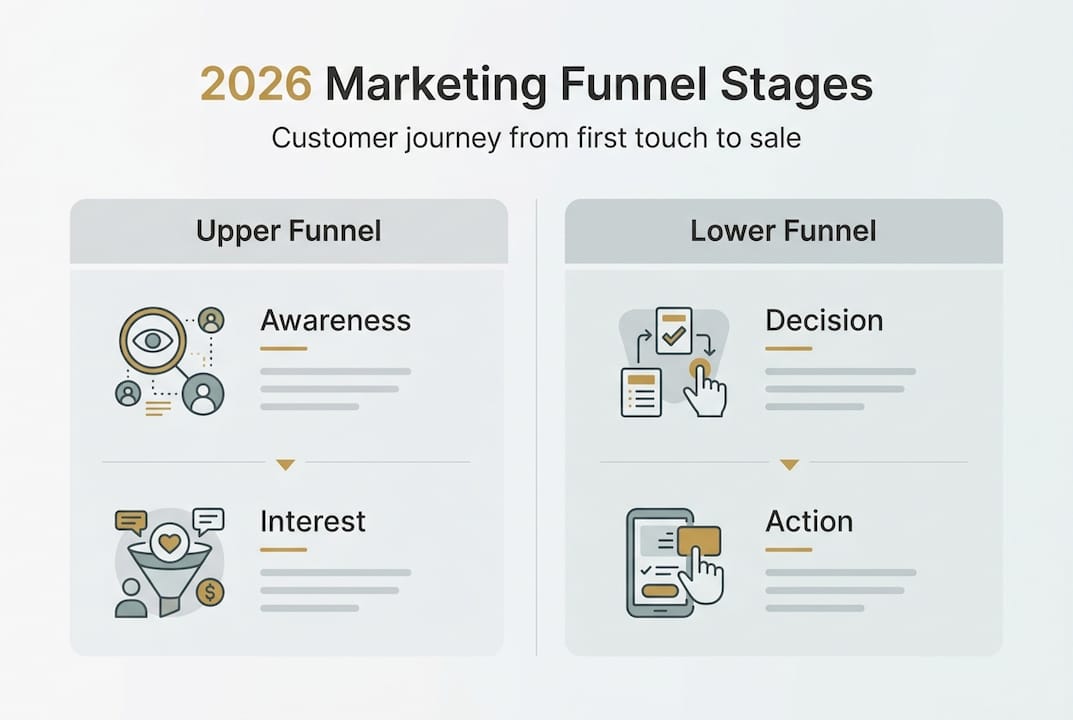
Most marketing funnels follow four core stages:
- Awareness: Prospects discover your business exists and learn about the problem you solve
- Interest: They research solutions and consider whether your offer matches their needs
- Decision: Prospects evaluate your specific solution against alternatives and build trust
- Action: They complete the purchase and become customers
Each stage requires different marketing tactics because prospect mindset changes as they move down the funnel. Awareness stage content educates and attracts attention through blog posts, social media, or ads. Interest stage materials like case studies and detailed guides help prospects understand your unique value. Decision stage tactics include demos, consultations, and testimonials that build confidence. Action stage elements like clear pricing, easy checkout, and strong calls to action remove final barriers.
Understanding these stages helps you allocate marketing budget effectively. Instead of spending everything on awareness ads, you invest across the entire journey to prevent leaks where prospects drop out. You also create content that matches where people are mentally, which dramatically improves conversion rates compared to generic messaging.
Pro Tip: Map your current marketing activities to funnel stages to spot gaps where you're not supporting prospects, then prioritize filling those holes before adding new tactics.
Core components and why each stage matters
Each funnel stage serves a specific purpose in moving prospects toward purchase, and neglecting any stage creates leaks that cost you sales. Let's examine what makes each component essential and how to optimize it.

The awareness stage is your first impression and determines whether prospects enter your funnel at all. Here you focus on grabbing attention and demonstrating that you understand their problem. Content should be educational rather than salesy, positioning you as a helpful expert. Tactics include SEO optimized blog posts, social media content, podcast appearances, and paid advertising. The goal is visibility and initial trust, not immediate sales.
Interest stage content builds desire by showing how your solution specifically addresses their pain points. Prospects at this stage actively research options, so you need detailed information that differentiates you from competitors. Email sequences, webinars, detailed guides, and comparison content work well here. How segmentation optimizes sales funnels for conversions by personalizing messages based on prospect behavior and characteristics, dramatically improving engagement.
The decision stage nurtures trust and removes objections that prevent purchase. Prospects know they want a solution like yours but need confidence that you're the right choice. Case studies, testimonials, product demos, free trials, and consultations prove your credibility. This stage often takes longest because people need time to feel comfortable, especially for higher priced offers.
Action stage tactics eliminate friction and make buying easy. Clear pricing, simple checkout processes, multiple payment options, and strong guarantees all reduce hesitation. Many businesses lose sales here because their purchase process is confusing or requires too many steps. Streamline everything and make the path to yes obvious.
Optimizing each stage requires understanding your specific audience and their journey. Track metrics like:
- Awareness: Traffic sources, reach, and cost per visitor
- Interest: Email open rates, content engagement, and time on site
- Decision: Demo requests, consultation bookings, and proposal acceptance rates
- Action: Conversion rate, average order value, and cart abandonment
Personalization and segmentation multiply effectiveness at every stage. Instead of sending the same message to everyone, tailor content based on how prospects found you, what they've viewed, and their specific industry or situation. This relevance increases conversion rates because people feel understood rather than marketed to.
Pro Tip: Review your funnel metrics monthly to identify stages where prospects drop off most, then test improvements specifically for those weak points before optimizing stages that already perform well.
Common types of marketing funnels and how to choose the right one
Different business models and goals require different funnel structures, and choosing the wrong type wastes time building something that doesn't match your sales process. Understanding common funnel types helps you select or design one that fits your specific situation.
Lead generation funnels focus on capturing contact information from prospects who aren't ready to buy immediately. You offer a valuable free resource like a guide, checklist, or tool in exchange for an email address. Then you nurture those leads through email sequences until they're ready for a sales conversation. This works well for high ticket services, complex products, or longer sales cycles where people need education before committing. What is digital lead generation provides detailed strategies for attracting quality prospects through this approach.
Sales funnels guide prospects directly toward purchase, typically for lower priced products or simple services. They move quickly from awareness through interest to action, often within a single session. E-commerce stores, online courses, and subscription services commonly use this model. The funnel might include a landing page with compelling copy, a checkout page, and upsell offers after purchase.
Webinar funnels use live or automated presentations to educate prospects and make offers. They're powerful for building authority and handling objections in real time. The typical flow includes registration page, reminder emails, the webinar itself, and a time limited offer at the end. This works exceptionally well for coaching programs, software tools, and educational products where demonstration builds desire.
Product launch funnels create anticipation and urgency around new offerings through a sequence of content releases. They typically involve pre-launch content that builds interest, an official launch event, and a limited availability period. This approach works for course creators, authors, and businesses introducing significant new products where you want concentrated attention and sales momentum.
| Funnel Type | Best For | Key Benefit | Typical Timeline |
|---|---|---|---|
| Lead Generation | High ticket services, complex sales | Builds relationships before asking for sale | Weeks to months |
| Sales Funnel | E-commerce, simple products | Fast conversion from awareness to purchase | Hours to days |
| Webinar Funnel | Coaching, software, education | Demonstrates value and handles objections live | Days to weeks |
| Product Launch | New courses, books, major releases | Creates urgency and concentrated buying momentum | Weeks |
Choosing the right funnel depends on several factors:
- Sales cycle length: Quick decisions suit sales funnels while considered purchases need lead generation approaches
- Product complexity: Simple products can sell directly while complex solutions require education
- Price point: Higher prices typically need more trust building through longer funnels
- Audience familiarity: Cold traffic needs more nurturing than warm audiences who already know you
- Your capacity: Some funnels require ongoing involvement like webinars while others run automatically
Many successful businesses use multiple funnel types for different products or audience segments. You might have a lead generation funnel for your main service and a sales funnel for a lower priced introductory product. The key is matching funnel structure to how your specific customers actually make buying decisions rather than forcing them through a process that doesn't fit.
How to build and optimize your marketing funnel in 2026
Building an effective marketing funnel requires strategic planning and systematic execution, but the process is straightforward when you follow proven steps. Here's how to create and improve your funnel for maximum results.
Start by setting clear goals for what you want your funnel to achieve. Define specific metrics like number of leads per month, conversion rate targets, or revenue goals. These objectives guide every decision about funnel design and help you measure success. Without clear goals, you can't determine whether your funnel actually works.
Next, map your customer journey by identifying the stages prospects move through before buying from you specifically. Interview recent customers about their decision process, review your sales data, and identify common patterns. This reveals the actual path people take rather than what you assume happens. Your map should show typical touchpoints, questions prospects ask, and objections that arise at each stage.
Create content and offers for each funnel stage based on your customer journey map. Awareness stage content attracts attention and demonstrates expertise. Interest stage materials educate about solutions and build desire. Decision stage assets prove credibility and remove objections. Action stage elements make purchasing easy and clear. Each piece should naturally lead to the next stage rather than existing in isolation.
Implement marketing tools that automate and track your funnel. Email marketing platforms let you send sequences automatically based on prospect behavior. Email marketing best practices to boost revenue include segmentation and personalization that dramatically improve results. Landing page builders create high converting opt-in pages. CRM systems track prospect interactions and help sales teams follow up effectively. Analytics tools show where people drop off so you can identify problems.
The implementation process follows these steps:
- Create your lead magnet or initial offer that attracts your ideal prospects
- Build a landing page that clearly communicates value and captures contact information
- Set up email sequences that nurture prospects through interest and decision stages
- Develop sales pages or processes that make taking action easy and appealing
- Connect tracking so you can measure performance at each stage
- Drive traffic to your funnel through content marketing, ads, or partnerships
Test and refine continuously because your first version won't be optimal. Run A/B tests on headlines, offers, email subject lines, and calls to action. Small improvements compound over time into dramatically better results. Focus testing on your biggest bottlenecks first rather than optimizing stages that already convert well.
Monitor key metrics weekly to catch problems quickly. Track traffic sources and cost per lead at the awareness stage. Measure email open rates and click rates for interest stage content. Watch consultation booking rates and proposal acceptance for decision stage. Analyze conversion rates and average order values for action stage. When numbers drop, investigate immediately rather than waiting for monthly reviews.
Use lead magnets strategically to capture interest from prospects who aren't ready to buy yet. Offer valuable resources like templates, checklists, guides, or tools that solve immediate problems. Make them specific to your ideal customer's situation rather than generic. The lead magnet should naturally lead to your paid solution as the next logical step.
Follow up with targeted email sequences that deliver value while moving prospects toward purchase. Share case studies, answer common questions, provide tips, and demonstrate expertise. Every email should give something useful rather than just asking for the sale. This builds trust and keeps you top of mind when prospects are ready to buy.
Pro Tip: Automate repetitive tasks using marketing software to save hours each week and ensure consistent follow up that manual processes often miss, letting you focus on strategy and high value activities instead.
Boost your marketing funnel success with BrassBalls
Building a high converting marketing funnel takes expertise and ongoing optimization that most small business owners don't have time to master alone. That's where strategic guidance makes the difference between struggling with inconsistent results and scaling predictably.
BrassBalls specializes in direct response marketing systems designed specifically for small businesses and entrepreneurs who need proven frameworks rather than generic advice. We help you implement no-BS marketing strategies that attract premium clients and generate consistent revenue through optimized funnels tailored to your industry.
Whether you need done-for-you implementation or want to learn the systems yourself through our courses, we provide practical tools and expert support that turn marketing from a frustrating expense into your most profitable investment. Explore how we can help you build funnels that actually work.
Frequently asked questions
What are the typical stages of a marketing funnel?
Most marketing funnels include four core stages: Awareness where prospects discover your business, Interest where they research solutions, Decision where they evaluate your specific offer, and Action where they complete the purchase. Some models add Loyalty and Advocacy stages for post-purchase customer relationships.
How long does it take to see results from a marketing funnel?
Simple sales funnels for low priced products can generate results within days once traffic flows. Lead generation funnels for complex services typically take weeks to months as prospects need more nurturing. Most businesses see meaningful data for optimization within 30 to 60 days of launching a funnel.
Can marketing funnels be used for any industry?
Yes, marketing funnels work across all industries because they simply map how customers make buying decisions. The specific stages, content types, and timeline vary by industry, but the core concept of guiding prospects through awareness to purchase applies universally whether you sell products, services, or information.
What tools help build effective marketing funnels?
Essential tools include email marketing platforms like ConvertKit or ActiveCampaign for automation, landing page builders like ClickFunnels or Leadpages for opt-in pages, CRM systems like HubSpot for tracking prospects, and analytics tools like Google Analytics for measuring performance. Many businesses also use webinar platforms and payment processors.
How do I measure the success of my marketing funnel?
Track conversion rates between each stage to identify where prospects drop off. Monitor cost per lead, email engagement rates, consultation booking rates, and final purchase conversion rates. Calculate customer acquisition cost and lifetime value to ensure profitability. Focus on improving your biggest bottlenecks first for maximum impact.