

Email marketing automation generates 41% of revenue from just 5% of sends, yet most small businesses still rely on manual broadcasts and social media posts. While you're crafting individual emails and hoping for engagement, automated funnel sequences are working 24/7 to nurture leads, recover abandoned carts, and turn customers into advocates. This guide shows you exactly how to leverage email marketing within your sales funnel to boost client conversions in 2026, using proven automation strategies, smart segmentation, and data-backed benchmarks that deliver measurable results.
Table of Contents
- Understanding Email Marketing Funnels: Stages And Strategies
- Automation And Segmentation: Keys To Funnel Optimization
- 2026 Email Marketing Benchmarks And Optimization Tips
- Common Pitfalls And Practical Applications For Small Businesses
- Boost Your Small Business Growth With Expert Email Marketing Support
Key takeaways
| Point | Details |
|---|---|
| Funnel stages drive conversions | Email funnels guide prospects through awareness, consideration, conversion, retention, and advocacy with targeted messaging at each stage. |
| Automation multiplies revenue | Triggered email flows outperform broadcasts with higher clicks, conversions, and revenue despite sending fewer total messages. |
| Segmentation prevents fatigue | Lifecycle-based list segments and behavioral triggers deliver personalized content without overwhelming subscribers. |
| Focus on conversion metrics | Click-to-open rates and revenue per recipient matter more than open rates alone in 2026 email performance tracking. |
| Start small and scale | Implement three core automations first, then expand based on testing data and customer journey insights. |
Understanding email marketing funnels: stages and strategies
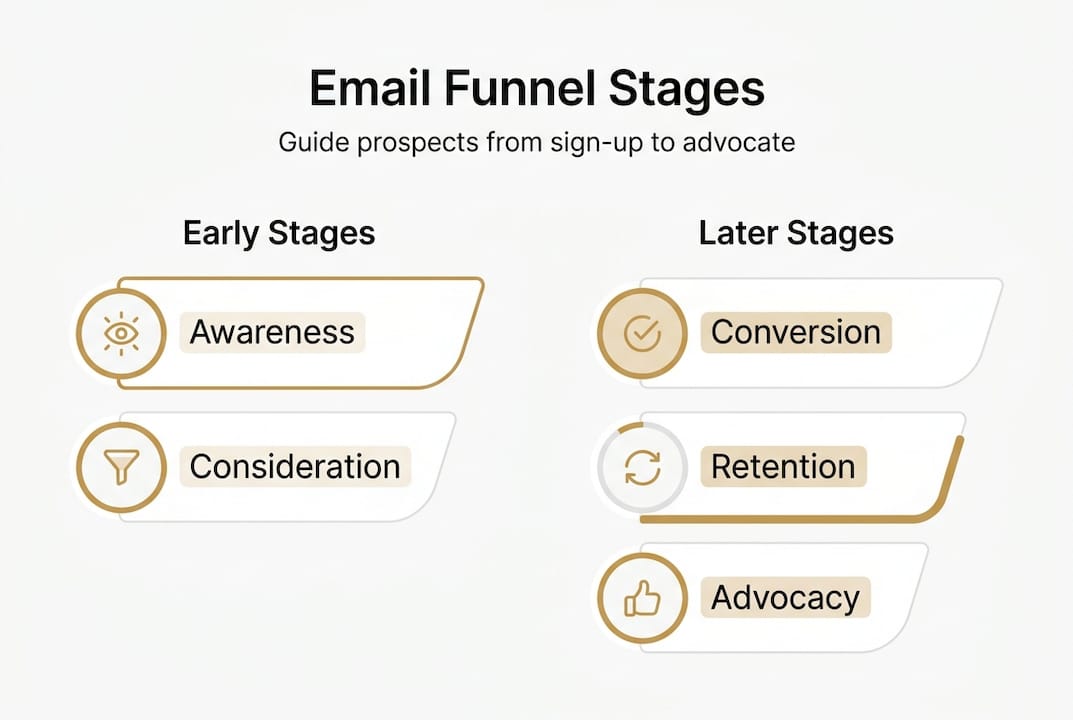
A sales funnel maps the journey prospects take from first hearing about your business to becoming loyal advocates. Email marketing funnels guide prospects through awareness, consideration, conversion, retention, and advocacy stages with specific email types designed for each phase. Understanding these stages helps you send the right message at the right time, dramatically improving conversion rates.
The awareness stage introduces your brand to new subscribers through welcome email sequences. Most successful businesses send 3 to 5 welcome emails over the first week, establishing expectations and delivering immediate value. These emails set the tone for your relationship and typically achieve the highest open rates of any email type.
Consideration stage emails nurture leads who aren't ready to buy yet. Send 4 to 7 educational emails showcasing your expertise, addressing common objections, and demonstrating how your solution solves specific problems. These nurture sequences keep your business top of mind while building trust through valuable content rather than constant sales pitches.
Conversion stage emails push prospects toward purchase decisions. Cart abandonment sequences with 3 to 4 emails recover lost sales by reminding shoppers what they left behind, addressing hesitation, and sometimes offering time-sensitive incentives. Product launch and promotional emails also fit this stage, creating urgency and highlighting benefits that motivate immediate action.
Retention emails keep existing customers engaged after purchase. Post-purchase sequences confirm orders, request feedback, and introduce complementary products. Upsell and cross-sell emails leverage purchase history to recommend relevant additions. Regular value emails maintain the relationship between transactions, reducing churn and increasing customer lifetime value.
Advocacy stage emails transform satisfied customers into brand ambassadors. Referral program invitations, review requests, and exclusive insider updates make customers feel valued while generating word-of-mouth growth. These emails cost little to send but can unlock exponential growth through trusted recommendations.
Pro Tip: Map each email to a specific funnel stage and buyer journey milestone. Generic email blasts ignore where prospects are in their decision process, while stage-aligned messages address exact concerns and motivations, boosting engagement and email marketing best practices results.
Here's a practical breakdown of email types by funnel stage:
| Funnel Stage | Email Types | Recommended Count | Primary Goal |
|---|---|---|---|
| Awareness | Welcome series, intro offers | 3-5 emails | Set expectations, deliver quick win |
| Consideration | Educational content, case studies | 4-7 emails | Build trust, address objections |
| Conversion | Cart recovery, product launches | 3-4 emails | Drive purchase decisions |
| Retention | Post-purchase, upsells | 2-3 emails | Increase lifetime value |
| Advocacy | Referral requests, VIP invitations | 1-2 emails | Generate word-of-mouth growth |
Automation and segmentation: keys to funnel optimization
Email automation sends triggered messages based on specific subscriber actions or timeline events, eliminating manual work while delivering timely, relevant content. Common automated flows include welcome sequences when someone joins your list, abandoned cart reminders when shoppers leave without buying, and post-purchase follow-ups after completed orders. These automation flows generate 41% of revenue from only 5% of email sends, proving their massive impact on funnel performance.

Segmentation divides your email list into smaller groups based on shared characteristics, behaviors, or lifecycle stages. Basic segments include new subscribers versus returning customers, engaged versus inactive contacts, and purchase history categories. Segment lifecycle stages and build key automations like welcome, abandoned cart, and post-purchase flows to maximize small business results without overwhelming your team.
The difference between broadcast and automated emails is striking. Broadcast emails go to your entire list or large segments at once, useful for announcements and promotions but less personalized. Automated emails trigger individually based on actions, creating one-to-one experiences at scale. This personalization drives significantly better performance across every metric.
| Email Type | Average Click Rate | Average Conversion Rate | Revenue Impact |
|---|---|---|---|
| Broadcast | 1.5-2.5% | 0.5-1.2% | Baseline revenue |
| Automated | 3.5-5.2% | 2.8-4.1% | 3-5x broadcast revenue |
The 5T Framework ensures automation success for small businesses. Target the right audience segment for each flow, avoiding irrelevant messages that damage trust. Timing matters immensely; send cart recovery emails within 1 to 3 hours for best results, not days later. Type refers to choosing the appropriate email format and tone for each automation purpose. Test subject lines, send times, and content variations to continuously improve performance. Trust builds through consistent value delivery, not just promotional hammering.
Start with three essential automations before expanding. A welcome series onboards new subscribers and sets relationship expectations. Cart abandonment recovery captures lost revenue from interested shoppers. Post-purchase sequences request reviews, provide usage tips, and introduce complementary products. These three automations alone can transform funnel performance without requiring complex segmentation strategies for funnels or overwhelming your resources.
Pro Tip: Avoid over-segmentation when starting out. Creating 20 micro-segments sounds smart but fragments your list, reduces statistical significance for testing, and creates maintenance headaches. Begin with 3 to 5 broad lifecycle segments, then subdivide based on actual behavioral patterns you observe in your data. Quality beats complexity in marketing automation tips for small businesses.
2026 email marketing benchmarks and optimization tips
Understanding current performance benchmarks helps you set realistic goals and identify improvement opportunities. Industry benchmarks show average open rates 35-42%, click-through rates 2-3%, conversion rates 2-3%, and ROI $36-42 per $1 spent across sectors in 2026. Your specific numbers will vary by industry, list quality, and funnel sophistication, but these ranges provide useful comparison points.
Click-to-open rate (CTOR) measures how many people who opened your email actually clicked a link, revealing true content engagement better than raw open rates. With Apple's Mail Privacy Protection inflating open rates since 2021, CTOR and conversion metrics matter more in 2026. A healthy CTOR ranges from 10% to 15%, showing your content delivers on subject line promises and motivates action.
The revenue impact of automation versus broadcast emails is staggering. Automation boosts conversion rates 2,361% compared to non-automated sends, transforming funnel economics for businesses that implement triggered flows. This massive difference stems from timing, relevance, and personalization that broadcasts simply cannot match at scale.
| Metric | Industry Average 2026 | Top Performer Range | Optimization Target |
|---|---|---|---|
| Open Rate | 35-42% | 45-55% | Compelling subject lines |
| Click-Through Rate | 2-3% | 4-6% | Clear calls to action |
| Click-to-Open Rate | 10-15% | 18-25% | Relevant content delivery |
| Conversion Rate | 2-3% | 5-8% | Funnel stage alignment |
| ROI per Dollar | $36-42 | $50-70 | Automation implementation |
Automated email sequences generate 41% of total email revenue despite representing only 5% of total sends, proving that strategic triggered messages outperform volume-based broadcast approaches.
Optimize your funnel performance by focusing on these high-impact areas. Audit subject lines ruthlessly, testing personalization, curiosity gaps, and benefit-driven angles to improve open rates. Clean inactive subscribers quarterly to maintain deliverability; bounce rates above 0.3% trigger spam filters and hurt inbox placement. Implement behavioral triggers based on browsing history, cart activity, and engagement patterns rather than just demographic data.
Personalize beyond first names. Reference past purchases, browsing behavior, and engagement history to create truly relevant messages. Balance promotional and value emails at a 1:3 or 1:4 ratio, ensuring you give more than you ask. Track revenue per recipient as your north star metric, combining list growth, engagement, and conversion into one actionable number.
Avoid over-segmentation traps that fragment your list into statistically insignificant groups. Five to seven segments usually suffice for small businesses, allowing meaningful personalization without creating maintenance nightmares. Focus testing efforts on high-volume touchpoints like welcome sequences and cart recovery rather than low-frequency broadcasts. Apply marketing strategies for client acquisition insights to email funnel optimization for maximum impact.
Common pitfalls and practical applications for small businesses
Small businesses repeatedly make five critical email funnel mistakes that tank performance. Recognizing these failures helps you avoid wasted effort and disappointing results.
- Generic subject lines that fail to create curiosity or communicate clear benefits. Your subject line competes with 100+ other messages daily, so bland descriptions get ignored while specific, benefit-driven hooks get opened.
- Neglecting list hygiene allows inactive subscribers and invalid addresses to accumulate, destroying deliverability and skewing metrics. Clean your list quarterly at minimum.
- Over-relying on broadcast emails instead of implementing core automations leaves massive revenue on the table. Broadcasts have their place, but automation drives disproportionate results.
- Creating too many micro-segments fragments your list, reduces testing validity, and creates operational complexity that small teams cannot maintain effectively.
- Using AI-generated copy without human editing produces generic, voice-less content that fails to build genuine connections with subscribers.
Common challenges include declining open rates from bad subject lines, inactive lists hurting deliverability, and over-segmentation causing subscriber fatigue across small business email programs. Fixing these issues requires systematic attention to fundamentals rather than chasing shiny tactics.
Best practices to fix these common failures include aggressive A/B testing of subject lines, testing at least two variations for every important email. Remove subscribers who haven't engaged in 90 to 120 days to protect deliverability, offering a re-engagement sequence first. Implement behavioral personalization using purchase history, browsing data, and engagement patterns rather than just demographic information.
Balance promotional and educational content, aiming for three value emails for every one sales pitch. This ratio builds trust and maintains engagement between purchase opportunities. Use AI tools for drafting and research, but always edit for your authentic voice and brand personality. Generic AI copy sounds like everyone else, while human-edited content builds distinctive relationships.
Pro Tip: Track revenue per recipient monthly by dividing total email-attributed revenue by your average list size. This single metric combines list growth, engagement, and conversion into one actionable number that reveals true funnel health better than vanity metrics like open rates alone.
Map every email to specific customer journey stages and buyer concerns. Awareness stage subscribers need education about their problem and your solution category. Consideration stage leads want proof through case studies and comparisons. Conversion stage prospects need urgency and risk reversal. Retention stage customers seek maximization tips and complementary solutions. Advocacy stage fans want exclusive recognition and referral opportunities.
Continuous testing separates growing businesses from stagnant ones. Test one variable at a time, whether subject lines, send times, content formats, or call-to-action placement. Run tests on high-volume emails first for faster statistical significance. Document results and apply learnings systematically across your program. Small improvements compound over time, transforming mediocre funnels into revenue machines. Review fixing email funnel issues regularly to maintain competitive performance.
Boost your small business growth with expert email marketing support
Implementing automation, segmentation, and funnel best practices efficiently requires expertise most small business owners don't have time to develop. You understand your product and customers better than anyone, but translating that knowledge into high-converting email sequences takes specialized skills and testing resources. Expert guidance helps you avoid costly mistakes, implement proven frameworks faster, and focus your energy on running your business rather than debugging email deliverability issues. Our professional email marketing solutions provide tested strategies, done-for-you implementation, and ongoing optimization tailored to small business realities, helping you drive sales and client retention without the learning curve or wasted ad spend.
Frequently asked questions
What is the role of email marketing in sales funnels?
Email marketing guides prospects through each funnel stage with targeted messages that address specific concerns and motivations at awareness, consideration, conversion, retention, and advocacy phases. Strategic email sequences nurture relationships over time, moving cold leads toward purchase decisions and customers toward repeat buying and referrals.
How does automation specifically drive better conversion than manual broadcasts?
Automation triggers emails based on individual subscriber actions and timeline events, delivering perfectly timed, highly relevant messages that feel personalized at scale. This relevance and timing combination produces conversion rates up to 2,361% higher than generic broadcast emails sent to entire lists simultaneously.
What automations should small businesses start with?
Begin with three essential automations: a welcome series for new subscribers, cart abandonment recovery for interested shoppers, and post-purchase follow-up for customers. These three flows address the highest-impact funnel stages and deliver measurable revenue improvements without overwhelming small teams.
How do I maintain deliverability and engagement?
Clean your list quarterly by removing subscribers who haven't engaged in 90 to 120 days, keeping bounce rates below 0.3%. Balance promotional and value emails at a 1:3 or 1:4 ratio, and segment based on engagement levels to send appropriate message frequencies to each group.
Why focus on conversion metrics instead of open rates in 2026?
Apple's Mail Privacy Protection and similar features inflate open rates by pre-loading email content, making opens unreliable for measuring true engagement. Click-to-open rates, conversion rates, and revenue per recipient reveal actual subscriber interest and business impact more accurately than open rates alone.